Oriyomi Akinyemi, Oluwole Soyinka (2022). Passengers’ perception on Bus Rapid Transit access: Case study of Ikorodu-Mile 12 corridor of Lagos State, Nigeria. In: Human Factors in Transportation. AHFE Open Access, vol. 60, pp. 229–236. https://doi.org/10.54941/ahfe1002453
The Bus Rapid Transit (BRT) system is a transport infrastructure that has grown tremendously among developing countries, including Africa. However, the effectiveness of such a transport system needs an evaluation from the users' perception. Access to a transportation system is an important factor in measuring the effectiveness of a transport system. Using Ikorodu-Mile12 corridor as a case study, this study examined the commuters' perception on the level of access to Lagos BRT to evaluate its effectiveness. The research employed a case study approach with quantitative analysis methods to explore the commuter's perception using dimensions of accessibility, affordability, availability, acceptability and adequacy. A total of 343 questionnaires were sampled using the accidental strategy at bus stops and inside neighborhoods of the study area at a distance of 400m, 800m, and 1200m from BRT bus stops. The results revealed that more than half of the respondents are satisfied with BRT service affordability, accessibility and adequacy. The system is perceived to be satisfactory but needs improvement on bus service frequency, service information and staff attitude.Keywords: Access, Acceptability, Accessibility, Affordability, Adequacy, BRT, Neighborhood, Public transport
Infrastructure development, including an efficient transport system, is essen- tial for urban development because it enables productivity and sustainable economic growth (Soyinka et al., 2016). As a significant transport infra- structure, Bus Rapid Transit (BRT) provides fast, comfortable, affordable urban transportation using a separate track to ensure quick urban mobility with outstanding customer service (Wright and Hook, 2007). Its operation is an integrated structure with a collection of facilities and services to enha- nce the BRT operations’ fastness, reliability, and uniqueness (Levinson et al., 2003). Cervero (2013) identified two forms of BRT operations as the high- end (complete separated right of way) and low-end (partially separated right of way) forms of the BRT operation. BRT has evolved in different forms to ensure better efficiency and value for services (Merkert et al., 2017). In some
instances, it is used as a feeder service to rail transport and other types of the city transportation system.
In 2008, Lagos State, Nigeria, introduced the BRT system with one of its objectives being transport service for different social groups, particularly the deprived. The first phase of the system starts from Mile12 to Lagos-Island on a 22km corridor and the second phase connects Mile 12 to Ikorodu town. The system is, however, currently confronted with several challenges. Oshodi (2016) and several other studies identified that BRT has contributed 0.41% to daily passenger movement, and therefore uncertain if the BRT system is accessible to the public. To address this knowledge gap, this paper gives an in-depth understanding of BRT as a public transport system and measures its level of access in Lagos State using the Ikorodu-Mile12 section as a case study. This study examined the commuters’ perception on the level of access to BRT to evaluate its effectiveness. The research employed a case study appro- ach with a quantitative analysis method to examine commuter’s perception using dimensions of accessibility, affordability, availability, acceptability, and adequacy. Subsequent sections of this paper describe the literature perspe- ctive, the study area, methodology, result, and discussion of the result. The conclusion of this research summarizes the level of access to the BRT system on Ikorodu-Mile12 corridor with a reflection on how empirical insights can inform policy formulation on public transportation planning.
BUS RAPID TRANSIT, ACCESS AND PERCEPTION Bus Rapid Transit
The BRT has grown globally over the last couple of decades because of its relatively lower cost and flexibility of implementation compared to the rail transit system. According to Global BRT Data (2021), the system has been implemented in 179 cities, both in high and low-income countries. Many of the BRT popularity in the high-income economies is mainly linked to their more recourses coupled with a better organizational structure and strong political support for sustainable transport solutions (Malik et al., 2021). On the other hand, the popularity of BRT in developing countries, like Nige- ria, is unnoticed due to several challenges such as lack or limited literature regarding the perceptions of the system’s users to evaluate its significance and harness its opportunities.
Access Access is a key concept within the field of transportation planning (Murray and Davis, 2001). It has different dimensions such as geographic accessibility, affordability, availability, acceptability, and others. Transport experts have given it different definitions, which includes economic benefit derived from the interaction between two activities. It is also regarded as the opportunity to partake in a service offered by a system based on its cost and proximity. While geographic accessibility is the distance covered or travel time taken to reach the transport service, access by affordability is the cost of using the service. Hence the longer the distance/travel time or higher the cost of
Passengers’ Perception on Bus Rapid Transit Access 231
Table 1. List of indicators for each dimension is based on (Carruthers et al., 2005; Obrist et al., 2007).
Table available in the original PDF paper.
Access dimensions Indicators Accessibility Travel distance/ time to BRT bus stops Affordability BRT fare Availability Availability of Tickets, frequency of the buses at stops Acceptability Service information, ticketing type, staff attitudes Adequacy BRT hours of operation
transport service, the higher the unlikeness to access the service. Geogra- phic proximity to the public transport system is a significant factor for the social and physiological well-being of the people, and it has an impact on the socioeconomic development of the area.
Perception Based on the conclusion of Tiznado-Aitken et al. (2020), there are two main approaches to measuring access: large-scale quantitative evaluations of available opportunities or small in-depth qualitative studies of accessibi- lity barriers. A qualitative method could be an in-depth interview, a focus group discussion or participants observation or perception. Perceptions are shaped by people’s experiences, based on the practical knowledge gained from doing, seeing or feeling something. In the context of urban transport, accessibility is viewed by different users based on their personal and collective travel experiences as well as satisfaction which in turn shape their perceptions (Tiznado-Aitken et al., 2020). The perception of people on public transport facilities is based on their travel experience which might include their qualita- tive analysis of access. Therefore, it is essential to incorporate public transport users’ experience and satisfaction within access analysis. Hence, this study assessed the perception on access level to BRT service in the study area with five dimensions. Table 1 presents the dimensions and list of indicators of an efficient public transport system - accessibility, affordability, availability and acceptability suggested by Carruthers et al. (2005), including the adequacy dimension from research by (Obrist et al., 2007).
Lagos BRT Context BRT in Lagos was commissioned for operation in 2008 and aimed to improve traffic congestion as well as fare affordability within Lagos (Oluwaseyi and Olawunmi, 2016). The BRT has created easy access to public transport for Lagosians and has a daily ridership level of 200,000 passengers (Ogunkoya, 2008; Global BRT Data, 2021). The system has a significant impact on pas- sengers’ mobility in the Lagos metropolis. On the other hand, Somuyiwa and Adebayo (2009) found out that less than half of the passengers were satisfied with the BRT service, and some were totally dissatisfied. Adedayo et al. (2014) conducted an access level to the BRT system by different soci- oeconomic groups using ease of entrance into the bus, affordability, age,
232 Akinyemi and Soyinka
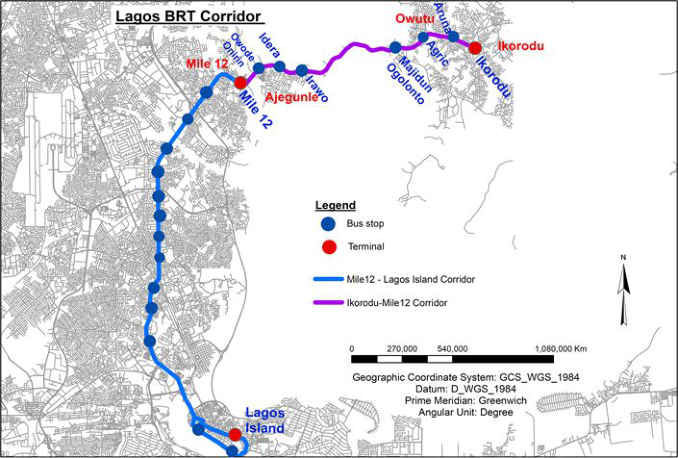
Figure 1: Lagos BRT Corridor. Source: Authors’ analysis based on data from LAMATA.
and physical disability to further corroborate the findings of (Somuyiwa & Adebayo 2009).
METHODOLOGY
Case Study The case study area is Ikorodu, which is one of the 20 local government areas in Lagos state. It is subdivided into six local council development areas (LCDAs), with only one of them (Ikorodu West) having the BRT corridor. According to the Lagos Bureau of Statistics (2017), Ikorodu has a popula- tion of 689,043 with a density of 1997.23 inhabitants/km2. Asides from the rail system, Ikorodu shares the same characteristics with other parts of Lagos. Ikorodu-Mile12 BRT corridor is one of the phases indicated for BRT service in Lagos state. The BRT corridor complements the existing 22km Mile12- TBS BRT corridor as shown in Figure 1. The system has eight bus stops in three different neighborhoods (Ikorodu Garage, Owutu, and Ajegunle). The neighborhoods have different spatial characteristics regarding public tran- sport and distance to Lagos metropolis. The level of access to BRT service on this corridor is unknown as no study has been conducted in this area. Thus, Ikorodu-Mile12 corridor is essential and adopted in this study to eva- luate the access level and enhance adequate policy formulation for future BRT connectivity in the area.
METHODS
The study adopts case study methods with quantitative data collection and analysis. A questionnaire survey using accidental strategy was adopted for
Passengers’ Perception on Bus Rapid Transit Access 233
the primary data sources, while the secondary data are published articles and documents. The survey was administered at the BRT bus stops, informal buses (popularly known as danfo) stops and inside the three neighborhoods (Ikorodu Garage, Owutu, and Ajegunle) at 400m, 800, and 1200m from BRT bus stops to get a wider view on the system. The questionnaires con- sisted of closed and open-ended questions in numeric and Likert (Bryman, 2012). The Likert scale structure “from 1 – very dissatisfied to 5 – very sati- sfied” was used to collect data on the perception of access to the BRT service on Ikorodu – Mile12 corridor using availability, affordability, accessibility, adequacy and acceptability dimensions. The questionnaire was administe- red electronically using an open-source app, ‘Kobotool box’, for mobile data collection that works both on and offline (Kobotoolbox, 2018). In contrast to the estimated 360 respondents for this study, a total of 343 respondents were administered because of challenges such as delayed government agency approval and hostility of some respondents.
RESULT AND DISCUSSION
BRT Users Travel Behavior The analysis of the respondent’s travel behavior, as presented in Table 2, revealed that a significant number (more than 50%) of them, particularly at Ajegunle neighborhood, travel for the purpose of work. It was also obse- rved that the majority of the respondents at Ikorodu garage travel every day while most of those in Owutu and Ajegunle travel more during the weekdays. The result further revealed that more than 80% of the respondents use BRT for their usual travel purpose, perhaps because of the separated lane the BRT ply and low ownership of private cars. The majority of the respondents leave home for their usual travel purposes by the time BRT begins operation. An insignificant number (less than 20%) leave before the operation of BRT. The travel destination of all the respondents is located outside the neighborhoods, particularly on Lagos Island.
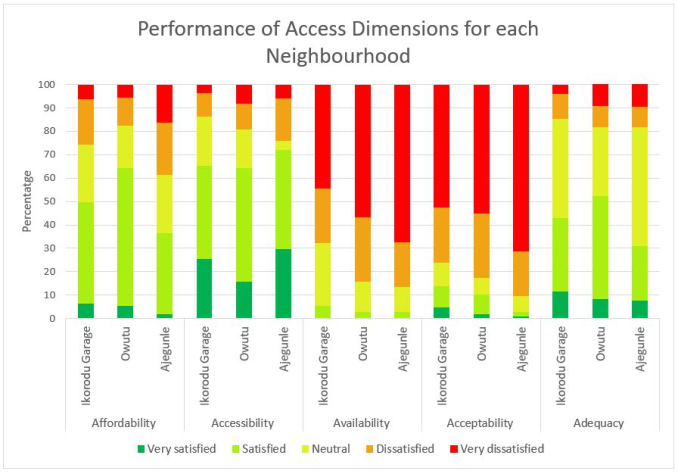
Perception on Access to BRT Service The perception of BRT users was measured using five dimensions (availa- bility, affordability, accessibility, adequacy and acceptability) as explained earlier. The disparity in respondents’ perceptions from each neighborhood is shown with their satisfaction level in Figure 2. The analysis of BRT service affordability as presented revealed that most respondents are satisfied with the affordability of BRT fares, work in the organized private sector, and belong to the middle-income class. The analysis further showed that less than 10% are very satisfied and as well very dissatisfied with the fare of BRT. More than 50% of the respondents in Ikorodu garage and Owutu neighborhoods are either satisfied or very satisfied with service fare. The major reason for the affordability satisfaction is that the fare is cheaper than the informal buses. This result confirmed the claim of Adedayo et al. (2014), which discovered that 50 per cent of Lagos residents have affordable access to the BRT service.
234 Akinyemi and Soyinka
Table 2. Travel behaviour.
Table available in the original PDF paper.
Also, perception on accessibility analysis showed that most of the respon- dents in the study area are either satisfied or very satisfied with the time and distance covered to reach the BRT stop. This result, however, differs from the claim of Adedayo et al. (2014) that public transport in Lagos seems not to be close to residents locations.
A significant number of the respondents in the entire study area are very dissatisfied with BRT service availability and acceptability. About 70% of the respondents are very dissatisfied with BRT service in Ajegunle neighbo- rhood, more than 55% in Owutu neighborhood, and about 50% of them at Ikorodu Garage neighborhood are very dissatisfied. The dissatisfaction is as a result of lack of service information, perhaps attributed to service dis- ruptions, low frequency of BRT buses, long waiting time etc. The outcomes of these two dimensions, therefore, contradicts the findings of Oluwaseyi A (2016), in which he claimed that more than 50% of BRT users were satisfied with its service. However, most of the respondents in the three neighborho- ods are neutral about how adequate the operation period of the BRT service. This is because more of the respondents travel within the operating hours of BRT.
Passengers’ Perception on Bus Rapid Transit Access 235
Figure 2: Access dimensions across the three neighbourhoods.
CONCLUSION
This study assesses the passenger’s access level perception on the Ikorodu- Mile12 BRT corridor, and it answers the question of what is the access level to the BRT service? The availability, affordability, accessibility, adequacy and acceptability are found to be good dimensions to measure the access level because of the characteristics of the BRT as well as that of the users. It was found that more than half of the respondents are satisfied with the acces- sibility, affordability and adequacy of BRT service because it can easily be reached, is cheaper comparatively and has a good service operating hour. However, more than half of the respondents are dissatisfied with the BRT service acceptability and availability mainly because of the long waiting time. This study contributes to the literature on public transport and informs poli- cymakers in Lagos and Nigeria on the development of sustainable transport policies. It also recommends further studies on factors influencing BRT usage in Lagos to identify the area of improvement in service delivery.
REFERENCES
Adedayo V, Amure K, Adeaga O, et al. (2014) Access to intra-urban public transport across varied socioeconomic groups: A case of Lagos bus rapid transit (BRT). Asian Journal of Humanities and Social Sciences (AJHSS) 2. Bryman A. (2012) Social research methods: 4 (53), 9 Oxford university press. Carruthers R, Dick M and Saurkar A. (2005) Affordability of public transport in
developing countries. Cervero R. (2013) Bus rapid transit (BRT): An efficient and competitive mode of public transport. Working paper. Global BRT Data. (2021) Available at: https://brtdata.org/.
236 Akinyemi and Soyinka
Kobotoolbox. (2018) KoBoToolbox | Data collection tools for challenging environments. Available at: https://www.kobotoolbox.org/. Lagos Bureau of Statistics. (2017) Digest of statistics, 2017. Available at: http://lago
sstate.gov.ng/Digest_of_Statistics_2017.pdf. Levinson HS, Zimmerman S, Clinger J, et al. (2003) Bus rapid transit: Synthesis of case studies. Transportation Research Record 1841: 1–11. Malik BZ, ur Rehman Z, Khan AH, et al. (2021) Investigating users’ travel beha-
viours and perceptions of single-corridor BRT: Lessons from Lahore. Journal of Transport Geography 91: 102942. Merkert R, Mulley C and Hakim MM. (2017) Determinants of bus rapid transit (BRT) system revenue and effectiveness–A global benchmarking exercise. Transportation Research Part A: Policy and Practice 106: 75–88. Murray AT and Davis R. (2001) Equity in regional service provision. Journal of
Regional Science 41: 557–600. Obrist B, Iteba N, Lengeler C, et al. (2007) Access to health care in contexts of livelihood insecurity: a framework for analysis and action. PLoS medicine 4: e308. Ogunkoya AO. (2008) Public Transport Innovation: The Impact of BRT on Pas-
senger’s Movement in Lagos Metropolitan area of Nigeria. Medwell Journals 5: 845–852. Oluwaseyi A. (2016) Commuters perception and preferences on the bus rapid transit in Lagos state. Journal of Research in National Development 14: 34–47. Oluwaseyi A and Olawunmi F. (2016) Assessment of Bus Rapid Transit in Efficient
of Movement of Commuters in Lagos State. Eur. J. Humanit. Soc. Sci 35: 15. Oshodi L. (2016) Transportation and mobility system in Lagos. Available at: https://oshlookman.wordpress.com/2016/08/12/transportation-and-mobility- system-in-lagos/. Somuyiwa A and Adebayo I. (2009) Impact of bus rapid transit system (BRT) on passengers’ satisfaction in Lagos Metropolis, Nigeria’. International Journal of Creativity and Technical Development 1: 106–119. Soyinka O, Siu KWM, Lawanson T, et al. (2016) Assessing smart infrastructure
for sustainable urban development in the Lagos metropolis. Journal of Urban Management 5: 52–64. Tiznado-Aitken I, Lucas K, Muñoz JC, et al. (2020) Understanding accessibility through public transport users’ experiences: A mixed methods approach. Journal of Transport Geography 88: 102857. Wright L and Hook W. (2007) Bus rapid transit planning guide. Institute for
Transportation and Development Policy, New York.
LISTED IN THE AHFE DIGITAL BOOKSTORE CATALOGUE
Explore the complete digital volume
Human Factors in Transportation
Read this individual research paper free through the original publisher, or explore the full digital proceedings book.
ISBN 978-1-958651-36-0
Explore this ISBN in the AHFE Bookstore ↗Listed in the July 2026 bookstore catalogue; search by ISBN to confirm current availability · Digital book purchase optional