Toshiki Kuroda, Toshihisa Doi, Sayaka Noda, Chika Nakatani, Seiji Minami, Satsuki Harada (2026). An Examination of Factors Contributing to the Perception of Chairs "Blending into" a Space and Their Respective Contributions. In: Human Factors and Ergonomics In Design. AHFE Open Access, vol. 210, pp. 75–80. https://doi.org/10.54941/ahfe1007427
When designing office spaces, selecting chairs that "blend into" the environment is crucial for aesthetic and functional integration. This study conducted two investigations to identify the factors and mechanisms that make chairs feel integrated into a space, aiming to support efficient chair development. In Survey 1, the Evaluation Grid Method was employed with 12 individuals highly interested in spatial design to clarify the underlying evaluation structure. The resulting hierarchical diagram revealed strong direct connections between space integration and factors such as matching materials, color coordination, not "looking out of place," and familiarity with the combination. In Survey 2, a web-based questionnaire was conducted with 100 participants to quantify the contribution of these factors. Data were analyzed using a Linear Mixed-Effects Model. The results showed that "Color Harmony," "Visual Integration (not looking out of place)," and "Plausibility (Familiarity)" had the most significant positive effects on the perception of blending. Currently, design decisions often rely on tacit knowledge, but this study provides objective design guidelines to enable evidence-based product development.
In recent years, the business model in the office furniture industry has shifted from selling standalone products to proposing comprehensive spatial solutions. Offices are no longer just places for desk work; they have become strategic hubs for collaboration and employee engagement. In this context, the value of an office is defined not only by physical function but also by the psychological comfort of the workers. Consequently, designers now prioritize how furniture relates to the entire environment, including walls, flooring, and other fixtures.
Within this relationship, whether a chair “blends into” the space is a critical factor. If a chair harmonizes visually with its surroundings, it contributes to the quality of the space. Conversely, if it looks out of place, it creates visual dissonance. However, despite its importance, the concept of Received February 6, 2026; Revised April 2, 2026; Accepted April 17, 2026; Available online July 20, 2026
“blending” remains subjective and abstract. Currently, designers rely on their own intuition and “tacit knowledge” to judge this harmony. This reliance on individual sensibility makes it difficult to explain design choices logically to stakeholders and hinders efficiency in product development.
This study aims to clarify the factors that make a chair feel like it “blends in” using Kansei engineering methods. By structuring this vague sensation and quantifying the contribution of each factor, we aim to provide objective design guidelines that allow designers to move away from relying solely on intuition. The study consists of two parts: Survey 1, a qualitative analysis using the Evaluation Grid Method to identify evaluation factors, and Survey 2, a quantitative questionnaire to measure the impact of these factors.
SURVEY 1: QUALITATIVE ANALYSIS USING EVALUATION GRID METHOD Method of Survey 1
To clarify the value evaluation structure that users hold when judging whether a chair “blends into” a space, this study employed the Evaluation Grid Method (Sanui, 1996). The Evaluation Grid Method is a qualitative technique based on the Repertory Grid Method, utilizing laddering interviews to reveal the hierarchical cognitive structure of individuals regarding a specific subject. This method allows for the visualization of the relationship between abstract psychological values (upper-level concepts) and concrete physical attributes (lower-level concepts).
Participants The participants consisted of 12 individuals (7 university students and 5 employees of Itoki Corporation) who possess a high level of interest in spatial design. The selection of participants with a specialized interest or professional background was intended to elicit a more diverse and articulated range of vocabulary regarding spatial harmony compared to the general public.
Procedure
1. Preparation of Stimuli: To obtain an evaluation structure derived from diverse spatial contexts, AI-generated images were used as stimuli. Using Adobe Firefly, we generated a wide variety of spatial images including not only office spaces but also living spaces. The only fixed keyword was “including a chair,” ensuring an unbiased variety of scenes. From the generated set, multiple researchers grouped the images based on impression and selected 46 representative images. 2. Interview Process: Participants were asked to sort the 46 images into four groups based on the degree to which they felt “the chair blends into the space” (Group 1: Strongest blend, Group 4: Weakest blend). Evaluation items were then extracted by comparing the groups in a specific sequence: first comparing Group 3 vs. Group 4, then Group 2 vs. Groups 3 & 4, and finally Group 1 vs. Groups 2, 3, & 4. For each extracted
An Examination of Factors Contributing to the Perception of Chairs 77 item, participants were asked “Why is that important?” (laddering up) to identify psychological values, and “What specific features make it so?” (laddering down) to identify physical attributes.
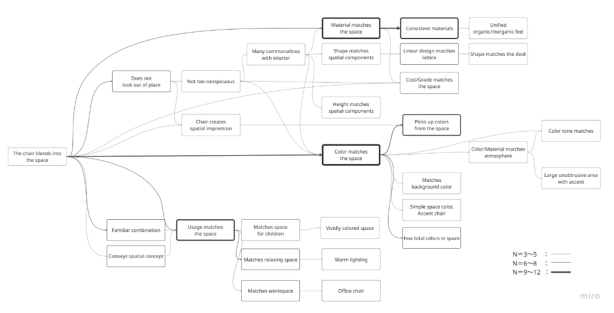
Results and Discussion of Survey 1 The evaluation structure diagrams from all 12 participants were integrated to construct a comprehensive hierarchical diagram (Figure 1). In this integration process, links with a frequency of N ≤ 2 were omitted to visualize only the elements with high importance. The analysis identified four primary factors with strong direct connections to the concept of “blending”:
1. Material Consistency: The item “The chair’s material matches the materials used in the space” was strongly linked to the lower-level attribute “No variation in materials.” It was also connected to “The perceived cost of the chair matches the space”. This suggests that users infer the “grade” or cost sense from materials, and consistency in this aspect is a key factor for blending. 2. Visual Integration (Not Looking Out of Place): The item “The chair does not look out of place” was linked to “The chair does not stand out too much”. This indicates the importance of the chair existing as a component that dissolves into the space rather than asserting strong individuality. 3. Color Harmony: The item “The chair’s color matches the space’s color” had strong links to attributes such as “The chair picks up colors present in the space” and “The total number of colors in the space, including the chair, is low”. While blending into the background was fundamental, items such as “Using the chair as an accent color” were also observed. This implies that “blending” is not solely about color assimilation but also involves designing appropriate color relationships. 4. Familiarity: The item “The combination of chair and space looks familiar” was strongly connected to “The chair’s usage matches the space” (e.g., office chairs with casters fit office spaces). This suggests that the mental models held by users regarding “typical usage” are inseparable from the perception of blending.
Selection of Variables for Survey 2: To verify these qualitative findings quantitatively in the next step, we selected explanatory variables from these results. We specifically chose items that (1) showed a strong direct connection to the “blending” node in Figure 1, and (2) represented psychological impressions (e.g., “looks familiar,” “not out of place”) rather than overly specific physical specifications. This selection ensures the factors are applicable to general design contexts while maintaining a strong link to the “blending” perception identified in Survey 1.
SURVEY 2: QUANTITATIVE ANALYSIS USING QUESTIONNAIRE Method of Survey 2
Participants A web-based survey was conducted with 100 individuals (50 males and 50 females; mean age 44.8 years, SD = 13.5). The participants were office workers who work in an office or coworking space for at least three days a week. We selected this demographic to ensure that the evaluation reflected the perceptions of actual users in typical working environments.
Questionnaire Items Based on the evaluation structure diagram obtained in Survey 1, evaluation terms were converted into questionnaire items. The questionnaire consisted of a total of 9 items:
Target Variable: One item evaluating the degree of blending (“I think the chair blends into the space”).
Explanatory Variables: Eight items derived from the key evaluation terms identified in Survey 1 (e.g., “The chair’s color matches the surroundings,” “The material texture is consistent,” “The chair does not look out of place”). Participants rated each item on a 7-point Likert scale ranging from 1 (“Strongly Disagree”) to 7 (“Strongly Agree”).
Procedure The survey employed a within-subjects design. Participants viewed 12 spatial images containing chairs, selected to represent a diverse range of office environments. They answered the 9 questionnaire items for each image, resulting in a total of 1,200 data points (100 participants × 12 images).
Analysis To identify the factors that significantly contribute to the perception of “blending,” a Linear Mixed-Effects Model (LMM) was employed. The “blending” score was set as the objective variable, while the eight evaluation items were set as fixed effects. Participant ID and Image ID were included as random effects to account for individual differences in rating tendencies and variations in image characteristics.
The analysis using the Linear Mixed-Effects Model revealed the degree of contribution of each factor to the overall perception of blending. The model showed a high level of explanatory power, with a Conditional R2 of 0.679 (explaining variance including random effects) and a Marginal R2 of 0.614 (explaining variance by fixed effects alone). This indicates that the selected design factors account for more than 60% of the perception of blending, regardless of individual differences. Table 1 shows the results of the fixed effects analysis.
Table 1: Results of linear mixed-effects model (fixed effects).
Table available in the original PDF paper.
Predictor β SE df t p VIF Does not look out of place 0.253 0.034 1049 7.48 <.001 ** 1.48 Color match 0.308 0.041 1133 7.51 <.001 ** 2.13
Forms spatial impression 0.03 0.034 1190 0.89 0.375 1.41 As shown in Table 1, the results of the fixed effects demonstrated that six out of the eight factors had a significant positive influence on the perception of blending (p < .001). The standardized partial regression coefficients (β) revealed the relative importance of these factors:
1. Color Harmony: “The chair’s color matches the surroundings” showed the strongest effect (β = 0.308, p < .001). This confirms that color coordination is the most critical determinant for a chair to blend into a space. 2. Visual Integration: “The chair does not look out of place” had the second-highest contribution (β = 0.253, p < .001). This supports the hypothesis that “blending” requires the object to be unobtrusive rather than assertive. 3. Plausibility (Familiarity): “The chair looks like it could actually exist in the space” was also highly significant (β = 0.220, p < .001). This corresponds to the “Familiarity” factor identified in Survey 1, suggesting that deviation from the user’s mental model reduces the sense of blending. 4. Physical Attributes: “Texture” (β = 0.206), “Shape” (β = 0.179), and “Height” (β = 0.148) were all significant contributors (p < .001).
In contrast, items related to high-level cognitive interpretation, such as “The designer’s intent is imaginable” (β = −0.051, p = 0.23) and “The chair forms the impression of the space” (β = 0.03, p = 0.38), were not significant. This implies that the perception of “blending” is primarily driven by immediate
visual fit and conformity to expectations, rather than by understanding the design concept or the chair’s dominance in the space.
CONCLUSION
This study investigated the factors that lead users to perceive an office chair as “blending into” a space, aiming to resolve the industry’s reliance on subjective tacit knowledge. By integrating the qualitative Evaluation Grid Method (Survey 1) and a quantitative questionnaire (Survey 2), we established that “blending” is driven primarily by immediate visual and cognitive harmony— specifically Color Harmony, Visual Integration (not looking out of place), and Plausibility (Familiarity)—rather than by understanding the designer’s conceptual intent.
These findings provide objective design guidelines, enabling a shift from intuition-based creation to evidence-based development. Designers can now confidently prioritize color coordination and alignment with user mental models to ensure spatial integration. This transition not only streamlines the product development process but also minimizes the risk of mismatch between furniture and office environments. Ultimately, applying this logical framework contributes to creating workspaces that optimize the psychological comfort of workers. Future research should explore applying this evaluation structure to other furniture categories, further expanding the possibilities of objective spatial design.
REFERENCE Sanui, J. (1996). Visualization of users’ requirements: Introduction of the Evaluation Grid Method. Proceedings of the 3rd Design & Decision Support Systems in Architecture & Urban Planning Conference, Vol. 1, 365–374.
LISTED IN THE AHFE DIGITAL BOOKSTORE CATALOGUE
Explore the complete digital volume
Human Factors and Ergonomics In Design
Read this individual research paper free through the original publisher, or explore the full digital proceedings book.
ISBN 978-1-964867-86-1
Explore this ISBN in the AHFE Bookstore ↗Listed in the July 2026 bookstore catalogue; search by ISBN to confirm current availability · Digital book purchase optional