Sarah Ahmed Alkindi, Saed Amer, Mecit Can Emre Simsekler, Zakia Dimassi, Siddiq Anwar (2026). A Human-Centered Systems Approach to AI-Enhanced VR Training for Home-Based Peritoneal Dialysis. In: Industrial and Systems Engineering. AHFE Open Access, vol. 219, pp. 146–153. https://doi.org/10.54941/ahfe1007785
Peritoneal Dialysis (PD) is a home-based therapy for kidney failure that requires patients to independently perform detailed sterile procedures, often several times per day. Even minor deviations in technique can lead to serious complications, including peritonitis and catheter failure. Although structured education programs are typically available, variations in training quality, health literacy, home environments, and patient confidence continue to contribute to preventable harm. Immersive Virtual Reality (VR) and Artificial Intelligence (AI) present promising opportunities to enhance PD education. However, their implementation must be grounded in patient safety principles and Systems Engineering approaches rather than driven solely by technological advancement. This paper presents a patient-focused, systems-based framework for AI-enhanced VR training in home PD, informed by human-centereddesign. The framework integrates realistic procedural simulations with AI-driven feedback on sequencing and sterile technique, while modeling the complete PD workflow within the home as a safety-critical care environment. Core elements include co-design with patients and PD nurses, identification of high-risk procedural steps, adaptation to varying literacy levels, transparent AI feedback mechanisms, and structured processes for ongoing monitoring and evaluation. Interdisciplinary collaboration among clinicians, human factors experts, AI developers, and patient representatives is essential to ensure safe, effective, and scalable implementation aimed at reducing preventable complications and strengthening patient confidence.
Peritoneal dialysis (PD) is a cornerstone home-based therapy for kidney failure, accounting for approximately 11% of global dialysis use and offering advantages such as cost-effectiveness, preservation of residual renal function, and improved quality of life compared with hemodialysis (Bello et al., 2022). However, unlike facility-based treatments, PD shifts safety-critical Received April 10, 2026; Revised May 14, 2026; Accepted June 2, 2026; Available online July 20, 2026
A Human-Centered Systems Approach to AI-Enhanced VR Training 147 sterile procedures into highly variable home environments, where patients and caregivers must independently perform complex exchanges multiple times per day (Usta et al., 2025). This transition introduces significant safety challenges, as even minor deviations in technique can lead to serious and preventable complications, most notably peritonitis, which remains a leading cause of morbidity and technique failure (Teitelbaum, 2021). Peritonitis can impair membrane function and contribute to technique failure, with risks further exacerbated by poor aseptic practice, low education levels, and comorbidities (Chow & Li, 2007). In addition, non-infectious complications such as catheter dysfunction, membrane damage including encapsulating peritoneal sclerosis, and metabolic imbalances further compromise long- term outcomes and treatment effectiveness (Parolin et al., 2025).
The clinical burden of PD is reflected in high variability in technique survival, ranging from 29% to 91%, and continued reliance on transfer to hemodialysis due to complications, particularly peritonitis, which carries a mortality risk of 2 to 6% (Bello et al., 2022)this provision ranges from 96% in high-income countries to 32% in low-income countries. Compared with haemodialysis, PD has numerous potential advantages, including a simpler technique, greater feasibility of use in remote communities, generally lower cost, lesser need for trained staff, fewer management challenges during natural disasters, possibly better survival in the first few years, greater ability to travel, fewer dietary restrictions, better preservation of residual kidney function, greater treatment satisfaction, better quality of life, better outcomes following subsequent kidney transplantation, delayed need for vascular access (especially in small children. These outcomes are strongly influenced by the quality of patient training and broader system factors. Despite the availability of structured education programs, PD training remains inconsistent, as variability in literacy, home conditions, and monitoring practices contributes to preventable harm and reduced long-term sustainability. Collectively, these challenges indicate that PD safety is not solely dependent on individual performance but is shaped by complex interactions between users, tasks, environments, and systems.
In response, emerging technologies such as immersive virtual reality (VR) and artificial intelligence (AI) offer promising opportunities to enhance training by enabling repeatable, risk-free practice, adaptive feedback, and scalable education delivery (Liaw et al., 2023; Chen & Liou, 2025; Kumar et al., 2025). However, many current implementations remain technology- driven, prioritizing innovation over the integration of patient safety principles and failing to adequately address the sociotechnical complexity of home- based care. As a result, existing approaches often do not fully account for real- world variability, user diversity, and safety-critical workflow requirements.
From a patient safety perspective, these limitations underscore the need for system-oriented interventions grounded in both systems thinking and Human-Centered Design (HCD). Medical errors rarely arise from isolated individual failures but instead emerge from multiple interacting system factors (Reason, 2000). Systems thinking enables a holistic understanding of these interdependencies, while HCD ensures that solutions are tailored to user capabilities, limitations, and contextual constraints (Clarkson et al.,
2017). Together, these approaches provide a robust foundation for designing training systems that are not only technologically advanced but also safe, usable, and effective in real-world settings.
Accordingly, this paper adopts a HCD approach informed by systems thinking to develop an AI-enhanced VR training framework for home-based PD. The proposed framework models PD as a safety-critical sociotechnical process and integrates workflow mapping, risk analysis, co-design with stakeholders, and AI-driven adaptive feedback. By aligning immersive simulation with identified safety-critical steps and user needs, the framework aims to standardize training, support individualized learning, and reduce preventable harm while strengthening patient confidence in home-based care (Fernàndez Labadía et al., 2024).
This paper makes three key contributions. First, it conceptualizes home- based peritoneal dialysis training as a safety-critical sociotechnical system, extending beyond traditional skill-based education approaches. Second, it develops a human-centered, systems-based framework that integrates immersive virtual reality with AI-driven adaptive feedback, explicitly grounded in workflow mapping and risk analysis. Third, it identifies design requirements for AI-enhanced VR training aligned with patient safety principles, supporting improved procedural adherence, reduced error likelihood, and more personalized learning in complex home-care environments.
METHODOLOGY
This study adopts an HCD approach informed by systems thinking, integrating expert-informed inquiry, workflow mapping, and risk- oriented framework development. As illustrated in Figure 1, the study follows a structured and iterative HCD process aimed at understanding and improving home-based PD training. The initial phase involves semi- structured interviews with nephrologists, PD nurses, and clinical educators to capture experiential and domain-specific knowledge. A purposive sampling approach is used to ensure participants had relevant expertise in PD training and patient management. Interview data are qualitatively synthesized to identify key training challenges, procedural risks, and system- level factors influencing performance. These insights provide a grounded understanding of real-world variability and inform subsequent workflow and risk analysis.
Building on these insights, the second phase focuses on mapping the patient and caregiver training journey. As PD is delivered through two main modalities, Continuous Ambulatory Peritoneal Dialysis (CAPD) and Automated Peritoneal Dialysis (APD), detailed process flowcharts are developed to represent the full sequence of PD tasks, including preparation, connection procedures, dialysis exchanges, monitoring, and completion, as shown in Figure 2. Beyond visualizing task sequences, this workflow mapping serves as a basis for identifying safety-critical steps, key decision points, and areas of risk accumulation across CAPD and APD pathways, providing a structured representation of how training translates into real- world task performance.
A Human-Centered Systems Approach to AI-Enhanced VR Training 149 Extending from this, the third phase involves identifying safety risks and training gaps through the combined analysis of interview findings and workflow maps. Critical vulnerabilities, including breaches in sterile technique, incorrect task sequencing, and misunderstandings of modality-specific processes, are systematically identified. These risks are not treated as isolated user errors but as outcomes of interacting system factors, reinforcing the need for system- oriented training interventions. This analysis enables the prioritization of high-risk procedural steps where targeted training can most effectively reduce preventable harm.
Finally, the outputs of expert-informed inquiry (Figure 1) and workflow- based risk analysis (Figure 2) are synthesized to inform the development of HCD-informed, systems-based design recommendations for an AI-enhanced VR training framework for home-based PD. These findings are translated into structured design requirements that align with user needs, system constraints, and safety-critical workflows. Grounded in this analysis, the proposed framework incorporates immersive simulation, adaptive AI-driven feedback, real-time performance monitoring, and explainable guidance mechanisms. This ensures that training interventions are directly targeted at identified risk points and user challenges, providing a coherent foundation for the framework presented in Figure 3.
Figure 1: Study design illustrating expert-informed inquiry, workflow mapping, and risk analysis for developing an AI-enhanced VR training framework.
Figure available in the original PDF paper.
Figure 2: Workflow mapping of PD training highlighting safety-critical steps and risk accumulation across CAPD and APD modalities.
In addition to informing framework design, the identified risks and workflow characteristics provide a foundation for defining measurable human factors outcomes. These include reduction of procedural errors, improved adherence to sterile technique, decreased cognitive load during task execution, and enhanced skill retention over time. Such metrics establish a basis for future empirical evaluation of the proposed framework in real- world PD training contexts.
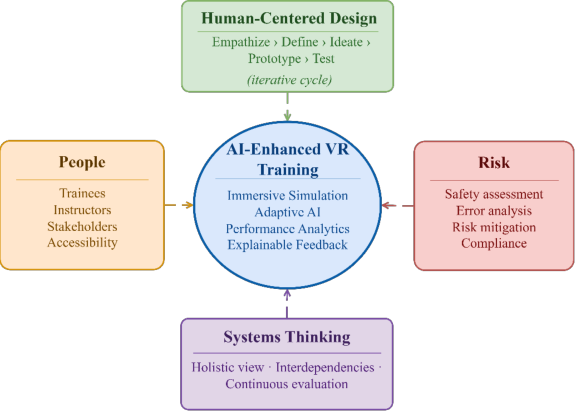
Figure 3: Human-centered systems framework for AI-enhanced VR training derived from workflow and risk analysis of PD care.
DISUSSION
Figure 3 presents the overarching framework developed in this study, synthesizing insights from the study design (Figure 1) and the workflow and risk analysis (Figure 2). Expert-informed inquiry identified real-world training challenges, user variability, and system-level constraints, while workflow mapping revealed safety-critical steps and points of risk accumulation across CAPD and APD processes (Simsekler et al., 2018). Together, these findings informed the translation of user needs, procedural risks, and system factors into structured design requirements.
Grounded in systems thinking and human factors principles, the framework is structured around four complementary perspectives: human, people, risk, and system (Clarkson et al., 2018). Together, these perspectives capture the interaction between user capabilities, stakeholder roles, safety-critical processes, and the broader sociotechnical environment in which PD training occurs. Rather than treating errors as isolated events, the framework emphasizes how risks emerge from these interdependencies, enabling targeted and system- oriented training interventions.
The human perspective is addressed through HCD, which structures development through an iterative cycle of empathizing, defining, ideating, prototyping, and testing (Meinel, Leifer & Plattner, 2011). Rooted in human factors principles, this approach recognizes that errors in complex care settings frequently result from mismatches between system design and human capabilities rather than individual failures (Reason, 2000). By embedding human factors considerations from the earliest design stages, this perspective ensures that the training system is co-designed with patients and PD nurses, tailored to diverse literacy levels, confidence, and lived experiences.
The people perspective foregrounds the full range of actors implicated in home-based PD, including trainees, instructors, and stakeholders, while explicitly addressing accessibility requirements. Patient safety culture, shaped
A Human-Centered Systems Approach to AI-Enhanced VR Training 151 by the attitudes and behaviors of the people within a system, is a central determinant of how risks are identified and managed in clinical settings (Simsekler, Ward & Clarkson, 2018), making this perspective essential to ensuring the training system reflects real-world practice rather than an idealized clinical scenario.
The risk perspective embeds safety assessment, error analysis, risk mitigation, and compliance considerations directly into the framework. From a human factors standpoint, complications such as peritonitis rarely result from a single failure but emerge from multiple interacting breakdowns across people, processes, and environments (Reason, 2000), reinforcing the need to target high-risk procedural steps identified through workflow analysis (Simsekler, 2019).
The system perspective, addressed through Systems Thinking, provides the structural logic connecting all four perspectives. By emphasizing holistic views, interdependencies, and continuous evaluation, it ensures that human, people, and risk considerations are addressed as elements of an integrated sociotechnical whole rather than in isolation (Clarkson et al., 2004).
At the center, the AI-enhanced VR training system operationalizes these four perspectives through immersive simulations, adaptive learning pathways, real-time performance analytics, and transparent feedback. This alignment between technological capability and systems thinking principles ensures the training system enhances user performance within the broader context of home-based PD, ultimately reducing preventable complications and supporting safer care.
CONCLUSION
PD requires patients and caregivers to perform safety-critical procedures in complex and variable home environments, where limitations in training quality contribute to preventable complications and inconsistent outcomes. This study addressed these challenges by adopting a HCD approach informed by systems thinking, reconceptualizing PD training as a safety- critical sociotechnical process rather than a standalone educational activity.
Grounded in expert-informed inquiry, workflow mapping, and risk analysis, this paper developed a structured framework for AI-enhanced VR training built around four foundational perspectives drawn from systems thinking theory: human, people, risk, and system. Each perspective addresses a distinct dimension of the sociotechnical context in which PD training occurs. HCD operationalizes the human perspective through an iterative co-design process with patients and PD nurses, ensuring the training system is tailored to diverse literacy levels, confidence, and lived experiences. The people perspective ensures that the full range of actors, including trainees, instructors, and stakeholders, are accounted for within the design, while patient safety culture is recognized as a central determinant of how risks are identified and managed. The risk perspective embeds safety assessment, error analysis, and risk mitigation directly into the framework, targeting high-risk procedural steps identified through workflow analysis. The system perspective, addressed through Systems Thinking, connects all four perspectives by emphasizing holistic views, interdependencies, and continuous evaluation,
ensuring that training is designed as part of an integrated sociotechnical whole rather than in isolation.
At the center of this framework, the AI-enhanced VR training system operationalizes all four perspectives through immersive procedural simulations, adaptive learning pathways, real-time performance analytics, and transparent feedback on sequencing and sterile technique. This ensures that technological capabilities are shaped by HCD requirements, constrained by system-level safety considerations, and targeted at the risk profile established through workflow analysis, rather than applied as isolated innovations.
The framework contributes to the field by demonstrating how AI and VR technologies can be meaningfully embedded within a human-centered systems structure, reflecting the realities of home-based PD care and the variability inherent in its practice. Future work will focus on implementing and empirically evaluating the proposed framework through co-design, prototype development, and usability testing in real-world PD training contexts. Evaluation will be guided by key human factors metrics, including reduction of procedural errors, improvements in adherence to sterile technique, cognitive load optimization, and long-term skill retention. These measures are essential to assess the framework’s effectiveness in enhancing patient safety and reducing preventable complications such as peritonitis, ultimately supporting safer and more confident home-based care.
REFERENCES
Bello, Aminu K., Okpechi, Ikechi G., Osman, Mohamed A., Cho, Yeoungjee, Cullis, Brett, Htay, Htay, Jha, Vivekanand, Makusidi, Muhammad A., McCulloch, Mignon, Shah, Nikhil, Wainstein, Marina & Johnson, David W. (2022). Epidemiology of peritoneal dialysis outcomes. Nature Reviews. Nephrology, 18(12), 779–793. Chen, Pao-Ju & Liou, Wei-Kai (2025). ChatGPT-driven interactive virtual reality
communication simulation in obstetric nursing: A mixed-methods study. Nurse Education in Practice, 85, 104383. Chow, K.M. & Li, Philip K.-T. (2007). Peritoneal dialysis-related peritonitis: Can we predict it? International Journal of Artificial Organs, 30(9), 771–777. Clarkson, John, Bogle, David, Dean, John, Tooley, Mark, Trewby, John & Vaughan,
Louella (2017). Engineering better care: A systems approach to health and care design and continuous improvement. Clarkson, John, Dean, John, Ward, James, Komashie, Alexander & Bashford, Tom (2018). A systems approach to healthcare: From thinking to practice. Future Healthcare Journal, 5(3), 151–155. Clarkson, Philip J., Buckle, Peter, Coleman, Roger, Stubbs, Dave, Ward, James,
Jarrett, J., Lane, R. & Bound, J. (2004). Design for patient safety: A review of the effectiveness of design in the UK health service. Journal of Engineering Design, 15, 123–140. Fernàndez Labadía, Elena, Masot, Olga, Tejero Vidal, Lorena Lourdes, Botigué, Teresa & Bielsa-Gracia, Sara (2024). Educational interventions and identification of risk factors to prevent and reduce peritonitis in peritoneal dialysis: A scoping review. Journal of Renal Care, 50(3), 307–318. Kumar, Abhishek, Saudagar, Abdul Khader Jilani, Kumar, Ankit, Alkhrijah, Yazeed
Masaud & Raja, Linesh (2025). Innovating medical education using a cost- effective and scalable VR platform with AI-driven haptics. Scientific Reports, 15(1), 26360.
A Human-Centered Systems Approach to AI-Enhanced VR Training 153 Liaw, Sok Ying, Tan, Jian Zhi, Rusli, Khairul Dzakirin, Ratan, Rabindra, Zhou,
Wentao, Lim, Siriwan, Lau, Tang Ching, Seah, Betsy & Chua, Wei Ling (2023). Artificial intelligence versus human-controlled doctor in virtual reality simulation for sepsis team training: Randomized controlled study. Journal of Medical Internet Research, 25, e47748. Meinel, Christoph, Leifer, Larry & Plattner, Hasso (2011). Design Thinking: Understand – Improve – Apply. Parolin, Mattia, Ceschia, Giovanni, Bertazza Partigiani, Nicola, La Porta, Edoardo,
Verrina, Enrico & Vidal, Enrico (2025). Non-infectious complications of peritoneal dialysis in children. Pediatric Nephrology, 40(10), 3055–3066. Reason, J. (2000). Human error: Models and management. BMJ, 320(7237), 768–770. Simsekler, Mecit Can Emre (2019). The link between healthcare risk identification and patient safety culture. International Journal of Health Care Quality Assurance, 32(3), 574–587. Simsekler, Mecit Can Emre, Ward, James R. & Clarkson, Philip J. (2018). Evaluation
of system mapping approaches in identifying patient safety risks. International Journal for Quality in Health Care, 30(3), 227–233. Teitelbaum, Isaac (2021). Peritoneal dialysis. The New England Journal of Medicine, 385(19), 1786–1795. Usta, Mehmet, Ozer Sensoy, Nur, Ortac, Hatice & Ersoy, Alparslan (2025). Transition
to a combination of peritoneal dialysis and hemodialysis in chronic kidney disease patients receiving peritoneal dialysis treatment: A single-center study. Renal Failure, 47(1), 2556293.
LISTED IN THE AHFE DIGITAL BOOKSTORE CATALOGUE
Explore the complete digital volume
Industrial and Systems Engineering
Read this individual research paper free through the original publisher, or explore the full digital proceedings book.
ISBN 978-1-964867-95-3
Explore this ISBN in the AHFE Bookstore ↗Listed in the July 2026 bookstore catalogue; search by ISBN to confirm current availability · Digital book purchase optional