Birte Thomas- Friedrich, Johannes Maria Ernst, Max Friedrich (2026). Human system integration in future AI-supported MUM-T mission management. In: Intelligent Human Systems Integration (IHSI 2026): Disruptive and Innovative Technologies. AHFE Open Access, vol. 200, pp. 307–317. https://doi.org/10.54941/ahfe1007090
Manned-Unmanned Teaming (MUM-T), i.e. the cooperation between manned and unmanned resources, will play a central role in future combat and mission management. In line with current technological advances, future MUM-T systems however will not only see cooperation with highly autonomous unmanned resources. In addition, AI-powered systems will support human operators during every step of planning, decision making and mission management. This integration of AI in existing mission management processes and systems has to take the needs of the humans into account to optimally support and enhance the human operators’ performance in mission management and fully harness the advantages of MUM-T and AI. Thus, future AI-supported mission management systems should be developed in a human-centered design process including future users instead of mainly focusing on what is possible from an engineering perspective. Therefore, this paper outlines our approach to human system integration in the development of AI-supported mission management systems along the example of developing an HMI for fighter pilots. After first understanding and describing the system in which mission management takes place, the main human factors issues that should be taken into account when developing systems for AI-supported MUM-T mission management are summarized. Then, we give a short overview of the user-centered development of the HMI mock-up and summarize the results of a user evaluation. Implementing such a human-centered development process will ensure the success of future AI-supported mission management systems.
Manned-Unmanned Teaming (MUM-T) will play a central role in future combat and mission management. MUM-T at its core is the cooperation of manned resources with unmanned resources in a coordinated mission, for example in air combat (e.g. Hammarbäck et al., 2024; Heilemann et al., 2021; Mehling et al., 2019; Paul & Brämer, 2013), maritime operations (e.g. Banas et al., 2020) and gunnery operations (e.g. Brewer et al., 2018). According to Heilemann et al. (2021), MUM-T can lead to high mission effectiveness and efficiency achievable with a minimum of personnel. An additional advantage of integrating unmanned resources in combat teams is in the possibility of
reducing risk for human team members by allocating dangerous tasks to unmanned resources. At the same time, this enables human team members to fully concentrate on strategic and complex tasks (Banas et al., 2020; Paul & Brämer, 2013). However, even though the autonomy of unmanned systems in MUM-T increases, humans will still remain a central member of the team; especially if there is a need to react to uncertainties or situations beyond preplanned use cases (Paul & Brämer, 2013).
In line with current technological advances, future MUM-T systems will not only see the cooperation between highly autonomous unmanned resources and human operators. Instead, artificial intelligence (AI)-powered systems for planning and decision support will cooperate with human operators (Cooke et al., 2016; Endsley, 2023; Hammarbäck et al., 2024). In short, the goal is to support mission management through intelligent planning systems from pre-mission planning, monitoring a running mission or supporting a replanning during the mission, if circumstances require it (e.g. Özcan et al., 2025; Peng et al., 2021). However, the integration of AI in existing mission management processes and systems has to take the needs of the human operators into account to fully harness the advantages of MUM-T (Niebuhr, 2024). Effective teaming depends on the match between the systems behavior and human expectations and needs, the operators’ understanding of the system and its explainability and transparency (Brewer et al., 2018; Friedrich et al., 2023). Such a system enabling effective teaming can be achieved when systems are developed with a focus on human-centered design instead of mainly focusing on what is possible from an engineering perspective (Banas et al., 2020; Brewer et al., 2018; Endsley, 2023; Huttner & Friedrich, 2023; Niebuhr, 2024). AI-supported mission management systems should be developed with the goal of optimally supporting and enhancing the performance of human operators, especially in systems where an increase in errors and a decrease in performance due to usability flaws could lead to fatal consequences (Niebuhr, 2024). This is only possible if future users are included in system development, giving feedback and communicating their needs. Therefore, this paper focuses on which human factors are especially important in MUM-T systems for mission management and how these human factors can be integrated in system development.
OUR APPROACH TO HUMAN SYSTEM INTEGRATION The question remains, how human factors and a human-centered design process can successfully be integrated in the development process of an AI-supported mission management system - what does the human system integration (HSI) look like? Multiple domains have developed approaches for HSI (e.g. Booher, 2003; Rochlis Zumbado, 2015; Thomas-Friedrich et al., 2022). In the following chapters, we outline our approach to the integration of human factors in system development from a researchers’ perspective, especially with regard to AI in military mission management.
Human System Integration in Future AI-Supported MUM-T Mission Management 309 STEP 1: UNDERSTANDING AI-SUPPORT IN MUM-T MISSION MANAGEMENT
From the perspective of an interdisciplinary team of researchers, the first step of a project always has to be understanding the system the project is focused on – here, understanding mission management in military domains. We first aimed to understand how mission management is done currently by conducting interviews and workshops with military pilots of the German Airforce, visiting mission management courses as observers, analyzing existing literature and conducting a work domain analysis of mission management (Thomas-Friedrich et al., 2025). Further, we discussed with subject matter experts (SME) how they would imagine an integration of intelligent mission management systems in current mission management would be helpful to them. Results from step one are summarized in the next sections.
Definition of Mission Management in MUM-T In a first step of understanding MUM-T in mission management, the terms mission and mission management need to be defined. According to the doctrine for the armed forces of the United States (Armed Forces of the United States, 2017), a mission consists of a task (a clearly defined action or activity) and a purpose (the reason for the action to be taken). Elements of a mission are always who needs to act, what needs to be done, when and where does it need to be done and why. Mission management or command in turn can then be defined as a continuous process of planning, executing, monitoring and, if changing conditions and constraints require it, potentially adjusting the actions that need to take place to achieve the goal of a mission (NATO standardization office, 2025). Mission management is an extremely complex process involving a multitude of actors and constraints. The complexity level of mission plans currently generated and executed by humans has to remain within the boundaries of human cognitive limitations. Thus, the mission planning conducted by humans currently leads to rather simple plans, while mission planning takes a long time. Switching between different plan options during a running mission is only possible if these alternative plans have been developed before the start of the mission, making plans relatively rigid. Adding unmanned resources to missions, i.e. MUM-T operations, will then add an additional layer of complexity to mission management (e.g. Neubauer & Schulte, 2025), especially if multiple unmanned resources have to be controlled by one operator or team, potentially exceeding human cognitive limitations (Banas et al., 2020; Hocraffer & Nam, 2017). One solution could be the integration of automation and AI-supported mission management systems enabling human operators to manage the complexity (e.g. Özcan et al., 2025; Peng et al., 2021). In addition, the integration of AI in mission planning and management systems could increase planning speed while supporting the development of more complex and flexible plans which in turn can increase mission success.
Integration of AI in MUM-T mission management For the purpose of further describing how AI could be integrated in MUM-T mission management, a mission in future air combat was chosen as an example. In this mission, several actors need to work together to achieve mission success. The following actors were chosen as part of the example mission:
Two packages of one manned fighter responsible for four UAV each
One helicopter
One multi-UAV swarm managed from a ground control station
An overall mission commander.
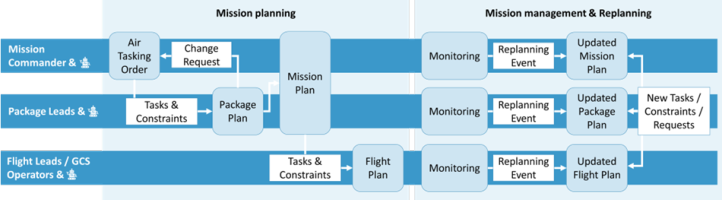
All actors are supported by the intelligent mission management system. Figure 1 depicts how we envision the mission management system to work. The mission management system supports the actors during all phases of a mission, from mission planning and mission monitoring to mission replanning during an active mission. However, due to constraints in computational power and time required for calculations it is more likely that there will not be one mission management system interacting with actors on all levels of the chain of command and in all functions. Instead, each actor will be supported by a local AI system. These multiple AI systems then interact with each other, requesting changes or communicating tasks and constraints.
During mission planning, the air tasking order (ATO) is given to the mission commander. Depending on the air tasking order, tasks and constraints are then communicated to the package leads, who begin formulating a package plan. During this process, an intelligent planning system could be used to e.g. summarize intel, suggest appropriate weaponry or even suggest entire plans. At the very least, the planning process could be supported with technical means supporting information management replacing the paper/pencil method that is used now. All package plans are then assembled into the mission plan, which in turn supplies the tasks and constraints for developing the flight plans on the level of flight leads and ground control station operators.
Figure 1: Process diagram of mission management supported by intelligent mission management systems.
During the mission, its status is monitored by the mission management systems and the responsible actors. The mission management system bases its assessment of mission status on several key performance indicators (KPI)
Human System Integration in Future AI-Supported MUM-T Mission Management 311 that are tracked during the mission, e.g. risk level or resource availability. If the calculated values for KPI move outside of previously set acceptable bounds, a replanning of the mission is triggered (Özcan et al., 2025) and the mission management system provides the human operator with several new mission plans. The operator can then decide to either implement one of the new plans or to further manually adapt one of the suggested plans. This replanning can be triggered on each level of the chain of command. If e.g. an updated mission plan is necessary for the plan of a flight (two-ship formation), new tasks, constraints or requests resulting from this new plan are communicated to higher levels on the chain of command by the mission management system. However, such a system depends on the availability of appropriate communication channels. Further research is needed on how to properly ensure means of communication, especially in spoofed or jammed environments. Finally, the human operators can also communicate their wishes to the mission management system by e.g. setting up a new no-fly zone, which then in turn could result in a replanning event.
STEP 2: IDENTIFICATION OF RELEVANT HUMAN FACTORS FOR THE INTEGRATION OF AI IN MUM-T MISSION MANAGEMENT After developing an understanding of the system, relevant human factors that should be considered have to be identified. Our starting point for this is an analysis of human factors issues from three perspectives: human, technology and organization. With regard to the integration of AI in mission management systems several relevant human factors questions were identified for each perspective.
Regarding the human in the system, several requirements need to be taken into account. First, operators need to be as capable of acting in a mission planned with AI-support as they are in a mission planned as it is planned today. Specifically, this means situation awareness of mission goals, tasks, plans and mission status needs to be ensured to enable operators to act decisively and correctly. However, previous research shows that especially situation awareness when working in a highly automated, AI-supported system can suffer (e.g. Brewer et al., 2018; Endsley, 2023; Hammarbäck et al., 2024; Paul & Brämer, 2013). Thus, situation awareness of the operators should be a main concern in system development (Endsley, 2023). Further, AI should be integrated in mission management in a way that can help prevent fatigue (DLR, 2025) and make workload more manageable (Hammarbäck et al., 2024; Neubauer & Schulte, 2025). In addition, operators must be willing to work with AI-support (Heilemann et al., 2021; Niebuhr, 2024), meaning e.g. that adequate usability needs to be ensured (Niebuhr, 2024) as well as designing the system in a way that fosters an appropriate amount of trust (Hoff & Bashir, 2015).
When focusing on technology, the main concern beyond the engineering side of system development is the design of the human-machine interface (HMI). In one direction, operators need to understand the reasoning of AI support systems. Thus, the design of the HMI needs to ensure explainability and transparency when communicating results from the AI-system to the
operators (e.g. Özcan et al., 2025; Würfel et al., 2024), while adhering to the relevant standards. In the other direction, operators need to be able to communicate their priorities and goals to the AI system with adequate efforts (Ernst et al., 2026; Neubauer & Schulte, 2025), and the system needs to be able to easily understand and maybe even anticipate the operators’ intent (Hammarbäck et al., 2024).
Finally, several questions regarding the overarching organization need to be taken into account for an effective and efficient MUM-T system, mainly: Which tasks should be allocated to which actor (human or AI; e.g. Sadraey, 2018)? How should the different actors collaborate (e.g. Neubauer & Schulte, 2025)? And most importantly: Which actor will have the authority to decide in different situations (e.g. Dudek & Schulte, 2022)? Here, different legal aspects and rules of engagement apply, as well as ethical constraints. Beyond questions concerning authority and task allocation, efficient information flow is crucial for success in missions with many actors (e.g. Brewer et al., 2018; Buchler et al., 2016). Therefore, it needs to be determined who needs which information when.
An integration of these three main areas of human factors during system development of an AI-supported mission management system for MUM-T missions is a requirement for a system that optimally supports and enhances the performance of human operators. The scope of the described human factors research questions, however, is large and most topics will be interdependent. Thus, it is necessary to develop a comprehensive plan for the integration of human factors before or at the earliest possible time during system development, ideally including human factors studies, iterative evaluation campaigns and workshops with pilots or other SME.
STEP 3: USER-CENTERED DESIGN OF A MISSION MANAGEMENT HMI As described before, the successful development of an AI-supported mission management system requires a human-centered design process, i.e. including future users in system development, taking into account their needs and feedback. Thus, in step three after identifying the relevant human factors issues, the work together with SME and future users is continued in an iterative development process. As an example of one of the studies we conducted, we will describe the process of developing a first HMI mockup for interacting with an AI-supported mission management system. Our focus here was firstly the information management, i.e. identifying which information operators need during which phase of a mission. Secondly, we focused on the usability of the HMI in general, with the goal of identifying which features future users would prefer the HMI to have.
The goal was to develop a mock-up of an HMI for the management of multiple highly autonomous UAV from a future fighter cockpit, meaning mission management on the level of the flight lead (see Figure 1). The pilot (flight lead) is supported by an intelligent mission management system that monitors mission KPI and calculates optimized mission plans if necessary. The pilot is responsible for monitoring mission progress and plan execution,
Human System Integration in Future AI-Supported MUM-T Mission Management 313 choosing between the optimized mission plans suggested by the mission management system or adapting the suggested plans manually.
HMI DESIGN PROCESS For the development of the HMI mock-up, we followed an HMI design concept developed at DLR for UAV system state monitoring (Friedrich, 2023). The design approach was developed together with SME and comprehensively evaluated in simulation studies involving both commercial airline and drone pilots with positive results (Friedrich, 2021; Friedrich & Lieb, 2019; Friedrich & Vollrath, 2021). The HMI design philosophy focuses in a large part on the information management, meaning which information should be shown to the pilots during which situation. The goal is to avoid clutter and to enable easy recognition of important information through parallel search and representation of system states using color-coded icons. This should result in an HMI that allows pilots to quickly identify potential problems with the execution of mission plans as well as quickly understand the plans proposed by the mission management system.
The first step of HMI design is the analysis of relevant elements and parameters of the system via an abstraction hierarchy (Vicente, 1999; Vicente & Rasmussen, 1992). This abstraction hierarchy was developed together with pilots of the German Airforce as potential future users of the HMI (Thomas-Friedrich et al., 2025). Based on the abstraction hierarchy it was identified which information should be displayed on the HMI in which level of detail in specific phases of mission management.
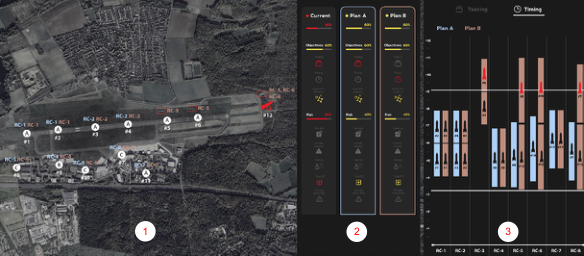
DESCRIPTION OF THE HMI Here, we will give a quick overview of the resulting HMI mock-up. For a detailed description see Ernst et al. (2026). The HMI is divided in three sections. In the first section (see 1 in Figure 2), a map view shows spatial information like the positions of the ownship, assets, targets or trajectories. Section 2 in Figure 2 shows an overview of the current mission plan, if everything is going according to plan. If the mission management system calculates new mission plans, these are shown in the middle section in a similar way to enable a quick comparison between plans. Each mission plan is represented by three progress bars and several icons depicting the mission parameters on the first three levels of the abstraction hierarchy. These are e.g. overall mission success, adherence to mission objectives, timing, tasking or overall risk level. The progress bars and icons are color-coded according to their state – if they exceed preset limits, they will be displayed in yellow or red, depending on the severity of the situation. If all parameters are within acceptable limits, they are displayed in white and grey. Section 3 can be used by the pilot to access more detailed information than is provided in Section 2. By clicking on an icon or progress bar, more parameters from lower levels of the abstraction hierarchy are shown in Section 3 for the pilot to investigate more thoroughly. In the example in Figure 2, the detailed timing of two different mission plans is displayed in comparison.
1 2 3
Figure 2: HMI layout for the mission re-planning assisted by the mission planning system.
STEP 4: EVALUATION Evaluation with regard to human factors should always be a central part in system development. Ideally, measurable human factors goals are formulated at the beginning of a project, together with preplanned steps for iterative evaluations. Evaluations should be done together with future users of the system. For our HMI mock-up, a first heuristic evaluation took place in a workshop with pilots from the German Airforce. Overall, pilots were pleased with the layout of the HMI. The representation of mission plans using icons and progress bars made sense to them, even though the level of detail regarding risk was judged as too high. There was a lot of feedback regarding the map section of the HMI, where pilots identified additional information they would deem necessary. It was suggested to permanently display some of the information on the map while providing the pilot with the option to add even more information in additional map layers. Further, pilots would like the option to change the map type from e.g. topography to aviation maps. Pilots did not like the design of some of the detailed views in section 3 of the HMI. Especially regarding the representation of tasking, they would prefer a more map-based, schematic representation instead of the current text-based schedule.
One important aspect in the evaluation workshop was the question how pilots would like to interact with an AI mission management system. The participants reported that it is especially important that pilots are able to efficiently communicate new constraints and instructions to the system. Examples would be new no-fly zones or points of interest as well as constraints like: “Always keep 50% of UAV within X miles to ownship”. Above that, participants expressed their desire for the UAV to fly as autonomously as possible to minimize pilots’ workload. When manually adapting mission plans, it should be done on the higher levels of the abstraction hierarchy, e.g. adapting the risk level or prioritizing tasking over timing (always within the margins of the commanders’ intent). Overall, these results match with previous research identifying a high level of autonomy as necessary in swarm
Human System Integration in Future AI-Supported MUM-T Mission Management 315 management (Hocraffer & Nam, 2017). Future work based on this first HMI evaluation will include a revision of our HMI design according to the feedback. Afterwards, a more formal evaluation of the HMI mock-up is planned, implementing the HMI in a high-fidelity flight simulator.
CONCLUSION
Overall, MUM-T including AI-powered systems will be a central part in future combat scenarios, including mission management. Putting human factors at the forefront when integrating AI in mission management systems is necessary to ensure optimal performance. In this paper, we outlined main human factors issues that need to be addressed in AI-supported mission management. Further, we described our process for human system integration along the example of developing an HMI for AI-supported mission management.
During the design of the HMI, we assumed certain characteristics of this mission management system that may not be found in future systems. However, our process of integrating human factors in system development outlined here can be implemented regardless of the characteristics of the target system. Implementing such a human-centered development process instead of focusing mainly on the engineering will ensure the success of future mission management systems.
ACKNOWLEDGMENT
The authors would like to thank all the subject matter experts who took the time to participate in our interviews and workshops.
REFERENCES
Armed Forces of the United States (2017). Joint Publication 1. Doctrine for the Armed Forces of the United States. Banas, J., Mehling, T., Paul, T., Cords, A. (2020). Manned-unmanned teaming
challenges in the maritime environment. 76th Annual Forum of the Vertical Flight Society, Volume 4, Virginia Beach, Virginia, USA. Booher, H., ed. (2003). Handbook of human systems integration. New Jersey: Wiley. Brewer, R. W., Cerame, E., Pursel, E. R., Zimmermann, A., Schaefer, K. E. (2018).
Manned-unmanned teaming: US army robotic wingman vehicles. International Conference on Applied Human Factors and Ergonomics, pp. 89–100. Buchler, N., Fitzhugh, S. M., Marusich, L. R., Ungvarsky, D. M., Lebiere, C., Gonzalez, C. (2016). Mission Command in the Age of Network-Enabled Operations: Social Network Analysis of Information Sharing and Situation Awareness. Frontiers in psychology, Volume 7, p. 937. Cooke, N. J., Demir, M., McNeese, N. (2016). Synthetic teammates as team players:
Coordination of human and synthetic teammates (No. RE201684401). DLR (2025). Studie zum Einfluss von Müdigkeit auf Teamarbeit nun veröffentlicht.
Dudek, M., Schulte, A. (2022). Meaningful guidance of unmanned aerial vehicles in dynamic environments. Proceedings of the 1st International Conference on Cognitive Aircraft Systems (ICCAS 2022), pp. 10–14. Endsley, M. R. (2023). Supporting Human-AI Teams: Transparency, explainability,
and situation awareness. Computers in Human Behavior, Volume 140, p. 107574. Ernst, J. M., Thomas-Friedrich, B., Friedrich, M. (accepted paper). Mission management in human autonomy teams - an HMI design concept for managing multiple uncrewed aerial systems from a fighter cockpit. Intelligent Human Systems Integration Conference (IHSI) 2026. Friedrich, M. (2021). Human Machine Interface Design to Support Safety Risk
Monitoring of Autonomous Small Unmanned Aircraft Systems – Results from a Mock-Up Evaluation. Digital Avionics Systems Conference (DASC), San Antonio, TX, USA. Friedrich, M. (2023). Display Design to Support Efficient Search in Safety Risk Identification for Supervisory Control of Unmanned Aerial Vehicles. Dissertation. Braunschweig: TU Braunschweig. Friedrich, M., Küls, J., Findeisen, M., Peinecke, N. (2023). HMI Design for
Explainable Machine Learning Enhanced Risk Detection in Low-Altitude UAV Operations. Barcelona, Spain. Friedrich, M., Lieb, J. (2019). A Novel Human Machine Interface to Support Supervision and Guidance of Multiple Highly Automated Unmanned Aircraft. Digital Avionics System Conference (DASC), San Diego, CA, USA. Friedrich, M., Vollrath, M. (2021). Human Machine Interface Design for Monitoring
Safety Risks Associated with Operating Small Unmanned Aircraft Systems in Urban Areas. Aerospace, Volume 8, No. 3. Hammarbäck, J., Alfredson, J., Johansson, B. J., Lundberg, J. (2024). My synthetic wingman must understand me: modelling intent for future manned–unmanned teaming. Cognition, Technology & Work, Volume 26 No. 1, pp. 107–126. Heilemann, F., Lindner, S., Schulte, A. (2021). Experimental evaluation of tasking
and teaming design patterns for human delegation of unmanned vehicles. Human- Intelligent Systems Integration, Volume 3 No. 3, pp. 223–240. Hocraffer, A., Nam, C. S. (2017). A meta-analysis of human-system interfaces in unmanned aerial vehicle (UAV) swarm management. Applied Ergonomics, Volume 58, pp. 66–80. Hoff, K. A., Bashir, M. (2015). Trust in automation: Integrating empirical evidence
on factors that influence trust. Human Factors, Volume 57 No. 3, pp. 407–434. Huttner, J. P., Friedrich, M. (2023). Current Challenges in Mission Planning Systems for UAVs: A Systematic Review. 2023 Integrated Communication, Navigation and Surveillance Conference (ICNS), Washington D.C., USA. Mehling, T., Viertler, F., Paul, T. (2019). Potential of the Unmanned Wingman
in Manned-Unmanned Teaming tested in Flight. Deutscher Luft-und Raumfahrtkongress, Darmstadt, Deutsche Gesellschaft für Luft- und Raumfahrt Lilienthal-Oberth e.V. NATO standardization office (2025). NATO Standard AJP-3. Allied joint doctrine for the conduct of operations. Neubauer, S., Schulte, A. (2025). The Impact of HAT on Team Dynamics and
Coordination: A Teaming-Oriented Study for MUM-T. 2025 IEEE 5th International Conference on Human-Machine Systems (ICHMS), pp. 465–470. Niebuhr, T. (2024). Enhancing NATO’s Strategic Edge. A Human-Centric Approach to Multi-Domain Operations. The Journal of the JAPCC, Volume 38, pp. 28–35.
Human System Integration in Future AI-Supported MUM-T Mission Management 317 Özcan, B., Friedrich, M., Huttner, J.-P., Dwinger, K. (2025). Enhancing Trust in
Human-AI Interaction Through Explainable Decision Support Systems for Mission Planning of UAS Swarms. AHFE International Conference. Human Factors in Robots, Drones and Unmanned Systems. Orlando, FL, USA. Paul, T., Brämer, E. (2013). Operational Considerations for Teaming Manned and Unmanned Helicopter. Journal of Intelligent & Robotic Systems, Volume 69, No. 1–4, pp. 33–40. Peng, Q., Wu, H., Xue, R. (2021). Review of Dynamic Task Allocation Methods
for UAV Swarms Oriented to Ground Targets. Complex System Modeling and Simulation, Volume 1, No. 3, pp. 163–175. Rochlis Zumbado, J. (2015). Human Systems Integration (HSI) Practitioner’s Guide.
NASA/SP–2015–3709, Houston, Texas: Lyndon B. Johnson Space Center. Sadraey, M. H. (2018). Manned-unmanned aircraft teaming. 2018 IEEE Aerospace Conference, pp. 1–12. Thomas-Friedrich, B., Ernst, J. M., Friedrich, M. (2025). UAS Mission Management
in Human Autonomy Teams – Advancing DLR’s HMI Design Concept for Managing Multiple UAS from a Fighter Cockpit. Internal Report DLR-IB-FL- BS-2025–130, Braunschweig: Deutsches Zentrum für Luft- und Raumfahrt e.V. Thomas-Friedrich, B., Windischer-Unterkircher, A., Widrig-Bamert, L., Fünffinger, D., Boos, D., Grippenkoven, J. (2022). Human Factors messbar machen – ein Vorgehensmodell für den Eisenbahnsektor. Measuring human factors – a process model for the railway sector. SIGNAL + DRAHT, Volume 114, pp. 38–45. Vicente, K. J. (1999). Cognitive work analysis: Toward safe, productive, and healthy computer-based work. Boca Raton: CRC Press. Vicente, K. J., Rasmussen, J. (1992). Ecological interface design: theoretical
foundations. IEEE Transactions on Systems, Man, and Cybernetics, Volume 22, No. 4, p. 589–606. Würfel, J., Papenfuß, A., Wies, M. (2024). Operationalizing AI explainability using interpretability cues in the cockpit: Insights from User-Centered Development of the Intelligent Pilot Advisory System. 26th International Conference on Human- Computer Interaction, HCII 2024, 14734. Washington, USA: Springer, Cham, pp. 297–313.
LISTED IN THE AHFE DIGITAL BOOKSTORE CATALOGUE
Explore the complete digital volume
Intelligent Human Systems Integration (IHSI 2026): Disruptive and Innovative Technologies
Read this individual research paper free through the original publisher, or explore the full digital proceedings book.
ISBN 978-1-964867-76-2
Explore this ISBN in the AHFE Bookstore ↗Listed in the July 2026 bookstore catalogue; search by ISBN to confirm current availability · Digital book purchase optional