Robert Sharples (2024). Humans, Physical Systems, Cyber Systems and Artificial Intelligence – An initial Architectural Integration. In: Human Factors in Software and Systems Engineering. AHFE Open Access, vol. 140, pp. 1–7. https://doi.org/10.54941/ahfe1005031
This research at Airbus DS started on 2015 with the integration of Humans into the Engineering Approach initially via Architecture Frameworks and Human Views, we then adding Human System Integration (HSI) and Human Engineering and are now moving into Physical and Cyber Systems with intelligent decision making. The aim of this research is to investigate and integrate various lines of development from Cockpit Design to Intelligent Manufacture that can have direct intelligent interaction with humans.
This paper will highlight the initial thoughts of moving Human / Physical / Cyber Systems and mapping to our Operational Concepts and Analysis and Modelling and Simulation with Artificial Intelligence / Human Interaction in the near future and then Quantum in the not so far future.
It will define a generic industrial system as any ‘real’ system will be commercially sensitive and unfortunately as will any reference to Aircraft.
The paper will define four initial interactions from an ‘As Is’ position in to a future fully intelligent automated system.
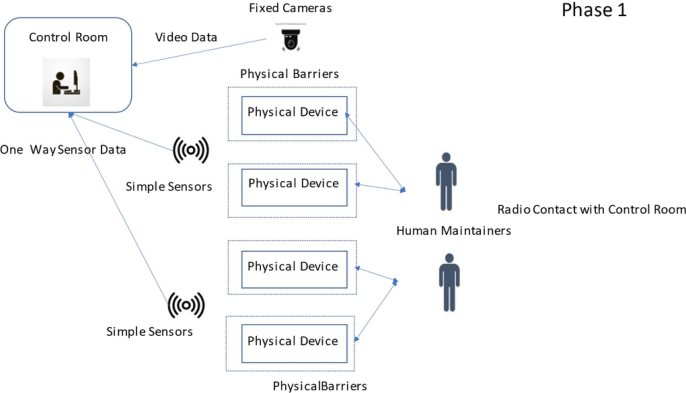
Phase 1 As Is – The Human(s) interact with a Physical Device (computer, laptop, tablet, etc.) which in turn is then connected to the Physical System Power which will include - Transmission, Devices (sensors etc), hardware and software.
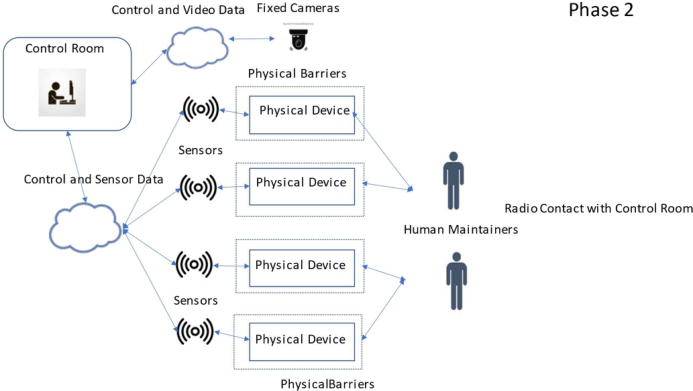
Phase 2 – As per Phase 1 but now adding a Cyber System which will include, Control, Analysis, Decision Making and Sensing sitting between the Human and Physical System together with an internal network.
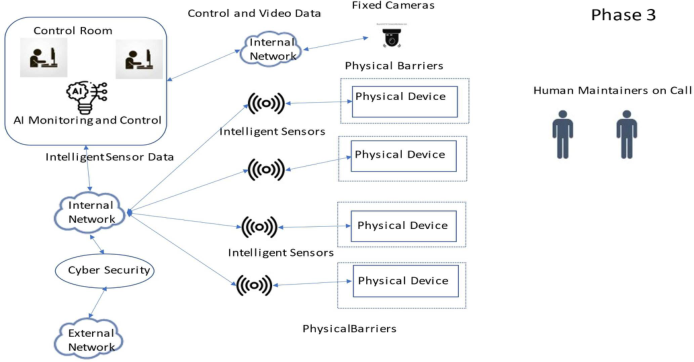
Phase 3 –As per Phase 2 and adding Artificial Intelligence which will include, intelligent decision making, Learning and Cognition, Intelligent control, intelligent sensing, together with an external network connection and Cyber Security.
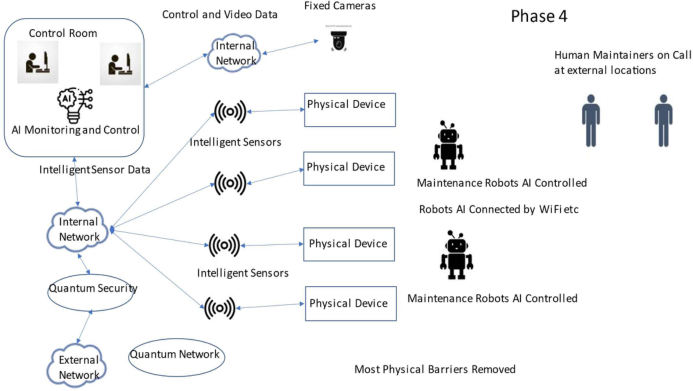
Phase 4 – The final phase is an automated system with the Humans act- ing as monitors. The maintenance role may be performed by robots on the Physical and Cyber Systems, which may have full AI learning and con- trol. Quantum technology will be introduced via a Quantum Network and Quantum Cryptography.
The Human engineering aspects will cover a set of Human System Integra- tion (HSI) Domains
Manpower
Personnel
Training
Human Factors Engineering
Environment
Safety
Occupational Health
Survivability
Habitability
Hypothesis The phase approach starting with a Physical System with ‘hands on’ Human maintainers and Humans in a basic control room, through to a future system that may have mainly robot maintainers and fully intelligent AI sys- tem, with Quantum Communications, with the Humans being restricted to remote control rooms and remote maintenance locations for emergency maintenance.
The impact on HSI will mirror the reduction in the human workforce, but will increase the HSI interfaces as they will be more complex between the AI systems and Robotic engineering. The Human personnel required for these future tasks will required higher education levels and more complex training, as the system complexity increases.
Phase 1 A Standard Production Type As Is What we have today
Each physical device is isolated and has a safety guard rail
Human Control is from an internal control room
Human Maintenance is on a pre- determined schedule with emergency response
The Control room has basic monitoring and control of the physical devices
Humans, Physical Systems, Cyber Systems and Artificial Intelligence 3
Figure 1: A standard production type.
Human Integration As this is the ‘As Is’ case only a basic interface exists between the physical device and the human maintainers and the humans in the control room.
Manpower – the man power levels are known at each location, as a defined number control operators and maintainers can be calculated to cover the shift patterns
Personnel – each site will require a personnel policy, career progression, health hazards etc. as deemed necessary for each site
Training – basic training is required for the Control Room operators, with higher level of training for the various level of maintenance, as required by the specific Physical Device
Human Factors Engineering – basic interfaces with humans
Environment - following national and international standards
Safety – following national and international standards
Occupational Health - Occupational Health will be required at each site
Survivability – not applicable to non-military systems
Habitability – Physical barriers protect the maintainers Phase 2 As Is Plus an Internal Network and Basic Cyber Security
All the devices are connected to an internal network
The Control Room receives monitoring and control to / from the sensors and cameras
The Human maintainers may have hand held devices to monitor the physical devices and contact the Control Room
The devices have basic monitoring sensors, software and network connec- tions
4 Sharples
Figure 2: As Is plus an internal network and basic cyber security.
Figure Human Integration
Manpower – the man power level is known as each location requires control operators and maintainers to cover the shift patters
Personnel – each site will require a personnel policy, career progression, health hazards etc. as deemed necessary for each site
Training – standard training for Control operators, higher level of training for the various level of maintenance required
Human Factors Engineering – basic interfaces with humans
Environment - following national and international standards
Safety – following national and international standards
Occupational Health – Occupational Health will be required at each site
Survivability –not applicable to non-military systems
Habitability – Physical barriers protect the maintainers Phase 3 Integration of Artificial Intelligence (AI)
As phase 2 adds AI, an External Network and Cyber Security
The control room has AI added to assist in monitoring, control and maintenance prediction
Each device has AI control and monitoring software
AI will perform - Intelligent decision making, Learning and Cognition, Intelligent control and intelligent sensing
The individual systems will be connected to an external network
The external network will require a more detailed Cyber Security system
The maintainers will be on call within the site or at a separate location and will be connected to the networks and control rooms as required
Humans, Physical Systems, Cyber Systems and Artificial Intelligence 5
Figure 3: Integration of artificial intelligence.
Human Integration
Manpower – the man power level is known as each location requires con- trol operators and maintainers to cover the shift patters. Manpower will be reduced; however, the updated roles will require more qualified personnel
Personnel – each site will require a personnel policy, career progression, health hazards etc. as deemed necessary for each site
Training – Less but more comprehensive training to interface with the AI systems
Human Factors Engineering – complex interfaces with Humans
Environment - following national and international standards
Safety – following national and international standards
Occupational Health - Industry standard, with a reduced need for Occu- pational Health on site
Survivability –not applicable to non-military systems
Habitability – Physical barriers still in place Phase 4 Future System
As Phase 3 a near fully AI automated system, with Robots performing the majority of the maintenance and the addition of Quantum encryption and communications
The control rooms are merged as location demands
AI is in control of the devices in terms of
AI Robots are in control of the regular maintenance and control of the physical devices
Human Maintainers are deployed at appropriate location to perform to deal with any emergencies
The majority of the physical safety barriers can be removed, therefore more physical devices can be added to the floor plate
Quantum Communications will be integrated into the system, this could include a Quantum Network and Quantum Cryptography
6 Sharples
Figure 4: Integration of artificial intelligence.
Human Integration
Manpower – the man power level is known as each location requires con- trol operators and maintainers to cover the shift patters. Manpower will be significantly reduced; however, the updated roles will require more qualified personnel and comprehensive training
Personnel – the require for require a personnel policy, career progression, health hazards etc. will reduce as required as site reduce the number of Humans.
Training – The Training needs will reduce in line with the workforce reduc- tion but more comprehensive training will be needed to interface with the AI and Quantum systems
Human Factors Engineering – very complex interfaces with Humans
Environment – Mainly a human free environment, most maintenance carried out by the Robots
Safety – following national and international standards
Occupational Health - Industry standard, but with a reduced Occupa- tional Health need on site. It may not be needed if some sites are Human Free
Survivability –not applicable to non-military systems
Habitability – Physical barriers removed
CONCLUSION
The Near Future The introduction of more complex Internal / External Networks, Intelligent sensors, the integration of AI, the need for added Cyber Security protection, will reduce the workforce in terms of numbers, but will require a higher degree of education and training for all humans.
Humans, Physical Systems, Cyber Systems and Artificial Intelligence 7
The Further Future The integration of Quantum Networks and Cryptography will be dependent on the development of Quantum Computers, together with the increased use of AI will further decrease the workforce, with the prospect of factories run by robots producing robots. Hopefully this will not happen and Humans will always be in the loop, which will mean a very complex HSI needed between the Humans and Robots.
This research is looking far into the future maybe 10 years, but the deci- sions we make now will define the interface between physical entries with and without Artificial Intelligence and Humans.
LISTED IN THE AHFE DIGITAL BOOKSTORE CATALOGUE
Explore the complete digital volume
Human Factors in Software and Systems Engineering
Read this individual research paper free through the original publisher, or explore the full digital proceedings book.
ISBN 978-1-964867-16-8
Explore this ISBN in the AHFE Bookstore ↗Listed in the July 2026 bookstore catalogue; search by ISBN to confirm current availability · Digital book purchase optional