Awwal Arigi, Maren Eitrheim (2024). Staffing in small modular reactors - first impressions. In: Human Factors in Software and Systems Engineering. AHFE Open Access, vol. 140, pp. 116–126. https://doi.org/10.54941/ahfe1005044
Small modular reactor (SMR) development around the world has seen significant progress in recent years. Some of the unique characteristics that may impact control room operations include integral core design, passive safety systems, low fission products in case of release, flexible power outputs, and siting flexibility. The policy for staffing in SMRs is still an open question as there is a wide variety of implementation possibilities due to the varied designs and application contexts. Some vendors plan single unit deployment, while others suggest operation of multiple units from one control room. However, the policy on staffing will potentially be interdependent on several other factors such as the concept of operation, communication style, integrated system validation including control room design, and level of automation. This study investigated two staffing arrangements in a six-unit SMR simulator with licensed nuclear power plant operators. We discuss variations in how; participants organize themselves and assign responsibility in the absence of a defined concept of operation, their monitoring strategies, how they respond to failures and prioritize task work, and how they respond to single unit and multiple unit failures. We also discuss the workload participants experienced during the scenarios implemented. The limitations of our studies and implications for future research and industry application are presented.
There has been a sustained interest in the development of small modular reac- tors (SMRs) worldwide due to the unique benefits they promise to bring to the nuclear industry and the society. Most of the current SMR designs promise design simplicity, modular designs, siting flexibility, competitive construction costs, co-generation (process heat applications, district heating, desalination, and hydrogen production) capabilities, and improved safety and security (Hidayatullah et al., 2015). Moreso, the safety risk profile of SMRs is limited to factors such as smaller power output, reduced radioactive inventory, pas- sive safety systems, underground location of the reactor vessels for improved protection against hazards, and reduced accident severity potential (Carless et al., 2019).
Staffing in Small Modular Reactors–First Impressions 117
There are over 80 SMR designs in various stages of development and deployment in 18 countries (IAEA, 2022). The United Kingdom (UK) gov- ernment has recently selected six SMR designs to move to the next stage in a government competition. The aim is to select some of the companies for government support to provide nuclear power in the UK by mid-2030s (The UK Government, 2023). The European Commission also emphasized its commitment to support research, innovation, education, and training with an aim to deploy SMRs in Europe by 2030 with a signature decla- ration of ‘EU SMR 2030’ in April 2023 (Bogoviˇc, 2023). Internationally, United Sates of America (USA), Canada, and China are some of the lead- ing countries taking several policy measures to support the development of SMRs.
Although significant technological advancements have been made in recent years, there is still rather little information on human factors and human per- formance aspects of SMR operation. The IAEA observed that there are some issues that require “considerable” attention, including control room staffing and human factors engineering for multi-module SMR plants (IAEA, 2022). The policy for staffing in SMRs is an open question as there is a wide vari- ety of implementation possibilities due to the varied designs and application contexts. Some vendors plan single unit deployment, while others suggest operation of multiple units from one control room. However, the policy on staffing will potentially be interdependent on several other factors such as the concept of operation, communication style, control room design, and level of automation.
Related Research Although the interest in SMRs has increased rapidly in recent years, ques- tions concerning staffing of advanced reactors and multi-unit operation are not new. More than 20 years have passed since a large empirical study was conducted on performance impacts of different crew configurations for con- ventional and advanced reactors. As (Hallbert & Morisseau, 2000) stated, the purpose was to “evaluate the impact(s) of advanced passive plant design and staffing of control room crews on operator and team performance”. The rationale was that staffing requirements for advanced plants may change due to improvements in ease of plant operation. Similar expectations of reduced human intervention are proposed for recent SMR designs.
Crews of four persons were tested in a conventional plant (Loviisa, Fin- land) and an advanced plant (simulation of Loviisa with passive features in Halden Man-Machine Laboratory (HAMMLAB)). Their performance was compared to smaller crews of three persons (conventional plant) and two persons (advanced plant). In the advanced plant, one of the participants in the two-person crews had a dual role, serving as both supervisor and opera- tor. Unsurprisingly, the four-person crews performed better performance than three persons in the conventional plant. However, the crews with two per- sons performed better than the four-person crews in the advanced plant. The authors (Hallbert & Morisseau, 2000) explained this as being due to control room design features in the two plant conditions supporting different crew
118 Arigi and Eitrheim
configurations. The smaller crews, and particularly the participant having a dual role, experienced more workload than the four-person crews.
In debriefing interviews, the participants expressed concerns about being able to work effectively during sustained periods of stress and maintain a global overview of the plant while performing mitigating actions. The work- load typically increased during the onset of a disturbance and persisted throughout the scenario. Although workload was higher in the advanced plant, crew performance was not impaired.
In 2010, three-person crews were tested in controlling one compared to two nuclear processes supported by plant automation (Eitrheim et al., 2010). The task performance was higher when controlling one nuclear process com- pared to operating two processes, while situation awareness showed an opposite pattern. A possible explanation could be that task performance was sacrificed for maintaining an overview of the plant status and automation activities. It could also be due to higher workload reported by the partic- ipants, especially during difficult scenario periods while being responsible for two nuclear processes. Some of the participants expressed that extended responsibilities exceeded their capacity. Getting support from a colleague was not sufficient to alleviate their workload. Participants acting in a supervisory role had mixed opinions about the extended responsibilities when controlling two processes. Some found it acceptable, while others were uncomfortable with deciding to prioritize one process over the other in demanding periods.
Study Aim This work is an initial attempt to study the performance of operators in dif- ferent staffing setups while operating multiple units from a single control room. The aim is to contribute to understanding potential safety issues and provide early insights that may support the review of staffing levels in SMR deployments. Thus, we investigated two different staffing arrangements in a six-unit SMR simulator with licensed nuclear power plant operators. Section 2 describes the test design including the simulator used. Section 3 discusses the variations in how; participants organize themselves and assign respon- sibility in the absence of a defined concept of operation, their monitoring strategies, how they respond to failures and prioritize task work, and how they respond to single unit and multiple unit failures. A discussion follows before the preliminary conclusions.
TEST DESIGN The Simulator
The simulator used for this work is the Halden SMR simulator (HSMR) which is based on an integral pressurized water reactor (iPWR)-type. As described by (Eitrheim et al., 2020), the primary circuit components of the iPWR reactor (steam generator, pressuriser, and control rod drive mecha- nism) are integrated in the reactor pressure vessel (RPV) and the core cooling is achieved either by forced or natural circulation of light water within the RPV. As with many new SMR designs, the iPWR utilises several passive safety
Staffing in Small Modular Reactors–First Impressions 119
features, including an Automatic Depressurisation system (ADS), a Pressure Injection system (PIS), a Gravity Injection system (GIS) and Passive decay heat removal (PDHR).
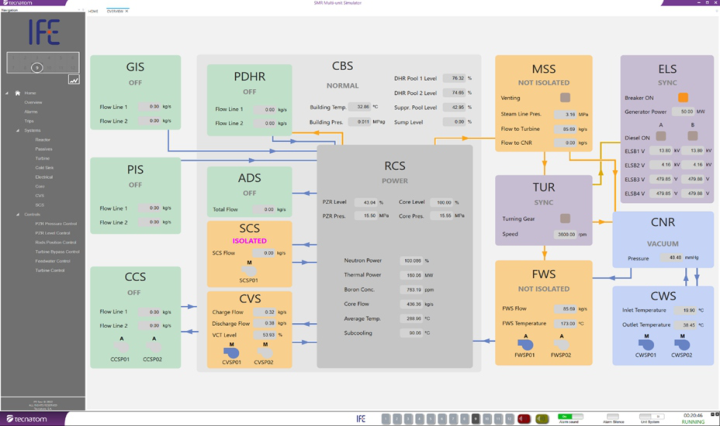
The HSMR was acquired and installed in the HAMMLAB in 2022. It allows for simulating up to twelve units at a time and has a dedicated inter- face for instructor operations (Blackett et al., 2023). The HSMR simulator can simulate full power operation, hot and cold shutdown, and the abnor- mal scenarios. As such, the simulation models for the electric, Residual Heat Removal (RHR), and Chemical and Volume Control (CVC) systems have been modified. Figure 1 shows the systems overview display page on the operator workstations with a navigation section on the left. The status of the current unit and other units can also be seen on the top left.
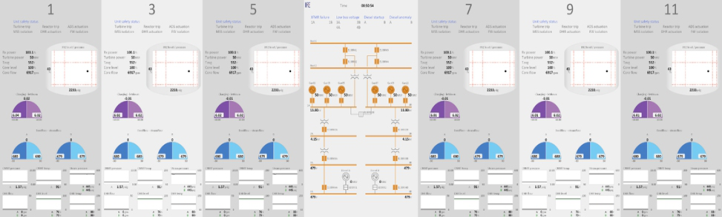
The large screen overview display (LSOD) is to support the operators in monitoring critical parameters and trends of all the units (see Figure 2). This display also shows the critical electrical system (in the centre) including the generators, buses, and real-time operating (output) values from all units. The display is compartmentalized so that each unit is clearly discriminated by the operators.
The Participants The participants for this study were licensed operators of conventional nuclear power plants (NPPs) from the USA and Sweden. They had several years of experience working in different roles in the NPPs as reactor operator, balance of plant operator, senior reactor operator, shift technical advisor, or shift supervisor. Twenty operators participated in this study. The participants had an average age of 40.3 years (range 31–54 years).
Figure 1: System overview on the operator workstation of the HSMR simulator.
120 Arigi and Eitrheim
Figure 2: The large screen overview display for the HSMR simulator.
Training All the participants were familiar with computerised interfaces and used these in their work. However, none of the participants had previous experience or training in iPWR or multi-unit operations before this study. The training for the first two crews was conducted in a classroom and included talk through of the simulator displays and controls using screen grabs of the major systems and components. However, a more hands-on approach was utilized for subse- quent participants by conducting the training using the simulator interface as this appeared to better prepare the participants for the data collection scenar- ios by effectively understanding how the plant works. The participants were also introduced to the Normal, Abnormal, Alarm, and Emergency Operating Procedures during this training.
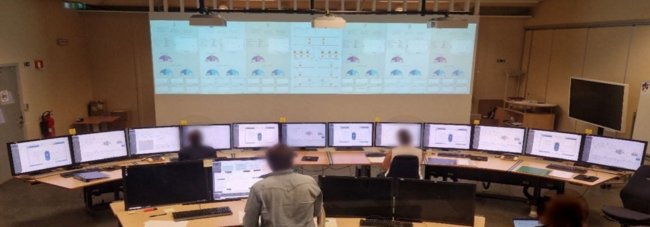
The Test Setup and Procedure The tests were conducted over several weeks during the years 2022 and 2023. The current study included operation of six units. This was in line with the staffing level in a previous study (Eitrheim et al., 2020) testing one partic- ipant controlling three units in a basic principle simulator (a precursor to the current version). Six units are also compatible with the current layout in HAMMLAB, providing the operators with a shared Large Screen Overview Display (LSOD), and two operator workstation screens per unit. Figure 3 depicts the setup for two-person crews.
Figure 3: Ongoing tests in the HSMR simulator with a two-person crew (a process expert is behind).
Staffing in Small Modular Reactors–First Impressions 121
The participants were tested in teams of two(s) and three(s) in the HAMM- LAB. The participants were first given a general introduction which covered the purpose of the study, and how the study would be conducted. The partic- ipants were informed that the purpose of the study was to better understand how operators would work in a multi-unit nuclear control room, where they are required to monitor and control multiple reactor units that are oper- ating simultaneously. The participants were informed of the “naturalistic” approach that would be adopted in the study. This meant that the experimen- tal staff would impose very few restrictions on how the participants should work individually or as a team, allowing them to choose a style of working that best suited them and the situation. The participants were asked to think aloud and to discuss as much as possible the tasks that they were perform- ing. This allowed the researchers to make better sense of the reasoning behind their actions. The scenarios were followed by 10–15 minutes debriefing ses- sions where the participants discussed their monitoring strategies and work distribution, actions, inactions, and self-assessments of individual workload during the scenario.
The Scenarios The staffing arrangements were tested in design-basis scenarios. Four scenar- ios were used for the first set of crews that had two (2) operators each. An additional (fifth) scenario was included for the three-operator crews as an attempt to force higher workloads.
The first scenario was used as a baseline monitoring scenario. All 6 units were in operation at full power without any disturbances introduced. The purpose was to observe how the operating team determined their strategy for organizing themselves and monitoring at both unit and plant level. The duration of this scenario was approximately 10 minutes.
The remaining scenarios were designed to have increasing levels of diffi- culty or complexity by introducing more planned tasks and disturbances at several units. They were meant to test different types of operator tasks like anomaly detection, reorganizing planned tasks, managing unplanned events, and prioritization in the case of multi-unit events. All the scenarios differed in the planned tasks, status of the different units, types, and timing of events and disturbances. The fifth scenario added for three-operators crews introduced planned tasks on three units and disturbances on two units. Each scenario lasted approximately 15–20 minutes.
SUMMARY OF FINDINGS The findings presented here are based on observations and interviews docu- mented by the researchers while testing eight (8) crews. Four (4) of the crews were made up of two operators each while the other four consisted of three operators each. This summary focuses on three aspects of their performance: team organization, response to multiple unit evets, and their reported work- load. To be concise, henceforth, we refer to two-person crews as group A and the three-person crews as group B.
122 Arigi and Eitrheim
Team Organization The participants were encouraged to organize themselves in a way that best suited them and the situation. The predominant structure for group A partic- ipants was that one participant took responsibility for 3 units in a left-right split of the control room i.e., one person monitors and performs controls tasks for the first three units, while the other performs monitoring and con- trol tasks for the remaining three units. In group B, responsibility for the units was split into three with each participant being primarily responsible for performing control tasks on two adjacent units.
Most of the crews in group A adopted a reader-doer approach i.e. peer- checking actions, in the initial stages of the tests (scenarios 1 and 2) while those in group B had a different approach; one person would perform the action, another would peer-check, and the third person would be dedicated to monitoring across the six-units. In the later, more complex scenarios, group A participants changed their strategy and compromised peer-checking of all actions whereas, those in group B seemed to maintain their strategy throughout.
Group B participants tended to allocate more resources and spend more of their time monitoring the plant across all units, compared to group A, who spent less resources on monitoring. In some cases, group B participants moni- tored in parallel with performing certain tasks, while in other cases cross-unit monitoring was allocated to a dedicated role that solely focused on this. This difference can be attributed to the extra personnel that was available in the control room for group B.
The team size did not appear to impact the communication pattern, i.e., no systematic differences were identified when comparing group A and B partici- pants. However, variations in communication patterns were observed among the crews, regardless of their size. For example, some crews adopted an overt (aloud) notification (sometimes including a raised hand) of alarms, plant sta- tus, and planned actions, whereas others worked more silently. When the scenarios got complicated with multi-unit tasks, the verbal communication typically decreased. In some situations, this led to incorrect assumptions by the participants about ‘who is doing what’.
Response to Multi-Unit Events The participants in both group A and B reported feeling uncomfortable in the scenarios where multiple unit failures occurred. A serial rather than a simulta- neous approach to handling tasks was clearly preferred by both groups A and B participants and that was obviously compromised in situations where mul- tiple issues were present at the same time. Thus, prioritization was necessary in some cases.
The participants in both groups, preferred to apply “effort reduction heuristics” in multiple unit events. This was characterized by either pausing or not initiating tasks whenever concurrent tasks were ongoing. However, group A participants mostly paused actions to attend to disturbances with neither peer-checking nor monitoring considerations, while group B partici- pants paused or postponed action implementations to maintain peer-checking
Staffing in Small Modular Reactors–First Impressions 123
or monitoring strategy. Group B participants sometimes sacrificed peer- checking to perform simultaneous tasks, thereby managing to avoid pausing or delaying any action implementations.
The role of monitoring often shifted between the different participants in Group B. This often depended on who had less tasks at that moment. We also observed instances where the performance in this role declined as the person responsible for monitoring was called to perform peer-checking tasks. How- ever, group B participants were obviously less reliant on alarms alone (than group A participants) to provide a cue during an incident. For example, all the crews in group B detected that the reactor power was increasing abnormally from the LSODs within seconds of the failure insertion (Arigi & Blackett, 2023) - whereas this failure went undetected by the group A crews for at least a few minutes (Blackett et al., 2023).
Workload Subjective workload ratings were captured orally on a scale of 1–10 from each participant during the debrief interviews. Overall, there were lower rat- ings in the earlier scenarios and higher ratings in the later scenarios by both the group A crews and the group B crews. This is not unexpected because the scenarios were designed to induce higher workload as they progress from scenarios 1–4 or 5. However, there were no systematic differences between the workload ratings from group A and group B participants. The results should be interpreted with caution due to the small sample size and simplistic, single-item assessment. Nevertheless, the measure may not have been sensi- tive to the difference in staffing arrangements. Similar patterns across crews may also reflect effectiveness of strategies to reduce task load and adjusting crew practices. When less resources are available, diagnosis and mitigation activities may be prioritized at the expense of maintaining peer checking rou- tines and conduct proactive cross-unit monitoring. Thus, the crews may have been able to handle the scenarios within certain workload margins regardless of their size.
DISCUSSION
The current studies were explorative, using a naturalistic approach. Except for the first two crews, the participants received largely the same training. The test set-up and majority of the scenarios were also kept the same for all crews. Since the order of scenarios was not counterbalanced, the scenario handling may have been susceptible to order effects. However, the increas- ing complexity from the first to the last scenario allowed the participants to get familiar with the novel situation. It also enabled the research team to observe the continuous adjustment of task prioritizations and strategies in response to the increasingly challenging scenarios. The main impression was that operators gradually left routines from their home plant and searched for appropriate practices to handle the multi-unit operation at hand. Future stud- ies may investigate to what extent new strategies are kept when the scenario complexity varies, including periods of both low and high workload. The
124 Arigi and Eitrheim
participants may also familiarize with specific roles and strategies in training scenarios prior to the data collection.
The ability to dynamically adjust task prioritizations and strategies may suggest that the crews were able to maintain a spare capacity for handling unexpected events. We observed examples of both postponing planned activ- ities and reducing the number of units running at full power. However, the extent to which operators may face unacceptable performance deterioration in periods with multi-unit disturbances and parallel tasks should be further investigated. Challenges related to prolonged periods of passive monitoring and low task load are less suitable topics for simulator studies. However, future studies may focus on transitions between periods of high and low workload. Beyond searching for workload thresholds with detrimental per- formance effects, future studies should investigate management strategies and self-regulation mechanisms to handle varying task demands in operation of multiple and highly automated units. The shift supervisor may play a signifi- cant role in this respect, ensuring appropriate balance of task allocations and rotation in the team. Although workload may not impair performance in the time span of a simulator study, prolonged periods of underload and overload may lead to stress and fatigue among the operators.
Previous studies (Hallbert & Morisseau, 2000) (Eitrheim et al., 2010) suggest that crew size may impact task performance, whereas findings on situation awareness appear inconsistent. Larger crews may have more capac- ity to perform complex scenarios and simultaneous tasks. Still, they appear to prefer a strategy of reducing parallel work as much as possible. In the study by (Eitrheim et al., 2010) smaller crews showed higher situation awareness than larger crews. However, in the current study three-person crews appeared to perform more proactive monitoring and detect disturbances earlier than two- person crews. Participants reported being uncomfortable with having dual roles of task performance and cross-unit monitoring. Shift supervisors also expressed uncertainty about prioritizations of units in periods with high task load in the team. Future studies may investigate situation awareness, task per- formance and resource management when cross-unit monitoring and planned operator actions are separated compared to operators being responsible for cross-monitoring and planned tasks in parallel. The interface between opera- tors and the shift supervisor may be specially addressed, as supervisors have traditionally been assigned a pure monitoring role.
It has been argued previously that the workload measures used are sim- plistic but the reasons why the workload measures might be ambiguous and other insights presented in this paper are better espoused in (Blackett et al., 2023) (Arigi & Blackett, 2023). Although staffing policies often rely partially on the qualification of the operators, the qualification requirements for SMR operators have not been investigated in this study.
CONCLUSION
This paper is the result of an ongoing research that gives insight to potential safety issues related to SMRs from a human factors perspective. The current approach is conducting tests using full scope simulators and licenced NPP
Staffing in Small Modular Reactors–First Impressions 125
operators in different team arrangements. The results so far seem to indicate that staffing policies should be developed in accordance with plant-specific characteristics because large conventional crew configurations may not be advantageous in all aspects, compared to smaller crews in the operation of advanced reactors. In addition, clear criteria for prioritization of tasks and allocation of resources are needed. We also see that having dual role of super- vision and operation may not be sustainable over time. Based on the current findings and insights, our research team will in the short term, investigate variations in the role of the supervisors and how this may impact operations safety in SMR plants. The cumulative data can support the review of staffing configurations especially for the multi-unit deployments of SMRs operated from a single control room.
ACKNOWLEDGMENT
This work was supported by the OECD Nuclear Energy Agency (NEA) Halden Human-Technology-Organisation (HTO) Project. Thanks to the members of the Programme Review Group of the Halden HTO Project for review and constructive comments. The authors would like to also acknowledge Robert McDonalds, Daniel Odéen, Claire Blackett, Alexandra Fernandes, Gyrd Skraaning, and Marten Bloch who were also part of the SMR research team.
REFERENCES
Arigi, A. M. & Blackett, C., (2023). Effects of staffing on human performance in a multi-unit SMR simulator, Halden, Norway: Institutt for energiteknikk, OECD- NEA Halden HTO Project. Blackett, C., Arigi, A., Eitrheim, M. & Fernandes, A., (2023). Human Performance in
Operation of SMRs: Results from 2022 and 2023 Small Studies, Halden, Norway: Institutt for Energiteknikk, OECD-NEA Halden HTO Project. Bogoviˇc, F., (2023). Report on small modular reactors (2023/2109(INI)), s.l.: European Parliament 2019–2024 (Committee on Industry, Research and Energy). Carless, T. S., Talabi, S. M. & Fischbeck, P. S., (2019). Risk and regulatory consid-
erations for small modular reactor emergency planning zones based on passive decontamination potential. Energy, Volume 167, pp. 740–756. Eitrheim, M. H. R., Skraaning Jr., G. & Fernandes, A., (2020). Operation of small modular reactors: Results from the 2019 SMR study in FutureLab, Halden, Norway: Institutt for Energiteknikk, OECD Halden Reactor Project. Eitrheim, M. H. R. et al., (2010). Staffing strategies in highly automated future plants
- Results from the 2009 HAMMLAB experiment, Halden, Norway: Institutt for Energiteknikk, OECD Halden Reactor Project. Hallbert, B. P. & Morisseau, D., (2000). A Study of Control Room Staffing Levels for Advanced Reactors, Washington DC 20555-0001: U. S. Nuclear Regulatory Commission. Hidayatullah, H., Susyadi, S. & Hadid Subki, M., (2015). Design and technol-
ogy development for small modular reactors - Safety expectations, prospects and impediments of their deployment. Progress in Nuclear Energy, Volume 79, pp. 127–135.
126 Arigi and Eitrheim
IAEA, (2022). Advances in Small Modular Reactor Technology Developments.
A Supplement to: IAEA Advanced Reactors Information System (ARIS) 2022 Edition, Austria: International Atomic Energy Agency. The UK Government, (2023). GOV. UK. [Online] Available at: https://www.gov.uk/government/news/six-companies-through-to-next-stage- of-nuclear-technology-competition [Accessed 14 December 2023].
LISTED IN THE AHFE DIGITAL BOOKSTORE CATALOGUE
Explore the complete digital volume
Human Factors in Software and Systems Engineering
Read this individual research paper free through the original publisher, or explore the full digital proceedings book.
ISBN 978-1-964867-16-8
Explore this ISBN in the AHFE Bookstore ↗Listed in the July 2026 bookstore catalogue; search by ISBN to confirm current availability · Digital book purchase optional