Yang Liu, Xinran Mao, Jiexin Sun, Sibei Chen, Jiayi Qian, Cherine Abigail Kurniawan, Clement Fernando Kusuma, Fang Liu (2026). Bridging Ancient Art and Modern Technology: AI-Driven Storytelling of Dunhuang Mogao Grottoes. In: Intelligent Human Systems Integration (IHSI 2026): Disruptive and Innovative Technologies. AHFE Open Access, vol. 200, pp. 184–198. https://doi.org/10.54941/ahfe1007078
Artificial intelligence (AI) is rapidly transforming creative design, raising critical questions about its role as a collaborator rather than a replacement for human creativity. This project investigates human–AI co-creation in the digital preservation and storytelling of the Dunhuang Mogao Grottoes, a UNESCO World Heritage site and a pivotal crossroads of Silk Road civilizations. Facing accelerating threats from environmental degradation and mass tourism, the Grottoes require preservation strategies that move beyond static digital archiving toward dynamic cultural revitalization.Positioning AI as an active creative partner, the study explores how artists train and guide Artificial Intelligence–Generated Content (AIGC) systems to interpret and reimagine the iconography and narratives of the Mogao murals. Through iterative collaboration, AI contributes visual variations and motion design, while human expertise ensures historical context, aesthetic judgment, and narrative coherence. The outcome is a high-quality moving-image sequence that fuses AI-generated visuals with human-centered storytelling, transforming ancient Buddhist parables into immersive digital experiences.Beyond offering an innovative model for heritage conservation and audience engagement, this research advances discourse in digital media arts by demonstrating how AI can amplify, rather than replace, human creativity. By bridging ancient art with cutting-edge technology, the project proposes a scalable framework for integrating AI-driven production into the preservation of cultural heritage and contemporary digital storytelling.
Dunhuang, located at the western terminus of the Hexi Corridor, has served as a significant gateway for cultural exchange and trade between China and the West along the Silk Road (Rong, 2022; Whitfield et al., 2015). This oasis city in the desert has played an important role in the development of Chinese culture (Rong, 2024a). As Ji Xianlin noted, Dunhuang represents a unique convergence point of four of the world’s major cultural systems: Chinese, ancient Indian, ancient Greek, and ancient Islamic (Ji, 1990). In 366 AD, the monk Lezun, upon witnessing a vision of a thousand Buddhas glowing in the cliffs of Mount Sanwei, excavated the first cave of the Mogao Grottoes. Over a millennium of continuous construction, the Mogao Grottoes underwent Received September 27, 2025; Revised November 10, 2025; Accepted November 25, 2025; Available online February 1, 2026
Bridging Ancient Art and Modern Technology 185 cycles of growth, flourishing, and eventual decline. The artistic legacy of Mogao grottoes embodies immense aesthetic and spiritual values, standing as both a pinnacle of traditional Chinese visual culture and a testament to the evolution of Chinese aesthetics. Nowadays, Dunhuang art exerts a profound influence, fuelling the development of Dunhuang studies and inspiring mod ern creative endeavors (Zhao, 2018).
In 1900, the rediscovery of the Library Cave (Cave 17) by Taoist priest Wang Yuanlu attracted global attention from explorers, collectors, and archaeologists to this long-forgotten treasure. This event sparked a fervent pursuit of Dunhuang studies within international academic circles. Historical records document the subsequent dispersal of a vast quantity of artifacts. In the early 20th century, explorers and archaeologists from England, France, Japan, and Russia removed vast amounts of manuscripts, textiles, and sculp tures, dispersing Dunhuang’s heritage across global collections. The English explorer Marc Aurel Stein acquired 24 boxes of manuscripts and five boxes of paintings and textiles in 1907, followed by 570 additional manuscripts in 1914. The French explorer Paul Pelliot systematically numbered the acces sible caves and removed a significant collection of manuscripts, paintings, and sculptures to France in 1908. Between 1910 and 1911, the Japanese Otani Expedition procured hundreds of manuscripts. The Russian explorer Sergei Oldenburg collected thousands of manuscripts and, most detrimen tally, removed over ten mural fragments and several sculptures directly from the cave walls. This period of uncontrolled excavation, exacerbated by polit ical instability and a lack of protective legislation, caused irreversible damage to the Mogao Grottoes and fragmented the cultural integrity of Dunhuang (Fan et al., 2007; Whitfield, 2015; Zhao, 2019; Rong, 2024b).
The Mogao Grottoes stand as a silent witness to the cultural and historical developments across ten dynasties. The murals and manuscripts document the fusion of Eastern and Western trade and culture along the Silk Road, chronicling socioeconomic changes and aesthetic evolution in Northwestern China. They provide invaluable support for contemporary historical and aes thetic research (Zhao, 2019). However, due to the harsh desert environment, the fragility of the murals, and the scholarly complexity of the subject matter, it is difficult for the public to systematically comprehend its vast scope— encompassing 735 caves, over 2,000 sculptures, and 45,000 square meters of murals (Fan et al., 2007).
This research project, “Bridging Ancient Art and Modern Technology: AI-Driven Storytelling of Dunhuang Mogao Grottoes,” employs artificial intelligence tools to create an AI-assisted moving-image production that reimagines the Mogao Caves through immersive digital storytelling, aimed at providing the audience with a brief introduction and a strong atmosphere for understanding the culture of Dunhuang. Using a non-linear narrative structure, the project connects historical and artistic elements from Cave 17 and Cave 61, drawing on archival materials, Sogdian letters, and donor inscriptions to reconstruct key moments in Dunhuang’s history. The proj ect investigates the creative collaboration between designers and AI systems in translating these narratives into a contemporary visual language, thereby
exploring the creative potential and limitations of AI as a tool in cultural heritage storytelling.
The development of artificial intelligence is now a powerful force in the protection, restoration, and archaeological study of cultural heritage sites (Zhang, 2023). With the continuous advancement of AI technology, AI-generated content (AIGC) has become a prominent topic in the arts and design fields (Chen et al., 2025). Image generation models are widely used in art creation, game development, VR experiences, and moving images, cre ating new opportunities for cultural heritage preservation and promotion (Chen et al., 2024; Li et al., 2024; Lin et al., 2024; Wang et al., 2024). To promote the sustainable development and digital archiving of the Mogao Grottoes, this research aims to transform the way audiences experience heri tage—shifting from passive observation to active emotional engagement. The outcomes demonstrate how generative AI can function not merely as a tool of automation but as an interpretive partner, expanding creative imagination and narrative accessibility.
HUMAN-CENTERED AI FOR SYSTEM DESIGN The methodological framework combines traditional 3D reconstruction with AI-based generative techniques to build a dynamic moving-image sequence. The process involved five primary phases: AI and text-based narrative cre ation, digital archive and creative co-creation, character modeling and ani mation, AI-assisted visual effects and digital compositing, and AI-integrated sound and voice-over design.
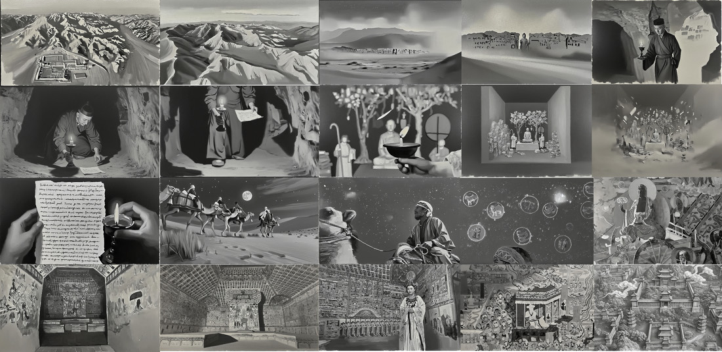
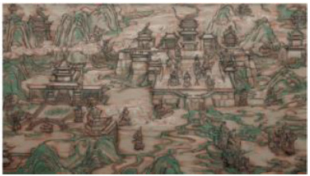
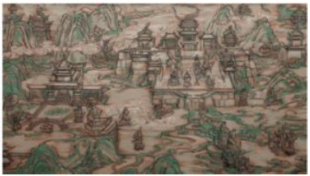
AI and Text-Based Narrative Creation Diverging from previous visual documentaries on Dunhuang that focus on historical analysis, this project utilizes a nonlinear narrative structure to weave together multiple storylines. It begins with an overview of Dunhuang, introduces Wang Yuanlu’s role, transitions to the story of Cave 17 and the Silk Road’s flourishing era through the lens of a Sogdian merchant, and finally connects to the contextual narratives displayed in the murals of Cave 61. A remarkable mural on the west wall of Cave 61 is the Map of the Five Terrace Mountain, which played a key role in architect Liang Sicheng’s reconstruc tion of Tang dynasty architecture (Han, 2022). Historical references to the Cao family, sponsors of Cave 61, and their ties with the Kingdom of Khotan further informed the storyboard development. At this initial stage, AI was employed to assist in the generation of the narrative framework through text-based prompts. The system synthesized fragmented ideas into structured sequences, facilitating the iterative expansion of narrative concepts under human direction (Figure 1).
Figure 1: Storyboard for the project video.
Digital Archive and Creative Co-Creation The visual design for three primary scenarios (Dunhuang Desert Overview, Mogao Cave 17, and Mogao Cave 61) involved an iterative process of tradi tional and AI-driven methods (Sun, 2021). A significant challenge in the pri mary stage was that the AI models struggled to identify the cultural symbols and iconographic details central to Dunhuang aesthetics. A clear gap emerged between the one-to-one digital archive of Mogao data and the AI’s output, as the technology demonstrated a powerful but often anachronistic imagi nation. To align the outcomes with aesthetic and historical expectations, the methodology evolved to combine traditional production assets with targeted training of the AI models using Mogao-specific datasets, thereby guiding the AI toward culturally coherent generation. The following three scenarios will deeply illustrate the training and cooperation process between the designer and AI models.
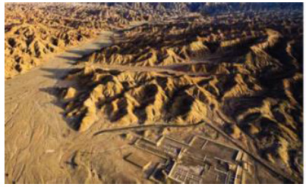
Dunhuang Desert Overview To establish the geographical context, the AI model was trained on designed overview images of the Dunhuang Desert (Sun, 2025) (see Figure 2). Text-to- image prompts were crafted to evoke the specific atmosphere, for example:
“A withered and desolate desert with rising sandstorms. Epic atmo spheric light shines on the dunes, with light and shadow flowing naturally with the wind. The scene is exquisitely beautiful, with a cinematic texture. Ultra-realistic, epic shots perfectly present the vast scale. Environment: The Mogao Caves in Dunhuang, a master piece, an epic scene. A row of caves appears on the verge of being buried by the desert. 3D stereoscopic space special effects, C4D, OC rendering, movie-level 8K resolution.”
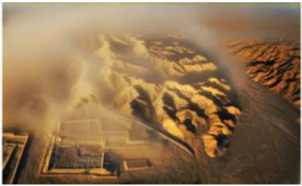
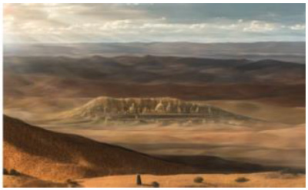
Figure 2: Desert (Sun, 2025).Figure 3: Generated by Jimeng.Figure 4: Generated by Kling.
Different generative models—including Jimeng (Figure 3) and Kling (Figure 4)—were compared. Among them, the Jimeng version best cap tured the intended visual tone and served as the basis for subsequent video generation.
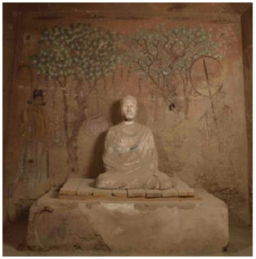
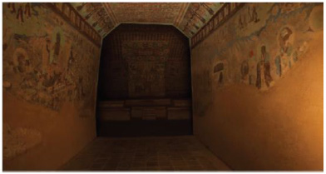
Mogao Cave 17 Cave 17 contains a seated statue of Monk Hong Bian and a mural on the north wall (Dunhuang Academy, 2013). (Figure 5) Based on photographic references from Dunhuang Academy, a one-to-one 3D digital reconstruction was produced. Lighting and texturing were refined through prompts such as:
“Add soft and warm top light to the picture to create a serene and sacred atmosphere.”
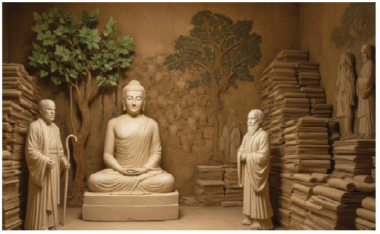
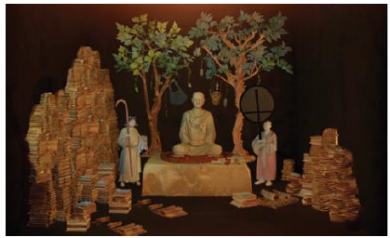
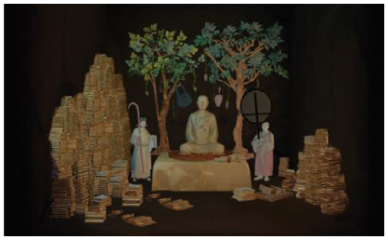
Figure 5: Dunhuang Academy (2013).Figure 6: Generated by Kling.Figure 7: Generated by Jimeng.Figure 8: Rendered by Maya.
Outputs from Kling (Figure 6) and Jimeng (Figure 7) were iteratively refined, achieving a balanced tone that evokes the spiritual ambiance of this historically significant space.
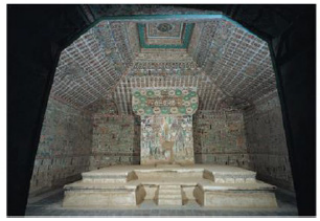
Mogao Cave 61 Cave 61, constructed in the 10th century as a family temple for Cao Yuanzhong, is renowned for its monumental mural depicting the Five Terrace Mountain. (Figure 9) To reproduce the intricate details of this mural, a traditional one-to-one modeling and high-resolution texturing process was first undertaken, ensuring a faithful digital reconstruction of the cave’s spatial and pictorial environment. (Figure 10) The resulting high-fidelity 3D assets were subsequently integrated into AI generative models for secondary creative transformation.
Detailed textual prompts and reference imagery were used to guide the AI in enhancing specific visual elements while preserving historical and stylistic accuracy. Through this co-creative process, the AI contributed interpretive variations that enriched the visual narrative without compromising authen ticity. Since the central sculptural element of Cave 61 is now missing, its recreation was informed by both historical research and imaginative recon struction. Working collaboratively with AI models, a new interpretation was visualized—featuring stylized lion sculptures positioned at the edge of the composition to evoke the cave’s symbolic and aesthetic integrity.
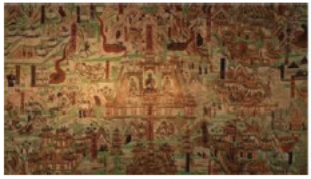
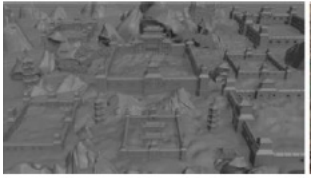
The mural of the Five Terrace Mountain remains the most visually compel ling feature of Cave 61 (Dunhuang Academy, 2013) (Figure 11). By combin ing traditional digital environment construction (Figure 12) with AI-assisted
Bridging Ancient Art and Modern Technology 191 generative tools, five distinct visual versions of the 3D map were produced, each reflecting different stylistic nuances and atmospheric interpretations (Figure 13). Following iterative refinement and expert evaluation, the final ized version was integrated into the project’s moving-image sequence, serving as a dynamic visual reference that bridges digital preservation with creative reimagination (Figure 14).
Figure 11: The mural of five terrace mountain.Figure 12: The map modeling by MAYA.Figure 13: The generated map of five terrace mountain.Figure 14: The generated map of five terrace mountain.
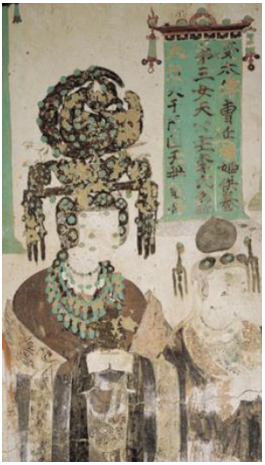
CHARACTER MODELING AND ANIMATION The character modeling process focused on two pivotal figures: the historical Princess of Khotan, depicted as a donor on the northwest wall of Cave 61 (Figure 15), and the Taoist priest Wang Yuanlu, associated with the discovery of Cave 17.
Figure 15: The original portraits of the Khotan Princess (Dunhuang academy, 2013).
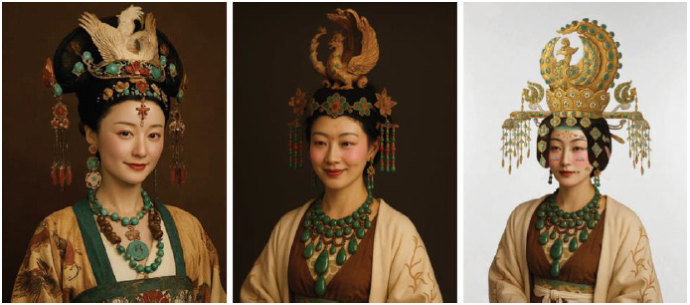
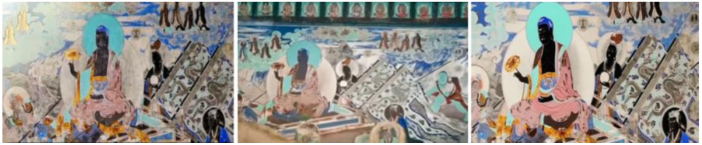
Drawing inspiration from the donor portraits on the northwest wall of Cave 61, particularly the depiction of the Princess of Khotan, this project developed both 2D and 3D character models to animate and recontex tualize figures from the mural environment. Due to the mural’s age and deterioration, the princess’s facial features and attire were difficult to dis cern. To address this, the reconstruction process incorporated comparative visual references from contemporaneous portrait paintings and restoration drawings by the Dunhuang Academy. Combining evidence-based historical interpretation with AI-assisted image generation produced a reconstructed portrait of the princess, blending scholarly accuracy with imaginative reconstruction (Figure 16).
Figure 16: The generated portraits of the Princess of Khotan by Midjourney, ChatGPT, and Jimeng (left to right).
Bridging Ancient Art and Modern Technology 193 The animation process compared AI-generated 3D models and 2D out puts through iterative refinement, focusing on the synchronization of lighting setups, texture enhancement, and camera motion to achieve the illusion of the princess walking gracefully within the mural space. This visual sequence symbolizes the dialogue between ancient mural art and contemporary digital storytelling.
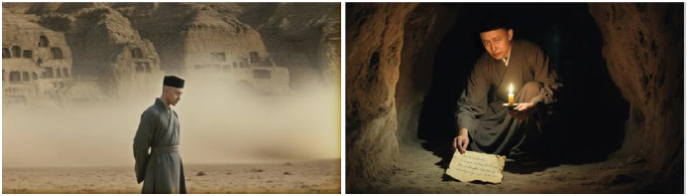
In parallel, the 3D character reconstruction of the Taoist monk Wang Yuanlu was modeled based on archival photographs and historical docu mentation. Through detailed digital sculpting, character design, and atmo spheric lighting integrated into the reconstructed Cave 17 environment, the rediscovery scene was reimagined, allowing the narrative of discovery to unfold within a digitally immersive cinematic framework (Figure 17).
Figure 17: Taoist monk Wang Yuanlu, generated by Jimeng.
AI-Assisted Visual Effects and Digital Compositing To achieve a visually compelling and deeply immersive narrative experience, this project utilized AI-driven visual effects (VFX) and compositing tech niques. A critical component of this process was the systematic evaluation and selection of an appropriate AI video generation tool. The outputs of three platforms—Jimeng, Kling, and LiblibAI—were rigorously compared, with Jimeng ultimately selected as the primary tool for its superior alignment with the project’s core requirements of detail fidelity, controllability, and cin ematic naturalism.
The selection was based on Jimeng AI’s demonstrable advantages in three key areas: High-Definition Output for Mural Detail Reproduction: Jimeng sup ports output resolutions of 1080P and above, incorporating a built-in image enhancement algorithm. This capability was crucial for accurately rendering the fine linework and subtle color gradations of the mineral-pigment-based murals, such as the intricate details in the Zodiac Murals and the distinctive lapis lazuli and ochre hues. This effectively mitigated the issue of “blur and fuzziness” common in AI generation, ensuring the faithful transmission of artistic detail.
High Prompt Adherence to Reduce Generative Randomness: The tool exhibited a high degree of accuracy in interpreting restrictive prompts. For instance, when instructed to “strictly preserve the original form of the murals and only introduce slight dynamics,” it consistently generated content with
minimal elemental distortion. The resulting dynamic details, such as the slow movement of ribbons, showed strong temporal consistency across dif ferent versions. This high level of controllability significantly reduced the need for repeated screening and met the project’s requirement for low output variation.
Reduced ‘AI Look’ for Naturalistic Dynamics: Jimeng AI’s dynamic gener ation logic more closely emulates real-world physics. Elements like flowing ribbons demonstrated natural gravitational inertia, and camera movements were steady without freezing. Furthermore, light transitions were smooth and devoid of abrupt flickering. The overall visual output more closely resembled live-action footage than stereotypical AI-generated content, thereby aligning with the desired atmospheric and historical tone of the Dunhuang narrative.
Figure 18: Cave 61 VFX, generated by Jimeng, Kling and LiblibAI (left to right).
In contrast, while Kling demonstrated moderate style reproduction capa bility, it exhibited technical shortcomings such as slight image instability and prompt deviation. LiblibAI’s functionality was deemed too limited, support ing only basic camera pans and thus failing to meet the requirement for nuanced mural dynamism. Consequently, neither was adopted for primary production (Figure 18).
Through this tool, AI was leveraged to generate foundational environmental effects—including drifting sand, dynamic light rays, and atmospheric parti cle systems—that responded to the narrative’s rhythm. Human designers then curated and composited these elements with traditional 3D assets, adjusting depth of field, atmospheric lighting, and spatial transitions to achieve a coher ent and poetic visual flow. This hybrid workflow underscores a critical bal ance: it harnesses AI’s computational power to generate visual richness while preserving human creative control over composition and emotional tone, ulti mately forming a cinematic language that bridges the ancient and the modern.
AI-Integrated Sound and Voice-Over Design To ensure a cohesive auditory experience, the project employed AI-generated voice narration using ElevenLabs’ advanced voice cloning technology. The aim was to develop a realistic, emotionally expressive voice that comple ments the project’s visual and narrative rhythm.
A reference voice was first imported into ElevenLabs’ Voice Cloner to rep licate vocal tone, texture, and emotional cadence suited to a documenta ry-style narration. Through iterative adjustments in tone, pacing, and empha sis, the generated voice achieved a natural, human-like delivery that aligned with the project’s atmospheric and thematic direction. Multiple generations
Bridging Ancient Art and Modern Technology 195 were compared, testing variations in pitch, tempo, and expressiveness to syn chronize with the animation’s rhythm.
The final narration was integrated and fine-tuned in Adobe After Effects, ensuring precise synchronization between voice, ambient sound, and back ground score. AI-generated music further enriched the soundscape, blending traditional Central Asian and Chinese instrumental motifs with cinematic ambiance to evoke the sacred, contemplative aura of Dunhuang’s caves. The result was a sound design that mirrored the emotional and cultural dimen sions of the visual narrative.
RESULTS AND DISCUSSION
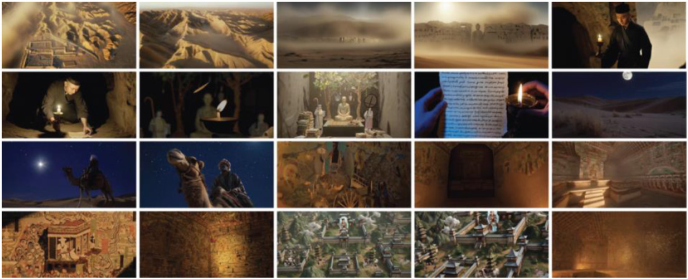
Project Outcomes The project demonstrates an innovative model for human–AI collaboration in digital cultural heritage production. The resulting moving-image sequence succeeds in translating the intricate spiritual and aesthetic dimensions of the Mogao Grottoes into an accessible, emotionally charged visual narrative (Figure 19). Three principal achievements can be summarized:
Figure 19: Outcomes of moving-image sequence.
Narrative Expansion and Ideation: The project demonstrated AI’s capacity to function as an ideation engine, significantly accelerating the pre-visual ization phase. By rapidly generating multiple narrative pathways and visual compositions, AI facilitated a non-linear mode of engagement with historical content. This moves beyond conventional documentary storytelling, allow ing audiences to experience Dunhuang’s history through interconnected tem poral layers rather than a rigid linear chronology, thereby fostering a more dynamic and personal form of historical interpretation.
Accelerated Workflow and Visual Experimentation: The integration of text-to-image and image-to-image models created a powerful feedback loop for rapid prototyping. This process enabled efficient experimentation with stylistic treatments, colour palettes, and spatial layouts that would be pro hibitively time-consuming through traditional methods alone. AI served not as a replacement for the designer, but as a prolific collaborator—producing a vast range of visual variations, from 3D texturing and atmospheric effects to
motion design—that expanded the creative vocabulary and accelerated the path from concept to polished outcome.
Symbiotic Creative Realization: A critical outcome was the emergent understanding of a new creative symbiosis. The iterative process of guiding, refining, and curating AI outputs forced a deeper, more explicit articulation of artistic intent and cultural nuance. Designers were not merely using a tool but were engaged in a dialogic process, constantly defining and defending their aesthetic and historical judgments. This co-creative loop highlights that the most significant value of AI may lie not in its autonomous output, but in how it compels human creators to refine their own vision and deeply under stand the “why” behind their creative choices.
Discussion
This study reveals that AI’s role in creative production is not one of automa tion, but augmentation—enhancing, rather than replacing, human expertise. Within the cultural heritage context, AI systems amplify the designer’s capac ity to interpret, visualize, and communicate complex historical narratives.
However, this collaboration also exposes the evolving tension between computational efficiency and human sensitivity. While AI excels at gener ating abundant visual material, it struggles to internalize emotional depth, contextual symbolism, or nuanced aesthetic judgment—qualities that remain inherently human. The project underscores that meaningful cultural storytell ing requires interpretive authorship: AI may assist in execution, but human insight determines cultural and ethical coherence.
From a production standpoint, AI tools expand creative bandwidth but demand higher conceptual clarity. For advanced practitioners familiar with full production pipelines, AIGC accelerates development and refines quality. Conversely, for less experienced creators, the iterative control required can be time-consuming, as conceptual abstraction must be translated into pre cise, trainable prompts.
Furthermore, current AI-generated outputs still fall short of professional industry standards in aspects such as motion continuity, depth realism, and fine compositional control. Designers must therefore operate as train ers and curators, not mere users, guiding AI systems toward meaningful and culturally responsible outcomes.
Nevertheless, the project demonstrates AI’s transformative capacity to redefine authorship and creative agency in digital heritage production. By merging computational imagination with human intuition, it opens a path toward hybrid aesthetics—where past and present, human and machine, converge in new forms of visual storytelling.
CONCLUSION
The AI-Driven Storytelling of Dunhuang Mogao Grottoes project establishes a robust model for integrating AI technologies into digital heritage creation. Through the synergy of traditional craftsmanship and generative intelligence, this research transforms the silent murals of Dunhuang into living narratives that resonate with contemporary audiences.
Bridging Ancient Art and Modern Technology 197 The study concludes that AI’s value lies in its interpretive augmentation— expanding human creative potential while maintaining historical integrity. The collaboration between algorithmic generation and curatorial sensibility fosters new ways to perceive, preserve, and reinterpret heritage.
Future research will focus on refining AI’s contextual understanding of art-historical data, improving model responsiveness to cultural symbol ism and emotional nuance. Further experiments will also explore real-time interactive systems, allowing audiences to engage with digital caves through multisensory, AI-adaptive environments.
In the broader scope, this project suggests a paradigm shift in the creative industries: from “human versus machine” to “human with machine”—a col laborative ecosystem where AI becomes not a replacement for human cre ativity, but a catalyst for deeper cultural reflection and innovation.
ACKNOWLEDGMENT
The authors would like to acknowledge the support of Summer Undergraduate Research Fellowships from Xi’an Jiaotong-Liverpool University.
REFERENCES
Chen, D. and Cheng, P. (2025) ‘AIGC empowers the sustainable development of traditional Chinese paper-cut’, Digital Scholarship in the Humanities, 00, pp. 1–11. Oxford: Oxford University Press. Available at: https://doi.org/10.1093/ llc/fqaf053 Chen, T., Pang, B. and Ma, C. (2024) ‘Exploration of brand visual communication
innovation design method based on AIGC technology’, Procedia Computer Science, 247, pp. 519–528. Dunhuang Research Academy (2013) Mogao Grotto IV. Beijing: Cultural Relics Press. Fan, J. and Liu, Y. (2007) Appreciation of Dunhuang Grottoes. Nanjing: Phoenix
Publishing & Media Network. Han, Q. (2022) ‘Architectural history research and the Dunhuang Caves: On the correspondence between Liang Sicheng and Paul Pelliot’, Dunhuang Research, 1, pp. 143–149. Available at: DOI: 10.13584/j.cnki.issn1000-4106.2022.01.013. Ji, X. (1990) ‘The position and role of Dunhuang Studies and Turfan Studies in the
history of Chinese culture’, in Buddhism and Sino-Indian Cultural Exchanges. Jiangxi: Jiangxi People’s Publishing House, pp. 32–43. Originally published in Hongqi, 3. (1986). Li, Z., Ma, Z., Xu, B. and Lei S. (2024) ‘AIGC enabling non-genetic design methods and practices’, Applied Mathematics and Nonlinear Sciences, 1, pp. 1–15. Available at: DOI: 10.2478/amns-2024-1319. Lin, Y. Gao, Z., Du, H., Niyato, D., Kang, J. and Xiong, Z. (2024) ‘Blockchain-based
efficient and trustworthy AIGC services in metaverse’, IEEE Transactions on Services Computing, 5, pp. 1–13. Available at: DOI: 10.1109/TSC.2024.3382958. Rong, X. (2022) From Zhang Qian to Marco Polo: Eighteen Lectures on the Silk Road. Zhejiang: Jiangxi People’s Publishing House. Rong, X. (2024a) Eighteen Speeches on the Learning of Dunhuang. Beijing: Peking
University Press.
Rong, X. (2024b) Searching for Dunhuang Treasures around the World. Beijing: Zhonghua Book Company. Sun, Z. (2021) Once in My Eyes: Images of Mogao Grottoes in Dunhuang Since
1907. Beijing: CITIC Press Group. Sun, Z. (2025) The Great Dunhuang. Changsha: Hunan Fine Arts Publishing House. Wang, L., Lou, Y., Li, X., Xiang, Y., Jiang, T. and Che, Y. (2024) ‘GlyphGenius: Unleashing the potential of AIGC in Chinese character learning’, IEEE Access, 12, pp. 136420–136434. Available at: DOI: 10.1109/ACCESS.2024.3464562. Whitfield, R., Whitfield, S. and Agnew, N. (2015) Cave Temples of Mogao at
Dunhuang: Art and History on the Silk Road. Hong Kong: Getty Publications. Zhang, B. (2023) ‘Research on Artificial Intelligence in New Year Prints: The Application of the Generated Pop Art Style Images on Cultural and Creative Products’. Applied. Sciences. 2023, 13, 1082. Available at: https://doi. org/10.3390/app13021082. Zhao, S. (2018) Ten Lectures on Dunhuang Art. Beijing: Cultural Relics Press. Zhao, S. (2019) A Brief History of Dunhuang Grottoes Art. Beijing: China Youth
Publishing House.
LISTED IN THE AHFE DIGITAL BOOKSTORE CATALOGUE
Explore the complete digital volume
Intelligent Human Systems Integration (IHSI 2026): Disruptive and Innovative Technologies
Read this individual research paper free through the original publisher, or explore the full digital proceedings book.
ISBN 978-1-964867-76-2
Explore this ISBN in the AHFE Bookstore ↗Listed in the July 2026 bookstore catalogue; search by ISBN to confirm current availability · Digital book purchase optional