Yang Liu, Zhegong Shangguan, Stéphane Safin, Françoise Détienne, Eric Lecolinet (2025). Assessing Cognitive Workload and Driver Performance: A Comparative Study of Pneumatic and Vibrotactile Haptic Alerts for Takeover Requests in Autonomous Vehicles. In: Advances in Human Factors of Transportation. AHFE Open Access, vol. 186, pp. 426–436. https://doi.org/10.54941/ahfe1006532
Publisher statistics will load when you open Metrics.
AHFE OPEN ACCESS OPEN ACCESS CONFERENCE PROCEEDINGS PAPER
Assessing Cognitive Workload and Driver Performance: A Comparative Study of Pneumatic and Vibrotactile Haptic Alerts for Takeover Requests in Autonomous Vehicles
This study explores the effectiveness of pneumatic and vibrotactile haptic feedback modalities on a steering wheel in improving driver response times and accuracy during Take-Over Requests (TOR) in Level 3 autonomous vehicles. Dual-modal feedback, combined with audio cues, was tested across nine TOR tasks to assess its impact on driver performance. Results show that combining audio with either feedback type significantly improved TOR performance compared to audio alone. Pneumatic feedback, offering a gentler and more naturalistic alert, enabled smoother transitions and reduced stress, while vibrotactile feedback, being more mechanical, may be better suited for high-urgency scenarios. Cognitive workload, measured using NASA-TLX scores, revealed that pneumatic feedback reduced mental demand and frustration more effectively than vibrotactile feedback. These findings suggest pneumatic feedback may be more comfortable for prolonged alerts, while vibrotactile feedback may be preferable in urgent situations. Further research could optimize adaptive feedback systems based on driving conditions.
Recent years have seen rapid advancements in automated driving technologies, marked by significant milestones. Among current innovations, Level 3 (L3) automated vehicles—categorized as “Conditional Automation”—stand out as a leading solution in the evolution of autonomous driving (Dogan, 2023; Li et al., 2022; Tang et al., 2020). As defined by the National Highway Traffic Safety Administration (NHTSA), L3 systems allow drivers to disengage from active control for non-driving tasks, provided they remain prepared to promptly reassume control when triggered by a Take-Over Request (TOR) from the vehicle (Yoon et al., 2019). However, the efficacy of TOR systems hinges critically on human
Assessing Cognitive Workload and Driver Performance 427
factors, including situational awareness, cognitive load, and reaction time, which directly influence a driver’s ability to safely regain control during transitions. This underscores the need for seamless collaboration between automated systems and human operators, balancing autonomy with adaptive human-machine interfaces and user-centric design principles.
In-vehicle interaction systems evolve to meet new features and preferences, meanwhile enhance driver attentiveness with adequate cues for safe driving (Clark et al., 2024; Gaffary and L’ecuyer, 2018; Stamer et al., 2020). Haptic feedback, which includes interactions that use touch to perceive surroundings, manipulate objects, and facilitate social interactions, has shown significant promise in augmenting driver awareness in various scenarios (Li et al., 2024; Zhang et al., 2021; Zhao et al., 2022). Researchers invites such haptic approaches into in-vehicle interactions, especially on steering wheels. The steering wheel, being the primary driver touchpoint (Lederman and Jones, 2011; Mirnig et al., 2016; Sherrick and Rogers, 1966), is a logical choice for implementing haptic feedback, as it supplements visual and auditory channels, creating a multimodal approach that enhances driver response time and focus (Chen et al., 2023; Shakeri et al., 2016).
Modern in-vehicle interaction systems are evolving to incorporate advanced features and user-centric designs while prioritizing driver attentiveness through sensory cues such as visual, auditory, and haptic feedback (Clark et al., 2024; Gaffary & Lécuyer, 2018; Stamer et al., 2020). Among these, haptic feedback—which leverages tactile sensations to enhance environmental perception, object manipulation, and communication—has emerged as a critical tool for improving situational awareness in dynamic driving contexts (Li et al., 2024; Zhang et al., 2021; Zhao et al., 2022). Researchers increasingly advocate integrating haptic interfaces into steering wheels, the primary tactile touchpoint between drivers and vehicles (Lederman & Jones, 2011; Mirnig et al., 2016; Sherrick & Rogers, 1966). This multimodal approach, combining tactile cues with visual/auditory signals, has demonstrated potential to reduce response times and sustain focus during driving tasks (Chen et al., 2023; Shakeri et al., 2016). Despite these advancements, critical challenges persist during driver-vehicle transitions, particularly in Level 3 automation. Stress, elevated cognitive load, and ergonomic mismatches in haptic interfaces can undermine driver readiness, complicating the handover process during Take-Over Requests (TORs). While existing studies emphasize haptic systems’ technical efficacy (e.g., response time), there is limited empirical understanding of how haptic modalities influence driver well-being (e.g., stress reduction, cognitive ergonomics) and long-term performance during repeated transitions. This gap hinders the design of adaptive systems that holistically balance safety, comfort, and human factors.
This study proposes a bio-inspired haptic interaction system for steering wheels using pneumatic tactile silicon sacs, designed to emulate naturalistic tactile sensations during Take-Over Requests (TORs) in Level 3 autonomous vehicles (Liu et al., 2024; Shangguan et al., 2024). While prior work has focused on vibrotactile feedback for in-vehicle alerts (e.g., Hassan et al., 2022; Hwang & Ryu, 2010), limited empirical evidence exists comparing
pneumatic and vibrotactile modalities in terms of safety, ergonomics, and user well-being. We systematically evaluate pneumatic and vibrotactile feedback systems—independently implemented on steering wheels—to assess their effectiveness in (1) reducing driver stress and cognitive load, (2) improving ergonomic comfort during prolonged use, and (3) enhancing safety metrics such as reaction time and task accuracy during TOR events. By quantifying the interplay between haptic modality, driver well-being, and performance, this work provides actionable insights for designing adaptive, user-centered haptic interfaces. Our findings aim to bridge the gap between technical efficacy and human ergonomics, advancing the development of autonomous vehicle systems that prioritize both safety and user comfort.
LITERATURE REVIEW
Steering wheel haptic feedback has evolved to address both performance and human-centric challenges. Early studies by Kern et al. demonstrated that combining vibrotactile cues (e.g., directional alerts) with auditory/visual signals reduces cognitive strain during navigation tasks. Building on this, Hwang et al. designed a multi-actuator steering wheel to deliver directional prompts (e.g., “Turn Left”), showing improved task efficiency with minimal visual distraction. Recent innovations, such as Kim et al.’s electrohydraulic vibrotactile interface, highlight tactile feedback’s role in sustaining alertness during monotonous driving. However, ergonomic trade- offs persist: San Vito et al. compared “cutaneous push” mechanisms to thermal cues, finding tactile prompts reduced errors but increased subjective workload, while Borojeni et al. revealed vibrotactile systems impose lower cognitive load than shape-changing interfaces but risk user annoyance over time. These works collectively emphasize the need for haptic designs that harmonize efficacy with ergonomic comfort.
While vibrotactile systems dominate in-vehicle applications pneumatic interfaces offer bio-inspired alternatives. Liu et al. developed silicone-based pneumatic sacs that mimic natural touch through gradual pressure changes, contrasting with the abrupt mechanical urgency of vibrotactile vibrations (Hwang & Ryu, 2010). Enriquez et al. demonstrated pneumatic cues improve reaction times in visually overloaded scenarios, suggesting reduced sensory stress compared to traditional systems. This dichotomy positions vibrotactile feedback as effective for immediate attention capture, while pneumatic systems prioritize intuitive, low-fatigue interactions. San Vito et al. found tactile-visual combinations improved lane-keeping accuracy under cognitive load. Human factors research further underscores TOR challenges: Yoon et al. identified stress and anxiety spikes during abrupt automation-to- manual transitions, exacerbated by prolonged automation reliance. Haptic feedback, particularly pneumatic systems, shows promise in mitigating stress, while vibrotactile interfaces reduce cognitive load. However, gaps remain in understanding how haptic modalities interact with individual differences (e.g., stress tolerance) to shape transition outcomes.
Despite progress, prior studies prioritize technical metrics (e.g., reaction time) over holistic human factors such as stress reduction, ergonomic
Assessing Cognitive Workload and Driver Performance 429
comfort, and long-term usability. No work directly compares pneumatic and vibrotactile feedback in TOR scenarios across these dimensions. This study bridges this gap by evaluating both modalities on steering wheels, aiming to (1) identify optimal haptic designs for driver readiness and safety, and (2) advance bio-inspired, user-centered interfaces for autonomous vehicles.
METHODOLOGY
The function of haptic interaction systems in Take-Over Request (TOR) scenarios is to prompt drivers to resume manual control in Level 3+ autonomous vehicles. Critically, this tactile feedback operates as a transition trigger—signalling the need to initiate takeover actions—rather than confirming the completion of the handover process. By delivering time- sensitive tactile signals through the steering wheel, the system synchronizes human-machine collaboration, ensuring drivers re-engage with minimal delay. This targeted approach prioritizes sensory priming over post-transition feedback, optimizing both the immediacy and fluidity of control transitions to mitigate safety risks and enhance response reliability.
In this study, we aim to compare the effectiveness of pneumatic and vibrotactile notifications for TOR, using audio notification as a baseline. The experiment examines combinations of audio and haptic signals to understand their effects on driver performance. Specifically, we formulated the following hypotheses: H1.1: Multimodal feedback (haptic + audio) reduces cognitive workload (NASA-TLX) and improves situational awareness, enhancing TTC and RT during TOR.
H1.2: Haptic-only notifications show no TTC/RT improvement compared to multimodal alerts.
H2: Pneumatic feedback reduces stress (lower speeds) and improves comfort versus vibrotactile, while matching TTC/RT performance.
H3: Pneumatic is better in navigation notification, mechanical vibrotactile notification makes driver nervous, result in larger speed.
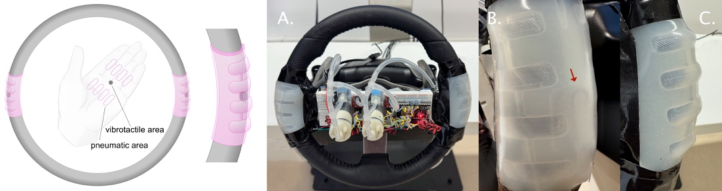
Figure 1: Dual-modal haptic interface on steering wheel and the interactive area: A. Steering wheel overview; B. Vibrator is beneath the silicone pad; C. Inflated air sacs.
To enable direct comparison of pneumatic and vibrotactile feedback, we developed a dual-modality haptic system (Figures 1 & 2) that dynamically
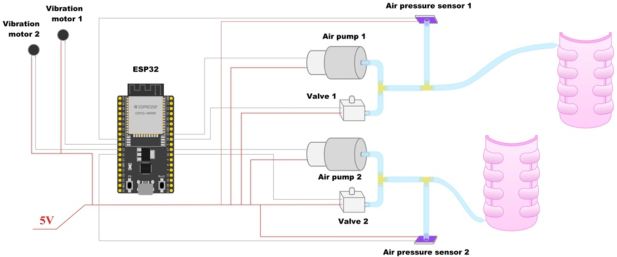
switches between feedback types without hardware reconfiguration, facilitating within-subject testing. The system features two silicone (Smooth- On ExoFlex 00-30) pads, each embedded with eight skin-safe air sacs optimized for tactile sensitivity and durability. Each sac is pneumatically actuated via ZT370-01 pumps and JS0520L valves, regulated by an ESP32 Wi-Fi/Bluetooth SoC. Two air pressure sensors prevent over-inflation, while two independently controlled vibration motors deliver vibrotactile stimuli. Wireless control via the ESP32 ensures uninterrupted haptic delivery during steering wheel rotation, with the system mounted on a Logitech G27 steering wheel. A ZENDURE SuperMini 10000mAh power bank affixed to the steering wheel provided uninterrupted power for prolonged testing.
Figure 2: Schematic overview of the electrical and pneumatic layouts.
Simulation control and data logging were managed via a MacBook 2019, which recorded driver inputs and system responses.
The experiment utilized the CARLA Simulator (Environment Town06) in a static driving rig. Participants interacted with a Logitech G27 steering wheel and pedals, positioned at a desk to replicate a vehicle cockpit. A 40-inch front-facing TV displayed the simulation, with auditory cues delivered via built-in speakers. The haptic system synchronized with the simulation through a Python-based interface, enabling precise coordination of visual, auditory, and tactile notifications.
The study employed a within-subject design, exposing participants to nine distinct Take-Over Request (TOR) notification types (Table 1) that combined pneumatic, vibrotactile, auditory, and multimodal cues. Each notification signaled a stopped vehicle ahead, requiring participants to resume manual control and execute a lane change. To minimize learning bias, tasks were randomized using random.shuffle.
Twenty-seven licensed drivers (11 female; mean age = 25.5 years, SD = 5.63) were recruited from a university population, controlling for age- related variance in situational awareness (Wang et al., 2022; Li et al., 2019; Zeeb et al., 2015). Only two participants had prior experience with Level 1 automation (adaptive cruise control). All received a 5-Euro reward upon completion.
Assessing Cognitive Workload and Driver Performance 431
Table 1: Notification modalities and lane change requests.
Table available in the original PDF paper.
Task Label Notification Modality Haptic Lane Change 1 Base Audio None Freely change to both direction 2 VB Audio + Vibration Both Freely change to both direction 3 VL Audio + Vibration Left Change to left 4 VR Audio + Vibration Right Change to right 5 VNA Only Vibration Both Freely change to both direction 6 PB Audio + Pneumatic Both Freely change to both direction 7 PL Audio + Pneumatic Left Change to left 8 PR Audio + Pneumatic Right Change to right 9 PNA Only Pneumatic Both Freely change to both direction
Participants began with a training session to familiarize themselves with the simulator and devices, reducing simulation sickness risks. During tasks, an auditory “beep” triggered a TOR after a variable 10–15 s delay to prevent predictability. Participants then resumed manual control, pressed the accelerator to counteract vehicle deceleration, and executed a lane change guided by the notification modality. After each task, participants completed a NASA Task Load Index (NASA-TLX) survey on a tablet, rating perceived workload across six subscales (mental, physical, and temporal demand; effort; performance; frustration) on a 20-point scale. Scores were aggregated and normalized for cross-modality analysis. Short breaks between tasks mitigated fatigue, followed by a post-experiment interview to gather qualitative feedback. Laboratory conditions—lighting, temperature, and seating—were standardized to minimize external influences.
Performance metrics included Time to Collision (TTC), defined as the interval from TOR initiation to collision avoidance (Zheng et al., 2014), and Reaction Time (RT), measured from the TOR signal to the first steering wheel movement (Zhang et al., 2019). These quantitative measures, alongside NASA-TLX scores and interview feedback, provided a holistic evaluation of haptic modality efficacy.
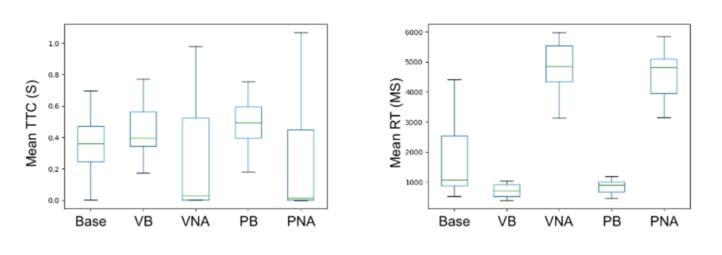
RESULTS & DISCUSSION To compare the existing of haptic notification, alongside with audio, we performed Friedman test in time to collision (TTC) and reaction time (RT) among Task 1 (Base), Task 2 (Vibrotactile Both side), Task 5 (Vibrotactile but No audio), Task 6 (Pneumatic Both side) and Task 9 (Vibrotactile but No audio). The result revealed that there is a signification difference in TTC (Q = 13.185, p = 0.01) and RT (Q = 84.652, p < 0.01). Post-hoc test by Mann-Whitney with Bonferroni corrections support this finding: for both TTC and RT, the base condition is significantly different from other conditions, suggesting that multi-modality notifications (audio + vibrotactile or audio + pneumatic) may result in longer time to collision (the higher value is better) and faster reaction time (the lower value is better). The NASA-TLX scores revealed significant differences in subjective workload across feedback modalities (Friedman test, p < 0.01). Post-hoc analysis (Mann-Whitney with Bonferroni correction) demonstrated that: Tasks 2 & 6 achieved the lowest workload scores (mean = 32.1 ± 4.2), with participants reporting reduced mental demand (M = 5.2/20) and frustration (M = 4.8/20), while Task 1
(audio-only) showed the highest workload (mean = 58.3 ± 6.7), driven by elevated temporal demand (M = 14.1/20) and effort (M = 13.5/20). On the other hand, Haptic-only conditions (Tasks 5 & 9) fell between multimodal and base (mean = 45.6 ± 5.1), with moderate frustration (M = 9.3/20) and mental demand (M = 8.7/20). These results suggest that multi-modality notifications (combining audio with either vibrotactile or pneumatic cues) lead to faster reaction times compared to the base condition, supporting Hypothesis 1.1.
However, the result among Task 2 (Vibrotactile Both side), Task 5 (Vibrotactile but No audio), Task 6 (Pneumatic Both side) and Task 9 (Vibrotactile but No audio) challenged Hypothesis 1.2: There is significant difference comparing with and without audio notification, TTC (Q = 9.889, p = 0.01) and RT (Q = 66.155, p < 0.01), suggesting that the absence of audio notification was associated with
Figure 3: Box plot of time to collision (left) and reaction time (right).
noticeably increased reaction times, supporting previous findings that adding audio to haptic signals (both vibrotactile and pneumatic) significantly enhances reaction time. Plus, no statistically significant differences in mental demand (p = 0.41) or frustration (p = 0.56) between haptic- only and multimodal conditions. Participants reported similar effort levels (M = 11.2/20 for haptic-only vs. M = 10.5/20 for multimodal). This outcome challenges Hypothesis 1.2, which anticipated no difference with and without audio.
The comparison between Task 2 (Vibrotactile Both side) and Task 6 (Pneumatic Both side) was conducted by Mann-Whitney U-test, The test showed no significant difference between these conditions, suggesting that participants adapted similarly to both types of haptic signals. This result does not support Hypothesis 2, which proposed differences between the two haptic modalities.
We further analysed the effects of direction-specific haptic signals in Task 3 (Vibrotactile left), Task 4 (Vibrotactile right), Task 7 (Pneumatic left), and Task 8 (Pneumatic right). The Friedman test showed a significant result in RT (Q = 8.988, p = 0.02), but not in TTC (Q = 3.844, p = 0.27). However, post- hoc Mann-Whitney tests with Bonferroni correction found no significant
Assessing Cognitive Workload and Driver Performance 433
differences across any pairs, with all p-values above the corrected threshold of 0.0083 (for 6 comparisons). What’s more, the Friedman test on NASA- TLX scores across Tasks 3, 4, 7, and 8 revealed no significant differences in subjective workload (Q = 5.217, p = 0.27). Participants rated all direction- specific haptic conditions similarly, regardless of modality (vibrotactile vs. pneumatic) or direction (left vs. right). The lack of significant pairwise differences supports Hypothesis 2, further suggesting no notable difference between pneumatic and vibrotactile notifications.
Furthermore, we calculated the Speed (S), Lateral Speed (LS), and Longitudinal Speed (LGS) following the TOR for the directional tasks, the Friedman test result support Hypothesis 3.2: S (Q = 25.80, p < 0.01), LS (Q = 51.75, p < 0.01), LGS (Q = 25.88, p < 0.01). The higher speeds observed following vibrotactile notifications may reflect increased participant anxiety in response to mechanical vibrations, supporting Hypothesis 3 that vibrotactile cues lead to faster post-TOR speeds compared to pneumatic cues.
Lane change accuracy revealed directional asymmetry: 100% success for rightward tasks (aligned with right-hand traffic norms) versus lower leftward accuracy (vibrotactile: 77.78%; pneumatic: 88.89%). This disparity likely stems from driver familiarity, as rightward lane change are more habitual in right-hand traffic systems. Participant feedback indicated occasional misinterpretation of directional haptic signals, particularly with vibrotactile cues, where unilateral vibrations were perceived as whole-wheel stimuli, complicating leftward responses.
CONCLUSION
This study investigated the effectiveness of pneumatic and vibrotactile haptic feedback on steering wheels in enhancing driver response during Take- Over Requests (TOR) in Level 3 autonomous vehicles. Key findings reveal that multimodal notifications (audio + haptic) significantly outperform auditory-only alerts, with longer Time to Collision (TTC) and faster Reaction Time (RT), while also reducing subjective workload (NASA-TLX). However, adding audio to haptic cues improved RT, though cognitive demand (NASA- TLX) did not significantly differ between haptic-only and multimodal conditions. This suggests that performance gains stem from enhanced signal salience, not reduced cognitive strain.
Contrary to initial expectations, no notable differences emerged between pneumatic and vibrotactile modalities in general TOR scenarios. Directional tasks further reinforced this parity, with equivalent TTC, RT, and NASA-TLX scores for both modalities. However, vibrotactile feedback induced faster post-TOR speeds, suggesting its mechanical urgency may heighten driver anxiety, whereas pneumatic systems offer gentler, more intuitive interactions.
Directional accuracy revealed a right-hand traffic bias: Participant feedback attributed left-lane challenges to occasional misinterpretation of unilateral haptic cues, particularly with vibrotactile vibrations perceived as whole-wheel stimuli. This underscores the need for spatially distinct feedback to improve directional clarity.
While the simulated environment ensured control, real-world testing is critical to validate haptic systems under dynamic conditions. Adaptive systems tailoring feedback type/intensity to driver state (e.g., stress levels) or context (e.g., urgency) warrant exploration to balance safety and comfort.
What’s more, allowing drivers to tailor the type and intensity of haptic feedback aligns the system’s responses with personal comfort levels and expectations, thereby increasing user acceptance and operational efficacy (Shata et al., 2024; Noubissie Tientcheu et al., 2024). This personalized approach acknowledges the diversity in driver sensitivities and reactions, ensuring that the haptic alerts are both noticeable and agreeable to each user (Xiao, 2023).
This study demonstrates that haptic feedback modality significantly impacts driver cognitive workload, stress, and performance during Takeover Requests (TOR). Our findings reveal that pneumatic interfaces reduce cognitive strain (evidenced by lower NASA-TLX scores) and minimize post- TOR overcompensation (e.g., lower lateral speeds), prioritizing ergonomic comfort without sacrificing reaction times. In contrast, vibrotactile alerts, while effective for urgent scenarios, increase frustration and anxiety, underscoring a critical trade-off between urgency and user well-being. These insights advocate for adaptive human-centered systems that dynamically modulate haptic feedback intensity based on driver state (e.g., stress levels, workload) and contextual urgency. Future work should validate these findings in real-world settings, incorporate diverse demographics (e.g., age, cultural driving norms), and integrate physiological sensors (e.g., heart rate monitors) to enable real-time personalization of haptic alerts. By harmonizing performance and ergonomic needs, such systems can foster safer, calmer, and more intuitive human-AV collaboration.
ACKNOWLEDGMENT
This work was supported by the Agence Nationale de la Recherche, research fund of SecondSkin: Shape-changing materials for HCI (Project-ANR-21- CE33-0018).
The authors would like to thank Professor Adriana TAPUS, Director of the Doctoral School Institut Polytechnique of Paris, Benoît Roman, physics researcher in PMMH Sorbonne Université, Thomas Bonald, engineer- research in LTCI, Télécom Paris and beloved Sheng Yuehua and Liu Ruiqing.
REFERENCES
American authorities. Automated Vehicles for Safety — NHTSA. URL https://www.
nhtsa.gov/vehicle-safety/automated-vehicles-safety. Borojeni, S. S., Wallbaum, T., Heuten, W., & Boll, S. (2017). Comparing shape-changing and vibrotactile steering wheels for take-over requests in highly automated driving. Proceedings of the 9th international conference on automotive user interfaces and interactive vehicular applications, 221–225. Chen, H., Zhao, X., Li, Z., Fu, Q., Wang, Q., & Zhao, L. (2023). Construction and
analysis of driver takeover behavior modes based on situation awareness theory. IEEE Transactions on Intelligent Vehicles, 9(2), 4040–4054.
Assessing Cognitive Workload and Driver Performance 435
Clark, J. R., Large, D. R., Shaw, E., Nichele, E., Galvez Trigo, M. J., Fischer, J. E., Burnett, G., & Stanton, N. A. (2024). Identifying interaction types and functionality for automated vehicle virtual assistants: An exploratory study using speech acts cluster analysis. Applied Ergonomics, 114, 104152. Di Campli San Vito, P., Shakeri, G., Brewster, S., Pollick, F., Brown, E., Skrypchuk,
L., & Mouzakitis, A. (2019). Haptic navigation cues on the steering wheel. Proceedings of the 2019 CHI Conference on Human Factors in Computing Systems, 1–11. Dogan, A. K. (2023). Handover from AI to humans in L3 automated vehicles: A pilot study. Master’s thesis, University of Twente. Enriquez, M., Afonin, O., Yager, B., & Maclean, K. (2001). A pneumatic tactile
alerting system for the driving environment. Proceedings of the 2001 workshop on Perceptive user interfaces, 1–7. Gaffary, Y., & Lécuyer, A. (2018). The use of haptic and tactile information in the car to improve driving safety: A review of current technologies. Frontiers in ICT, 5, 5. Hassan, W., Raza, A., Abdullah, M., Hashem, M. S., & Jeon, S. (2022). Hapwheel:
Bringing in-car controls to driver’s fingertips by embedding ubiquitous haptic displays into a steering wheel. IEEE Transactions on Intelligent Transportation Systems, 23(10), 18526–18534. Hwang, S., & Ryu, J. (2010). The haptic steering wheel: Vibro-tactile based navigation for the driving environment. 2010 8th IEEE International Conference on Pervasive Computing and Communications Workshops (PERCOM Workshops), 660–665. Kern, D., Marshall, P., Hornecker, E., Rogers, Y., & Schmidt, A. (2009). Enhancing
navigation information with tactile output embedded into the steering wheel. Pervasive Computing: 7th International Conference, Pervasive 2009, Nara, Japan, May 11-14, 2009. Proceedings 7, 42–58. Kim, H., Nam, J., Kim, M., & Kyung, K. U. (2021). Wide-bandwidth soft vibrotactile interface using electrohydraulic actuator for haptic steering wheel application. IEEE Robotics and Automation Letters, 6(4), 8245–8252. Lederman, S. J., & Jones, L. A. (2011). Tactile and haptic illusions. IEEE
Transactions on Haptics, 4(4), 273–294. Li, S., Blythe, P., Guo, W., & Namdeo, A. (2019). Investigating the effects of age and disengagement in driving on driver’s takeover control performance in highly automated vehicles. Transportation Planning and Technology, 42(5), 470–497. Li, S., Blythe, P., Zhang, Y., Edwards, S., Guo, W., Ji, Y., Goodman, P., Hill, G.,
& Namdeo, A. (2022). Analysing the effect of gender on the human–machine interaction in level 3 automated vehicles. Scientific Reports, 12(1), 11645. Li, T., Polette, A., Lou, R., Jubert, M., Nozais, D., & Pernot, J. P. (2024). Machine learning-based 3D scan coverage prediction for smart-control applications. Computer-Aided Design, 103775. Liu, Y., Shangguan, Z., Tapus, A., Safin, S., Détienne, F., & Lecolinet, E. (2024).
Silicone-based haptic interfaces: Enhancing multimodal interactions through pneumatic tactile feedback. 2024 16th International Conference on Intelligent Human-Machine Systems and Cybernetics (IHMSC 2024). IEEE. Mirnig, A., Kaiser, T., Lupp, A., Perterer, N., Meschtscherjakov, A., Grah, T., & Tscheligi, M. (2016). Automotive user experience design patterns: an approach and pattern examples. Int. J. Adv. Intell. Syst, 9, 275–286.
Shakeri, G., Brewster, S. A., Williamson, J., & Ng, A. (2016). Evaluating haptic feedback on a steering wheel in a simulated driving scenario. Proceedings of the 2016 CHI Conference Extended Abstracts on Human Factors in Computing Systems, 1744–1751. Shangguan, Z., Liu, Y., Song, L., Li, T., & Tapu, A. (2024). Using a pneumatic tactile
steering wheel to enhance the multi-modal takeover request in smart vehicle. 2024 16th International Conference on Social Robotics + BioMed (ICSR + BioMed). IEEE. Shata, A. A. A., Naghdy, F., & Du, H. (2024). Augmenting driver awareness and performance through haptics, assistive controls, and environment perception. Sherrick, C. E., & Rogers, R. (1966). Apparent haptic movement. Perception &
Psychophysics, 1(3), 175–180. Stamer, M., Michaels, J., & Tümmler, J. (2020). Investigating the benefits of haptic feedback during in-car interactions in virtual reality. HCI in Mobility, Transport, and Automotive Systems. Automated Driving and In-Vehicle Experience Design: Second International Conference, MobiTAS 2020, Held as Part of the 22nd HCI International Conference, HCII 2020, Copenhagen, Denmark, July 19–24, 2020, Proceedings, Part I 22, 404–416. Tang, Y., Xiu, H., & Shu, H. (2020). Study on comprehensive evaluation of
L3 automated vehicles. 2020 4th CAA International Conference on Vehicular Control and Intelligence (CVCI), 701–707. Wang, Q., Chen, H., Gong, J., Zhao, X., & Li, Z. (2022). Studying driver’s perception arousal and takeover performance in autonomous driving. Sustainability, 15(1), 445. Yoon, S. H., Kim, Y. W., & Ji, Y. G. (2019). The effects of takeover request modalities
on highly automated car control transitions. Accident Analysis & Prevention, 123, 150–158. Zeeb, K., Buchner, A., & Schrauf, M. (2015). What determines the take-over time? An integrated model approach of driver take-over after automated driving. Accident Analysis & Prevention, 78, 212–221.
LISTED IN THE AHFE DIGITAL BOOKSTORE CATALOGUE
Explore the complete digital volume
Advances in Human Factors of Transportation
Read this individual research paper free through the original publisher, or explore the full digital proceedings book.
ISBN 978-1-964867-62-5
Explore this ISBN in the AHFE Bookstore ↗Listed in the July 2026 bookstore catalogue; search by ISBN to confirm current availability · Digital book purchase optional