Zack Walker, Ansgar Gerlicher (2025). Demonstrating the Need for Application-Level Design Guidelines in In-Vehicle Augmented Reality to Alleviate Motion Sickness: A Field Study. In: Human Factors in Design, Engineering, and Computing. AHFE Open Access, vol. 199, pp. 935–945. https://doi.org/10.54941/ahfe1006906
With fully autonomous vehicles on the horizon, promising new opportunities emerge for productivity during travel. However, motion sickness remains a significant barrier. This study investigates whether video-passthrough (VPT) augmented reality (AR) can reduce motion sickness when working in a moving vehicle. Specifically, we compare the Apple Vision Pro (AVP) Head-Mounted Display (HMD) with a traditional tablet device to assess and compare their impact on motion sickness. The investigation is split into two parts: (1) a main field-study with 40 participants performing visual tasks with both AVP and tablet while traveling in a vehicle and (2) a control-study to evaluate the impact of the device's technical specifications on motion sickness response. Our results indicate that motion sickness occurred less frequently with the AVP compared to the tablet, though the difference was not statistically significant. Severe nausea was exclusively reported during AVP use, though only by a small number of highly susceptible participants who had previously experienced symptoms with the tablet. Our findings also suggest that technological factors such as display resolution, image clarity and Photon-to-Photon (P2P) latency of the AVP at most lead to minor discomfort or mild nausea in highly susceptible individuals and do not trigger moderate or severe motion sickness. The results discussed in this work emphasize the need for design guidelines and standards to ensure in-vehicle AR applications are accessible without inducing motion sickness.
Assuming that autonomous vehicles (AVs) will eventually develop to be able to completely take over the full driving task in all driving situations (Level 5 autonomy, SAE International), car interiors are expected to evolve from driver-centric to passenger-centric environments. Interactions will shift from driving-related tasks to enhancing passenger comfort, entertainment, and productivity. Traditional dashboards and steering wheels may give way to large displays, flexible seating, and integrated workspaces designed around passenger needs. Multiple AV interior concepts demonstrate the feasibility of such designs (Mercedes-Benz, 2023; Audi, 2025; Bosch, 2020; Volkswagen, 2024; Panasonic, 2018). The broader research project associated with this
study includes a virtual autonomous shuttle with vis-à-vis seating, where passengers face each other to explore interior and interaction concepts for AVs. However, individuals prone to motion sickness may not fully benefit from such layouts, as they must constantly remain aware of vehicle motion to avoid nausea. Augmented Reality (AR) could help address this by enabling virtual displays to be positioned freely within the environment, allowing users to keep content at head height and maintain visual contact with their surroundings, potentially reducing motion sickness.
This paper examines whether current AR technology can already help mitigate motion sickness or whether AR applications must be specifically adapted to ensure accessibility and comfort in in-vehicle contexts.
RELATED WORK
Motion sickness describes a condition in which a person experiences symptoms such as dizziness, nausea and general discomfort and is most common during travel in cars, planes or boats (Golding, 2006). The widely accepted explanation for motion sickness is Reason and Brand’s sensory mismatch theory (1975), which posits that it occurs when perceived motion differs from what the inner ear senses. For example, a car passenger reading a book or using a laptop focuses on a stationary object instead of the moving environment outside, disrupting the brain’s ability to align visual and vestibular inputs. This sensory mismatch can then trigger motion sickness. Extensive research supports this assumption (Griffin & Newman, 2004; Diels et al., 2016). Furthermore, diverting attention toward a non- driving activity also inhibits the ability to anticipate a vehicle’s motion. This unpredictability of motion has been shown to be significantly more provocative than predictable motion (Kuiper et al., 2020).
Regarding susceptibility, multiple investigations show that about two thirds of car passengers suffer from some form of car sickness (Reason and Brand 1975; Schmidt et al., 2020), with susceptibility peaking in prepubescent children and young adults (Schmidt et al., 2020; Metzulat et al., 2025). Motion sickness is not completely curable; however, multiple studies suggest that it is preventable to a certain extent. A number of behavioral and pharmacological countermeasures have been suggested, such as reducing head movements (Golding et al., 2003), laying face-upwards (Golding et al., 1995) or using anti-motion sickness drugs (Golding, 2006). The most reliable prevention method is habituation – constantly and gradually exposing individuals to the specific motion or stimuli that trigger their symptoms, allowing the sensory systems to acclimate and re-calibrate the sensory mismatch over time. Various investigations confirm this theory (Glaser, 1959; Shupak and Gordon, 2006; Brainard and Gresham, 2014; Murdin et al., 2011). A more recent study claims it is the “most effective non-pharmacological method to reduce motion sickness” (Keshavarz and Golding, 2022). However, habituation is not a solution for individuals who do not have access to a vehicle often enough or are simply unwilling to regularly submit themselves to uncomfortable symptoms over a long period
Demonstrating the Need for Application-Level Design Guidelines 937
of time. Anti-motion sickness drugs may not be without side-effects (Golding, 2006). The rise of highly automated vehicles is expected to intensify motion sickness, as passengers will engage more in non-driving activities such as reading or screen use while the vehicle moves. Although prior studies have explored design strategies to reduce motion sickness in AVs (Diels et al., 2016; 2022; Sivak & Schoettle, 2015), they primarily focus on vehicle design rather than interior or application design. Emerging technologies like AR head-mounted displays (HMDs), which are beginning to enter the consumer market, may offer new ways to mitigate motion sickness in vehicles. In the context of working while driving, AR systems are not yet integrated into vehicles, but devices like the Apple Vision Pro and Meta Quest 3 demonstrate how such capabilities could soon become accessible. Walker et al. (2024) describe how AR could enable virtual displays or objects inside AVs that passengers can control via hand gestures or joystick-like devices. The ability to position virtual displays at head height could help reduce motion sickness by maintaining peripheral vision. Kuiper et al. (2018) support this with findings from a study where a tablet positioned at head height in front of a windshield alleviated symptoms. Conversely, Sasalovici et al. (2023) found no such effect using a Varjo XR-3 HMD in a controlled environment, though technical limitations suggest the hypothesis should be re-examined with more advanced and appropriate standalone hardware under real-world driving conditions.
METHODOLOGY
To investigate the aforementioned assertion, a main field study compared a video-passthrough (VPT) AR HMD with a tablet during real driving, focusing on motion sickness. Using a mixed-methods, within-subject design, each participant interacted with both the tablet and the AVP, with counterbalancing to reduce order effects. A smaller technical control study aimed to determine whether motion sickness was linked to VPT AR HMD features. Motion sickness was assessed after each ride using the 7-point Motion Sickness Severity Scale (MSSS) (Polymeropoulos et al., 2020), and participants’ susceptibility was recorded via the Motion Sickness Susceptibility Questionnaire (MSSQ) (Golding, 2006). Two hypotheses were derived from the literature: H1: Placing virtual windows at head height in AR leads to, at most, a minor reduction in motion sickness symptoms compared to using a tablet device.
H2: The technical characteristics of the VPT AR HMD induce, at most, only minor symptoms of motion sickness.
Study Design Both the field and control studies were conducted in the front passenger seat of a compact car. The Apple Vision Pro (AVP) was selected as the VPT AR HMD for its low P2P latency (<12 ms), high refresh rate and resolution, and suitability for AR-first applications (Apple, 2023; iFixit, 2024). Additionally,
938 Walker and Gerlicher
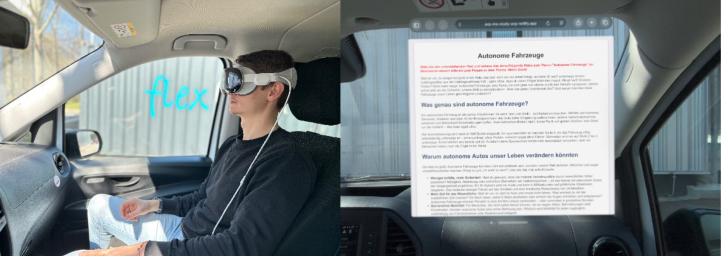
a recent Apple patent suggests ongoing research to reduce motion sickness in XR environments through dynamic peripheral content adjustments and inertially anchored visual cues (Damveld & Mulliken, 2023). To ensure comfort, the AVP’s Dual Loop Band was used. Participants received a brief introduction to the device to reduce frustration and completed the built-in eye and hand calibration. Two conditions were evaluated during the field study: the tablet condition (TABc), using a Samsung Galaxy Tab S9 Ultra placed on the participant’s lap, allowing them to tilt or leave it resting naturally to reflect realistic usage, and the AR condition (AVPc), using the AVP with the virtual display positioned at head height, so participants neither had to look down nor up (Figure 1).
Figure 1: A user wearing the Apple Vision Pro (left) and the user’s view (right).
The default display size set by the device’s operating system was used. The route for both studies had three five-minute sections: a federal highway segment, urban streets with many turns, and a concluding highway section. Speeds were limited to 80 km/h on highways and 40 km/h in urban areas. To simulate a working-while-driving scenario, participants performed three tasks per condition: a reading task (short text), a video task (five-minute video), and a writing task (answering questions about the text and video). Tasks were completed at the participant’s own pace. Immediately after each ride, participants rated their perceived motion sickness using the MSSS (0 = no symptoms to 6 = vomiting), providing a quick assessment without needing to distinguish nausea-specific symptoms. Notably, it eliminates the need for distinguishing between symptoms accompanied by nausea and those devoid of it, as this distinguishment is not relevant for the study. In the control study, participants used the VPT AR HMD without tasks or virtual displays, viewing only the device’s external camera feed during the same 15-minute ride. Participants were not informed beforehand that the study targeted motion sickness, to avoid influencing symptom occurrence.
Study Population The main field study included 40 participants (34 female, 6 male), aged 19–26 (Mdn = 21.5), with little to no AR-headset experience (19 never used, 19 rarely, 2 sometimes). 29 reported motion sickness as car passengers: 8 rarely, 14 sometimes, 5 often, and 2 always. According to the MSSQ,
Demonstrating the Need for Application-Level Design Guidelines 939
most showed above-average susceptibility, with 34 in the 50th percentile. The control study included 10 participants (7 female, 3 male), aged 19–31 (Mdn = 21), who similarly showed above-average susceptibility, with all but one in the 50th percentile and seven in the 80th percentile.
RESULTS
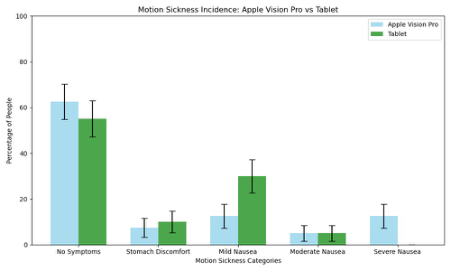
When viewing the field-study motion sickness incidence data for both the AVP and tablet rides recorded with the MSSS (Fig. 2), both variants display similar results overall. A Wilcoxon signed-rank test showed that motion sickness severity did not differ significantly between the AVPc and TABc (W = 129; p = 0.539). In terms of occurrences of motion sickness symptoms, the AVP performed slightly better in the categories “No symptoms”, “Stomach discomfort”, “Mild nausea”and “Moderate nausea”. A significant difference in the “Severe nausea” category was observed, with it being exclusively experienced in the AVPc (12.5% of participants; n = 5; SD = 5.23; W = 0.0; p = 0.046) (Table 1).
Figure 2: Motion sickness severity experienced during a ride as a passenger using an AVP versus using a tablet.Table 1: Overall results of MSSS per category.
Table available in the original PDF paper.
Category nAVP nTAB W p No symptoms 25 22 84.0 0.371 Stomach discomfort 3 4 4.0 0.059 Mild nausea 5 12 40.0 0.197 Moderate nausea 2 2 2.5 0.317 Severe nausea 5 0 0.0 0.046
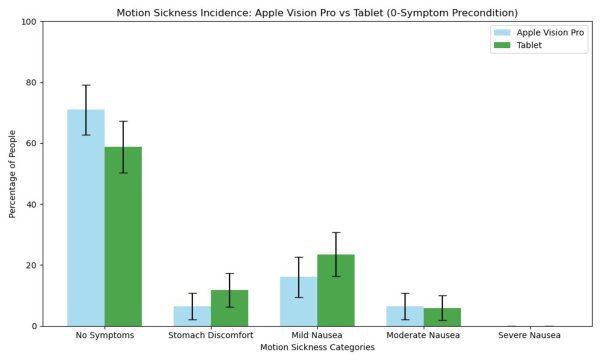
Notably, all AVP rides with severe nausea were preceded by tablet rides where participants already experienced motion sickness—either mild (n = 4) or moderate nausea (n = 1). These cases involved highly susceptible participants, all in the 95th MSSQ percentile. Focusing on rides without prior symptoms (0-symptom-precondition)—including all first rides and second rides without symptoms from the previous one (Figure 3)—no severe nausea
940 Walker and Gerlicher
occurred. Results for this subset align with previous findings, with AVP performing slightly better in all categories except “moderate nausea,” where counts were equal between AVPc and TABc. A Mann-Whitney-U test showed that motion sickness severity did not differ significantly for this group in any category (Table 2).
Table 2: Results of MSSS per category for cases with a 0-sympomprecondition.
Table available in the original PDF paper.
Category nAVP nTAB W p No symptoms 22 20 617.5 0.251 Stomach discomfort 2 4 515.5 0.494 Mild nausea 5 8 506.0 0.502 Moderate nausea 2 3 531.0 0.758
The observed results stay mostly consistent when looking at subsets of participants who are highly susceptible towards motion sickness. With increased susceptibility, the proportion of participants who experience no symptoms decreases, while the opposite increases, which is to be expected. The most susceptible individuals (in the 95th percentile, according to the MSSQ), experienced no symptoms non-significantly more often during the ride with the tablet (25%; n = 2; SD = 15.31) than with the AVP (12.5%; n = 1; SD = 11.69).
Figure 3: Comparison of motion sickness severity between AVP and tablet rides with no previous symptoms.
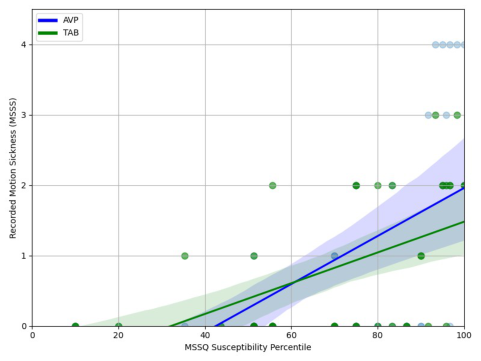
The relationship between motion sickness susceptibility (MSSQ-Adult percentile) and the severity of recorded symptoms was analysed using Spearman’s rank correlation and indicates moderate positive monotonic relationship for both conditions (AVP: r = 0.64, p = 0.00001; Tablet: r = 0.59, p = 0.00007) (Figure 4).
Demonstrating the Need for Application-Level Design Guidelines 941
In the control study, half the participants (n = 5) experienced motion sickness symptoms—four reported mild nausea and one slight discomfort— while the remaining five reported none. All affected participants were in the 80th MSSQ percentile for susceptibility. Of those with mild nausea, three noted symptoms beginning or worsening during the urban section with sharp turns and stop-and-go traffic. Two participants reported limited visibility and difficulty reading street signs due to AVP image resolution, and two mentioned the headset felt heavy and uncomfortable over time.
Figure 4: Correlation between motion sickness susceptibility and recorded severity for AVP and tablet conditions.
DISCUSSION
The study provides insights into the effects of video-passthrough AR headsets like the AVP in a working-while-driving context. Participants in both studies reported above-average motion sickness susceptibility (MSSQ), making them well-suited for evaluating VPT AR HMD effects and supporting the study’s validity. The control study indicated that, technologically, VPT AR HMDs like the AVP limit motion sickness to mild nausea, suggesting that factors such as display resolution, field of view, PPD, refresh rate, and P2P latency are sufficient to prevent severe symptoms, confirming hypothesis H2. Hardware factors like weight and fit may still cause discomfort and increase motion sickness risk, highlighting areas for future improvement.
Our results align with those of Sasalovici et al. and extend them to a real- world context. In the main field study, motion sickness severity showed mixed outcomes: both AVP and tablet conditions produced a similar symptom distribution. Motion sickness occurred slightly less with the AVP, but the difference was small. As this difference did not reach statistical significance, hypothesis H1 cannot be confirmed, although the observed trend appears consistent with it. Furthermore, this result indicates that presenting content at head height alone may not reliably reduce symptoms in dynamic driving.
942 Walker and Gerlicher
The default AVP window, opaque and large enough to block most of the road view (Figure 1), likely contributed to unpredictable motion as outlined by Kuiper et al. (2020), suggesting that a smaller or more translucent window improving visibility could reduce symptoms in future designs. Notably, severe nausea occurred only in the AVP condition, exclusively in highly susceptible individuals who had already experienced symptoms in the preceding tablet ride. This suggests that the AVP may not reduce motion sickness once symptoms begin and may even exacerbate them. Participants’ lack of prior experience with the AVP or similar XR devices, and unfamiliarity with moving or resizing the virtual window to see through the windshield, may have increased stress and frustration. Unlike with a tablet, they could not simply look up to regain awareness of vehicle movement, which may have contributed to severe nausea. Greater device familiarity and understanding of its interactions may improve these outcomes.
Limitations The population sample that took part in this study consisted exclusively of participants aged 20 to 30. While this age group is appropriate based on existing literature (Reason and Brand, 1975; Dobie et al., 2001; Huppert et al., 2019; Paillard et al., 2013), the findings may not be generalizable to other age groups. The study relied on self-reported measures (MSSS, MSSQ), which provide only rough estimates and may be affected by biases in symptom perception or recall. Participants could also under- or overreport symptoms based on expectations or discomfort. The field study measured only perceived motion sickness, not task-related severity, which may vary between reading, watching, or writing tasks. Finally, the predominantly female sample may limit generalizability - future studies should aim for a more balanced gender distribution.
CONCLUSON In summary, while the AVP did not significantly reduce motion sickness incidence compared to a tablet, it also did not exacerbate symptoms. We conclude that, as of today, VPT AR HMDs such as the AVP are sufficiently technologically advanced to compete with more traditional devices like tablets and laptops in a working-while-driving context regarding motion sickness. However, assuming AVs become the dominant mode of transportation and AR glasses gain widespread adoption, it is crucial to design applications, accessibility tools and motion sickness prevention methods to enable all passengers to comfortably work while riding AVs.
Looking ahead, VPT AR devices are likely to evolve into true see- through AR headsets. However, our findings show that this technological advancement alone may not be enough to eliminate motion sickness in vehicles. AR applications designed for home or office use cannot be transferred to in-vehicle contexts without adaptation. It is essential that application design must also evolve to include accessibility options in order for AR applications to be used with minimal discomfort. Understanding the interplay between environmental factors, user perception, and interface
Demonstrating the Need for Application-Level Design Guidelines 943
design will be key to ensuring that AR technology becomes a seamless and comfortable tool for productivity in future mobility scenarios. It is also crucial to develop standards or a set of best practices to guide the design of AR applications that minimize motion sickness and support safe, productive use in autonomous vehicles.
To address these open questions, further studies are planned to investigate the effectiveness of such interface adaptations in reducing motion sickness and enhancing user comfort in dynamic environments.
REFERENCES
Apple (2023) Apple Vision Pro - technical specifications [online]. Available at: https:// www.apple.com/apple-vision-pro/specs/ (Accessed: 15 February 2025). Audi (2025) A progressively luxurious lounge on wheels [online]. Available at: https://www.audi.com.cy/en/stories/future/a-progressively-luxurious-lounge- on-wheels/ (Accessed: 02 February 2025). Bosch (2020) Staying on track despite malfunctions: How driverless shuttles get
safely from a to b [online]. Available at: https://www.bosch.com/stories/driverless- shuttles/ (Accessed: 02 February 2025). Brainard, A. and Gresham, C. (2014) Prevention and treatment of motion sickness. American Family Physician, 90(1), pp. 41–46. Damveld, H. and Mulliken, G. (2023) Adjusting image content to improve user experience. EU Patent. Diels, C., Bos, J. E., Hottelart, K. and Reilhac, P. (2016) Motion sickness in automated
vehicles: The elephant in the room. In: Road Vehicle Automation 3, pp. 121–129. Springer. Diels, C., Ye, Y., Bos, J. E. and Maeda, S. (2022) Motion sickness in automated vehicles: Principal research questions and the need for common protocols. SAE International Journal of Connected and Automated Vehicles, 5(12–05-02–0011), pp. 121–134. Dobie, T., McBride, D., Dobie Jr, T. and May, J. (2001) The effects of age and sex on
susceptibility to motion sickness. Aviation, Space, and Environmental Medicine, 72(1), pp. 13–20. Glaser, E. M. (1959) Prevention and treatment of motion sickness. Proceedings of the Royal Society of Medicine, 52(11), pp. 965–972. Available at: https://doi.org/ 10.1177/003591575905201116. Golding, J. F. (2006a) Motion sickness susceptibility. Autonomic Neuroscience,
129(1–2), pp. 67–76. Golding, J. F. (2006b) Predicting individual differences in motion sickness susceptibility by questionnaire. Personality and Individual Differences, 41(2), pp. 237–248. Golding, J.F., Bles, W., Bos, J.E., Haynes, T.and Gresty, M.A.(2003) Motion sickness and tilts of the inertial force environment: Active suspension systems vs. active passengers. Aviation, Space, and Environmental Medicine, 74(3), pp. 220–227. Golding, J. F., Markey, H. M. and Stott, J. R. R. (1995) The effects of motion direction, body axis, and posture on motion sickness induced by low frequency linear oscillation. Aviation, Space, and Environmental Medicine, 66(11), pp. 1046–1051. Griffin, M. J. and Newman, M. M. (2004) Visual field effects on motion sickness in
cars. Aviation, Space, and Environmental Medicine, 75(9), pp. 739–748.
944 Walker and Gerlicher
Huppert, D., Grill, E. and Brand, T. (2019) Survey of motion sickness susceptibility in children and adolescents aged 3 months to 18 years. Journal of Neurology, 266, pp. 65–73. iFixit (2024) Vision Pro teardown, zweiter Teil: Wie schaut’s mit dem Display aus? [online]. Available at: https://de.ifixit.com/News/90725/vision-pro- teardown-zweiterteil-wie-schauts-mit-dem-display-aus (Accessed: 15 February 2025). Keshavarz, B. and Golding, J. F. (2022) Motion sickness: Current concepts and
management. Current Opinion in Neurology, 35(1), pp. 107–112. Kuiper, O. X., Bos, J. E. and Diels, C. (2018) Looking forward: In-vehicle auxiliary display positioning affects carsickness. Applied Ergonomics, 68, pp. 169–175. Kuiper, O. X., Bos, J. E., Schmidt, E. A., Diels, C. and Wolter, S. (2020) Knowing
what’s coming: Unpredictable motion causes more motion sickness. Human Factors, 62(8), pp. 1339–1348. Mercedes-Benz (2023) The Mercedes-Benz F015: Luxury in Motion [online].
Available at: https://www.mercedes-benz.com.au/passengercars/campaigns/ mercedes-benz-f-015.html (Accessed: 02 February 2025). Metzulat, M., Metz, B., Edelmann, A., Neukum, A. and Kunde, W. (2025) Sick of being driven?–prevalence and modulating factors of carsickness in the European population in context of automated driving. Applied Ergonomics, 129, 104590. Murdin, L., Golding, J. and Bronstein, A. (2011) Managing motion sickness. BMJ,
343. Paillard, A. C., Quarck, G., Paolino, F., Denise, P., Paolino, M., Golding, J. F. and Ghulyan-Bedikian, V. (2013) Motion sickness susceptibility in healthy subjects and vestibular patients: Effects of gender, age and trait-anxiety. Journal of Vestibular Research, 23(4–5), pp. 203–209. Panasonic (2018) Autonomous cabin concept [online]. Available at: https:// eu.automotive.panasonic.com/solutions/infotainment/ecockpit/autonomous- cabin-concept (Accessed: 02 February 2025). Polymeropoulos, V., Czeisler, M., Gibson, M., Anderson, A., Miglo, J., Wang, J., Xiao, C., Polymeropoulos, C., Birznieks, G. and Polymeropoulos, M. (2020) Tradipitant in the treatment of motion sickness: A randomized, double- blind, placebo-controlled study. Frontiers in Neurology, 11. Available at: https:// doi.org/10.3389/fneur.2020.563373. Reason, J. T. and Brand, J. J. (1975) Motion sickness. Academic Press. ISBN
9780125840507. Sasalovici, M., Leenders, S., Schramm, R. C., Freiwald, J. P., Botzet, H. F., Keßelheim, D., Krach, T. and Winkler, C. (2023) In-car office: Can HMD-based AR alleviate passenger motion sickness? In: Adjunct Proceedings of the 15th International Conference on Automotive User Interfaces and Interactive Vehicular Applications, AutomotiveUI ‘23 Adjunct, pp. 133–138. ACM. Available at: https://doi.org/ 10.1145/3581961.3609869. Schmidt, E. A., Kuiper, O. X., Wolter, S., Diels, C. and Bos, J. E. (2020) An
international survey on the incidence and modulating factors of carsickness. Transportation Research Part F: Traffic Psychology and Behaviour, 71, pp. 76–87. Shupak, A. and Gordon, C. R. (2006) Motion sickness: Advances in pathogenesis, prediction, prevention, and treatment. Aviation, Space, and Environmental Medicine, 77(12), pp. 1213–1223. Sivak, M. and Schoettle, B. (2015) Motion sickness in self-driving vehicles. Technical
report. University of Michigan, Ann Arbor: Transportation Research Institute.
Demonstrating the Need for Application-Level Design Guidelines 945
Volkswagen (2024) Sedric - meet our first fully automated concept car [online]. Available at: https://www.volkswagen.com.au/en/technology/ innovation/sedric.html (Accessed: 02 February 2025). Walker, Z., Gerlicher, A., Braun, A., Pinnow, L., Heinemann, D., Janik, S.
and Merzhäuser, E. (2024) Exploring interactions in autonomous vehicles: A comprehensive evaluation of various interaction methods for 2D and 3D content. In: Stuttgart Conference on Automotive Production, pp. 206–222. Springer.
LISTED IN THE AHFE DIGITAL BOOKSTORE CATALOGUE
Explore the complete digital volume
Human Factors in Design, Engineering, and Computing
Read this individual research paper free through the original publisher, or explore the full digital proceedings book.
ISBN 978-1-964867-75-5
Explore this ISBN in the AHFE Bookstore ↗Listed in the July 2026 bookstore catalogue; search by ISBN to confirm current availability · Digital book purchase optional