Maftuh AHNAN, Dukgeun Yun (2026). Traffic Flow Analysis in Mixed Environments with Autonomous and Human-Driven Vehicles. In: Human Interaction and Emerging Technologies (IHIET-FS 2026): Future Systems and Design Applications. AHFE Open Access, vol. 235, pp. 365–376. https://doi.org/10.54941/ahfe1007290
1 Department of Highway & Transportation Research, KICT School, University of Science & Technology, Indonesia ↗
2 Department of Highway and Transportation Research, Korea Institute Civil Engineering and Building Technology (KICT), Republic of Korea, Corresponding Author ↗
Autonomous vehicles (AVs) have the potential to improve traffic efficiency, safety, and environmental sustainability; however, their impacts under mixed traffic conditions remain unclear. This study investigates the effects of cautious autonomous vehicles on traffic performance at different MPRs(market penetration rates) in a mixed environment with human-driven vehicles. A microscopic traffic simulation was developed using VISSIM and applied and applied to the Harbour Toll Road in Jakarta, Indonesia with driving behavior parameters calibrated to reflect realistic human-driven and autonomous vehicle characteristics. Several scenarios were analyzed, ranging from fully human-driven traffic to fully autonomous traffic, with AV MPR in 10% increments. Traffic performance was evaluated using level of service (LOS), average speed, traffic volume, vehicle delay, queue length, fuel consumption, and emissions. The results show that at low AV penetration levels, mixed traffic conditions can initially worsen performance due to conservative autonomous driving behavior and interaction conflicts with human drivers. In these scenarios, delays, congestion, and emissions increase compared to conventional traffic. As the AV MPR increases, traffic performance improves significantly. At penetration levels above 90%, cautious autonomous vehicles substantially enhance level of service, increase average speed and traffic throughput, and reduce vehicle delays and queue lengths. Environmental benefits are also observed at high penetration levels, with notable reductions in emissions and fuel consumption. These findings indicate that the positive impacts of autonomous vehicles strongly depend on high adoption rates and highlight the importance of supportive infrastructure and traffic management strategies during the transition to autonomous mobility.
Unregulated population expansion is a critical concern in urban environments. People increasingly view autonomous vehicles (AVs) as the transportation of the future, as they have the potential to address various issues plaguing current traffic systems, such as congestion, accidents, and inefficiency (Cheng et al., 2022; Hu et al., 2020; Ye et al., 2021). Autonomous vehicles
366 Ahnan and Yun (AVs) employ sophisticated technologies, including artificial intelligence for decision-making, real-time data processing, sensors, and vehicle-to-vehicle (V2V) communication, enabling operation with minimal human interaction. These technology advancements allow autonomous vehicles to predict traffic scenarios, communicate with other vehicles, and make immediate decisions to improve driving behaviors (Aria et al., 2016; Avogadro et al., 2024; Kaths et al., 2021; Park et al., 2017; Petrovic et al., 2020).
Autonomous vehicles (AVs) have attracted significant attention as a transformative technology, providing considerable enhancements in road safety, traffic efficiency, and urban mobility (Azam, Hassan, & Puan, 2022). Autonomous vehicles, by mitigating human error—a key factor in road accidents—are poised to improve the safety and efficiency of future transportation systems. The anticipated benefits include reduced congestion from more consistent vehicle spacing, enhanced safety through automated decision-making, and the ability to manage traffic flow, especially in densely populated urban regions. Incorporating autonomous vehicles into existing road networks presents several challenges, particularly in mixed traffic situations where autonomous vehicles share the road with human-driven vehicles (Azam, Hassan, Puan, et al., 2022; Ko et al., 2021; Morando et al., 2017; Shin et al., 2024). Human operators introduce variability, potentially affecting the effectiveness of autonomous vehicle traffic systems.Therefore, understanding the influence of autonomous vehicles on traffic dynamics, particularly in relation to human-driven vehicles, is crucial for future urban planning and infrastructure development (Azam, Hassan, & Che Puan, 2022; Liu et al., 2017; Miqdady et al., 2023).
Research has revealed diverse outcomes throughout this changeover period. We expect that the predictive driving and sensor-based navigation of autonomous cars would enhance traffic flow, particularly with increased deployment of AVs (Friedrich et al., 2019). Simulations suggest that a higher prevalence of autonomous vehicles in traffic can lead to decreased congestion and fewer traffic conflicts by improving lane-keeping and controlling deceleration behaviors. Conversely, diminished penetration rates result in other issues, as conventional vehicles do not operate as predictably as autonomous vehicles, hence undermining the advantages of automated vehicles in a completely automated environment (Li, 2017; Talebpour & Mahmassani, 2016; Zeidler et al., 2019).
This study examines the impact of autonomous vehicles on traffic by simulating various market entry scenarios and analyzing their interactions with human-operated vehicles concerning traffic flow and demand. This study uses VISSIM, a detailed traffic simulation tool, to look at how autonomous vehicles might affect traffic, such as reducing delays and accidents, but also possibly causing more congestion when mixed with regular vehicles. This research aims to study and improve how autonomous vehicles fit into city traffic by changing how both autonomous and human-driven vehicles behave to mimic real driving patterns using a detailed driving model. This method will facilitate the planning and policy formulation for the implementation of autonomous technologies.
LITERATURE REVIEW
Over the past decade, researchers have extensively investigated the potential impacts of autonomous vehicles on traffic networks. Numerous studies indicate that autonomous vehicles, via sophisticated vehicle-to- vehicle communication, can alleviate traffic congestion by synchronizing vehicle movements to circumvent bottlenecks and enhance route efficiency. Researchers have discovered that autonomous vehicles can reduce traffic delays in congested urban areas by mitigating sudden stopping and accelerating actions typical of human drivers. Nonetheless, the true effects of this technology remain uncertain, and researchers, businesses, and legislators are eager to understand the future of these smart cars (Azam, Hassan, & Che Puan, 2022; Ko et al., 2021).
Numerous researchers have forecasted the market penetration rates (MPRs) of autonomous vehicles (AVs). The MPR of AVs is projected to range from 24% to 87% by 2045. The primary advantages of autonomous vehicles are linked to complete market saturation; nevertheless, achieving 100% market penetration remains a considerable challenge. During the transition period, autonomous vehicles (AVs) will share the road with human-driven vehicles (HDVs), and the complex situation created by these vehicles with different levels of self-driving ability is expected to affect how drivers behave in traffic. Numerous researchers are also investigating mixed traffic scenarios, considering MPR forecasts and the anticipated behavior of autonomous vehicles when simulated alongside human-driven vehicles. They are disseminating valuable books on the crucial subject of this era, including (Park et al., 2017; Ye et al., 2021), analysis focuses on mixed traffic scenarios in which autonomous vehicles and human-operated vehicles share the roads. While autonomous vehicles (AVs) often maintain consistent speeds and safe following distances, the unpredictable behavior of human drivers can disrupt traffic flow, particularly during merging and lane-changing scenarios. As the adoption rate of autonomous vehicles rises, the mobility of the network improves; however, traffic flow becomes unstable when human-driven and autonomous vehicles mix, highlighting the critical need for safety management. Moreover, meteorological phenomena or infrastructural conditions may impair a vehicle’s sensors or communication systems, and diminished sensor coverage has been demonstrated to elevate both abrupt decelerations and the frequency of vehicle-to-vehicle collisions. This study aims to reduce the challenges and impacts of using autonomous vehicles (AVs) and human-driven vehicles (HDVs) by looking at how traffic moves and how drivers behave, while considering the different speeds at which autonomous cars are being adopted. We will analyze the driving habits of human-operated vehicles to establish an optimal and secure traffic flow on highways. We modify the driving behaviors of autonomous and human-operated cars to align with real-world settings, employing a conservative driving behavior model. We subsequently employ VISSIM to evaluate the mobility and safety of these vehicles in relation to their adoption rate.
METHODOLOGY
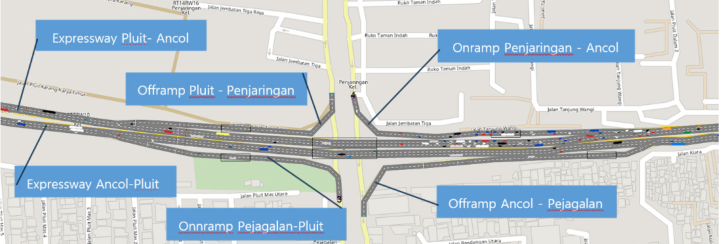
Research Area The Harbour Tollroad in Jakarta, Indonesia, serves as the research area for this study. Cars, trucks, and buses can access the 3-lane arterial roads, but pedicabs and motorcycles cannot use these routes. One on-ramp and one off-ramp connect each road. Figure 1 illustrates the research area pertinent to this study.
Figure 1: Harbour tollroad in jakarta.
Research Design Model Development We introduced the analysis simulation environment, analysis scenarios, and how to set input variables for human-driven and autonomous vehicle driving behavior in the experimental design.
This study uses Harbour Toll Road simulation. Analysis network is two- way. One continuous-flow route from Pluit to Ancol has a three-lane main road segment of 1455 m and an off-ramp from Pluit to Penjaringan and an on-ramp from Penjaringan to Ancol. The other route from Ancol to Pluit is a continuous-flow road with a three-lane main road stretch of 1457 m, an off-ramp from Ancol to Pejagalan, and a two-lane auxiliary lane.
After removing speed and acceleration outliers, we calculated Pluit-Ancol’s traffic volume and spatial average speed, finding 1465 vehicles. On toll roads and highways, Indonesian laws require 60–100 km/h. After investigation, we set the network speed at 60–100 km/h, taking into account road traffic and allowing driving speed to change. To prevent influencing analysis results, we only studied the last 3000 s of the 3600-s simulation.The analysis allowed traffic-related adjustments.
Nine scenarios with different market penetration rates were analyzed. Different assumed demand levels have been used in the literature. Different demand levels, from low to high, reflect peak and off-peak traffic circumstances during a complete day. For the base model, there is three primary simulation scenarios:
1. Human-Driven Vehicle Traffic: This scenario serves as a baseline, modeling traditional traffic without the presence of AVs.
2. Mixed Traffic Environment: Market penetration rates (MPR) range from 10% to 90% in 10% increments with human-driven vehicles. 3. Fully Autonomous Traffic: AVs constitute 100% of the traffic, representing a futuristic scenario where AVs dominate the roadways.
The simulations run provide outputs for process results and discussion, which include average vehicle speed, traffic volume, congestion levels, and delay.
Simulation Microscopic We utilized the VISSIM 2022 program to create the foundational model and execute several contemplated scenarios. We developed scenarios that took into account varying demand levels, the proportion of autonomous vehicles in the vehicle composition, and the travel behaviors of these vehicles. We got simulation results for four performance metrics: vehicle speed, traffic volume, congestion levels, and delay. We measured these using VISSIM’s node assessment and network performance parameters.
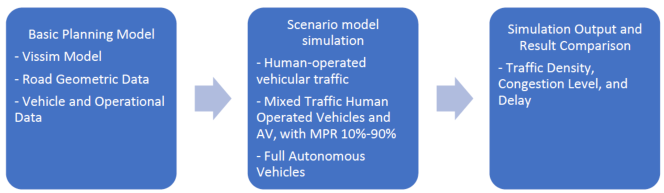
The method consists of three phases: the development of the base model, the creation of a mixed traffic scenario, and the analysis and comparison of the simulation output. Figure 2 shows the three aforementioned main phases along with the steps involved in each of the phases.
Figure 2: Three phases of analysis of dynamic mix traffic.
Modelling Dynamic Mix Traffic The analysis of traffic mix focused on two primary categories of vehicles: Autonomous Vehicles (AVs) and Human Driven Vehicles (HDVs). The cautious AV category was simulated. We established the categories based on the underlying logic in VISSIM, using parameter values derived from the CoEXist project. The value We derived the size, speed, and lateral distance values for AVs from those used for human-driven cars. We adopted the values for various operational characteristics of AVs, including headway, standstill distance, and acceleration aspects, in accordance with the AV driving logic employed. Although the AV and human-driven cars are physically identical, their behavior in traffic streams diverges due to distinct driving logics.
The system must adjust several input variables to emulate automotive driving behavior; however, identifying the ideal values for each variable is a challenge. We looked at the results of earlier research that used VISSIM to calibrate the input variables for regular vehicles. Then, we found the main input parameters that have a big effect on vehicle performance, along with their lowest and highest values. Table 1 displays the results. We selected the range values of the input variables based on the minimum and maximum values from prior research.
Table 1: Parameters for human operated vehicle behavior and performance.
Table available in the original PDF paper.
Parameters Park et al. (2006)
He (2022) Shin et al. (2024)
Current Research
Following Model Look-ahead distance 200 ~ 300 72 ~ 108 - 60 ~ 100
Waiting period prior to diffusion - - - 60.00 0.1 ~ 0.9 - 0.50 Minimum Front/Rear Clearance (m)
(Continued)
Table 1: Continued.
Table available in the original PDF paper.
Parameters Park et al. (2006)
He (2022) Shin et al. (2024)
Current Research – 0.0 ~ 1.0 0.0 ~ 1.0
Factor of safety distance decrease
–5.0 ~ −1.0 –5.0 ~ 0.0 –5.0
Cooperative braking maximum deceleration (m/s2)
RESULTS AND DISCUSSIONS Analysis of Traffic Performance Metrics Cautious Autonomous Vehicles (CAVs)
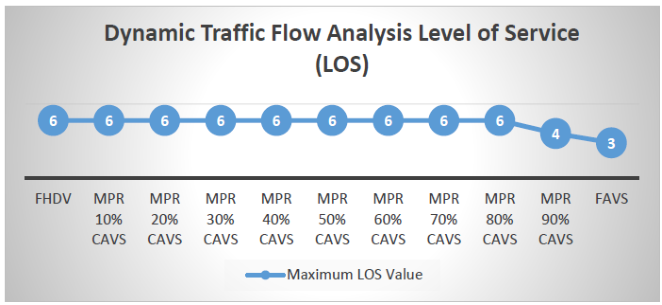
Level of Service (LOS) A key traffic efficiency statistic is Level of Service (LOS). We rate it from A (ideal) to F (severely congested). In the study, human-operated autos always run at Level of Service F, or 6, signifying poor traffic conditions. Even with market penetration rates (MPR) of 80%, cautious autonomous vehicles (CAVs) do not immediately improve LOS. The finding highlights the challenges of mixed traffic with human drivers and autonomous vehicles. LOS improves to a D at 90% CAV MPR. This is a major change as autonomous vehicles reduce congestion and enhance traffic flow. Figure 3 shows that cautious fully autonomous vehicles improve LOS to C by optimizing traffic conditions.
Figure 3: Graph level of service of cautious autonomous vehicles.
The link between LOS and MPR suggests that partial CAV use may initially increase traffic inefficiency. Different driving patterns of humans and autonomous systems cause this. As autonomous cars become more common, their coordinated decision-making and faster reaction times improve service. Autonomous vehicles can transform traffic management over time, as seen by this pattern. The increase in LOS from D to C during the transition from 90% MPR CAVs to fully autonomous vehicles shows the relevance of 100% automation. Partial automation provides benefits, while complete
372 Ahnan and Yun automation maximizes efficiency and smoothness. The report emphasizes the necessity for planning and infrastructure to gradually introduce autonomous cars. Policymakers and engineers must overcome transitional challenges to reap the benefits of improved service and traffic.
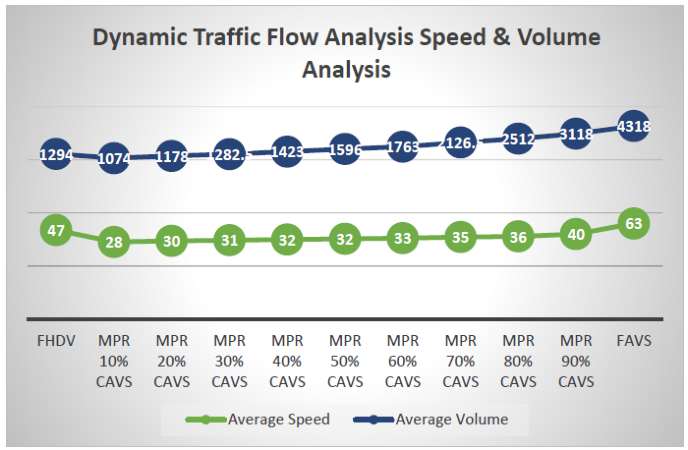
Speed and Volume Analysis Speed and volume are key indications of traffic dynamics. Human-driven autos average 47 km/h and 1,294 cars. These values indicate modest efficiency while underlining human driving limitations, including fluctuating speeds and reaction times. At 10% connected and autonomous vehicle market penetration, the average speed drops to 28 km/h. Traffic diversity caused the degradation. At low penetration rates, autonomous vehicles may drive conservatively, reducing speeds. Volume drops to 1074 automobiles, highlighting early CAV integration inefficiencies. As MPR rises, speed and volume improve. The velocity is 32 km/h, and the volume is 1423 automobiles at 40% MPR. This continues with 90% MPR at 40 km/h and 3118 automobiles. Fully autonomous vehicles average 63 km/h across 4,318 units. As adoption rates climb, autonomous technology can enhance traffic flow, as seen in Figure 4.
Figure 4: Graph speed & volume of cautious autonomous vehicles.
The study shows driverless vehicles can reduce congestion. Increased speeds and volumes reduce bottlenecks and maximize roadway capacity.The shift from cautious autonomy to complete autonomy is where speed and volume increase most. Results demonstrate the need for progressive adoption. Early
Traffic Flow Analysis in Mixed Environments With Autonomous 373 CAV deployment may require specific lanes or clever traffic management systems to reduce early issues and maximize speed and capacity benefits.
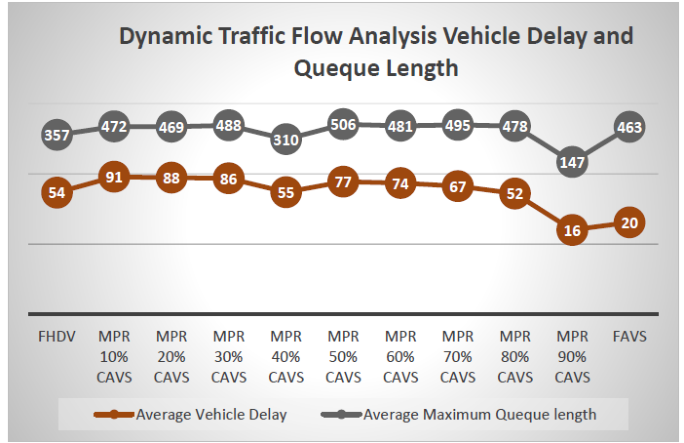
Vehicle Delay and Queue Length Traffic congestion is measured by vehicle delay and queue length. For fully human-operated vehicles, the average wait is 54 seconds and the maximum is 357 meters. These numbers show conventional traffic networks are congested and inefficient. With 10% market penetration of linked and autonomous vehicles, the average delay rises to 91 seconds and the maximum line length is 472 meters. This drop is due to mixed traffic circumstances, when autonomous cars’ cautiousness clashes with human drivers’ unpredictability. As CAV MPR grows, these measurements improve. The delay drops to 55 seconds and the line length to 310 meters at 40% MPR. The delay drops to 16 seconds and the line length to 147 meters with a 90% MPR. The 20-second delay of fully autonomous vehicles emphasizes automation’s ability to reduce congestion, as shown in Figure 5.
The decrease in delay and queue length with elevated MPRs for CAVs underscores their capacity to improve traffic efficiency. The capacity of autonomous cars to sustain uniform speeds, predict traffic conditions, and synchronize movements diminishes stop-and-go patterns, which significantly contribute to delays and congestion. The study emphasizes the necessity of attaining elevated penetration rates for autonomous vehicles to actualize these advantages. Policymakers and traffic planners must prioritize methods to expedite the integration of autonomous technologies while confronting the complexities of mixed traffic environments.
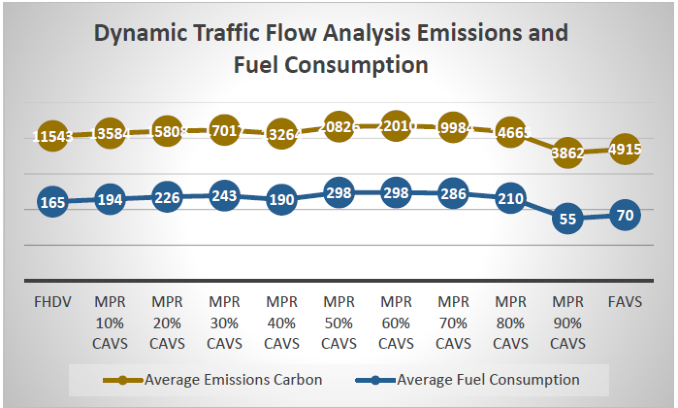
Carbon emissions and fuel consumption are major environmental impacts of vehicle traffic. Human-driven autos emit 11,543 grams and use 165 units. These numbers illustrate traditional traffic networks’ environmental cost. At 10% CAV market penetration, emissions reach 13,584 grams and fuel consumption 194 units. The trend continues until 60% MPR, when emissions peak at 22,010 grams and fuel consumption reaches 298 units. Mixed traffic inefficiency and autonomous car conservatism have caused the initial environmental impact increase. Above 60% MPR, emissions and fuel consumption drop. At 90% MPR, emissions drop to 3862 grams and fuel consumption to 55 units. Fully autonomous vehicles reduce pollutants to 4915 grams and fuel consumption to 70 units. Figure 6 shows that autonomous technology can lessen traffic’s environmental impact.
Figure 6: Graph emissions and fuel consumption of cautious autonomous vehicles.
The results highlight the importance of achieving high penetration rates for autonomous vehicles to maximize environmental benefits. Policymakers and technologists must address transitional challenges and develop strategies to enable the use of autonomous technologies. The report points out that it requires additional initiatives, such as the adoption of electric vehicles and renewable energy sources, to further reduce the environmental impact of traffic. When linked with sustainable practices, autonomous technology can revolutionize transportation and mitigate its environmental impact.
CONCLUSION
The shift from cautious autonomous vehicles to completely autonomous vehicles signifies a substantial advancement in traffic efficiency and sustainability. At 90% MPR of CAVs, the mean velocity is 40 km/h, the delay is 16 seconds, and emissions total 3862 grams. Fully autonomous vehicles
Traffic Flow Analysis in Mixed Environments With Autonomous 375 enhance these parameters, attaining 63 km/h, 20 seconds, and 4915 grams, respectively. The juxtaposition between cautious autonomy and complete autonomy underscores the constraints of partial implementation.
Cautious autonomous vehicles have several advantages; nonetheless, their conservative driving patterns and dependence on mixed traffic circumstances constrain their efficiency. Fully autonomous cars attain enhanced synchronization and optimization, leading to improved traffic performance. The data illustrates the importance of infrastructure and policy in facilitating the move to complete autonomy. Designated lanes, adaptive traffic control systems, and public awareness initiatives are essential for expediting the integration of autonomous technologies and tackling the complexities of mixed traffic situations.
The results underscore the capacity of autonomous technology to transform transportation and enhance the quality of life for all road users. The shift to complete autonomy signifies a fundamental change in traffic management, promising decreased congestion, improved safety, and lower environmental impact. The analysis offers a framework for politicians, engineers, and academics to tackle the difficulties and opportunities presented by autonomous technology. By concentrating on measures to facilitate the adoption of fully autonomous vehicles, we can realize the complete potential of this disruptive technology.
ACKNOWLEDGMENT
This research was supported by the Korea Agency for Infrastructure Technology Advancement (KAIA) grant funded by Ministry of Land, Infrastructure and Transport (Grant 21AMDP-C160881-01, Future Road Design and Testing for Connected and Autonomous Vehicles).
REFERENCES
Aria, E., Olstam, J., & Schwietering, C. (2016). Investigation of Automated Vehicle Effects on Driver’s Behavior and Traffic Performance. Transportation Research Procedia, 15, 761–770. https://doi.org/10.1016/j.trpro.2016.06.063 Avogadro, N., Birolini, S., Redondi, R., & Deforza, P. (2024). Assessing airport
ground access interventions: An integrated approach combining mode choice modeling and microscopic traffic simulation. Transport Policy, 148, 154–167. https://doi.org/10.1016/j.tranpol.2024.01.013 Azam, M., Hassan, S. A., & Che Puan, O. (2022). Autonomous Vehicles in Mixed Traffic Conditions—A Bibliometric Analysis. In Sustainability (Switzerland) (Vol. 14, Number 17). MDPI. https://doi.org/10.3390/su141710743 Azam, M., Hassan, S. A., & Puan, O. C. (2022). Autonomous Vehicles in Mixed
Traffic Conditions—A Bibliometric Analysis. In Sustainability (Switzerland) (Vol. 14, Number 17). MDPI. https://doi.org/10.3390/su141710743 Azam, M., Hassan, S. A., Puan, O. C., Azhari, S. F., & Faiz, R. U. (2022). Performance of Autonomous Vehicles in Mixed Traffic under different Demand Conditions. International Journal of Automotive and Mechanical Engineering, 19(4), 10050– 10062. https://doi.org/10.15282/ijame.19.4.2022.02.0776
Impact Analysis and Complexity Assessment of Autonomous Vehicles Based on the Potential Field Method. International Journal of Environmental Research and Public Health, 19(16). https://doi.org/10.3390/ijerph191610337 Friedrich, M., Pestel, E., Schiller, C., & Simon, R. (2019). Scalable GEH: A Quality Measure for Comparing Observed and Modeled Single Values in a Travel Demand Model Validation. Transportation Research Record, 2673(4), 722–732. https:// doi.org/10.1177/0361198119838849 Hu, X., Huang, M., & Guo, J. (2020). Feature Analysis on Mixed Traffic
Flow of Manually Driven and Autonomous Vehicles Based on Cellular Automata. Mathematical Problems in Engineering, 2020. https://doi. org/10.1155/2020/7210547 Kaths, H., Keler, A., & Bogenberger, K. (2021). Calibrating the wiedemann 99 carfollowing model for bicycle traffic. Sustainability (Switzerland), 13(6). https://doi. org/10.3390/su13063487 Ko, W., Park, S., So, J., & Yun, I. (2021). Analysis of Effects of Autonomous Vehicle
Market Share Changes on Expressway Traffic Flow Using IDM. J. Korea Inst. Intell. Transp. Syst, 20(4), 13–27. https://doi.org/10.12815/kits Li, Qingli. (2017). CISP-BMEI 2017 : proceedings, 2017 10th International Congress on Image and Signal Processing, BioMedical Engineering and Informatics : 14-16 October 2017, Shanghai, China. IEEE. Liu, Y., Guo, J., Taplin, J., & Wang, Y. (2017). Characteristic analysis of mixed traffic
flow of regular and autonomous vehicles using cellular automata. Journal of Advanced Transportation, 2017. https://doi.org/10.1155/2017/8142074 Miqdady, T., de Oña, R., & de Oña, J. (2023). Traffic Safety Sensitivity Analysis of Parameters Used for Connected and Autonomous Vehicle Calibration. Sustainability (Switzerland), 15(13). https://doi.org/10.3390/su15139990 Morando, M. M., Truong, L. T., & Vu, H. L. (2017). Investigating safety impacts of
autonomous vehicles using traffic micro-simulation. http://www.atrf.info/ Park, S., Kim, J., Lee, S., & Hwang, K. (2017). Experimental Analysis on control constraints for connected vehicles using Vissim. Transportation Research Procedia, 21, 269–280. https://doi.org/10.1016/j.trpro.2017.03.097 Petrovic, D., Mijailović, R., & Pešić, D. (2020). Traffic Accidents with Autonomous
Vehicles: Type of Collisions, Manoeuvres and Errors of Conventional Vehicles’ Drivers. Transportation Research Procedia, 45, 161–168. https://doi.org/10.1016/j. trpro.2020.03.003 Shin, S., Cho, Y., Lee, S., & Park, J. (2024). Assessing Traffic-Flow Safety at Various Levels of Autonomous-Vehicle Market Penetration. Applied Sciences (Switzerland), 14(13). https://doi.org/10.3390/app14135453 Talebpour, A., & Mahmassani, H. S. (2016). Influence of connected and autonomous
vehicles on traffic flow stability and throughput. Transportation Research Part C: Emerging Technologies, 71, 143–163. https://doi.org/10.1016/j.trc.2016.07.007 Ye, W., Wang, C., Chen, F., Yan, S., & Li, L. (2021). Approaching autonomous driving with cautious optimism: Analysis of road traffic injuries involving autonomous vehicles based on field test data. Injury Prevention, 27(1), 42–47. https://doi. org/10.1136/injuryprev-2019-043402 Zeidler, V., Buck, S. H., & Vortisch, P. (2019). Simulation of Autonomous Vehicles
Based on Wiedemann’s Car Following Model in PTV Vissim. https://www. researchgate.net/publication/331020495
LISTED IN THE AHFE DIGITAL BOOKSTORE CATALOGUE
Explore the complete digital volume
Human Interaction and Emerging Technologies (IHIET-FS 2026): Future Systems and Design Applications
Read this individual research paper free through the original publisher, or explore the full digital proceedings book.
ISBN 979-8-950676-11-6
Explore this ISBN in the AHFE Bookstore ↗Listed in the July 2026 bookstore catalogue; search by ISBN to confirm current availability · Digital book purchase optional