Yang Liu, Qiu Jie J (2024). Olfactory Profile: Enhancing the Satisfaction and Pleasure of Ride-Hailing Experiences. In: Intelligent Human Systems Integration (IHSI 2024): Integrating People and Intelligent Systems. AHFE Open Access, vol. 119, pp. 37–48. https://doi.org/10.54941/ahfe1004468
As ride-hailing services become a major mode of transportation for people's daily commutes, the quality of air inside the vehicle has always been a significant factor affecting the riding experience. Based on this, we have designed the “Olfactory Profile” system. This system enhances the comfort and enjoyment of ride-hailing passengers by providing a personalized olfactory environment throughout the entire ride and handling typical scents in various scenarios. The main functions include: First, creating a comfortable environment before getting into the car by releasing customized scents; Second, adjusting the emotional atmosphere during the ride through scenario customization. The specific method employed is the User-Centered Design (UCD) research approach. It involves uncovering user needs, transforming these needs into concrete design plans, and conducting experimental simulations with the developed prototypes. The evaluation of the prototypes is done through a combination of subjective interviews and objective physiological metrics analysis. Experimental results have demonstrated the usability and user-friendliness of the Olfactory Profile in enhancing the ride experience. The Olfactory Profile can be applied in future ride-hailing services to continuously improve the passengers' riding experience.
As people increasingly prioritize travel efficiency and seek solutions for the “last mile”problem, ride-hailing has become one of the most important modes of urban transportation. However, the frequent use of ride-hailing services has led to certain air quality issues inside the vehicles, significantly impacting the passengers’ experience and adversely affecting the ride-hailing business. This paper applies a user-centered design research method, priori- tizing the usage scenarios and needs of ride-hailing passengers, and integrates tools from service design to develop an olfactory experience system aimed at enhancing passenger comfort and pleasure. The system mainly targets two typical scenarios: firstly, before the ride, where passengers can customize scent parameters in advance to ensure a pleasant initial experience; secondly, during the drive, where the olfactory environment can change according to navigation information or contextual scenarios to ensure a positive overall experience.
The preliminary test results of the prototype are discussed, and simulations have been conducted to validate the usability and ease of use of the olfactory profile in initial environments and various scenarios.
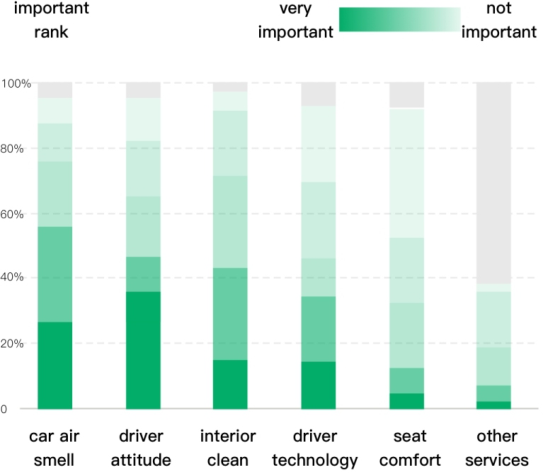
RESEARCH STATUS OF RIDE-HAILING PASSENGER EXPERIENCE Ride-hailing has become one of the most important modes of transportation in people’s lives. According to data from the China Internet Network Infor- mation Center, the number of ride-hailing users reached 453 million in 2021. Taking ride-hailing services has become a daily routine for many people, with everyone having higher expectations for the riding experience. However, ride-hailing is full of uncertainties with random “drivers”and “vehicles”, lacking relevant measures to ensure overall comfort inside the vehicle. Cao Cao Travel, a prominent Chinese ride-hailing company, partnered with First Financial and DT Finance to unveil the “2022 Ride-Hailing In-Car Air Report,” presenting research findings on the air quality within ride-hailing vehicles (Cao Cao Travel, 2022). The key to assessing travel quality is the pas- senger experience, and according to the ranking and selection ratio of factors affecting the ride, the top factor is “in-car air scent,”followed by “driver atti- tude,”with “vehicle cleanliness” and “driving skills” ranked third and fourth (see Figure 1). The most influential factors on the riding experience are the in- car environment and driver quality. While driver attitude has already received adequate attention, little research has emphasized the in-car environment, which is precisely what affects the experience throughout the journey.
Figure 1: Online car ride experience factors (2022 network car air report).
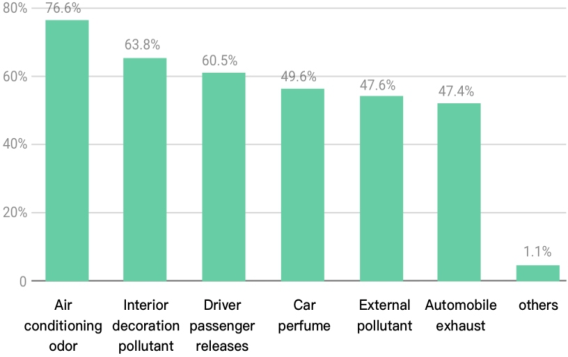
To address the issue of poor air quality inside vehicles, we conducted a survey among 168 Chinese university students (see Figure 2). The primary reasons for the poor in-car air environment were identified as the smells of
Olfactory Profile: Enhancing the Satisfaction and Pleasure of Ride-Hailing Experiences 39
air conditioning, uncleanliness inside the car, and smells released by drivers/- passengers (such as smoking, eating, and body smell). It is evident from the various air quality issues inside the car that the interviewed passengers have the lowest tolerance for directly perceivable problems, especially the unpleas- ant smells from air conditioning. The concern of passengers about in-car air quality is not only due to physical discomfort and health concerns but also because the air quality inside the car can affect their mood. The survey data also showed that over 70% of the students had experienced physical dis- comfort such as difficulty breathing, chest tightness, dizziness, and motion sickness due to the poor air quality inside ride-hailing vehicles.
Figure 2: The cognitive status of Chinese college students on the causes of poor air quality in e-hailing cars.
Cleanliness, health, and circulation are essential conditions for an ideal rid- ing environment. Hygiene can be ensured through regular cleaning, but issues related to hardware, such as air conditioning smells and other in-car smells, involve higher costs and are challenging to guarantee in ride-hailing vehicles due to their varying quality.Additionally, even if vehicle source assurance can be well-managed, it is challenging to consistently remind drivers to adhere to rules about keeping windows open for ventilation. Currently, there is limited design focus in various countries on the olfactory environment inside ride- hailing vehicles, yet the quality of the in-car air determines the entire riding experience. Therefore, we have introduced a study of passengers’ in-car riding experience based on the User-Centered Design (UCD) method and provided optimization measures.
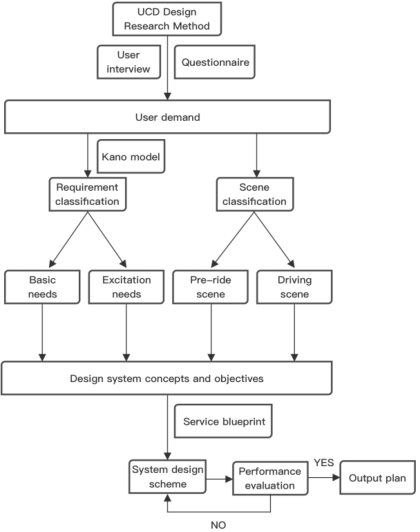
USER-CENTERED SYSTEM DESIGN The design of the in-car olfactory system uses the UCD research method (Imbesi, 2021), starting from user needs. It involves summarizing design requirements and scenarios based on these needs, thereby clarifying the sys- tem design concept and objectives. The process includes user research, pain
40 Yang and Jie
point analysis, insight into needs and scenarios, system design construc- tion, and performance evaluation of the output system. The system is then improved based on identified issues (see Figure 3).
Figure 3: UCD based online car passenger olfactory experience design process.
Based on the behavioral characteristics and usage scenarios of ride-hailing passengers, to further explore the pain points of passengers’ experiences dur- ing ride-hailing, the author conducted a survey and interviews. A total of 60 paper questionnaires were distributed to people aged 18-40, and 50 valid questionnaires were ultimately collected. Based on the data from these valid questionnaires and 20 in-depth user interviews, eight most typical passenger needs were identified. The Kano model, as a tool for classifying and pri- oritizing user needs (Xu Q, 2009), can analyze the impact of user needs on satisfaction. By categorizing passengers’ experiential needs, we identi- fied two main categories of core needs: basic needs and excitement needs (see Table 1). Basic needs are the qualities that users expect to be fulfilled and are essential; excitement needs are unexpected by users and significantly enhance satisfaction when met. Among these, detecting in-car air quality, eliminating in-car smells, and establishing a personal habitual scent environ- ment are basic needs. Reducing traffic jam anxiety, alleviating tension during peak morning and evening hours, improving irritation during late-night rides, soothing unease in bad weather, and alleviating boredom during the ride are categorized as excitement needs.
Olfactory Profile: Enhancing the Satisfaction and Pleasure of Ride-Hailing Experiences 41
Table 1. Kano model needs and satisfaction evaluation.
Table available in the original PDF paper.
Requirement type M O A I Q R Result Detect the smell quality inside the car 36 7 6 1 0 0 M Remove car smell 42 4 3 1 0 0 M Establish a personal customary smell environment 43 5 2 0 0 0 M Relieve anxiety about traffic jams 11 27 8 3 1 0 O Regulate morning and evening peak tension 9 24 6 7 3 1 O Improve your late night ride irritability 8 31 6 2 2 1 O Soothe inclement weather jitters 14 28 2 6 0 0 O Manage boredom during the ride 11 24 4 7 4 0 O
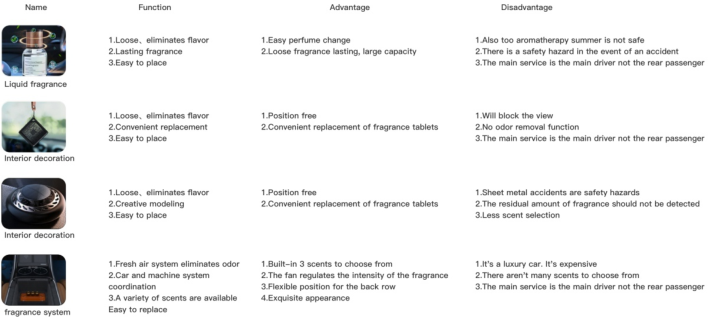
To address these eight main needs, we analyzed existing solutions in the industry. Currently, in-vehicle olfactory products are divided into two main categories: fragrance hardware products and vehicle-mounted fragrance sys- tems. We selected four different types of products for analysis (see Figure 4). Currently, there are few fragrance products specifically designed for rear pas- sengers, and in terms of odor elimination methods, products should avoid using scent to mask smells. Instead, they should scientifically eliminate smells through a combination of air purification and scent release. Products should also reasonably select fragrances, as there are currently no unified guidelines for the use of fragrances. Materials should be chosen with safety in mind, avoiding liquids, metallic materials, and flammable substances.
There are numerous benefits to introducing the olfactory.Academic research on olfaction indicates that the use of scents can reduce stress and fatigue, evoke memories and associations, and increase our sense of well- being, which is beneficial for regulating emotional needs during travel. This has been a motivating factor in the recent advancements in the automotive industry, with several manufacturers including Mercedes, Audi, BMW, and Bentley creating their own in-car scents (DAIMLER, 2019) to enhance the pleasurable driving experience. Using scents as an interactive mode in the
42 Yang and Jie
automotive environment has three main benefits: (1) Olfactory stimuli cause less disruption to the current task compared to other senses, due to the close connection between smells and the user’s emotions and memories, making it easier to accept than other sensory inputs (Kiecolt, 2008); (2) The effi- ciency of olfactory transmission of information is quicker than other senses, as scents activate the user’s central nervous system and directly connect to the primary cortex; (3) Scents have the ability to enhance the user’s sense of well-being, a capacity not found in other senses (YANAGIDA, 2009).
The interior of a vehicle forms a relatively enclosed olfactory interaction space. Since smells take longer to be perceived by users compared to visual and auditory stimuli, not every notification related to the ride may be useful in olfactory interactions. Furthermore, because not every fragrance immediately captures attention, careful selection of scents becomes crucial. At this stage, valuable insights can be gleaned from research results on the activation of the central nervous system. To overcome the unfamiliarity of smells, we can draw inspiration from research findings on olfactory modulation.In the field of Human-Computer Interaction (HCI), most interaction technologies and user experiences revolve around the design of visual and auditory elements. Due to this, despite providing a more vivid experience than any other human senses, the number of devices utilizing olfactory systems as a mode of communica- tion is limited. Over a decade ago, research emphasized the underutilization of olfaction in HCI (Kaye, 2004). Over the past 15 years, olfaction has proven to be highly beneficial in supporting tasks related to human-computer inter- action, such as introducing gas interaction in wearable devices, incorporating olfactory channels in 4D cinemas, and implementing olfactory interaction in games, augmented reality (AR), and virtual reality (VR) applications (Covar- rubias, 2015). This trend is also evident in the automotive industry. Due to the significant impact of odors on our emotions and memories, scents can help passengers calm down and improve their mood (Mustafa, 2016). Olfac- tion is closely linked to the hippocampus and amygdala in the brain’s limbic system, which are associated with human memory and emotions. Olfaction can evoke pleasant feelings, regulate emotions, attention, stress, and memory. The motivation behind olfactory experiences is to create a sense of presence, immersion, and realism. In complex environments and passive influences, olfaction can serve as a natural complement to visual and auditory stimuli, providing strong, recognizable, and even instinctive responses (Herz, 1996).
Based on the fragrance wheel, standard scents were selected, including 11 subcategories categorized under three odor types: fruit, floral, and woody. The subcategories include lemon, sage, peach, citrus, mint, lavender, vanilla, rosemary, rose, tea tree, and sandalwood. The scents are further classified into three awakening levels: medium, low, and high. We selected sandalwood with medium awakening, lemon with high awakening, and rose, lavender, vanilla, and sweet orange with low awakening (Dmitrenko, 2020).
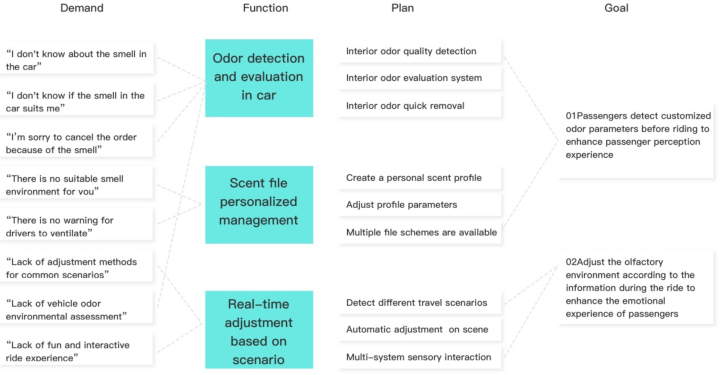
In conclusion, we transformed the research findings into specific design functionalities, each addressing distinct user pain points. These pain points were then refined into design objectives, ultimately leading to the develop- ment of concrete design solutions. Notably, the detection and assessment functionalities, coupled with personalized olfactory profiles, contribute to
Olfactory Profile: Enhancing the Satisfaction and Pleasure of Ride-Hailing Experiences 43
the goal of enhancing the comfortable perceptual experience. The feature of contextualized olfactory experiences, on the other hand, aims to fulfill the objective of emotional regulation. Both perceptual and emotional experiences harness the innate emotional and natural characteristics of scents, enhancing passengers’ overall experience without causing disruption.
Figure 5: Product demand, function extraction, scheme design transformation diagram.
DEVELOPED A “OLFACTORY PROFILE” PROTOTYPE DESIGN AND TEST AND EVALUATION FOR RIDE-HAILING SERVICES Prototype Design of “Olfactory Profile”
Based on the above analysis, we introduced the “Olfactory profile” system design. Its most significant advantage lies in catering to ride-hailing pas- sengers, enhancing their perceptual and emotional experiences during the ride, and also monitors and evaluates the in-car environment, encouraging drivers to maintain good air quality inside the vehicle. The introduction of the “Olfactory profile” system can also increase the brand influence of ride-hailing services and enhance their commercial value.
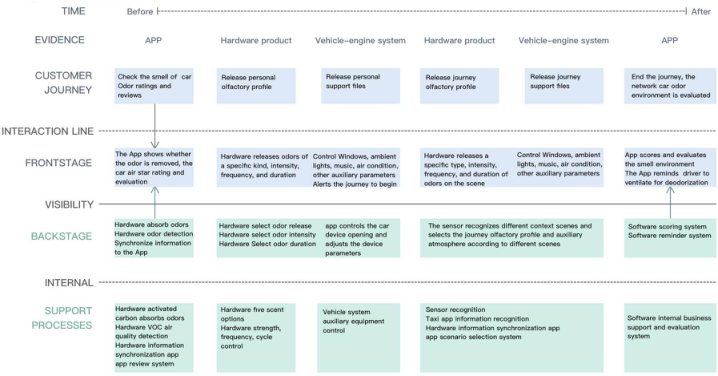
The system is designed according to the chronological order of the ride, from before the ride to during, and then after the ride. The main task before the ride is to detect the in-car scent quality and release the personal olfactory profile, which is established based on the user’s riding habits and personalized preferences. The personal “Olfactory profile” includes scent release and the coordination of vehicle-assistant features. Scent release involves the choice of smell, the intensity of scent release in the rear space, the frequency of scent release, and the cycle of scent release. Vehicle-assistant features include coor- dination of in-car ambient lighting, temperature, music, window controls, etc. During the ride, the main task is to adjust the journey “Olfactory profile” based on navigation and contextual information to determine the scenario. The journey scent adjustment also includes scent release and vehicle-assistant
44 Yang and Jie
feature coordination. The main task after the ride is passenger smell evalua- tion and driver ventilation reminders (see Figure 6). The figure shows that the system is a combination of software and hardware, so we will next introduce the specific hardware and application.
Figure 6: Olfactory file system design service blueprint.
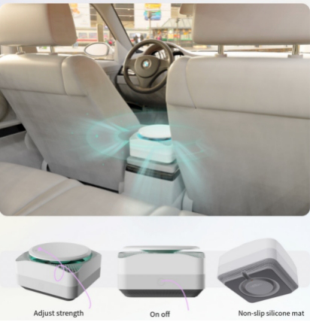
The hardware product is located behind the front armrest panel. To ensure the product is safe, practical, and comfortable, we considered various shape factors and materials. The appearance of the product is sleek and integrates seamlessly with the car interior, in line with our design philosophy of being unobtrusive and natural (see Figure 7). The product mainly includes function- alities for scent environment detection, odor removal, scent release, control of scent parameters, and controllable auxiliary features.
Figure 7: Olfactory file system hardware demonstration.
Olfactory Profile: Enhancing the Satisfaction and Pleasure of Ride-Hailing Experiences 45
The scent environment detection feature includes a built-in VOC sensor that can detect the current air environment inside the vehicle and upload VOC air quality data in real-time to the app, allowing passengers to under- stand the current air quality inside the car in advance. Odor removal employs activated carbon adsorption deodorization and neutral sandalwood purifi- cation. The scent release includes five fragrances to choose from, all derived from internationally standard environmental fragrances, featuring three rep- resentative scent categories of plants, flowers, and fruits: vanilla, lavender, sandalwood, orange, and rose to meet various fragrance needs of users. The built-in fan controls the intensity, cycle, and frequency of the scent, ensuring that the scent received by passengers in the rear maintains the desired emo- tional effect. Additionally, controllable ambient lights assist in adjustment, changing colors and brightness according to different scents to aid the in-car atmosphere.
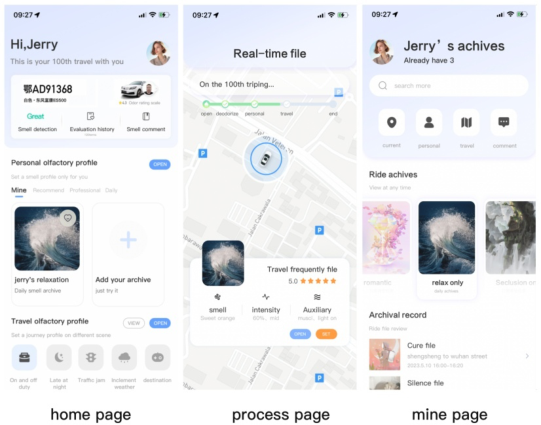
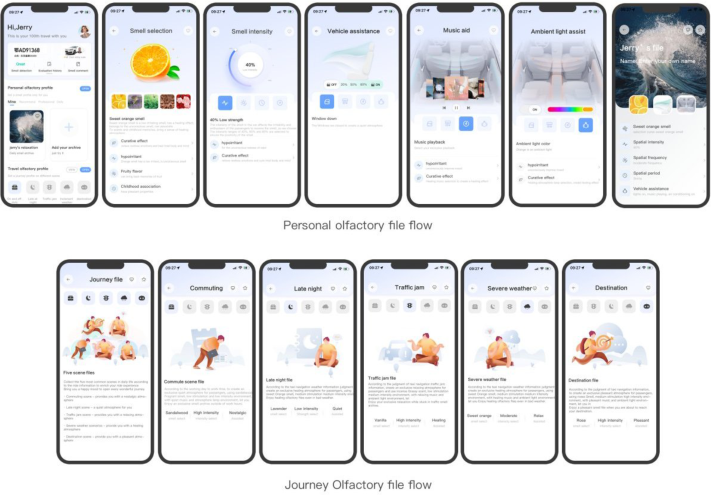
The design of the application involves embedding the olfactory profile into existing ride-hailing apps (see Figure 8). The main functions are to detect the in-car scent environment and evaluate the in-car score on the left, and to establish a personal olfactory profile for getting into the car and a jour- ney olfactory profile for during the ride on the right, saving olfactory profile records and classifications. The detection of the in-car environment through hardware feeds back to the app, allowing passengers to understand the scent situation of the ride-hailing car before using. The application mainly contains two primary functional processes: the personal profile and journey profile olfactory process (see Figure 9). Establishing a personal olfactory profile involves a customized process, including hardware odor removal before the ride and scent release and auxiliary adjustments during the ride, with specific options like scent choice, intensity, window, music, ambient light, and air con- ditioning settings. This process enables users to create and use their personal olfactory profile in advance to create a customized in-car environment upon boarding. Establishing a journey olfactory profile during the ride displays five main travel olfactory profiles, allowing viewing of olfactory scene profiles and real-time automatic adjustment of passengers’ emotions based on differ- ent data detection scenarios, maintaining a pleasant experience choice. These five scenarios, derived from survey results impacting passenger emotions, have been mapped by the olfactory profile, establishing an in-car atmosphere regulation system led by scents. They include a night ride scenario using low-intensity, low-frequency lavender scent to improve anxious emotional experiences; a traffic jam scenario using medium-low intensity, medium- frequency vanilla scent to relieve anxious emotions; adverse weather scenario using high-intensity, medium-frequency sweet orange scent to regulate uneasy emotions; commuting scenario using medium-intensity, medium-frequency sandalwood scent to regulate tense emotions; and nearing destination sce- nario using high-intensity, high-frequency rose scent to create a romantic emotional experience.
46 Yang and Jie
Figure 8: Olfactory profile system software demonstration.Figure 9: Personal and journey olfactory profile flow chart.
Testing and Evaluation of Olfactory Profiles We created a prototype and simulated real driving scenarios using the method of ‘The Wizard of Oz’ to assess the Olfactory Profile in the context of every- day ride-hailing experiences. The primary test was to evaluate the system’s robustness and usability over an extended period in multiple scenarios. We recruited 8 male participants (average age 27) who were asked to use the
Olfactory Profile: Enhancing the Satisfaction and Pleasure of Ride-Hailing Experiences 47
system in 5 different driving simulation scenarios over 3 days. Participants reported no allergies to scents and had previous experience with in-car fra- grance products. Scent selection was based on previous research examining whether scents induce comfort and how they affect emotional experiences during driving journeys. The evaluation of participants’ perceptions of the system was done using physiological indicators (skin conductance as a good indicator of individual emotional response) and face-to-face final interviews.
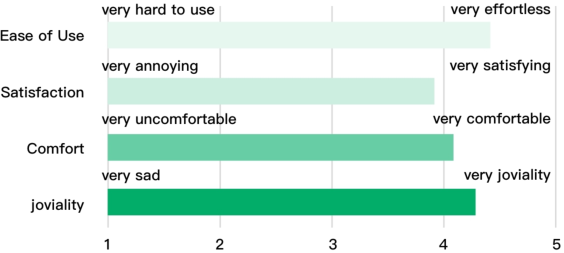
Physiological indicators were analyzed for users’ skin conductance responses, comparing the introduction of the Olfactory Profile in journey sce- narios with auditory, visual, and vibration feedback (see Table 2). The data indicates that the Olfactory Profile has significant advantages in terms of emotional response intensity, improvement in emotional response, and dura- tion of emotional impact. Face-to-face interviews used a 5-point Likert scale to rate the results, indicating that the Olfactory Profile system is robust and practical enough for long-term use in all 5 scenarios (see Figure 10). The olfactory system successfully functioned in all tests, and participants gave very positive feedback on their experience using the Olfactory Profile. The results show that users generally find the Olfactory Profile easy to improve perceptual experience and significantly enhance emotional experience.
Table 2. Prototype physiological experiment data analysis table.
Table available in the original PDF paper.
SCL Mean Value Rising Proportion Half Deacy Time nSCR olfactory archives 7.16µS 42% 3.75s 16times audio 5.72µS 28% 1.69s 8times vibration 6.91µS 38% 2.94s 5times vision 7.01µS 36% 2.73s 8times
Figure 10: Richter scale of passenger satisfaction.
CONCLUSION
This paper presented the “Olfactory profile” system, a user-centered experi- ential design system for ride-hailing passengers, which offers a comfortable experience from the moment of boarding to a pleasant experience during the
48 Yang and Jie
ride. Due to its low cost and reliable performance, it can be widely adopted in ride-hailing vehicles. The paper also discussed the preliminary test results of the prototype and conducted simulations to verify the usability and ease of the “Olfactory profile” in various scenarios. It will promote health and well-being in a way that is markedly different from current in-vehicle equip- ment. The current prototype has the limitation of being able to use only one scent at a time. Considerations for future designs include the habituation and desensitization to scents, gender influences, and specific limitations on scent intensity and frequency, all of which will impact the final experimental results. Through continuous improvement of the “Olfactory profile” in the future, it will greatly solve the problem of unpleasant smells in ride-hailing vehicles and regulate passengers’ emotions during their journey, significantly enhancing the future travel experience.
ACKNOWLEDGMENT
We would like to thank all the designers and stakeholders who participated in the interviews of this project for generously sharing their experiences. We also appreciate all the reviewers of the paper for their constructive and cru- cial comments. This project has received funding fromthe Key Research and Development Project of Hubei Province (2022BAA071).
REFERENCES
Covarrubias M, Bordegoni M, Rosini M, et al. VR system for rehabilitation based on hand gestural and olfactory interaction[C]. Proceedings of the 21st ACM symposium on virtual reality software and technology. 2015: 117–120. Daimler. A fragrance for the new S-Class. 2019. [Online; accessed 14-June-2019]. Dmitrenko D. Opportunities for olfactory interaction in an automotive context[D].
University of Sussex, 2020. First Financial and Cao Cao Travel “2022 Network car in-car Air Experience Report”, 2022. Website: https://www.zhihu.com/question/392199482/answer /2630712889. Funato, H., Yoshikawa, M., Kawasumi, M., Yamamoto, S., Yamada, M., and
Yanagida, Y. Stimulation effects provided to drivers by fragrance presentation considering olfactory adaptation. In Intelligent Vehicles Symposium 2009 (2009), IEEE. Herz R S, Engen T. Odor memory: Review and analysis[J]. Psychonomic bulletin & review, 1996, 3: 300–313. Imbesi S, Scataglini S. A user centered methodology for the design of smart apparel
for older users[J]. Sensors, 2021, 21(8): 2804. Kaye J J. Making scents: Aromatic output for HCI[J]. Interactions, 2004, 11(1): 48–61. Kiecolt-Glaser, J., Graham, J., Malarkey, W., Porter, K., Lemeshow, S., and Glaser, R.
Olfactory influences on mood and autonomic, endocrine, and immune function. Psychoneuroendocrinology 33, 3 (2008). Mustafa M, Rustam N, Siran R. The impact of vehicle fragrance on driving performance: what do we know?[J]. Procedia-Social and Behavioral Sciences, 2016, 222: 807–815. Xu Q, Jiao R J, Yang X, et al. An analytical Kano model for customer need analysis[J].
Design studies, 2009, 30(1): 87–110.
LISTED IN THE AHFE DIGITAL BOOKSTORE CATALOGUE
Explore the complete digital volume
Intelligent Human Systems Integration (IHSI 2024): Integrating People and Intelligent Systems
Read this individual research paper free through the original publisher, or explore the full digital proceedings book.
ISBN 978-1-958651-95-7
Explore this ISBN in the AHFE Bookstore ↗Listed in the July 2026 bookstore catalogue; search by ISBN to confirm current availability · Digital book purchase optional