Xinyu Zhao, Wenxuan Yang (2025). Context-Based Interactive Experience Design System for Children's Food Education. In: Affective and Pleasurable Design. AHFE Open Access, vol. 164, pp. 221–231. https://doi.org/10.54941/ahfe1006078
The issues of childhood dietary disorders and obesity are becoming increasingly severe. Helping children to correctly perceive food is crucial for their healthy development. Current food education tools fail to connect dimensions such as food knowledge, food manipulation, food interest, and food etiquette, making it difficult to establish a correct food cognition from an early age. Learning and development of knowledge are often enhanced and consolidated through situational interaction. Therefore, introducing a contextual learning model into children’s food education to build a comprehensive experience system that encompasses personal context, physical context, and sociocultural context is essential. Stimulating children’s positive emotional experiences with food through situational resources thereby enhances their intrinsic motivation to learn. Methodology: Firstly, 15 food education situational elements were identified through literature review. Secondly, data from the target group was collected using a questionnaire survey and analyzed using factor analysis, principal component analysis, and correlation analysis. Finally, an interactive experience model for food education was constructed based on the revised situational elements, and design strategies were proposed. Significance: This study provides new perspectives and methods for food education experience design. By enriching children’s multisensory interactive experiences, it deepens their understanding of food at cognitive, behavioral, and emotional dimensions, thereby compensating for the lack of emotional dimension in traditional food education.
In recent years, eating disorders and childhood obesity have grown more severe in China. The 2021 report “Nutritional Knowledge and Practice for School-age and Preschool Children” shows that 4.6% of 3–6 year-olds are overweight, and 9.2% obese. Among 6–12 year-olds, these rates rise to 14.4% and 20.0%, respectively. This is a significant public health issue in contemporary China. It’s crucial to integrate healthy food concepts into children’s education to guide them to develop accurate food awareness. Current educational methods such as picture books and games are simple
and repetitive, failing to connect food cognition, behavior, and culture, and do not leverage food education’s interdisciplinary potential. How to stimulate children’s intrinsic motivation with positive food experiences is a challenge for educators and designers.
Learning is enhanced by contex-based interactions. Scholars have found that sensory modalities such as vision, hearing, touch, smell, and taste are key in children’s food exposure, showing that multi-sensory contexts can boost food knowledge learning and children’s ability to judge and choose food (Brug et al., 2008). This study integrates a contextual model into children’s food learning, clarifies the relevant elements, and develops an interactive educational approach. It aims to enhance children’s emotional engagement with food on cognitive, physical, and social dimensions, offering strategies for practitioners.
RELATED WORKS Contextual Model Elements and Theoretical Applications
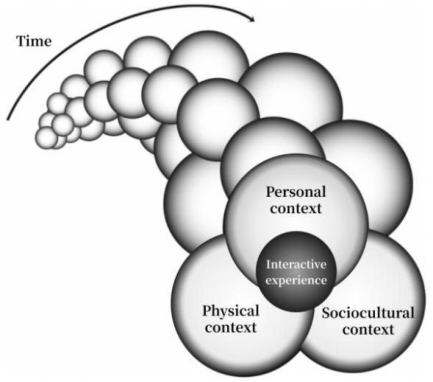
Schilit defined context as changes in the relationships between people, objects, and environments (Schilit et al., 1994). Dierking and Falk (1992) saw learning as a context-driven value-creation process, influenced by individual, physical, and social factors. The contextual model, shown in Figure 1, represents these factors as interacting spheres: personal context, physical context, and sociocultural context. The shaded area symbolizes how these contexts shape the learners experience. The personal context includes psychological factors such as prior knowledge and motivation. The physical context involves responses to the environment, such as artifacts and lighting. The sociocultural context includes cultural and social relationships.
Figure 1: Contextual interaction experience model (Dierking & Falk, 1992).
Context-Based Interactive Experience Design System for Children’s Food Education 223
Contextual theory research evaluates how various elements affect user experience and behavior. Luo Shijian incorporated contextual analysis into design, creating a system model. Its effectiveness was confirmed in learning software design, achieving high usability scores (Luo et al., 2010). Zhang Jun’s study on product gesture design identified how design content relates to users, devices, and the environment. Testing showed that contextual modeling boosts gesture interaction efficiency (Zhang et al., 2019). Tong Yixuan applied the contextual model in a children’s outdoor camping scenario and described the context-driven process that influences the outcome. The positive effects of contextual model on children’s outdoor learning were revealed, including knowledge and skills, social skills, and positive emotions (Tong et al., 2020).
Research has expanded context to children’s food education, examining interactions between cognition, behavior, products, and the environment (Birch & Fisher, 1998). Regarding learners, children have varying knowledge backgrounds, and personal context can be adapted to children’s cognitive experiences with food. In terms of content, the concept of food can be abstract and complex. Physical and virtual elements in the physical context can engage children’s senses and behaviors, to form concrete emotional memories of food. From a socio-cultural perspective, interpersonal interaction is a fundamental aspect to social learning. Interaction can facilitate children’s understanding of diverse food cultures and perspectives. This emotional connection to food can be further extended through social roles. The contextual model in food education assesses children’s needs, guides product design, enhances interactions, and promotes positive engagement.
Conceptualization of Contextual Elements in Food Learning The contextual model informs food education research, comprising children, physical objects, and social individuals. The personal context is related to the perceptual characteristics of children. It includes motivation to eat, food expectations, prior knowledge, food experiences and preferences. The physical context is related to physical environment attributes. It includes environment size, educational materials, activity themes, and atmosphere. The sociocultural context includes children’s food-related social networks and interactions with peers, parents, and teachers.
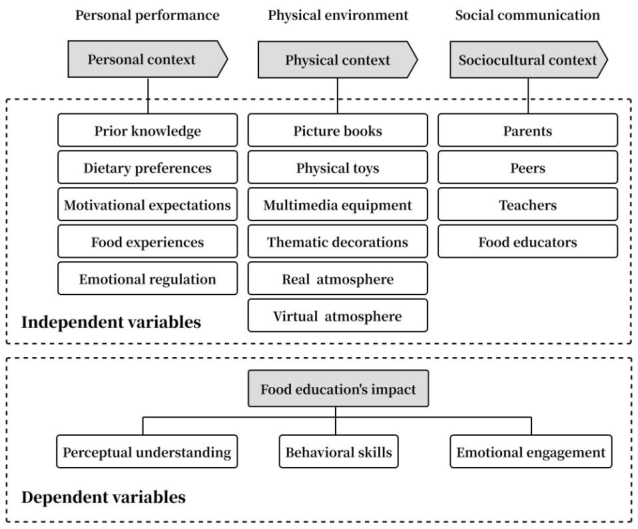
This study conceptualized key contexts for preschoolers’ food learning. 15 contextual elements were identified through literature for later data analysis. 5 personal context factors were established in children’s initial perception phase: prior knowledge, dietary preferences, motivational expectations, food experiences, and emotional regulation. 6 physical context elements were established in the behavioral manipulation phase: picture books, physical toys, multimedia equipment, thematic decorations, real and virtual atmospheres. 4 sociocultural context elements were established in the emotional communication stage: parents, peers, teachers, and food educators.
224 Zhao and Yang
METHOD
The study utilized questionnaires and statistical methods. The questionnaires were designed and distributed based on the 15 pre-set model elements. The collected data were analyzed using statistical methods. Three methods— namely factor analysis, principal component analysis, and correlation analysis—were employed to enhance data depth and accuracy (Yu and He, 2003). Factor analysis focuses on the underlying structure and dimensionality of the variables. Principal component analysis can downgrade the data and eliminate variables with low correlation. Correlation analysis is used to reveal the strength of association and causality among variables. This comprehensive analysis filtered positive food education factors to support a contextual interactive experiential model of food learning.
Participants Since preschool children cannot answer questions objectively, the food education questionnaire was administered to their parents. The aim was to gather data on children’s dietary traits and habits. Parents were informed of the study’s purpose and procedures prior to participation and provided signed consent forms. A total of 208 questionnaires were distributed.
Experimental Settings Incorporating food learning context into the questionnaire standardized questions for parent understanding. Considering the hypothesized 15 contextual factors as independent variables, the dependent variables (e.g., learning outcomes) must also be defined. Aligning with Japan’s Food Education Organization goals, “Food Education Perspectives” outcomes include food cognition, choice skills, social-emotion, and personality values, assessing food education’s impact on early development (Wang et al., 2021). From the three dimensions of personal performance, physical environment, and social communication. Based on the contextual model, Figure 2 shows that learning effects include perceptual understanding, behavioral skills, and emotional engagement.
The questionnaire had two parts: six questions on the child and food parenting background, and 15 Likert-scale scored questions assessing satisfaction with food education, rated 1 (strongly disagree) to 5 (strongly agree). SPSS software showed the 15 questions had a Cronbach Alpha of 0.861, proving high reliability. After removing invalid responses, 205 valid questionnaires were analyzed.
Context-Based Interactive Experience Design System for Children’s Food Education 225
Figure 2: Delineation of contextual elements in food learning.
RESULTS & DISCUSSION Higher Correlation Between Independent Variables
Factor analysis identified underlying variable structures and validated the questionnaire’s accuracy and validity. The 15 scale-related questions were selected for analysis to generalize key factors. Table 1 shows a KMO coefficient of 0.719 and high correlations between independent variables. Bartlett’s test yielded a p-value below 0.05, confirming the suitability of the hypothesised factors for factor analysis.
Table 1: KMO and Bartlett’s test for sphericity.
Table available in the original PDF paper.
KMO and Bartlett Test
KMO Quantity of Sample Suitability 0.719 Bartlett Sphericity Test Approximate Chi-Square 890.687 Degrees of Freedom 105 Significance 0.000 The Contextual Elements Are Divided into Three Main Dimensions
Principal component analysis reduces data dimensionality, detects structure and variability, and verifies hypotheses. For 205 valid samples with 15 variables, Table 2 shows three principal components accounting for 63.258% of total variance, capturing the majority of the dataset’s variability. The factor matrix was then rotated using variance maximization to identify high-loading terms explaining the contextual dimension’s principal factors.
Table 3 presents the rotated component matrix, showing the specific elements of the three dimensions. After eight iterations, 14 elements loaded more than 0.5 on a single dimension, meeting the validity test criteria. The emotion regulation factor was excluded despite loading over 0.5 on both dimensions, as it lacked theoretical relevance to the contextual model.
Extraction method: principal component analysis. Rotation method: Kaiser normalized maximum variance method.a a. The rotation has converged after 8 iterations.
In summary, the first dimension is child-centered personal context, including children’s prior knowledge, dietary preferences, motivational expectations, and food experiences. The second dimension is the physical context, consisting of picture books, physical toys, multimedia devices, thematic decorations, real atmosphere, and virtual atmosphere. The third dimension is the sociocultural context, composed of parents, peers, teachers, and food educators. Comparison with the contextual model shows that the three main dimensions are basically the same, verifying the rationality of applying personal context, physical context, and sociocultural context to food education.
Context-Based Interactive Experience Design System for Children’s Food Education 227
11 Independent Variables Correlate With the Dependent Variable
Pearson correlation analysis was used. Table 4 shows the correlations between the 14 independent variables and 3 dependent variables. Coefficients above 0.5 were considered highly correlated, and variables below 0.3 were removed. This analytical approach is critical for constructing theoretical models and guiding practical applications.
First, correlations between 4 factors in the personal context and children’s perceptual understanding were analyzed. The analyzed factors included: prior knowledge (0.378), dietary preferences (0.419), motivational expectations (0.552), and food experiences (0.300). Motivational expectations had coefficients over 0.5, demonstrating strong associations. Second, correlations between 6 factors in the physical context and behavioral skills were analyzed. The analyzed factors included: picture books (0.647), physical toys (0.590), multimedia equipment (0.284), thematic decorations (0.476), real atmosphere (0.619), and virtual atmosphere (0.138). Multimedia equipment and virtual atmosphere were excluded due to coefficients below the 0.3 threshold. Picture Books, Physical Toys, and Real Atmosphere showed coefficients exceeding 0.5, demonstrating strong associations. Third, correlations between 4 factors in the sociocultural context and emotional engagement were analyzed. The analyzed factors included: parents (0.331), peers (0.608), teachers (0.295), and food educators (0.406). Teachers did not meet the 0.3 coefficient standard and were removed. Peers had coefficients over 0.5, suggesting robust relationships.
Table 4: Correlation between independent and dependent variables.
**. At the 0.01 level (two-tailed), the correlation was significant. *. At the 0.05 level (two-tailed), the correlation was significant.
228 Zhao and Yang
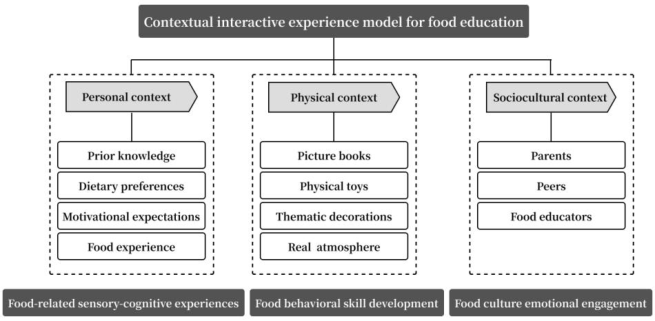
The food education contextual model’s rationality was verified using statistical methods, identifying 11 key elements in the food learning process. The personal context includes prior knowledge, dietary preferences, motivational expectations, and food experiences. The physical context includes picture books, physical toys, thematic decorations, and real atmosphere. The sociocultural context includes parents, peers, and food educators.
CONTEXTUAL INTERACTIVE EXPERIENCE MODEL FOR FOOD EDUCATION The food learning cycle system is shown in Figure 3. Learning is translated into cognitive, affective, and social connections through three dimensions of contextual elements input and output. In the personal context, children are provided with motivational expectations for eating based on their prior knowledge, experience, and preferences. Children perceive attributes such as food appearance, texture, odor, and sound and learn to understand food. In the physical context, digital and virtualized applications need to be reduced. The recommendation to minimize digital applications in the physical context aligns with evidence that hands-on manipulation enhances children’s sensory engagement (Hornecker et al., 2006). In sociocultural context, establish interactions in intimate or professional roles. Enable children to experience the culture that food carries and to develop lasting socio-emotional experiences.
Figure 3: Contextual interactive experience model for food education.
DESIGN STRATEGY Personal Context: Eliciting Food-Related Sensory-Cognitive Experiences
The human cognitive system integrates sensation, perception, attention, memory, and reasoning. Real-world elements (e.g., light, color, sound) directly stimulate children’s senses and align with their cognitive
Context-Based Interactive Experience Design System for Children’s Food Education 229
development. Designers should explore multi-sensory food experiences to enhance emotional cognition.
Incorporate visual sensory experiences by extracting food characteristics such as color, form, and texture. Select representative food colors based on color psychology to aid children in differentiating food information. Combine food forms with product styling, and integrate food textures with product textures to improve practical properties such as anti-slip and drop-resistant. For example, designers have translated the morphological characteristics of celery into a series of tableware, where the food is presented in an elegant shape on cutlery.
Include auditory sensory experiences through physical mechanisms or digital technology by simulating sounds of food cutting, cooking, and chewing. These sounds add interest and allow children to perceive operation status and system progress.
Restore the sense of touch of food using different materials to integrate tactile sensory experiences. Simulate external tactile sensations, physical changes, and mouth textures of food through materials like silicone, flocking technology, heat-sensitive materials, resin, foam.
Elicit associations with the sense of smell by integrating olfactory and taste sensory experiences. Embed fragrances to simulate the odor of cooking food using methods like special ink printing and odor triggers.
Physical Context: Facilitating Food Behavioral Skill Development Thematic scenes with interactive elements enable real-time feedback, prompting children to question, judge, and act. Thus, the physical world of objects, thematic series, spatial layout, and atmosphere becomes necessary to influence children’s behavior.
Creating dynamic food interaction scenes provides children with ways to communicate with food. Picture books, models, and cards help children learn fine manipulations like food cutting and mixing, aiding their understanding of the food process from farm to table. Thematic series offer design scope for food education modules, focusing on food life cycles, regional culture, and healthy living. Product kits include tasks, props, and obstacles. Children construct a food knowledge framework by engaging in structured, hands- on learning activities. Spatial layouts, with removable partitions, encourage children to discover food elements freely. A positive atmosphere, with natural light, soft sounds, and engaging props, makes food practices enjoyable for children.
Sociocultural Context: Deepening Food Culture Emotional Engagement Integrate the perspectives of parents, peer children, and professional food educators in the design. It promotes children’s understanding of food culture and deepens interpersonal connections. First, parent-child interaction and exploration. Deconstructing the product into multiple modules, children and parents work together to combine and innovate. Second, peer cooperative learning. Utilizing the social tendency of peers, sharing food experiences
230 Zhao and Yang
among peers. Group cooperation to complete food tasks, develop team socialization and empathy. Third, multi-role co-creation. Parents and food educators can play the role of professional guidance to form a supportive food learning environment.
With the support of contextual elements, the interactive experience of children’s food education products transitions from the sensory-cognitive dimension, to the physical-behavioral dimension, and ultimately into the socio-emotional dimension. These three dimensions are interdependent and reinforcing.
CONCLUSION
In the context of aesthetic education in the new era, this study breaks through the limitations of the traditional food education model. It innovates the shape of food education practice and expects to bring ideas for food education. This study redefines food education through a contextual model, identifying 11 elements across personal, physical, and sociocultural dimensions. The interactive experience model in the food education context is constructed, and design strategies are proposed. These strategies fit children’s characteristics in the personal context, integrate physical resources in the physical context, and promote multi-role interaction in the sociocultural context. Achieve the purpose of enhancing children’s food cognition, behavioral skills and emotional engagement. Nevertheless, the user sample of this study’s questionnaire research was focused on the Jiangsu region of China, where children’s backgrounds are more limited. In the future, designers can explore the applicability of strategies in different food culture contexts. To track the impact of relevant design outputs on children’s long-term eating habits.
REFERENCES
Birch, L. L., & Fisher, J. O. (1998). Development of eating behaviors among children and adolescents. Pediatrics, 101(Supplement 2), 539–549. Brug, J., Tak, N. I., Te Velde, S. J., et al. (2008). Taste preferences, liking, and other
factors related to fruit and vegetable intakes among schoolchildren: Results from observational studies. British Journal of Nutrition, 99(S1), S7–S14. China Food Safety News. (2021, November 30). Nutrition Knowledge and Practice Report for School-Aged and Preschool Children 2021. China Food Safety News, p. C02. Dierking, L. D., & Falk, J. H. (1992). Redefining the museum experience: The
interactive experience model. Visitor Studies, 4(1), 173–176. Hornecker, E., & Buur, J. (2006). Getting a grip on tangible interaction: A framework on physical space and social interaction. DBLP. https://doi.org/ 10.1145/1124772.1124838 Luo, S., Zhu, S., Ying, F., & Zhang, J. (2010). Context-based user experience
design in mobile interfaces. Computer Integrated Manufacturing Systems, 16(2), 239–248. Schilit, B., Adams, N., & Want, R. (1994). Context-Aware Computing Applications.
In 1st International Workshop on Mobile Computing Systems and Applications (pp. 85–90).
Context-Based Interactive Experience Design System for Children’s Food Education 231
Tong, Y., Wu, M. Y., Pearce, P. L., et al. (2020). Children and structured holiday camping: Processes and perceived outcomes. Tourism Management Perspectives, 35, 100706. Wang, S., Li, X., & Gao, H. (2021). Four key issues in curriculum integration:
Insights from Japan’s food education curriculum system. Global Education Outlook, 50(6), 12–26. Yu, J., & He, X. (2003). Data Statistical Analysis and SPSS Application. Beijing: People’s Posts and Telecommunications Press. Zhang, J., Liu, Y., & Chen, K. (2019). Gesture interaction design for wearable devices
based on context model. Packaging Engineering, 40(12), 140–146.
LISTED IN THE AHFE DIGITAL BOOKSTORE CATALOGUE
Explore the complete digital volume
Affective and Pleasurable Design
Read this individual research paper free through the original publisher, or explore the full digital proceedings book.
ISBN 978-1-964867-40-3
Explore this ISBN in the AHFE Bookstore ↗Listed in the July 2026 bookstore catalogue; search by ISBN to confirm current availability · Digital book purchase optional