Fausto Zapatta, Catalina Astudillo-Rodriguez (2023). The Use of Virtual Reality in Tourism Education: Systematic Review. In: Training, Education, and Learning Sciences. AHFE Open Access, vol. 109, pp. 112–122. https://doi.org/10.54941/ahfe1003157
The present study reviewed primary studies that report the use of virtual reality in tourism education to identify the impact that the use of virtual reality has generated in the classroom. The applied methodology was the systematic literature review proposed by Kitchenham, which includes planning, review and reporting of results. As a result, 365 scientific articles were obtained, of which, after reviewing, we selected 52 papers. In these articles, it is evident that virtual reality is a tool that has positively impacted education, establishing through constructivism an adequate relationship of students with the knowledge, does not discriminate gender or age, which allows having a range of action at all educational levels, in terms of tourism facilitates approaching the area where the activity takes place from every context.
In recent years, tourism has experienced different evolutionary curves, disco- vering that the flow of visitors to the main destinations in the world has increased. This fact was altered due to the COVID-19 pandemic, reducing the number of people travelling to almost zero. All these variations have cau- sed various analyses, new ways of managing tourism and how the academy approaches it (Yung, Khoo-Lattimore and Potter, 2021).
The evolution of technology has taken leaps and bounds, allowing tech- nology to become more accessible to the consumer. Many theorists have analysed the use of different technological tools in education, allowing the development of new systems, virtual learning environments, and educa- tional techniques with a different approaches. In the case of tourism, it has not been the exception; the use of technology to approach a desti- nation, a historical fact, a somehow unattainable space, and the acade- mic interest in optimising technological resources guide the present study (Schott and Marshall, 2018).
The present work presents an alternative in which Virtual Reality (VR) contributes to learning without discriminating academic groups. However, the study is focused on tourism education. Since despite being a rapidly gro- wing industry, its relationship with technological systems has been limited to
Systematic Review of Literature of the Use of Virtual Reality 113
reservation systems concentrated on the hotel industry and tourism. Leaving aside other elements which can improve the ability to learn and the same academic development of tourism professionals.
Despite a large amount of existing literature, very little has focused on studying or researching the use of virtual reality in tourism. Therefore, the objective of this paper is to carry out a systematic review of primary studies that report the use of virtual reality in tourism education. To identify the impact that the use of virtual reality generated in the classroom. The reported characteristics of their inclusion in the academic tourism field, the academic group about age, gender and level of study where better results have been achieved.
This document is divided into the following sections: initially, it presents the theoretical support and previous related research, followed by applying the methodology proposed by (Kitchenham and Charters, 2007) for the syste- matic review of literature, including the phases of planning, carrying out and reporting results; Finally, it presents the conclusions.
Related Work
Virtual reality, known by its acronym in English VR, made its first appeara- nce in 1938 with the stereoscope, or stereopsis, that generates a depth effect through two images; later, in 1929, the first simulator for combat pilots was created, which would be the prototype for current VR, through the years evo- lving until what we have today (Garcia Garcia, Vivar Zurita and Universidad Complutense de Madrid, 2005).
To define virtual reality, it is essential to consider that VR must generate a three-dimensional environment. The author describes VR as a series of inte- ractive data generated through an operating system, which stimulates the senses, is visualisable, and can be manipulated in “real-time”, allowing the user to be part of the virtual world (Levis, 2012).
Virtual reality is efficient for learning, contributing to the critical analy- sis and reflection of the students. Thanks to the technological adva- nces in recent years and the lower costs of VR, these trips can now be made from the classroom without having to leave it (Schott, 2017). It is also important to consider as a constructivist tool since learning is built through individuals and their interaction with the environment through VR (Chen, 2009).
Tourism and technology are two industries that have been growing toge- ther over the years; the evolution and interest in them have increased thanks to globalisation that every day covers more areas. Tourism somehow depends on technology to promote itself and reach more consumers (tourists) (Rodriguez, 2015).
Competition in tourism year after year has become more radical, which has led to some destinations including technologies such as VR and AR so that tourists can access other types of experiences in the same destinations from smartphones or any device that enhances the visit (Katkuri, Mantri and Anireddy, 2019).
114 Zapatta-Moya and Astudillo-Rodriguez
VR encourages the student to feel in place, generating an immersive expe- rience that allows knowledge to be developed—having these tools at our disposal in the academic field. It is proposed to contribute to the tourism career. (Schott and Marshall, 2021). According to (Xerach Pérez, 2014), it is essential to pay attention to technological evolution since, over the years, its link to all industries has been gaining ground, and the tourism industry has been one of the least able to adapt and use these resources.
METHOD
The present study takes as a basis for its development the proposal presen- ted by (Kitchenham and Charters, 2007) for systematic literature reviews. It includes the phases of planning, carrying out and reporting the SLR.
Research Questions The research questions are presented in Table 1.
Search Process The applied search strategy includes identifying the terms or keywords for the search, assembling the search string and executing the search string in the selected digital libraries.
Search String. The main terms are established as: “Virtual Reality”, “Education”, and “Tourism”; the alternative term is: “VR”, and conne- ctors in the English language are established for the search string: “OR” and “AND”.
Online Databases. The search string is applied to the title, abstract, and keyword metadata. Automatic searches were done in the digital libra- ries: IEEE Xplore, Scopus, ACM, Springer, Emerald, and SAGE. Also, from manual searches in Google scholar, the 4th International Conference of the Virtual and Augmented Reality in Education, the 7th International Conference on Arts IT 2018 and the 3rd EAI International Conference on Design, Learning and Innovation.
Study Selection The selection process of studies is based on reading the title and abstract by each reviewer and according to the established inclusion and exclusion criteria (see Table 2).
Table 1. Research questions.
Table available in the original PDF paper.
N. Research Question RQ1 What impact has generated the use of virtual reality in the classroom? RQ2 What characteristics were found in applying virtual reality in the academic field of tourism? RQ3 In which academic group, considering age, gender, and study level, have achieved the best results with virtual reality? RQ4 How has virtual reality influenced the academic development of students?
Systematic Review of Literature of the Use of Virtual Reality 115
Table 2. Inclusion and exclusion criteria.
Table available in the original PDF paper.
Inclusion criteria Exclusion criteria IC1: Articles that address the use of virtual reality in education. IC2: Articles that mention virtual reality in tourism. IC3: Articles that analyse the use of virtual reality in tourism education. IC4: Complete articles. IC5: Articles in English, Spanish, and Portuguese
EC1: Editorials, prologues, opinions, discussions, interviews, news, publicity, summaries of articles, panels, or posters. EC2: Articles for which the complete document is not available. EC3: Duplicate articles in other bibliographic bases. EC4: Articles that still need to be validated. EC5: Articles that are written in languages other than those mentioned.
Once the search string is applied in the libraries, 319 articles are obtained, distributed as follows: ACM 11 articles, Emerald 119 arti- cles, IEEE 19 articles, Sage Journals 2 articles, Scopus 128 articles and Springer 43 articles. In the first review, 34 duplicate papers were elimi- nated, followed by the title and abstract being reviewed in each study. The inclusion and exclusion criteria were applied, leaving 53 articles evaluated.
Quality Assessment The quality of each selected article is evaluated according to the criteria pre- viously established; the score for each closed question will be the arithmetic mean of all the individual scores of each reviewer. The whole of the sco- res of the three closed questions of each study provides a final score (an integer between -4 and 4). These scores shown in Table 3 were not used to exclude articles from the study but were used to detect representative research studies.
Strategy for Data Extraction The data extraction strategy defines the possible answers to each question that can be identified in the reviewed studies, as represented in Table 4.
Table 3. Quality evaluation.
Table available in the original PDF paper.
Question Criteria Score Have five or more authors cited the article?
Three or more 1 2 or 3 0 Two or less -1 Has the article been published in a relevant journal or conference?
Q1, Q2 1 Q3, Q4 0 Others -1 Does the study draw a conclusion where VR is linked to tourism education?
Yes 1 Average 0 No -1
Yes 1 It’s mentioned 0 No -1 Does the study link data collection, data interpretation and conclusions correctly?
116 Zapatta-Moya and Astudillo-Rodriguez
Table 4. Research question.
Table available in the original PDF paper.
N. Description RQ1 Learning process, better attitude, accessibility, improved learning, mitigate risks, Teaching process, Helps understand student problems, Fosters innovation., Education system, Educational, content, Experiential education, Active participation, Health conditions, Pedagogical benefit, Increased school, engagement, Skill enhancement, Research tool, Constructivism RQ2 Immersive interface, Animation routines, Interactive capability, Virtual environments, Critical thinking, Motion, Tourism education, Sensory stimulation RQ3 New generations, All ages, Digital natives, All genders RQ4 Complete experience, reduces science phobia, improves skills, Professional development, Accessibility and inclusion, Cultural context, Health condition (disadvantage), Improves learning process, promotes collaborative learning, Experiential learning, Better attitude, Committed students.
RESULTS
Once the information extraction is complete, the following results are evidenced for each research question posed.
RQ1. What Impact Has Generated the Use of Virtual Reality in the Classroom?
Studies have shown that adopting virtual reality (VR) technology can enhance the educational process by allowing students to interact in controlled and risk-free environments without limitations of time and space. Additionally, the immersive experience of VR can generate positive feelings in participants (Stavroulia et al., 2019).
When discussing the educational system and its relationship with VR, it is argued that the government must intervene through policies that allow development, innovation, and entrepreneurship. This also generates new employment sources (Rath, Satpathy and Patnaik, 2019).
Studies have shown that virtual reality technology can improve the edu- cational process. This technology helps students interact in a risk-free envi- ronment where they can face controlled situations without time and space limitations. VR can create positive feelings in the participants and improve their concentration, making it easier for them to understand abstract conce- pts. Virtual environments simulate reality, allowing students to understand situations more vividly. This can change students’ attitudes towards learning and generate new skills and experiences. VR also contributes to constructi- vism by enabling students to interact and experiment with virtual objects, building their own knowledge. Additionally, VR is seen as a way to approach blended learning, allowing both virtual and in-person activities. For students and educators, VR contributes to research, allowing them to test and evaluate theories without affecting natural objects or environments (Guttentag, 2010; Perez-Valle and Sagasti, 2012; Stavroulia et al., 2019; An, Ko and Kang, 2020; Baxter and Hainey, 2020a; McGovern, Moreira and Luna-Nevarez, 2020). The impact classification and articles mentioned it is represented in Table 5.
Systematic Review of Literature of the Use of Virtual Reality 117
Table 5. Impact on the use of virtual reality in the classroom.
Table available in the original PDF paper.
Description N. Description N.
Learning process 8 Educational content 1 Better attitude 3 Experiential education 1 Accessibility 2 Active participation 1 Improve learning 1 Improve concentration 1 Improve skills 2 Health conditions 1 Mitigate risks 1 Pedagogical benefit 1 Teaching process 3 Increased school engagement 1 Helps understand student problems 1 Skill enhancement 1 Fosters innovation 1 Research tool 1 Education system 1 Constructivism 1
Q2. What Characteristics Were Found in Applying Virtual Reality in the Academic Field of Tourism?
The academic curricula related to hospitality worldwide aim to develop professionals who can adapt to the changing world of work. v VR in tourism can improve the education process by providing new and engaging learning experiences through virtual environments (Gupta, Hassanien and Khanna, 2020). VR can reduce the need for physical trips, increase efficiency and optimise learning times while still delivering holistic knowledge (Shen et al., 2022). The perception of VR is positive and contri- butes to student motivation, interpersonal communication skills, and critical thinking. VR also allows for a better understanding of sensitive environments and the impact of tourism (Lee et al., 2017; Schott and Marshall, 2021b).
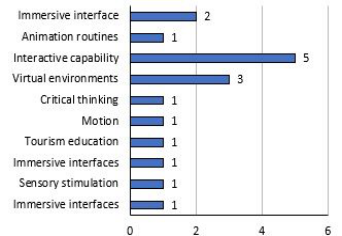
As you can see in Figure 1, most of the features related with the different papers talk about virtual environments, immersive experience and interactive capabilities.
Q3. In Which Academic Group, Considering Age, Gender, and Study Level, Have Achieved the Best Results With Virtual Reality?
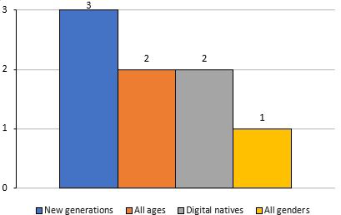
Once all the articles selected for this study have been reviewed, it is determi- ned that there is no age limit for virtual reality since it is adaptable to different contexts and realities. The same happens with gender and educational level as shown in Figure 2.
Figure 1: Features of virtual reality applications.
118 Zapatta-Moya and Astudillo-Rodriguez
Figure 2: Age group and gender.
VR can be easily adapted to different age, social, and cultural groups; it is even proposed to be accessible for people with disabilities, allowing them greater reach and commitment (Chiao, Chen and Huang, 2018). It should be noted that for the new generations, it is more accessible, and they are more enthusiastic when adapting to new technologies (McGovern, Moreira and Luna-Nevarez, 2020). By being more involved in using mobile devices, they have greater familiarity; therefore, the learning process is much more familiar (De Paolis and Bourdot, 2019).
Efforts have been made to develop technological advances in the educa- tional field, especially in higher education. According to (Hsu, 2018), for millennials, who have a very short-term level of attention, proposing inte- ractive, collaborative activities through new technologies will allow them to adapt and learn better. However, this can challenge educators since they must redefine their strategies. Since the stakeholders who have a particu- lar characteristic, being digital natives, it is straightforward to adapt them to new technologies such as virtual reality (Loureiro, Bilro and Angelino, 2021). When talking about age, it should be mentioned that virtual reality can affect younger users since it can cause long-term problems of photosensitivity and seizures. All this is due to the high visual and auditory stimulus generated by VR, which is why it is essential to consider these effects to mitigate them (An, Ko and Kang, 2020). Regarding gender, (Baxter and Hainey, 2020b) mention that men tend to be more enthusiastic when proposing study meth- ods through virtual reality, which can be translated into better assimilation of the knowledge delivered through this technology.
Q4. How Has Virtual Reality Influenced the Academic Development of Students?
The use of virtual reality (VR) in education presents benefits for students, tea- chers, and professionals (Perez-Valle and Sagasti, 2012). VR can help improve students’ science phobia and learning through guided activities (Sakamoto et al., 2018). It provides safe and controlled environments for solving pro- blems and helps teachers guide students in learning (Stavroulia et al., 2019). Additionally, VR generates new skills in students compared to traditional presentations and can evidence knowledge differently (McGovern, Moreira and Luna-Nevarez, 2020).
Systematic Review of Literature of the Use of Virtual Reality 119
The use of virtual reality positively influences being able to adapt to people with disabilities through solutions such as generating assisted locomotion; that is, through external tools, people with reduced mobility problems or some learning disabilities can be assisted by the use and operation of the con- trols. It encourages greater activity participation (Torres Mas et al., 2022). In the field of autism, it contributes since it is not limited to texts or illustrations, which allows the concept to be visualised and experience how things work (Nalluri, L and Munavalli, 2021).
Virtual reality is increasingly being used in education and has several benefits, including providing safe and controlled learning environments and allowing for immersive experiences. The technology is also being used to mitigate adverse effects, and companies are using AI and 5G to improve it (Nalluri, L and Munavalli, 2021). Despite limited options for educational games, VR has the potential to enhance students’ learning experiences by making them more practical and engaging (An, Ko and Kang, 2020). VR offers a first-person experience, allowing students to understand cultural processes, surroundings, and environmental context. In tourism, VR gene- rates greater engagement and learning through simulations of the natural world (Chen, Warden and Lin, 2017; Martín-Gutiérrez et al., 2017; Gupta, Hassanien and Khanna, 2020; Loureiro, Bilro and Angelino, 2021). The con- structivist approach to VR in education allows students to be the leading interpreters in their learning experiences. The use of VR in education impro- ves student learning and critical thinking skills, with a focus on the student (Chiao, Chen and Huang, 2018; Bilotta et al., 2021).
As represented in Table 6, there are different influences related to students’ academic development.
Table 6. Influence of VR on students’ academic development.
Table available in the original PDF paper.
Description N. Description N.
Full experience 1 Improve learning process 3 Reduces science phobia 1 Promotes collaborative learning 1 Improve skills 1 Experiential learning 1 Professional development 1 Improve concentration 1 Accessibility and inclusion 1 Better attitude 1 Cultural context 2 Committed students. 1 Health condition (disadvantage) 1
CONCLUSION
The study found the importance of technology in education and the need to optimise its use in the academic field. The benefits of virtual reality in the classroom have been noted, including its contribution to the academic world, gamification, and inclusivity for people with disabilities (Memos et al., 2020).
The use of virtual reality in education has been found to improve the state of mind of students. Therefore the educational system should invest in developing new technologies to lower costs and improve the quality of education.
120 Zapatta-Moya and Astudillo-Rodriguez
The use of virtual reality in tourism education is limited and mainly focu- sed on language learning or as a guiding tool. The technology available in the tourism academic field is limited to reservation systems. The curriculum must adequately prepare professionals to utilize technology for new ways of communicating tourism with consumers.
REFERENCES
An, M. Y., Ko, K. A. and Kang, E. J. (2020) ‘Problems and Directions of Development through Analysis of Virtual Reality-Based Education in Korea’, International Jour- nal of Information and Education Technology, 10(8), pp. 552–556. Available at: https://doi.org/10.18178/ijiet.2020.10.8.1423. Baxter, G. and Hainey, T. (2020a) ‘Student perceptions of virtual reality use in higher
education’, Journal of Applied Research in Higher Education, 12(3), pp. 413–424. Available at: https://doi.org/10.1108/JARHE-06-2018-0106. Bilotta, E. et al. (2021) ‘Industry 4.0 technologies in tourism education: Nurturing students to think with technology’, Journal of Hospitality, Leisure, Sport & Tou- rism Education, 29, p. 100275. Available at: https://doi.org/10.1016/j.jhlste.2020. 100275. Chen, C. J. (2009) ‘Theoretical Bases for Using Virtual Reality in Education’, 2009
[Preprint]. Chen, J. F., Warden, C. A. and Lin, H. J. (2017) ‘Efficacies of 3D Immersive Virtual World Classrooms’, in T.-C. Huang et al. (eds) Emerging Technologies for Education. Cham: Springer International Publishing (Lecture Notes in Computer Science), pp. 45–48. Available at: https://doi.org/10.1007/978-3-319-71084-6_6. Chiao, H.-M., Chen, Y.-L. and Huang, W.-H. (2018) ‘Examining the usability of
an online virtual tour-guiding platform for cultural tourism education’, Journal of Hospitality, Leisure, Sport & Tourism Education, 23, pp. 29–38. Available at: https://doi.org/10.1016/j.jhlste.2018.05.002. De Paolis, L. T. and Bourdot, P. (eds) (2019) Augmented Reality, Virtual Reality, and Computer Graphics: 6th International Conference, AVR 2019, Santa Maria al Bagno, Italy, June 24–27, 2019, Proceedings, Part II. Cham: Springer International Publishing (Lecture Notes in Computer Science). Available at: https://doi.org/10. 1007/978-3-030-25999-0. Garcia Garcia, A. L., Vivar Zurita, H. and Universidad Complutense de Madrid,
F. de C. de la I. (2005) ‘Realidad virtual’. Madrid: Universidad Complutense de Madrid, Servicio de Publicaciones. Gupta, D., Hassanien, A. E. and Khanna, A. (eds) (2020) Advanced Computational Intelligence Techniques for Virtual Reality in Healthcare. Cham: Springer International Publishing (Studies in Computational Intelligence). Available at: https://doi.org/10.1007/978-3-030-35252-3. Guttentag, D. A. (2010) ‘Virtual reality: Applications and implications for tourism’,
Tourism Management, 31(5), pp. 637–651. Available at: https://doi.org/10.1016/ j.tourman.2009.07.003. Hsu, C.H. C.(2018) ‘Tourism education on and beyond the horizon’, Tourism Management Perspectives, 25, pp. 181–183. Available at: https://doi.org/10.1016/j.tm p.2017.11.022. Katkuri, P. K., Mantri, A. and Anireddy, S. (2019) ‘Innovations in Tourism Indu-
stry & Development Using Augmented Reality (AR), Virtual Reality (VR)’, in TENCON 2019 - 2019 IEEE Region 10 Conference (TENCON). TENCON 2019 - 2019 IEEE Region 10 Conference (TENCON), Kochi, India: IEEE, pp. 2578–2581. Available at: https://doi.org/10.1109/TENCON.2019.8929478.
Systematic Review of Literature of the Use of Virtual Reality 121
Kitchenham, B. and Charters, S. M. (2007) ‘Guidelines for performing Systematic Literature Reviews in Software Engineering Guidelines for performing Systematic Literature Reviews in Software Engineering EBSE Technical Report EBSE-2007- 01 Software Engineering Group School of Computer Science and Ma’, (October 2021). Lee, B.-W. et al. (2017) ‘Educational Virtual Reality implementation on English
for Tourism Purpose using knowledge-based engineering’, in 2017 International Conference on Applied System Innovation (ICASI). 2017 International Confere- nce on Applied System Innovation (ICASI), Sapporo, Japan: IEEE, pp. 792–795. Available at: https://doi.org/10.1109/ICASI.2017.7988550. Levis, D. (2012) ‘Qué es la realidad virtual?’, p. 29. Loureiro, S. M. C., Bilro, R. G. and Angelino, F. J. de A. (2021) ‘Virtual reality and gamification in marketing higher education: a review and research agenda’, Spanish Journal of Marketing - ESIC, 25(2), pp. 179–216. Available at: https: //doi.org/10.1108/SJME-01-2020-0013. Martín-Gutiérrez, J. et al. (2017) ‘Virtual Technologies Trends in Education’, EURA-
SIA Journal of Mathematics, Science and Technology Education, 13(2). Available at: https://doi.org/10.12973/eurasia.2017.00626a. McGovern, E., Moreira, G. and Luna-Nevarez, C. (2020) ‘An application of virtual reality in education: Can this technology enhance the quality of students’ learning experience?’, Journal of Education for Business, 95(7), pp. 490–496. Available at: https://doi.org/10.1080/08832323.2019.1703096. Memos, V. A. et al. (2020) ‘A Revolutionary Interactive Smart Classroom (RISC)
with the Use of Emerging Technologies’, in 2020 2nd International Conference on Computer Communication and the Internet (ICCCI). 2020 2nd Internatio- nal Conference on Computer Communication and the Internet (ICCCI), Nagoya, Japan: IEEE, pp. 174–178. Available at: https://doi.org/10.1109/ICCCI49374. 2020.9145987. Nalluri, S. P., L, R. and Munavalli, J. R. (2021) ‘Evaluation of Virtual Reality opportunities during Pandemic’, in 2021 6th International Conference for Conver- gence in Technology (I2CT). 2021 6th International Conference for Convergence in Technology (I2CT), Maharashtra, India: IEEE, pp. 1–6. Available at: https: //doi.org/10.1109/I2CT51068.2021.9418003. Perez-Valle, A. and Sagasti, D. (2012) ‘A novel approach for tourism and education
through virtual Vitoria-Gasteiz in the 16th century’, in 2012 18th Internatio- nal Conference on Virtual Systems and Multimedia. 2012 18th International Conference on Virtual Systems and Multimedia (VSMM), Milan, Italy: IEEE, pp. 615–618. Available at: https://doi.org/10.1109/VSMM.2012.6365991. Rath, D., Satpathy, Dr. I. and Patnaik, Dr. B. C. M. (2019) ‘Augmented Reality (Ar) & Virtual Reality (Vr) - A Channel for Digital Transformation in Industrialization Fostering Innovation & Entrepreneurship’, International Journal of Innovative Technology and Exploring Engineering, 8(10), pp. 3228–3236. Available at: https://doi.org/10.35940/ijitee.J1167.0881019. Rodriguez, C. I. (2015) ‘eTourism applying geolocation technology, virtual tours
and augmented reality mobile’, in 2015 IEEE Thirty Fifth Central American and Panama Convention (CONCAPAN XXXV). 2015 IEEE Thirty-Fifth Central American and Panama Convention (CONCAPAN XXXV), Tegucigalpa: IEEE, pp. 1–6. Available at: https://doi.org/10.1109/CONCAPAN.2015.7428453. Sakamoto, M. et al. (2018) ‘A Study on Applications for Scientific Experiments Using the VR Technology’, in 2018 International Conference on Information and Com- munication Technology Robotics (ICT-ROBOT). 2018 International Conference on Information and Communication Technology Robotics (ICT-ROBOT), Busan,
122 Zapatta-Moya and Astudillo-Rodriguez
Korea (South): IEEE, pp. 1–4. Available at: https://doi.org/10.1109/ICT-ROBOT. 2018.8549868. Schott, C. (2017) ‘Virtual fieldtrips and climate change education for tourism students’, Journal of Hospitality, Leisure, Sport & Tourism Education, 21, pp. 13–22. Available at: https://doi.org/10.1016/j.jhlste.2017.05.002. Schott, C. and Marshall, S. (2018) ‘Virtual reality and situated experiential educa-
tion: A conceptualization and exploratory trial’, Journal of Computer Assisted Learning, 34(6), pp. 843–852. Available at: https://doi.org/10.1111/jcal.12293. Schott, C. and Marshall, S. (2021a) ‘Full-immersion virtual reality for experiential education: An exploratory user experience analysis’, Australasian Journal of Educational Technology, p. 15. Available at: https://doi.org/10.14742/ajet.5166. Shen, S. et al. (2022) ‘Exploring the factors influencing the adoption and usage of
Augmented Reality and Virtual Reality applications in tourism education within the context of COVID-19 pandemic’, Journal of Hospitality, Leisure, Sport & Tou- rism Education, p. 100373. Available at: https://doi.org/10.1016/j.jhlste.2022. 100373. Stavroulia, K. E. et al. (2019) ‘Assessing the emotional impact of virtual reality-based teacher training’, The International Journal of Information and Learning Tech- nology, 36(3), pp. 192–217. Available at: https://doi.org/10.1108/IJILT-11-2018- 0127. Torres Mas, M. et al. (2022) ‘Proyectos de digitalización y realidad virtual en el patri-
monio arqueológico. El caso del yacimiento de la Motilla del Azuer en Daimiel (Ciudad Real)’, Virtual Archaeology Review, 13(26), pp. 135–146. Available at: https://doi.org/10.4995/var.2022.15004. Xerach Pérez, D. (2014) ‘Creatividad, innovación y uso de las tics, nuevas fórmulas docentes en materia turística’, Historia y Comunicación Social, 19(0), pp. 551–563. Available at: https://doi.org/10.5209/rev_HICS.2014.v19.44984. Yung, R., Khoo-Lattimore, C. and Potter, L. E. (2021) ‘Virtual reality and tourism
marketing: conceptualizing a framework on presence, emotion, and intention’, Current Issues in Tourism, 24(11), pp. 1505–1525. Available at: https://doi.org/ 10.1080/13683500.2020.1820454.
LISTED IN THE AHFE DIGITAL BOOKSTORE CATALOGUE
Explore the complete digital volume
Training, Education, and Learning Sciences
Read this individual research paper free through the original publisher, or explore the full digital proceedings book.
ISBN 978-1-958651-85-8
Explore this ISBN in the AHFE Bookstore ↗Listed in the July 2026 bookstore catalogue; search by ISBN to confirm current availability · Digital book purchase optional