Valeria Minucciani, Michela Benente, Annamaria Berti (2023). Neurosciences and museum - Museum visit as inclusive, embodied and transformative experience. In: Design for Inclusion. AHFE Open Access, vol. 75, pp. 122–131. https://doi.org/10.54941/ahfe1003333
Following their previous writings and research works, Authors describe very recent experimentations at Museo Nazionale Etrusco di Villa Giulia (Rome) devoted to study the visitors’ behavour and to verify the effectiveness of inclusive and multisensorial communication.Starting from the assumption that access and accessibility to Cultural Heritage are not simply intended as physical approach, and they happen when individuals “appropriate” and “transform” cultural contents, this paper shortly discusses the “Emotion Museology” principles, according to which what moved visitors will be particularly remembered by them, processed and transformed, becoming a very personal asset.Emotions, although difficult to define, are an important element in cognitive processes and are inclusive, as each visitor can empathise with objects and stories. The innovative experiment described by Authors has been conducted in a museum environment with the aid of techniques for detecting the neurophysiological factors of visitors during a visit: a number of experiments have been carried out in recent years on perception mechanisms of a neuro aesthetic nature, but not to indagate the spatial cognition and the role of “atmospherical” conditions.Searching for what all audiences have in common, and not what divides and differentiates them, emotions answer to objects, spaces and communicative stimuli proposed by museums (captions, context, relations). Conversely, differences have also to be considered and “celebrated” as a humanity’s treasure. Then, emotional stimuli can originate very different responses, assuring intimate and individual appropriation processes. From this point of view, the research team aims to relate unconscious responses with cognitive processing of contents: pre visit expectations and “bias” and post visit feedback can support an integrate interpretation of data.In this perspective, and following the seven “Design for All” principles, can be updated referring to cultural accessibility and inclusion, overcoming and abandoning the unrealistic goal of guaranteeing the same experience for different publics, but rather aiming to ensure a fulfilling, lasting and transformative experience for all.
This paper refers to a large research project concerning archaeological museums in Europe, which the Authors investigated recently. This heritage is particularly difficult to communicate in an accessible and inclusive way: it
requires prior knowledge, the ability to understand a language often for insi- ders, and references that not everyone possesses. It is therefore often avoided by a public that is not passionate about it, and previous investigations carried out by the Authors show that it often generates situations of rejection.
But before realising that the issue of accessibility to cultural heritage is something that actually involves all visitors, the museum has dedicated atten- tion and efforts, in recent decades, to removing barriers that hinder the fruition of people with disabilities.
Some years before the 2006 UN Convention on the Rights of Persons with Disabilities, in fact, in Gail and Barry Lord’s “Manual of Museum Planning” the subject of visitors with special needs is already addressed at length by Phillip Thompson (Thompson, 1999). Referring to this audience, Thompson means “people with permanent or temporary disabilities, people with health problems, and people going through certain stages of the normal life cycle such as childhood, motherhood or old age”. Interestingly, the adjective “nor- mal”has been combined with the expression “special needs”. Acknowledging that this focus only came about once the concept of social integration was developed, Thompson lists four categories of what he calls “functional defi- cits”, clearly specifying that the term is devoid of any negative connotation and is to be interpreted simply for the purposes of a functional classification: motor deficit; visual deficit; communication deficit; comprehension deficit. Beyond general indications and accurate diagrams of motor-accessible spaces, Thompson’s intervention does not go into further detail.
Despite the considerable progress made in the following decades, it is now necessary to move decisively away from this approach with the help of the disciplinary foundations of museography. It aims to attract, intrigue, and involve the visitor, making his or her visit a memorable experience. It, there- fore, acts on conscious and unconscious mechanisms of perception, mental associations, and memorisation. Yet, museographer is merely tasked with designing an environment that meets the technical requirements of conse- rvation and exhibition (lighting, above all) and is aesthetically pleasing. It originated generations of museums lacking in character and appeal, albeit stylistically impeccable; museums that are all the same, places of experiences that merge and blur in the weary memory of the public, however willing and well-disposed they may be.
Conversely, museography is a design discipline where an architect must necessarily make use of psychological knowledge, as Manfred Lehmbruck already said in the 1970s, in essence, unheeded (Lehmbruck, 1974).
It is hard to believe how many things can be communicated in space and with space. The focus on communicative solutions that are accessible to all and, therefore, inclusive is far more crucial than the elimination of physical and sensory barriers (which also need to be broken down). The first thing all visitors must be able to grasp is a spatial character and a communicative climate.
The Museum Experience From Access to Encounter: The Interpretation The so-called “museum experience”, a widely used expression in contempo- rary museums, has been investigated by numerous scholars. It is a notion that
encompasses many aspects: cognitive but also social and emotional, as Falk and Dierking pointed out thirty years ago (Falk & Dierking, 1992).
In the new millennium, the sociological approach has been combined with the psychological one to understand the dynamics of visitation and visitor behaviour. The attitude of openness to the experience, the personality traits, and the self-image conveyed by the museum play an essential role in the choice to visit the museum. This evidence emerges from a strand of resea- rch that, as Eidelman, Gottesdiener, and Le Marec summarise (Gottesdiener et al., 2013), shows that a museum visit involves the individual more dee- ply than one might expect and how certain behaviours are deeply rooted in the individual and are not easily changed. However, this also suggests that heterogeneous audiences may attach different meanings to knowledge.
Audience studies show the relationships between what happens in the museum and general trends in social life, the multicultural dimension, and the pluralism typical of contemporary society. According to Eidelman, Got- tesdiener, and Le Marec, these researches lead to “a different approach to the problem of social and cultural inequalities. It is not as much a question of developing conditions of equal access to the commons as it is about legiti- mising the knowledge and practices of differentiated social groups”. It is a significant cue for the theme of inclusion, which is related to the considera- tion that institutions promote new technical devices to equip visitors, but at the same time, cannot avoid a critical reflection on the inequalities these new practices create. Scholars themselves recall that equipment is not only tech- nical but also intellectual and that reading skills among e-natives are often overestimated.
Later, new investigations on the nature of museum experience kept evo- lving, including the before (the visit anticipation), the during (the visit experience), and the after (the visit memory) (Eidelman et al., 2013).
Therefore, the museum experience cannot be reduced either to purely phy- sical access or aseptically intellectual access to content: these in themselves mean very little. For a visit to leave a mark on all the visitors, something must happen that we can call an encounter.
Over time, several contributions have built up this concept. First of all, the concept of heritage interpretation, described in the 1950s, overseas, by Free- man Tilden (Tilden, 1957). He observes that direct experience is fundamental in learning, and only great “interpreters” can engagingly communicate heri- tage. Tilden lists several principles: it is necessary to engage with the personal experience of the visitor; to be aware that in different age groups, interpre- tation acts very differently; to provide explanations useful for interpreting, rather than “information”; to try to identify the meaning of the works and their interrelationships; not to aim to “instruct” but to “provoke”; to try to show the object in its entirety.
In the following decade, the museum is intended as a place of interpretation (Ruggieri, 2000), which must be within everyone’s reach.
Interpretation can be also intended as an encounter: between the past that escapes to us and the present to which we belong; between a distant culture and our forma mentis, between our own diversities.
Neurosciences and Museum - Museum Visit 125
Another important concept is focused on the “cultural learning”, which has always been considered a central objective of the modern museum, albeit one that needs to be remodelled. In 2007, Barry Lord emphasised how the museum is “a place of interaction between object and user that is played out in an essentially aesthetic context”. These statements shift the centre of gra- vity towards more individual and personal aspects of the visiting experience, an experience not so much and not only of “cultural learning” as of “cultural encounter” (Irace, 2014). The underlining is not banal: as a matter of fact, in this panorama that may appear more philosophical than practical, muse- ography is not (should not be) the stone guest. The “fundamentally aesthetic context” Barry Lord refers to includes not only the way things are presented but the very space in which this takes place (which is neither irrelevant nor even less neutral).
The term “encounter”, which becomes central in the contemporary museum experience, is examined again by Barry Lord with some enlightening remarks: he defines museum learning as informal (thus different from insti- tutional courses), voluntary (selected by the subject), and emotional rather than cognitive. An aspect, the latter, to which it will be necessary to return with due attention.
Cognitive and Emotional Experiences in the Museum Barry Lord defines “cultural learning” as a transformative experience, i.e. able to foster new interests, beliefs, values, and critical capacity (Lord, 2007). On the subject of “transformative experiences”, a few years later, Laurie Anne Paul states that transformative experiences are such because we live them, not because we reflect on them. They are radical experiences not to be discussed but accepted, and they consist of an encounter with something that will transform us (Paul, 2020).
At the same time, Eilean Hooper-Greenhill also defines museum learning as an activity that is not only intellectual but actively involves the body (Hooper- Greenhill, 2007).
The role of emotions in the museum experience referred to by Barry Lord is much more relevant than has been considered so far, and it is specifically relevant to museum design.
The museum space must be designed to facilitate the encounter that occurs in the museum: between subject and object, there is space.
Back to the concept of cultural learning, to which the museum is ultimately oriented to promote personal and collective growth, it is now recognised that many variables come into play: from individual thoughts to the external envi- ronment, from expectations to experience and emotions. Thus, museography is not reduced to being the solution to technical and ostensive problems but creates a spatial context in which the experience of encounter has to be engaging and, really, emotionally moving.
Then a veritable strand of studies has developed over time to investigate the role played by emotions in museum visits. This line of research was first considered fragile from a scientific point of view: because of the ambiguity of emotions and the difficulty of defining and measuring them. Moreover,
emotions have long been considered as non-functional for learning. This approach takes it for granted that there is correct and objective content to protect in a process that one would like to be purely rational and conscious. Today, instead, emotions are seen as positive stimuli and resources.
Yet, as scientists have long warned, we still know too little about emotions, and philosophers predominantly proposed a duality between the emotional and rational components. Such an opposition concerns so-called slow and fast thoughts: the former derived from conscious rational processing, the lat- ter from immediate and irrational responses whose the individual appears to be the object rather than the subject (Kahneman, 2011).
Caruana and Viola (Caruana and Viola, 2018) note hat the innter life investigation cannot guarantee the scientific requirements for formulating theories, namely measurability and intersubjective verifiability. Today, how- ever, it is believed that the emotional and rational spheres are not alternative expressions of dualism but are inextricably intertwined in a complex chemi- cal, neurological and physiological, cognitive, and sensory system (Damasio, 1994). The intention here is not to discuss the definition of emotions or related theories but rather to understand their possible role in cultural learning and encounters with heritage, in such a way that they can be within the reach of all visitors, regardless of their knowledge and abilities. Contents and emotional experiences can provoke visitors, challenging them.
Indeed, it must be acknowledged that museum practices in recent deca- des have moved towards emotional solutions, and emotion-based museology and museography are, in fact, developing (Varutti, 2020). Far from being determined solely by texts, explanatory panels, and overt forms of commu- nication, the museum visit is strongly conditioned by the emotional and, so to say, subliminal aspects of the communicative context itself.
In the 2000s, the role of emotions had gained special attention from sch- olars of museology and museography: in 2006, Dominique Poulot edited an issue of the journal “Culture & Musées” dedicated explicitly to the heritage- emotion pair. And in 2020 Gaëlle Crenn and Jean-Christophe Vilatte (Crenn & Vilatte, 2020), remind us that it has been confirmed that, in general, a response capable of activating not only the mind but also the body stimula- tes curiosity and facilitates recollection. This result has given rise to so-called multisensory and scenographic installations, in front of which it is difficult to remain indifferent.
Emotional involvement is, in fact, now recognised as a teaching tool: and arousing “contemporary” emotions seems all the more necessary when referring to heritage from the remote past, like the archaeological one.
These aspects are difficult not only to design but also to manage: yet, they open up powerful perspectives to make simple access to content a personal encounter and, even more, possible for all and, therefore, inclusive.
Then, the role of emotions, imagination, and physical sensations play in shaping human experiences has been rehabilitated and reconsidered (Lem- mings & Brooks, 2014). Everyone shares basic emotions, and recogni- sing oneself in them unites all visitors above and despite their difficulties, backgrounds, interests, and capacity for attention and understanding.
Neurosciences and Museum - Museum Visit 127
In other words, emotions are, from a museographic point of view, a truly inclusive tool because they transcend pure sensory perceptions and the pure abilities/difficulties of the audience.
Emotions in Museums: A Scientific Experimentation at Etruscan National Museum in Rome In order to examine in a scientifically measurable way the phenomenon of emotions in museums, and their relation not only to cultural learning but also to actual, intimate appropriation, the Authors recently carried out innovative experiments at the National Etruscan Museum of Villa Giulia in Rome.
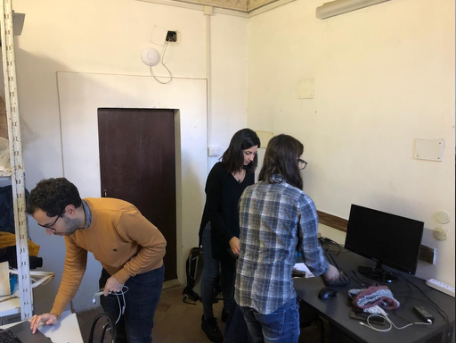
The experiment consisted in measuring the neurophysiological and neu- ropsychological responses related to different typologies of visitors before, during and after the visit (Fig. 1). In particular we considered the age, the gender and the education of the participants with specific focus on the inte- rests and attitude towards cultural heritage. With the support of the Red Cross, volunteers who never visit museums were also recruited, representing the so-called non-public, or disaffected public. The participants were invited to take the tour of the museum without specific indication or restriction with the aim of maintaining an ecological situation The objectives of the experiment were as follows:
- To monitor the emotional state before the visit (thanks to a five-minute pause before starting the experience, to disconnect from the influences that visitors brought from the outside world) to measure changes more meaningfully; - to monitor visitor’s psychophysiological reactions during the visit experie- nce (by means of wristbands able to detect physiological parameters such as heart rate and skin conductance), and by means of a simple positioning
Figure 1: Etruscan Museum of Vila Giulia, Roma 2022: the experiment’s “headquarter”, near the start of the visit, where the equipment was housed, where the participants were given the wearable devices and where the measurements for the ‘baseline’ were taken.
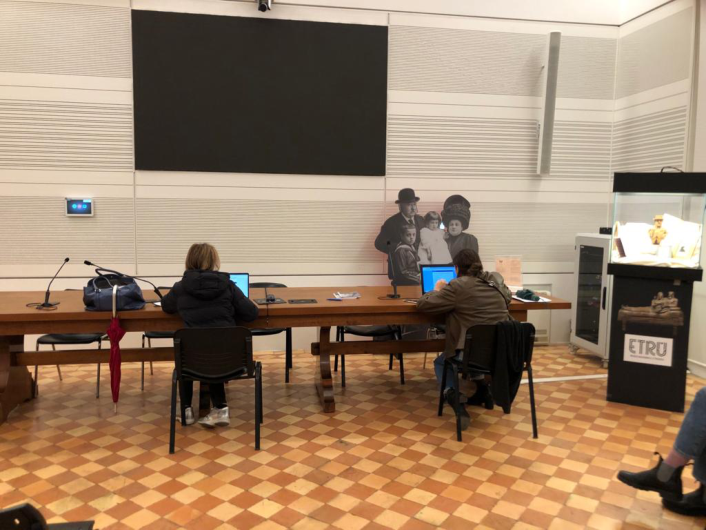
system (beacons distributed in crucial points of the path) to relate these responses to the content of the visit; - to monitor the modulation on participants’ emotional state of the visit we used ad hoc questionnaires that could capture the emotional state of the participants both at the beginning of the visit and at the end (Fig. 2); - to verify the contents really grasped by visitors at cognitive level, by means of answers returned to questionnaires. - to connect the emotional and the cognitive level, by a standardised que- stionnaires, in order to understand how much the emotional states have influenced the cultural learning.
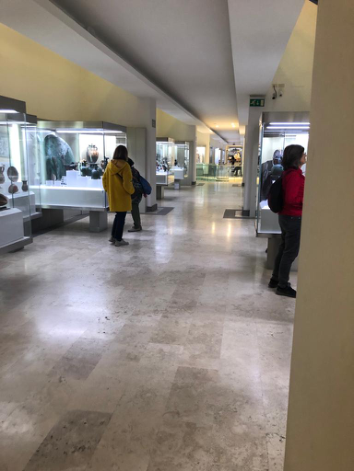
In essence, the aesthetic, spatial, and communicative characteristics of the exhibition generate emotions, which in turn are forms of sensorial and embodied knowledge that contribute to producing meaning: emotional regi- sters are neither goals in themselves nor mere means to achieve impressive experiences (Fig. 3).
Interpretation of results is still in progress, but several considerations can already be extracted:
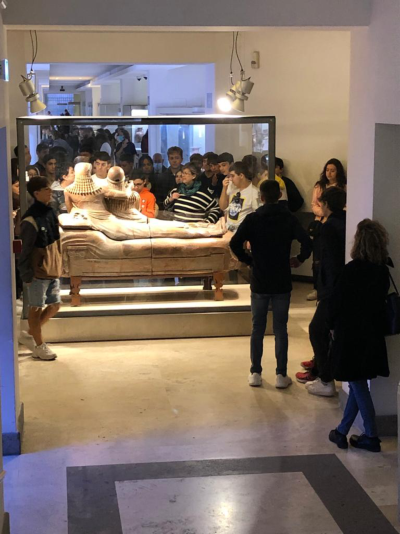
1) the duration of the visit, obviously, was very different according to the public’s typology: in particular, the disaffected public performed significantly shorter visits (as expected); 2) some disturbing elements were more powerful than the attraction and interest exerted by the exhibits and collections (Fig. 4): in particular, the
Figure 2: Etruscan Museum of Villa Giulia, Roma 2022: participants in the experiment were asked, after the visit, to fill in a second questionnaire.
Neurosciences and Museum - Museum Visit 129
Figure 3: Etruscan Museum of Villa Giulia, Roma 2022: participants in the experiment were invited to “normally” visit the museum, equipped with wearable devices.Figure 4: Etruscan Museum of Villa Giulia, Roma 2022: being “ecological”, experiments sometimes had to deal with noticeable disturbing elements, such as visits from classes of young and (noisy) students.
presence of many visitors, and therefore situations of noise and crowding, negatively influenced the visit in a very evident way; 3) immersive situations are generally appreciated by visitors more than tra- ditional exhibit solutions, which clearly separate the observing subject and the observed object; 4) variations in the exhibition space, which break a monotony situation, generate evident responses at a neurophysiological level.
CONCLUSION
We believe that this research represents the first step towards defining forms of evaluations able to capture the foundational aspects of the museum expe- rience, for different groups of subjects. The aim is not only to assess the status quo in relation to a particular museum tour, but also to capture pos- sible suggestions for improving exhibitions and pathways within a certain museum. The implicit physiological data (collected through the wristbands) together with the explicit data of emotional and cognitive evaluation (colle- cted through the standardised questionnaires) is an important starting point for guiding museum choices. Moreover, the possibility of relating the psych- ophysiological data with the spatial position of the visitor (through the beacons) gives the possibility of correlating the bodily reaction with the artwork observed by the visitor.
This first study certainly has limitations. Indeed, in order to better delineate the pros and cons of a certain museum setting, we adopted a very ecological approach, leaving participants free to choose paths and stops. This approach, which certainly has the advantage of being very close to the natural behaviour of the participants, certainly has drawbacks. For instance, the interpretation of the data can be ambiguous considering the poorly controlled conditions. Therefore, some aspects of the experiment will have to be revised to block certain conditions and make the data more easily interpretable. In future rese- arch, virtual reality could help to compare the participants’ responses to the actual museum situation with those of alternative exhibition proposals.
The main advantage of our approach is the transdisciplinary line of research we adopted that promises extremely interesting results, inspiring who have to plan transformative, cultural experiences, aiming to generate long-lasting and, above all, inclusive results, overcoming the traditional information approach in the Cultural Heritage communication.
The next steps are intended to conclude the interpretation of the large amount of data collected, to also cross-reference them with sociological observations.
Then it will be necessary to deepen the conditions under examination, nar- rowing the field to punctual episodes, and studying the effects that small and large changes in the exhibition layout and in the CH communicative approach can generate on different sectors of audience.
ACKNOWLEDGMENT
The authors would like to acknowledge The Polytechnic of Turin for the financial support granted for research, which has not been directly funded
Neurosciences and Museum - Museum Visit 131
by other organisations or competitive entities. The choice recognises the fre- edom of research and demonstrate Polytechnic’s confidence in its researchers, who are aware of their privileged position from this point of view. The auth- ors would also like to thank the National Etruscan Museum of Villa Giulia ETRU (Rome, Italy) in the person of its director and staff for their support in carrying out the experiments.
REFERENCES
Caruana, F. & Viola, M. (2018). Come funzionano le emozioni. Da Darwinalle neuroscienze, Bologna, Il Mulino. Crenn, G. & Vilatte, J-C. (2020). “Introduction”, in: Culture & Musées. Muséologie
et recherches sur la culture 36. Damasio, A. (1994). Descartes’ Error: Emotion, Reason, and the Human Brain, New York, Avon Books. Eidelman, J., Gottesdiener, H. and Le Marec, J. (2013). “Visiter lesmusées: Expéri-
ence, appropriation, participation”, in: Culture & Musées. Muséologie et recherches sur la culture, Hors-série: Lamuséologie : 20 ans de recherches. Falk, J. H. & Dierking, L. D. (1992). The Museum Experience. Washington D. C., Whalesback Books. Hooper-Greenhill, E. (2007). Museums and Education: Purpose, Pedagogy, Perfor-
mance (Museum Meanings). New York: Routledge. Irace, F. (2014). Design & Cultural Heritage, Mondadori Electa. Kahneman, D. (2011). Thinking Fast and Slow, New York, Farrar, Strausand Giroux. Lemmings, D. & Brooks, A. (2014). “The emotional turn in the humanities and social sciences”, in: Emotions and Social Change: Historical and Sociological Perspectives, London, Routledge. Lord, B. (2007). “What is Museum-Based Learning?”, in: The Manual of museum
Learning, ed. Barry Lord, Lanham MD, AltaMira Press. Paul, L. A. (2020). “Who Will I Become?” In: Becoming Someone New: Essays on Trans formative Experience, Choice, and Change. Edited by: Enoch Lambert and John Schwenkler, Oxford University Press. Ruggieri, M. C. (2000), I fantasmi e le cose, Milano Lybra Immagine. Thompson, P. (1999). Visitors with special needs, in Lord, G. D. and Lord, B., The
Manual of Museum Planning”, Great Britain, The Stationery Office. Tilden, F. (1957). Interpreting our Heritage, University of North Carolina Press.
1957. “Psychology: perception and behaviour”, in: Museum, XXVI, 3/4. Varutti, M. (2020). “Vers une muséologie des émotions”, in: Culture & Musées.
Muséologie et recherches sur la culture 36.
LISTED IN THE AHFE DIGITAL BOOKSTORE CATALOGUE
Explore the complete digital volume
Design for Inclusion
Read this individual research paper free through the original publisher, or explore the full digital proceedings book.
ISBN 978-1-958651-51-3
Explore this ISBN in the AHFE Bookstore ↗Listed in the July 2026 bookstore catalogue; search by ISBN to confirm current availability · Digital book purchase optional