Michela Benente, Valeria Minucciani, Melania Semeraro (2024). Narrative apparatus in archaeological museums and communication for all. In: Design for Inclusion. AHFE Open Access, vol. 128, pp. 1–11. https://doi.org/10.54941/ahfe1004785
This paper focuses on the communication in museums, intended as solutions, both verbal and perceptive, to involve visitors and convey messages.Captions and panels are the first and most evident components of museum communication, and can entail difficulties of different nature: from the language for insiders to the inadequate font dimensions. Nevertheless, space can create atmospheres and communicative environments even without words or explicit references. Involving other senses than the sight, we are more exposed to them and less vigilant in recognising and critically evaluating them. This matter involves all audiences, but it can create considerable differences between audiences that are more or less culturally equipped to recognise implicit messages. From the other sides, the communicative power of spatial signals can be exploited to reach people who do not feel like reading, and are suspicious of long speeches and an abundance of information.Finally, if verbal communication and spatial environment create a consistent system, they can be much more effective. This paper examines in particular the archaeological heritage and its difficulties to reach a very heterogeneous audience. The inclusive solutions should tend to overlap different tools, avoiding to explicitly “target” them. The Authors question how to decline design for all, if by fruition we do not only mean making contact but understanding the message (above all the values, not only the information content); they question how to adapt the modes of narration to the perceptive but above all cognitive capacities: a profound rethinking is needed since the translation from one medium to another one is not enough. Lastly, they wonder what role space and its perception play and how exhibition design can influence/help, given that the mediation of content for archaeological heritage encounters "ideological and cultural rather than practical or economic" limits and difficulties.In particular, this paper is based on the outcomes of two surveys carried out in Musei Reali Torino and Museo Nazionale Etrusco di Villa Giulia (Rome), revealing the difficulties in transmitting contents and enabling visitors reflect on them.
This article focuses on communication in museums, intended as solutions, both verbal and perceptual, to engage visitors and convey messages. The main research question relates to how to make information and interpre- tation in museums accessible to all audiences (with particular reference to their cultural background and attitudes), triggering reflection and using all tools at museographers and museologists disposal: space, exhibit solutions and, in particular, panels and texts. The difficulties in conveying archaeologi- cal heritage values are considered with specific attention. A visit to a museum
and the resulting encounter with heritage is certainly relatable to the interac- tion with several components, included the exhibition space, the texts, and the technological devices. In addition, each visitor experiences the museum according to his/her motivations, interests, knowledge and skills, as well as attitudes, learning patterns, health conditions and resistance to fatigue. The components in play are many and, in their variability and subjectivity, can strongly affect the effectiveness of museum layouts, routes and activities.
They contribute in making cultural heritage in general, and museums in particular, accessible to all and in this context archaeological heritage appears particularly problematic to communicate to a large and heterogeneous audience.
Democratisation of Culture, People at the Centre The policies of democratisation and access to culture present in interna- tional documents (UN, Universal Declaration of Human Rights, 1948; CoE, European Cultural Convention, 1954; ICOMOS, The Burra Charter: The Australia ICOMOS Charter for Places of Cultural Significance, 1979 and updates of 1999 and 2013; CoE, European Charter of the Architectural Heritage, Amsterdam, 1975; CoE, Convention for the Protection of the Architectural Heritage of Europe, Granada 1985; CoE, Convention on the Value of Cultural Heritage for Society, Faro, 2005; UN, Convention on the Rights of Persons with Disabilities, 2006) call for putting people at the centre: actions have to be studied to generate a greater awareness about the Heritage’s role in the history of individuals. The principles of ‘design for all’ are a reference to consider the multiplicity of needs and study strategies to include as many individuals as possible.
The challenge that cultural heritage has to take up requires a variety of approaches for “the development of tools for reading the evidence and the creation of appropriate promotion strategies” that are “scientifically correct and at the same time accessible to all” (Romeo, 2015).
Attention to heritage is closely connected to the acknowledgement of its value, but this is not given a priori and immutable in time: conversely, “cul- tural heritage is such as long as we have the ability to recognise it and make it recognisable” (Cecchi, 2015).
It becomes central to ensure cultural mediation, which makes accessible the values that heritage bears.
In this sense, it is not just a matter of putting in place educational or touristic fruition: a true encounter with heritage has to be offered to citizens.
As the more recent definition of museums recalls, the knowledge sharing and the interpretation are decisive in making cultural heritage accessible or not, inclusive or not: because cultural contents must be conveyed in such a way that each visitor can find in them cues for personal reflection, deepening and individual growth. Examining the current state of museum narratives, this concern in most cases is not recognizable enough. An “engaging” narra- tive means using different tools or ways to communicate heritage, but also to identifying topical contents able both to satisfy an intellectual curiosity and
Narrative Apparatus in Archaeological Museums and Communication for All 3
to arouse deeper and more emotional reactions. In turn, the exhibition space is by no means neutral: storytelling and cultural mediation cannot take place in every place with equal results. An unwelcoming space could undermine the message’ soundness while, vice versa, a different atmosphere could support observation, reflection, in-depth study.
As Giuliano Volpe also points out, “the only real recovery of possession of these spaces by ‘the people’ is achieved through the activation of the spaces themselves as venues for the transmission of historical memory: otherwise the people, the citizenship, may enter them physically, but will not really possess them culturally” (Volpe, 2019).
In order to achieve such a complex goal, a cultural project has to be developed where cultural and intellectual mediation represents the core activ- ity. This is particularly important when the cultural heritage is mute or hardly recognizable, as is the case of archaeological heritage. It often has lost its intelligibility, being fragmentary and lacking historical continuity with contemporary time.
If an artistic or formal value are not recognizable, a communicative and mediation effort is indispensable, so that the heritage can be understood, appreciated and consequently passed on.
Thus, the cultural experiences can represent a significant and enriching opportunity for all visitors, involving and reapproaching even audiences that consider art to be for a select few (Minucciani, Benente, Masino, 2021).
Mediation and Interpretation of Archaeological Heritage Presentation and interpretation become, with the Ename Charter, “essential components of heritage conservation efforts and as a means of enhancing public appreciation and understanding of cultural heritage sites” (ICOMOS, 2008). The presentation and interpretation of collections and their values are an essential aspect as stated in (UNESCO, 2015), and as recently reaffirmed in the definition of museums. The communities’ participation, varied experi- ences, “education, enjoyment, reflection and sharing of knowledge”promote “diversity and sustainability”: not only research, collection, conservation and exhibition but also interpretation of heritage and its values are the core activities in museums (ICOM, 2022).
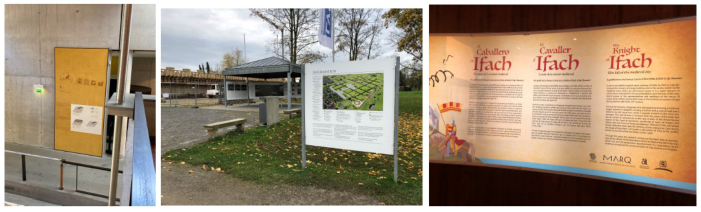
Captions and panels are the first and most obvious components of museum communication, but have rarely really been renewed in their essence, and still can involve several difficulties and shortcomings: from language for insiders to inadequate font size, from unattractive layout to excessive text and long, complex sentences.
Figure 1: Examples of captions and panels in museums: Musée Départemental Arles Antique in Arles, Archäologischer Park Xanten in Xanten and Museo Arqueològico de Alicante.
However, space can create atmospheres and communicative environments even without words or explicit references (Ruggieri, 2000). By involving other senses besides sight, we are more exposed to implicit messages: this involves all audiences, but can create considerable differences between audi- ences that are more or less culturally equipped to recognize and critically evaluate unspoken messages.
On the other hand, the communicative power of spatial signals can be exploited to reach people who do not feel like reading and who distrust long speeches and plentitude of information.
Finally, if verbal communication and the spatial environment create a coherent system, they can be much more effective.
Therefore, if one wants to explore the concept of inclusion as a possi- bility for everyone to have a “transformative” museum experience, starting with the need to be emotionally involved, one cannot ignore the concept of atmosphere. In the last years many scholars are studying this concept (Avanzino et al., 2019; Canepa and Condia, 2022), which in the past has been considered too fragile and lacking scientific rigour.
However, it can be argued that the atmosphere is (also) made up of mate- rial factors: not only the geometry of space, colours, shapes, and not only elements that we are accustomed to recognising with our senses, such as tem- perature or smells, but also other factors that are entirely intangible yet clearly perceptible. They could be defined as energetic vibrations that combine and dialogue with each other, coming from natural and artificial elements as well as from people themselves.
The experience of a space generates an indivisible complex of impres- sions and sensations, which remain imprinted with greater or lesser force: we remember through our body just as we remember through our nervous system and brain.
According to Edward Casey, without a body memory, one could not really have an experience that could not be remembered but only imagined (Casey, 2009). Therefore, even our memory capacity would be impossible. While imagination often has fuzzy contours and may be independent of specific situations/places, remembrance is always surrounded by an atmo- sphere that gives a sense of self-presence (Pallasmaa, 1996 and 2011).
Narrative Apparatus in Archaeological Museums and Communication for All 5
This notation is significant when referring to the museum visit: the atmo- sphere is not neutral either during the visit or for constructing the memory.
In the case of a museum visit, each visitor will therefore be able to perceive the atmosphere, whatever his or her difficulties: with his or her residual senses and sensitivity, he or she will build an image and a memory of it, which cannot be defined as either “right” or “wrong”, and should not and cannot be the same as those of others. The social aspect also has a role to play (Fyfe, 2006): visiting alone or in the company of others influences the perception of the atmosphere, generating a kind of shared memory slightly different from the purely individual remembrance.
Museum as a Well-Being Place?
A final reference considered essential for the inclusive design of a museum and its layout comes from recent studies on well-being (Minucciani and Saglar Onay, 2022). Again, this concept is complex and partly superimposable on health, comfort, or quality of life notions. Actually, it represents a much more instantaneous state, which has to do with a multitude of factors: as in the atmosphere case, it is evident that its multiple components can neither be managed nor mastered, but certainly, some elements can be worked on.
It is influenced by individual factors (personal predisposition, situational circumstances of life), social-historical factors (the cultural environment, the socio-political and economic situation), and physical factors (the character- istics of the environment and space in which one is at that given moment). It is on the latter that one can intervene with great effectiveness (Lyubomirsky et al., 2005).
The visitor in museums must first feel comfortable (which does not mean that the contents, and the emotions connected with them, must be pleasant!).
As obvious as this may seem, this basic principle does not always appear to be considered central: when visitors are forced into physically and men- tally tiring performances; when their psycho-physiological needs are not considered; when their diversity is not taken care of (Lehmbruck, 1974).
It is no casualty that, even today, visitors, especially the less frequent ones, associate the museum with notions of fatigue, boredom, and intellectual and physical effort.
Once again, this helps to emphasise how important the physical context in which museum communication takes place is and how much it influences the receptive attitude, the mental and emotional disposition, and thus the experience, learning and remembering itself. For this, it will be necessary, again with an empathetic attitude, to put the visitor at ease both physically and mentally.
So, on the subject of access and accessibility in museums, we can tentatively conclude that in museums:
access to cultural heritage does not consist only of the possibility to reach it physically, nor to perceive its characteristics with different senses, but must also include access to its contents and meanings;
nevertheless, the mere understanding of these contents is not sufficient since access to heritage means an encounter with heritage, a transforma- tive experience (from the intellectual and emotional point of view);
the context in which this encounter takes place is determinant: space and setting are decisive as they have the power to qualify the experience of this encounter, especially from an emotional perspective;
the atmosphere in which this encounter takes place is, by its very nature, multisensory: then, great attention must be paid to all components in addition to the visual one (which is also predominant). Thus, allowing everyone, regardless of their difficulties, to find elements that can be perceived and interpreted;
this does not mean simply translating visual elements into other sensory stimuli, albeit needed for merely informative components: rather, it means processing the context in all its complexity and communicative, percep- tive, and interpretative richness in such a way as to be able to offer stimuli to everyone.
Inclusion originates from an attitude that overcomes bias and predictable evaluations, with the decisive contribution of space, which always has emo- tional connotations. As such, it actively participates in the encounter with heritage and its transformative experience: the atmosphere is the inclusive medium par excellence, being complex and multi-sensorial, besides being the first element offered to the visitor.
Museums, Archaeological Sites and Public As in other types of museums, a divide risks being created in archaeological museums between the already introduced, if not even experienced, public and all others, unfamiliar with the subject matter or even considering it hostile.
It may seem a great success for large archaeological museums to show record numbers of visits: but less explored is the typology of this public. In other words, how many “new” visitors can an archaeological museum intercept? How hard does it work to include all who have turned away from it for various difficulties?
While talking about archaeology may seem relatively straightforward, it is not so easy to make it fascinate the public, especially all audiences. In fact, although not always strictly true, an archaeological find usually has the following attributes in the collective imagination:
it is uprooted from its context
it is fragmentary or, in any case, incomplete
it is mute and often incomprehensible
it requires much knowledge, even if not immediately referable to it; and archaeological musealisation for its part:
does not effectively support the imagination
does not always reconstruct the whole of what is incomplete (not even by denouncing, arguing, or justifying such impotence)
uses elitist and specialised language
invites mainly to an aesthetic reading of the findings (or allows only that), often generating misunderstandings and distortions of their mean- ing. A fragment generally has no aesthetic value in itself, especially when it belongs to a functional object, not an artistic one - as is often the case with archaeological findings (Minucciani, Benente, Masino, 2021).
Narrative Apparatus in Archaeological Museums and Communication for All 7
Outdoors or indoors, in situ or relocated elsewhere, artefacts can be exhib- ited in many ways, but the effort required of the public, especially a public that is not particularly well prepared and easily exposed to the risk of disaf- fection, is never of little value. The noticeable progress made over more than a century by museography leads right back to him, the visitor, as the central element of every museum: and visitors are not all the same.
Attention to visitors, exploring their satisfaction and expectations, has also been given by the new discipline of museum marketing (Kotler and Kotler 1990), which has opened up new areas of thinking for museum curators and directors. Above all, it highlighted the laws of competition that pit the museum against other cultural and non-cultural entertainment opportuni- ties, from which the public is called upon to choose. These are not secondary considerations if realising that the majority of the disaffected public (e.g. the very young, who only visit museums within the school offer) does not usually lack free time but prefers to devote it to other activities. The need, there- fore, to offer visitors an engaging and competitive experience has aroused the creativity of museologists and museographers, architects, set designers, and communication experts, with the support of new technologies capable of transcending time and space.
It is worth repeating: the museum includes different audiences and over- comes different kinds of difficulties, especially if it offers a communicative climate in which everyone can find meaning and emotion.
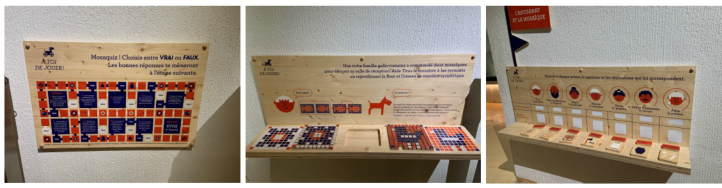
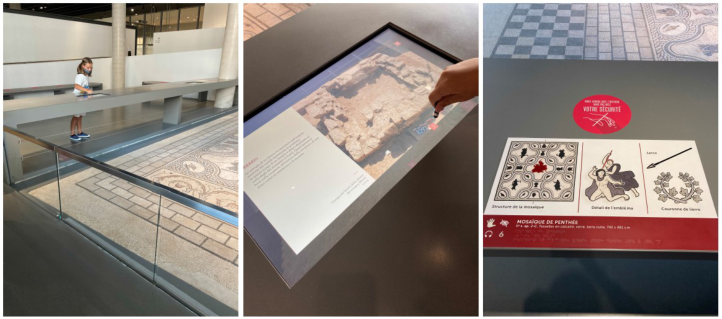
Figure 2: Educational stations dedicated to mosaics: graphics, text, size and height make them recognisable and usable by children and in some way they could exclude other users. Lugdunum, Musée et Théâtres Romains in Lyon.
Narrative Tools On the one hand, narrative tools (panels, captions, audio-visual supports) are indispensable and must allow the visitor to make an autonomous, free visit, imagining being able to grasp the main information. The sense of bewilderment in front of a panel or a caption with too much specialised lan- guage that too many visitors encounter in archaeological museums should induce professionals to provide clear and easily understandable explanatory and descriptive information, perhaps by choosing a double register that can include, alongside broader descriptions, short explanations as in the case of facilitated reading texts.
However, the mere description/explanation of an artefact is a minor thing compared to its interpretative and transformative potential in each visitor.
Needless to say, the fonts, their size, and the colour contrasts of such tools make them more or less comfortable for different user groups, just as obviously their iconographic apparatus is decisive.
Figure 3: Examples of panels and captions with descriptive details: Archäologischer Park Xanten in Xanten and Musée Gallo Romaine de Saint-Germain-en-Lay in Vienne.
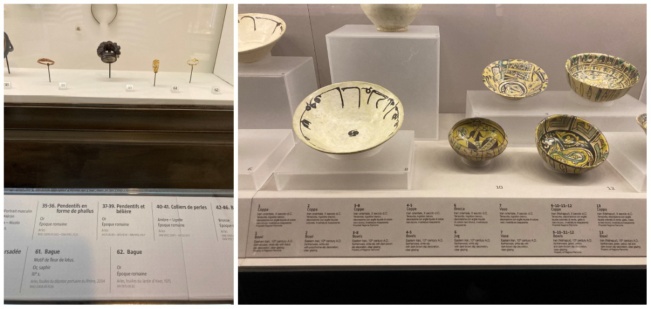
Nevertheless, the predictability of certain information (in fact useless if not downright offensive in providing completely superfluous and obvious infor- mation) generates a sort of mistrust in the visitor who, in most cases, does not even approach the captions. Such communicative choices seem to shy away from the interpretative role that has been entrusted to the museum in its most recent definition, and shelter it from possible ideological and cultural contrasts.
But this is precisely what is required of the museum today, an unbalanc- ing towards a topical reading of the values conveyed by heritage. Inclusion therefore means not so much and not only superimposing or “decoding” the messages through media accessible to people with specific needs, but trying to make sure that everyone understands the values and contents of the message.
Figure 4: Examples of captions with repetitive and totally predictable information: Musée Départemental Arles Antique in Arles and Museo di Arte Orientale in Torino.
Therefore, the mere ‘translation’ of the narrative is neither sufficient nor meaningful, if not accompanied by a profound rethinking of the modes of
Narrative Apparatus in Archaeological Museums and Communication for All 9
narration, including the space and the silent but inevitable dialogue that is established between the exhibits.
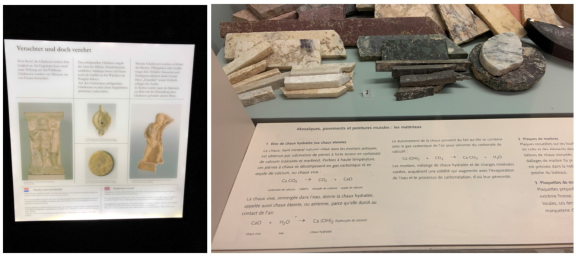
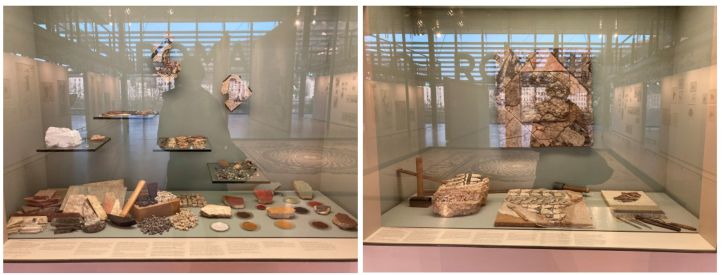
Figure 5: Display cases showing materials and tools used to make the mosaics. Musée Gallo Romaine de Saint-Germain-en-Lay in Vienne.
Very significant are, for instance, the displays around Roman mosaics, where an attempt is made to preserve a kind of environmental contextual- isation (associating them with other artefacts, or the intangible technological knowledge that made them possible).
The same adaptation of the message for children can be a way of mediating in an inclusive manner, but often only in appearance, if one lingers on overly targeted techniques of representation.
Figure 6: Particularly inclusive approach because it tries to let different modes of fruition coexist. Musée de la Romanité in Nimes.
CONCLUSION
Concerned about preservation, the perfect understanding of the drawings and the possibility to appreciate their details, museums often incur in very basic
communicative omissions: when, for instance, mosaics are displayed on the wall without specifying that they were originally on the floor.
In conclusion, details are fundamental: precisely because they are grasped almost unconsciously. From colours to symbols, from pictograms to recon- structions, every time it is necessary to be clear that they should speak to as wide an audience as possible. With this in mind, the ‘easy language’, the tactile visit, sounds and words translated into gestures, apparently born as alternatives to the ‘normality’ of fruition, are exceptional learning methods for everyone precisely because they explicitly aim at the essence.
ACKNOWLEDGMENT
The authors would like to acknowledge the Polytechnic of Turin, for mak- ing funding available to its professors and researchers for “curiosity driven” researches. It is uncommon in the national, academic scenario.
REFERENCES
Avanzino, L. et al. (2019). Atmospheres: Feeling Architecture by Emotions. Preliminary Neuroscientific Insights on Atmospheric Perception in Architecture. In ambiances, no. 5. Canepa, E. and Condia, B. (2022) Generators of Architectural Atmosphere.
Manhattan, KS, USA: New Prairie Press. Carter, J. (2022). Interpretation for all, in Interpreting World Heritage. Road to inclusiveness, Inaugural periodical, December, 19, 2022, WHIPIC, pp. 14–15. Casey, E. S. (2009). Remembering: A Phenomenological Study (Second Edition).
Bloomington and Indianapolis: Indiana University Press. Cecchi, R. (2015). Abecedario. Come proteggere e valorizzare il patrimonio italiano.
Ginevra-Milano: Skira. Del Maso, C. (2018) Racconti da museo. Storytelling d’autore per il museo 4.0, Bari: EDIPUGLIA. Falk, J. H. (2009). Identity and the museum visitor experience, CA: Left Cost press,
2009. Fyfe, G. (2006). Sociology and the Social Aspects of Museums. In Macdonald, S. A Companion to Museum Studies. Oxford: Blackwell PublishingKotler, N., Kotler, P. (1990), Marketing dei musei. Obiettivi, traguardi, risorse. Roma: Comunità (ed). Jameson, J. H. (2020). Cultural Heritage Interpretation, in Encyclopedia of Global
Archaeology, Switzerland AG: Springer Nature. Kerr, J. (2013). The Seventh edition. Conservation Plan. A Guide to the Preparation of Conservation Plans for Places of European Cultural Significance. ICOMOS Australia. La Rosa, M. (2024) Neuroscienze della narrazione. Lo storytelling nell’era delle
neuroscienze e dell’intelligenza artificiale, Milano: Hoepli. Lehmbruck, M. (1974) Museum International vol. XXVI, no. 3–4, January. Paris: United Nations Educational. Lyubomirsky, S. et al. (2005). Pursuing Happiness: The Architecture of Sustainable
Change. In Review of General Psychology, Volume 9 issue 2, June. Mairesse, F., Van Geert, F. (2022). Médiation muséale. Nouveaux enjeux, nouvelles formes, Paris: L’Harmattan. Melotti, M. (2013). Il ruolo emergente dell’edutainment nella fruizione del patrimo-
nio culturale, in: Formazione & Insegnamento, XI, 2. pp. 129–142.
Narrative Apparatus in Archaeological Museums and Communication for All 11
Minucciani, V., Benente, M., Masino, F. (2021) The Museum listens: a collaborative project on Torino archaeology collections. In: Di Bucchianico, G., et al. AHFE 2020, New York: Springer. pp. 281–288. Minucciani, V., Saglar Onay, N. (2022) Architectural Space and Emotions. Evalua-
tion of responses to different spatial characteristics. In: Abitare la Terra. Quaderni 7–8 / Supplemento al no. 58. Roma: Gangemi. pp. 50–53. Pallasmaa, J. (1996). The Eyes of the Skin. Architecture and the Senses. London: Academy Editions. Pallasmaa, J. (2011). The Embodied Image. Chichester: Wiley & Sons Publishers. Romeo, E. (2015). Alcune riflessioni sulla conservazione e valorizzazione degli
antichi edifici ludici e teatri gallo-romani, in: “Restauro Archeologico”, no. 1, 2015, Firenze: DIDA. pp. 14–37. Ruggieri, M. C. (2000). I fantasmi e le cose. La messa in scena della storia nella comunicazione museale. Milano: Lybra Immagine. Unesco WHIPIC (2023), Research report 2023. World Heritage and interpreta-
tion policy identifying attributes as heritage interpretation, Corea del Sud, KR: UNESCO WHIPIC. Ungaro L., Schettini M. C., Vignarolo P. (2018). La storia e il racconto dei Musei di Traiano – Museo dei Fori Imperiali attraverso la voce dei protagonisti – Museo Glass Beacon e il racconto delle anfore, in: Pignataro, F., Sanchirico, S., Smith, C. (eds.), Museum.dià. Chronos, Kairòs e Aion. Il tempo dei musei. Atti dell’Incontro Internazionale di Studi. Roma, Museo Nazionale Romano alle Terme di Diocleziano. 26–28 maggio 2016, Roma. pp. 185–219. Volpe, G. (2019). Il bene nostro. Un impegno per il patrimonio culturale. Bari:
EDIPUGLIA. Zhu, Y. (2022). The Ladder of Heritage Interpretation, in Neil A. Silberman, World Heritage: 50 Years and Moving Forward. An Anthology of World Heritage Interpretation and Presentation, Corea del Sud, KR: WHIPIC, pp. 104–123.
LISTED IN THE AHFE DIGITAL BOOKSTORE CATALOGUE
Explore the complete digital volume
Design for Inclusion
Read this individual research paper free through the original publisher, or explore the full digital proceedings book.
ISBN 978-1-964867-04-5
Explore this ISBN in the AHFE Bookstore ↗Listed in the July 2026 bookstore catalogue; search by ISBN to confirm current availability · Digital book purchase optional