Michela Benente, Valeria Minucciani, Francesco Paganelli, Daniel John Mangano (2025). Experiments conducted in the Egyptian Museum of Turin on public behavior and the potential of participatory activities for inclusive communication. In: Human Factors in Design, Engineering, and Computing. AHFE Open Access, vol. 199, pp. 493–502. https://doi.org/10.54941/ahfe1006861
Cultural communication in museums is an extremely prescient issue, especially considering inclusion as central to accessibility. Visitor behavior is a subject in which audience surveys rarely delve and provide curators with precise and practical guidance about how visitors experience the museum. As part of the European META-MUSEUM project, which investigates in detail the public's responses to cultural stimuli, not only from a cognitive but also from an emotional (i.e. neurophysiological) point of view, two experiments were conducted at the Egyptian Museum in Turin, from which useful indications for future solutions can be drawn. The first experiment utilized eye tracker on a sample of volunteers as they visited two Rooms, to monitor their observation patterns, later mapped for analysis. This allows for a visitor centred approach to assess how the curated environment of a museum reaches the public, trends in public engagement with the contents in the room and how the intentions of the curator line up with the experience of the visitor. The second involved a sample of young adult visitors who were invited to take part in co-creation activity: an opportunity for them to interact with the curators, on historic photos of archaeological excavations. While the first experiment shows that very few visitors are able to identify the most important objects, and that their gaze often follows trajectories that are contrary to what the curated exhibition aims for, the second experiment shows that the active involvement of visitors greatly increases their attention and understanding of objects that they had not previously even glanced at. At the same time, the opportunity to contribute to the interpretation of the objects on display greatly increases their self-esteem and therefore their ability to memorize and recall the content: a process open to everyone, regardless of background, ability, or gender. This paper illustrates these experiments in detail and analyses the results, developing some useful considerations for museum professionals to increase the involvement of all visitors.
The format of the museum has long remained unchallenged since the conception of the museum as a public facing institution. The public has traditionally been invited to view artifacts of interest curated by expert
collectors in the relevant field. Visitors are presented with information framed by experts. In this model of museum curation the emphasis has been placed on the artifact and its relationship to the body of expertise deemed appropriate by the scholarly curators and presenters of the collection (Greenhill, 1992). The visitor risks to find themselves in a position of the least priority, a passive audience which has arrived to absorb the authorized narrative of the museum. The last decades have seen some work done to understand the actual experience of visitors inside a museum in a more active position.
Visitor behavior is a subject in which audience surveys rarely delve and provide curators with precise and practical guidance about how visitors experience the museum. Questionnaires are able to provide qualitative self- reports on the impact of the experience which can speak to the affect this communication model in the museum lands with members of the public on an individual level (Pekarik et al., 1999). This paper will present and discuss experiments carried out in the Egyptian Museum of Turin which seek to understand how visitors actually engage with the environment and contents of the museum moving beyond questionnaires to an analysis of the museum visit itself.
The Horizon EU funded project META-MUSEUM intends to study visitors’ behavior, how Heritage can transform people and how cognitive and neurophysiological combine in the development of the cultural experience. Within the project framework, some experiments have been carried out in Museo Egizio in Turin.
Prior to experiment implementation, extensive monitoring of visitors’ behavior in ecological condition was carried out aiming to observe patterns in time and visit of museum rooms, considered of particular interest: the one hosting artifacts retrieved from Deir el-Medina (Room 6) and the one dedicated to Kha and Merit’s tomb (Room 7).
Monitoring a vast sample, heterogeneous for gender, age and educational background, revealed how – considered the impact and effects of the entire visit – the time spent in the two rooms averaged at about 5 minutes. It was also discovered how the path followed while in the rooms was not following expected patterns, rather a casual roaming of the room with only short stops in front of a handful of vitrines.
This fashion of monitoring, empirical, although capable of showing interesting aspects, does not allow precise tracking of visitors’ movement nor objects or time spent observing. In order to do so, during the experiment systems for indoor positioning and movement tracking were implemented alongside eye tracking devices.
Using eye tracking glasses the visual attention of participants was recorded and mapped to assess patterns in visual attention to inform the curation and composition of elements in the museum which would illicit a more visitor focused engagement. Previous eye tracking studies to date have focused on the impact of individual pieces in the collection of the museum, many of these studies are not mobile eye tracking studies therefore fundamentally differ from the reality of the museum experience (Calandra et al., 2016; Cantoni et al., 2016). Previous studies focused on how eye movement and attention correspond to artistic composition or how elements of the presentation of
Experiments Conducted in the Egyptian Museum of Turin 495
art or objects could affect the way in which participants engage with factors of visual stimuli (Eghbal-Azar and Widlok, 2013; Ferrato et al., 2024; Scott et al., 2019). The study that will be presented here is a mobile eye tracking study in which the observance behaviors of participants were collected in environmental conditions that more closely simulate a museum visit. The objective of this study is to understand how the museum exhibits are engaged by the public.
In addition to the collection and elaboration of the visual engagement of visitors, to further challenge the top-down curatorial approach to museum exhibition and explore the potential of public involvement in the process of curation, three sessions of co-creation activities moderated by museum curators were organized in the same week as the experiments. The results of these co-creation activities provide a basis to further interpret the visual behavior of the participants tested in the eye tracking experiments. Adding to the results obtained by the analysis of visitors’ visual engagement in the experiments, the paper will present the outcomes of the co-creation experience and its possibilities as a mean to juxtapose a bottom-up participative perspective as an alternative to traditional curation.
METHODOLOGY
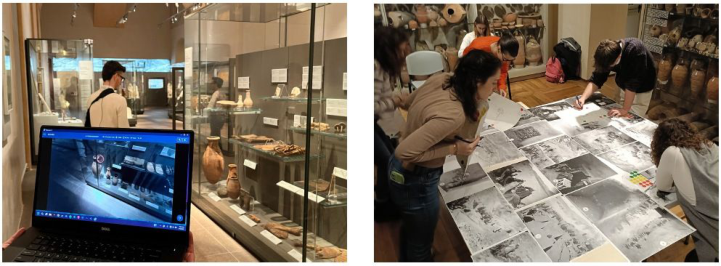
Participants for this study were recruited via online appointments, publicized at the Politecnico di Torino and via word of mouth. 24 participants were tested, ranging in ages 26 – 70, 11 female, 10 male and 3 not disclosed. Participants were recruited from the local population of Turin with most being students or employed full time. Eye tracker participants were required to have optimal vision without glasses so as to be acceptable candidates for the Tobii pro 3 eye tracking glasses. 12 participants were tested in protected conditions before and after museum opening hours and 12 were tested in environmental conditions while the museum was open with the general population. All participants were exposed to the same light throughout the duration of the experiments. Each participant was outfitted with the Eye tracking glasses, a triangulated GPS positioning system which tracked the participants movement within the museum and a shimmer galvanic skin response reader. A baseline reading was recorded for one minute with the participants eyes open and facing a white wall with no other visual or auditory stimuli present. The participant was then escorted to the entrance of room 6 of the Egyptian Museum. The participant each followed the Illustrated experimental sequence (Fig. 1).
Figure 1: Experimental sequence.
Figure available in the original PDF paper.
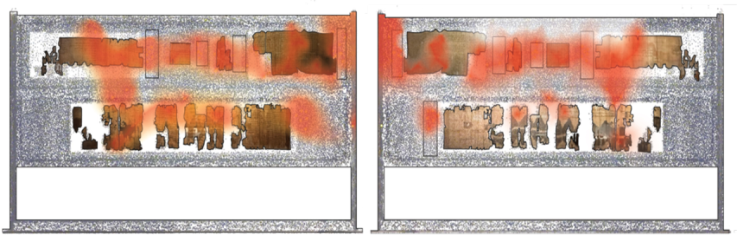
The Tobii pro eye tracking glasses used record the visual field of the participant as a video file, with the gaze data included in the video collected by nano-cameras embedded in the lenses of the glasses which track ocular movements. Using a 3D laser scan of rooms 6 and 7 a model was created of the gaze behaviors for each participant by mapping a sample of every 10 seconds of gaze. The coordinates of the gaze focus were approximated to the nearest surface and mapped in the model to create an accumulation cloud of points representing a sample of each participants observation behaviors. From the mapping of points onto the model’s surfaces, Kernel density diagrams were produced to describe the trends in attention given in the regions of the rooms (De La Fuente Suárez, 2019; Ramsden, 2015). It was expected that participants in this study would not engage significantly with artifacts that required more complex explanation to understand. Most participants will not want to read long supporting information in order to understand the presentation rather will be more engaged by elements of the museum that are conceptually accessible and easy to understand. Special attention was paid in this analysis to the strike papyrus, one of the most significant papyri in the Egyptian museum’s collection which recounts the first workers strike known to have occurred in human history. The papyrus, however, is hypothesized to receive fairly little attention and engagement from visitors due to the inaccessibility of the object and its interpretation to the museum audience. To understand the papyrus a highly developed knowledge base is required which is not a characteristic to be expected in most visitors to a museum.
Figure 2: Measurements with the eye tracker and co-creation activities.
The co-creation sessions, which occurred contemporaneously involved 32 participants, recruited via word of mouth: participants’ age ranged between 20–30 with apparent equal distribution between male and female identifying participants; this sample description is based solely on visual assessment from the research team as no personal data was collected during the activity.
Participants were invited into a room where 30 numbered pictures from the Museum photographic archive were laid out, no caption or other source of information on the content of the pictures was made available. Participants were left free to roam, observe the pictures and required to select a maximum
Experiments Conducted in the Egyptian Museum of Turin 497
of 5 that particularly impressed them, then write down 3 keywords per picture and rate the valence of their emotional response through green, yellow and red stickers; each participants proceeded individually on a personal sheet that was provided. Once all participants to the session had completed their selection, the sheets were collected and the most selected pictures, regardless of attributed positive or negative valence, were commented on by museum curators involved in the activity, starting the discussion from participants’ input. After this introductory activity, participants were distributed cards to anonymously submit questions to the curators, who then proceeded to select and answer some. The last section of the session was dedicated to a photograph (present in the rooms selected for the eye tracking experiment) selected by curators, considered of particular interest because of its composition and background. Participants then explored the content and history of the plate through a detailed comment by the curator. Next, an additional card was distributed to participants who were then invited to think and write down a new caption for the picture, based on their impressions and the explanation received. The conclusive assignment required participants to work in group and discuss to draft one final collective proposal for the new caption that, they were informed, might be placed next to the existing one in room 7. To test the impact of the curator description, during the second session of the week the order of the activities was inverted, moving up the curator’s speech and asking participants to complete the activities only after they had listened to the explanation.
Figure 3: Kernel density maps describing the hot spots where most participants viewed the papyri.
Participants were required to fill out a post-activity questionnaire via an online form to collect their feedback on the activity; the data collected was later analyzed and results shared with the museum staff.
RESULTS
The expected results of these experiments were that participants would not be very engaged by interpretation in the rooms which was difficult to understand and overly oriented to experts rather than members of the public. It was
expected that visitors would be engaged the most by artifacts within the museum which relate to themes of daily life which are still familiar today. Particular artifacts of note for this study were the collection of ancient bread and other foodstuffs, games, the wig of Merit and other clothing related objects.
To address these hypotheses the eye tracker data is uniquely able to indicate what elements of visual stimuli were engaged by the subjects in the experiments. Generally little attention was paid to the room beyond the artifacts. Most subjects followed a similar rout through the museum with hotspots of attention on particular regions.
A preliminary analysis was conducted focusing on visitor behaviour in the Strike Papyrus area within room 6. Most participants viewed the papyrus for a period less than 70 seconds, with a major outlier being a participant who viewed the papyrus for 144 seconds, much more participants viewed the papyrus than did not view it with 6 participants not viewing the papyrus at all. Comparing the different typologies of participants, there are not significant differences in how they look at the vitrines.
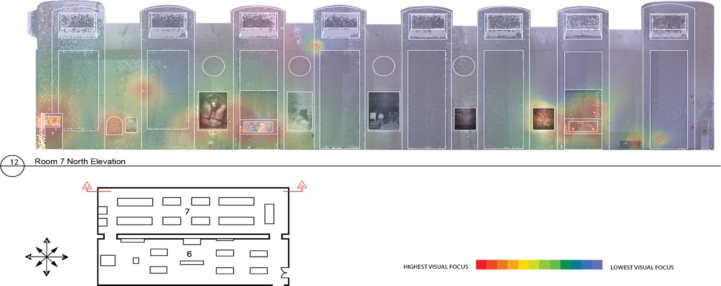
Figure 4: Kernel density map projected onto an elevation of a wall in room 7 showing where participants viewed the most.
These Kernel density maps represent the cumulative density of visual focus among eye tracker participants.
These maps provide information on the overall trends of a group of participants instead of an individual’s attention throughout the museum. Stimuli representing the human form (statues, photographs, human remains, and funerary masks) received targeted and consistent attention.
Analysis of the co-creation individual sheets showed a much higher interest in photographs depicting Egyptian workers moving or recovering artefacts, which translated to a higher selection rate by participants. The same was later confirmed by answers to the post-experience questionnaires where 26 out of 32 participants stated they were most inspired by people while working on the new caption proposal. Among the highest-scoring pictures in the sample, just one solely depicts an artefact. This result is consistent with the clear preference for the human form observed in the eye tracker experimental
Experiments Conducted in the Egyptian Museum of Turin 499
results. Consistent with the eye tracker experiments. Merit’s funeral mask was the subject of the only highly rated photo by co-creation participants and was the picture visitors tended to engage the most during the visit monitored with eye tracking glasses. This could suggest the importance of a spatial relationship and proximity between photos and the objects they depict that would under other circumstances go unnoticed, as observed with most other pictures present in the room according to the eye tracker study (Fig. 3).
The interest taken in the Egyptian workers, and pictures depicting them, was significantly heightened during the second session of the week, with a large number of keywords expressing compassion towards the conditions of the workers and negative ratings, whereas in the other two sessions the latter were generally more positive and paired to more generic words regarding the setting, the excavation process and the value of the artefacts.
The captions proposed by the three groups all converged towards the workers’ role in the excavation of the artefacts now on display and part of the collection brought to the Museum by Schiaparelli’s campaigns. Comments on the overall experience, provided by participants were positive with great preference shown for the interaction with the curator. About the collegial activities, participants stated the cooperative work on the collective caption drafting instilled confidence in them and promoted a sense of trust in the quality of the final product as a result of the cooperative editing.
DISCUSSION
Between the demographic and spatial representations of this data, it is notable that the strongest correlations emerge not from fixed aspects of identity such as gender or education, but from self-reported levels of cultural interest. The frequency of visits to cultural institutions within the past year was the most reliable predictor of prolonged engagement with the Strike Papyrus, suggesting that prior exposure and cultural literacy significantly shape visual attention.
The prominence of artifacts depicting the human form—whether statues, paintings, or human remains—further underscores the role of empathy and familiarity in perceptual engagement. These objects invite recognition and emotional resonance, allowing visitors to situate themselves within a shared human continuum. In contrast, utilitarian artifacts of daily life, though historically significant, did not elicit the same intensity of gaze or sustained attention. This data is certainly useful for understanding how different types of audiences are involved in a similar way, all in all.
These results support arguments from embodied and affective museology that emphasize the role of sensory and emotional identification in visitor experience. From a practical standpoint, the findings suggest that curators might enhance the interpretive potential of daily-life artifacts through narrative framing or multimodal displays that bridge the gap between functional object and lived human experience. This kind of solutions can be more inclusive than more traditional ones.
These considerations could be related to the public involvement in co- creation activity, in exploring under different conditions whether these
attitudes are actually confirmed. The co-creative solutions can be considered a paramount element in designing truly inclusive exhibitions, according to the results recorded by the research team. As evident in this case, museums and curators often tend to tailor their work to similarly skilled and knowledgeable professionals, resulting in the oversight of the needs of a lager public who, as stated in the introduction, finds itself as the passive receptor of the curators’ effort. In these cases, the effect produced on the visitor is minimal and short- lived, The development of different approaches and techniques for cultural heritage communication, capable of eliciting an emotional response and inducing reflection, is part of the core goals of META-MUSEUM towards deeper and long-lasting results coming from the cultural experience.
Opening to a bottom-up approach that includes the public in the curatorial process further allows visitors to become personally engaged with heritage, without diminishing to the scientific and research scopes of the museum. By doing so, and proposing this kind of activities, cultural institutions can welcome the chance to listen to their public and more effectively target their communication and mediation strategies.
Shifting back to the results of the co-creation activities on the historical plates, these inevitably forced participants to work and reflect on something that, by their own admission, would have otherwise been overlooked in a normal visit. What apparently struck participants the most was the description of how child-labor was a common practice during the excavation campaigns, prompting a re-evaluation of the tale of greatness of how the collection found its way to the museum. Even if negatively hued, the emotional response provoked in the sample helped establish a personal connection with heritage through the pictures.
The interest reported by the sample in the dialogue with the curator showed how an unmediated relation with their expertise, and the possibility to personally explore heritage in a way that would not otherwise be possible, renders the experience more meaningful and capable of inducing reflection whereas one would tend to minimize, or overlook, the importance of some elements because of their cultural inaccessibility: limited personal knowledge on the matter, excessive amount of detail in the captions or a downright frigid approach that fails to capture the visitors’ interest. Bringing the public into the process allows cultural institutions to learn about their perspective, improving results in efficacy of cultural communication and ultimately resulting in enrichment of the encounter with cultural heritage, favoring understanding, personal elaboration, appropriation, hence deepening its meaningfulness.
CONCLUSION AND RECOMENDATIONS Mapping the eye tracker data shows very interesting trends in visitors’ behavior, especially if related to other activities where the users can be involved in first person in developing comments and contents.
The co-creation activity allowed participants to understand how little they had actually observed the photographs on display, as demonstrated by the eye-tracking experiment. At the same time, the interaction between visitors
Experiments Conducted in the Egyptian Museum of Turin 501
and curator led to a truly transformative encounter for both parties: the opportunity to understand the varied responses and attitudes of the public opened up new perspectives for communication on the part of the museum, while the opportunity to actively participate in the development of a shared meaning made it possible to overcome barriers of all kinds, creating a truly inclusive experience.
ACKNOWLEDGMENT
This paper is part of the research conducted in the framework of META-MUSEUM [101132488 – META-MUSEUM ‘Moving Emotions towards confidence in the Transformative Appropriation for a Meaningful Understanding of cultural heritage: a neuroScientific approach to European Museums’ – HORIZON-CL2-2023-HERITAGE-01] funded by the European Union. Views and opinions expressed are however those of the authors and do not necessarily reflect those of the European Union or European Research Executive Agency (REA). Neither the European Union nor the granting authority can be held responsible for them.
The authors wish to thank Fondazione Museo delle Antichità Egizie di Torino for the willingness shown and the support given in sharing material and hosting the experiment and activities here described.
REFERENCES
Benente, M., Minucciani, V., Dabove, P. (2023). Technology as a tool to study visitor behaviour in museums: Positioning and neuropsychological detection to identify physical & cognitive barriers. In: Pepetto Di Bucchianico (eds) Design for Inclusion. AHFE (2023) International Conference. AHFE Open Access, vol 75. AHFE International, USA. http://doi.org/10.54941/ahfe1003332. Benente, M., Minucciani, V., Paganelli, F. (2025). How to design inclusion in Cultural
Heritage: An innovative approach. In: Giuseppe Di Bucchianico (eds) Design for Inclusion. AHFE (2025) International Conference. AHFE Open Access, vol 169. AHFE International, USA. http://doi.org/10.54941/ahfe1006156. Calandra, D. M., Di Mauro, D., D’Auria, D., Cutugno, F., 2016. E. Y. E. C. U.: An Emotional eYe trackEr for Cultural heritage sUpport, in: Torre, T., Braccini, A. M., Spinelli, R. (Eds.), Empowering Organizations. Springer International Publishing, Cham, pp. 161–172. https://doi.org/10.1007/978–3-319–23784-8_13. Cantoni, V., Merlano, L., Nugrahaningsih, N., Porta, M., 2016. Eye Tracking
for Cultural Heritage: A Gaze-controlled System for Handless Interaction with Artworks, in: Proceedings of the 17th International Conference on Computer Systems and Technologies 2016, CompSysTech ’16. Association for Computing Machinery, New York, NY, USA, pp. 307–314. https://doi.org/ 10.1145/2983468.2983499. De La Fuente Suárez, L. A., 2019. Visualization of Architectural Experiences Using Heat Maps. Int. J. Architecton. Spat. Environ. Des. 13, 17–34. https://doi.org/ 10.18848/2325–1662/CGP/v13i01/17–34. Eghbal-Azar, K., Widlok, T., 2013. Potentials and limitations of mobile eye tracking
in visitor studies: Evidence from field research at two museum exhibitions in Germany. Soc. Sci. Comput. Rev. 31, 103–118. https://doi.org/10.1177/ 0894439312453565.
Ferrato, A., Limongelli, C., Mezzini, M., Sansonetti, G., Micarelli, A., 2024. Artwork Segmentation in Eye-Tracking Experiments: Challenges and Future Directions, in: Adjunct Proceedings of the 32nd ACM Conference on User Modeling, Adaptation and Personalization. Presented at the UMAP ’24: 32nd ACM Conference on User Modeling, Adaptation and Personalization, ACM, Cagliari Italy, pp. 477–481. https://doi.org/10.1145/3631700.3664906. Greenhill, E. H., 1992. Museums and the Shaping of Knowledge. Routledge, London.
https://doi.org/10.4324/9780203415825. Hooper-Greenhill, E., 2020. Museums and the interpretation of visual culture, 1st ed. Routledge, London. Pekarik, A. J., Doering, Z. D., Karns, D. A., 1999. Exploring Satisfying Experiences in Museums. Curator Mus. J. 42, 152–173. https://doi.org/10.1111/ j.2151–6952.1999.tb01137.x. Ramsden, J., 2015. A kernel density estimation implementation for Grasshopper.
James Ramsden. URL https://james-ramsden.com/kernel-density-estimation- grasshopper/ (accessed 7.14.25). Scott, N., Zhang, R., Le, D., Moyle, B., 2019. A review of eye-tracking research in tourism. Curr. Issues Tour.
LISTED IN THE AHFE DIGITAL BOOKSTORE CATALOGUE
Explore the complete digital volume
Human Factors in Design, Engineering, and Computing
Read this individual research paper free through the original publisher, or explore the full digital proceedings book.
ISBN 978-1-964867-75-5
Explore this ISBN in the AHFE Bookstore ↗Listed in the July 2026 bookstore catalogue; search by ISBN to confirm current availability · Digital book purchase optional