Valeria Minucciani, Michela Benente, Daniel John Mangano, Charina Knutson (2026). The case for co-creation to mediate Cultural Heritage museums toward inclusive communication for all. In: Universal Design and Design for Inclusion. AHFE Open Access, vol. 209, pp. 98–106. https://doi.org/10.54941/ahfe1008023
Co-creation offers an opportunity to both gauge and enhance the communication of complex and nuanced narratives around cultural heritage in ways that move beyond the expected presentation of cultural heritage in a museum. The starting point for this paper is an analysis done at the Egyptian museum in Turin, regarding the presentation of historic photos in a prominent highly visited gallery within the museum. Very few of the visitors dedicated their attention to them, suggesting that the current state of the exhibition is not sufficient to meaningfully communicate these photos to the public. The Authors carried out an experimental activity of co-creation to enhance the public’s involvement. The results of this study provide a baseline by which to understand how co-creation can be used in museums and other cases are discussed in this paper to present techniques applied by curators and interpreters. This paper further illustrates how co-creation activities could represent useful exercises to involve and include the most diverse public. Some fundamental principles of co-creative activities have been selected in different European countries. The Design of these activities in collaboration with museum curators is critical to define how to communicate cultural heritage in an inclusive way.
A BRIEF INTRODUCTION TO CO-CREATION The META-MUSEUM project funded by Horizon Europe, brings together partners across Europe to collaborate and establish a solid foundation for co-creation in museums across Europe. The project seeks in part to explore how co-creation can chart a path toward inclusion with Cultural Heritage (CH) through interactions that can trigger confidence, empathy, and resilience. META-MUSEUM approaches co-creation with the assumption co-creation can instill mutual trust in the contributions of communities creating confidence.
Over the last two decades, new technologies and expanded social networks have significantly reshaped debates around cultural democratization, participation, and public engagement with CH. Social media and participatory digital platforms have contributed to a reconfiguration of the museum model, shifting toward forms of exchange that foreground dialogue, (Simon, 2010).
The Case for Co-Creation to Mediate Cultural Heritage Museums 99 This opens a door to the changing role of the ‘visitor’ to the ‘contributor’, co-creators of cultural content, producing what is commonly described as User Generated Content (UGC) and redefining their relationship to cultural institutions (Simon, 2010). This shift has narrowed the perceived distance between institutions and their publics, fostering stronger expectations of agency, recognition, and inclusion. For example, the Derby Silk Mill, in Derby, England used co-creation to rethink their very identity as a museum, resulting in the local citizens advocating for the museum they wanted in their community while respecting the factory’s 300 year history (Cummings & Waelde, 2016; Visser, 2014).
Within museum and heritage practices, these developments have supported the emergence of participatory and co-creative models that emphasize the cultivation of community belonging (Bonacini, 2012). Co-creative processes have frequently been framed as forms of cultural crowdsourcing or co-production, particularly in relation to the interpretation, enrichment, and dissemination of collection-related content (Hellin-Hobbs, 2010). At the same time, co-creation has been theorized as a response to broader societal demands for active civic participation, positioning citizens as protagonists in the generation of cultural and social value (Chesbrough et al., 2006; Prahalad & Ramaswamy, 2004).
The democratizing potential of co-creation is evident in participatory knowledge platforms which utilize the principle of co-creation to establish communities based on mutual trust of other’s contributions. Following, the London Science Museum launched an open object wiki where anyone could upload an object with reflections and thoughts about what that object meant to them – the entries represented memories, and highly personal insights which formed a volume of collective experiences with objects in the collection (Hellin-Hobbs, 2010).
Fundamentally, productive co-creative environments depend on this trust, motivation, and carefully considered processes that enable groups to work together effectively (Füller, 2010; Johnson, 2010; Sawyer & Dezutter, 2009). Creativity is understood as a relational outcome of engagement and shared knowledge, suggesting that the capacity to contribute meaningfully is widely distributed, provided that appropriate conditions are in place (Ind & Coates, 2013). In European museums and CH sites, co-creation has emerged as a method to amplify the relationship between publics and CH, responding to the limitations of expert-driven interpretation and to growing demands for more inclusive, socially responsive forms of engagement.
This paper presents a discussion of the value of co-creation activities as an addition to interpretive practice within museum environments, and their potential to increase the engagement of museum visitors (Benente et al., 2025). The co-creation activities discussed in this paper took place in the Egyptian Museum of Turin, Italy the MuséoParc Alésia (carried out by Politecnico di TORINO), France and the Jamtli Museum of Östersund, Sweden (carried out by the Nordic Centre of Heritage Learning and Creativity, NCK, based in Östersund, Sweden).
They were employed as experimental tools to enhance inclusion of the public within the museums in addition to exploring alternative ways of
communicating, understanding and interpreting complex cultural heritage narratives.
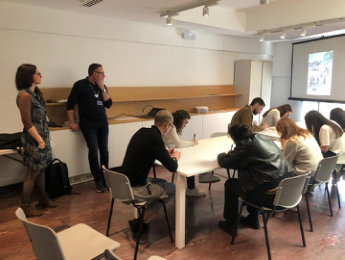
THE EGYPTIAN MUSEUM In Egyptian Museum, META-MUSEUM team and museum curators teamed up to propose activities centred on historical photographs of archaeological digs. Small groups of 15-20 people took part to the sessions (Fig. 1).
Figure 1: Participants during the co-creation activity in Egyptian Museum (left); Image C01982C, representing archaeological digs at the beginning of the XX century, displayed in Egyptian Museum (right).
The activity requested participants to go through a set of thirty images selected by museum curators, picking five that impressed them the most and rating their emotional response (either good or bad) through stickers (green/red) to be applied on a separate, and personal, sheet listing a maximum of three keywords. Personal sheets were subsequently publicly commented together with curators to identify recurring observations from participants.
In the following activity, image C01982C was then projected and participants were given a card and invited to write in one minute:
a short caption without any prompting from the mediators on the front of the card,
a question to the curator for additional information, on the back.
The curator responded to the questions as concisely as possible, avoiding any additional details or information that could influence the subsequent activity. After a discussion between the group and the curators, one caption card was selected and returned to the participants, who were then invited to modify it in turn by removing, replacing, or adding a maximum of two words each. In the end, the curators commented on the final caption and shared further reflections on the participants’ work.
The activity concluded with a viewing of the photographic plate, during which the curators conducted an in-depth analysis, revealing details to the participants and explaining the photograph’s backstory, composition, and heritage value beyond the object itself. This provided additional material for reflection on the content and message conveyed by the image.
The Case for Co-Creation to Mediate Cultural Heritage Museums 101 Given the strong interest shown by participants in the co-creation activities, once the scheduled sessions with the curators had ended, they were invited to visit two rooms displaying historical images. Participants were also asked to complete pre- and post-experience questionnaires to profile them and their cultural habits, and to assess their feedback in terms of engagement, knowledge gained, and personal reflection.
MUSÉOPARC ALÉSIA As previously implemented at the Egyptian Museum, a co-creative activity was proposed at Alésia. Participants were given a card inviting them to choose between Julius Caesar and Vercingetorix, place a sticker representing their choice on the card, and write down a quality they particularly admired in the selected figure (translated from French: Choose one of the two characters and write down a quality you admire). On the reverse side, two additional questions invited participants to identify traces of Gaulish and Roman heritage within themselves (translated from French: What aspects of the ancient Gauls/Romans still reside in you?).
To ensure randomization, half of the sample received the card before the visit, while the other half completed it afterward. In addition, to prevent any potential order effect, half of the cards presented the question on the Gauls first and the Romans second, while the remaining cards followed the opposite order.
As expected, the vast majority of participants chose Vercingetorix over Julius Caesar, although a small proportion—primarily among younger participants—selected Julius Caesar. The qualities identified by participants were collected and visualized in a word cloud: Figure 2 shows the results related to Vercingetorix, from which the terms “unifier” (rassembleur) and “courage” emerged most prominently in relation to his character.
A somewhat hostile reaction emerged in response to the question concerning perceived “Roman heritage.” Many participants either voiced their discomfort directly to the researchers, left the question unanswered, or wrote “nothing” on the card in an overtly negative manner.
Figure 2: Word cloud resulting from the co-creation activity conducted at MuséoParc Alésia: responses to the question “Choose one of the two characters and write down a quality you admire.
EXPERIMENTING IN THE JAMTLI MUSEUM, ÖSTERSUND, SWEDEN In the frame of META-MUSEUM project NCK - co-located with the regional museum Jamtli - has the opportunity to collaborate with museum curators. Ideas on co-creation can therefore move quickly from the desktop to testing in living environment. When presented to museum visitors, even the most carefully examined ideas can prove problematic, and unexpected outcomes
can occur. NCK therefore considers real-life testing to be an integral part of the design process.
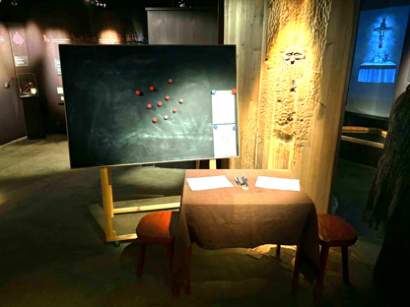
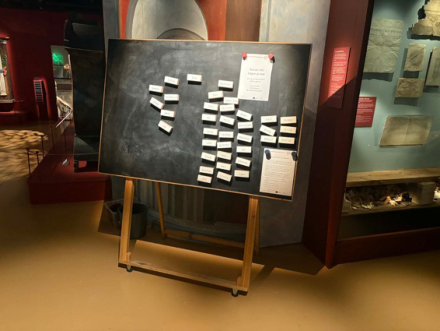
Three of the concepts that have been outlined are: the Eulogy Concept, the Voting Concept, the Refrigerator Poetry Concept NCK conducted an initial round of testing of these concepts in a deliberately simple and low- cost manner, using only materials already available in the Jamtli Museum. The main equipment consisted of a magnetic blackboard that could also be used for writing, a table, and two stools. The Christmas holiday period, when the activities occurred, is a period with relatively high visitor numbers at the Jamtli Museum, with approximately 300 visitors per day. After spending several days indoors during the holidays, people visit Jamtli for an outing with family and friends. Groups consisting of two or three generations are particularly common. All visitors, regardless of age or educational background, were invited to participate in the experiments.
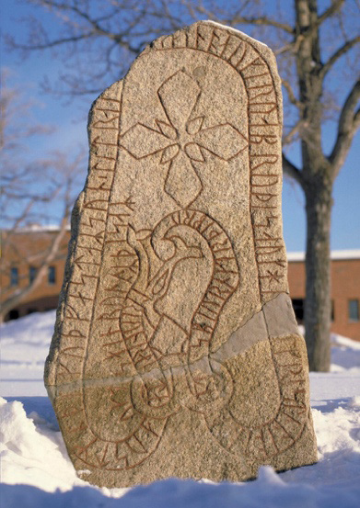
The Eulogy Concept. Almost every museum holds objects or narratives that relate to legacy, such as sarcophagi, epitaphs, reconstructed graves, and similar material. Jamtli Museum tells the story of a runestone from the Viking age, dated to around 1060 AD, (Fig. 3). The original runestone, still standing in the open air on the nearby island of Frösön, is the northernmost runestone in Sweden. Runestones were primarily erected to commemorate a relative, but the Frösön runestone was commissioned by a man named Östman Gudfastson to assert his own achievements. In English, the inscription reads: Östman Gudfastson erected this stone and made the bridge and he Christianized Jämtland. Åsbjörn made the bridge. Tryn and Sten carved the runes.
Figure 3: The runestone on Frösön, Östersund Municipality, Jämtland, Sweden. Photo: Bengt A. Lundgren/the Swedish National Heritage Board (CC-BY).
The Case for Co-Creation to Mediate Cultural Heritage Museums 103 NCK wanted to explore whether this carved message, almost 1,000 years old, could prompt people to reflect on what they themselves wish to be remembered for. The idea was to encourage visitors to imagine their life in reverse, thereby provoking reflections for the present. To conduct the experiment, the runestone was redrawn on a sheet of paper, but without reproducing the runes (letters) from the original inscription. This left a blank space for participants to write their own eulogy (Fig. 4).
Figure 4: The setting: A table, two stools, sheets of paper with blank runestones, pencils, and a blackboard with magnets to post the contributions of the visitors. Photo: Charina Knutson.
When visitors encountered the experiment, they were invited to participate. Approximately one out of ten chose to sit down and engage with the task.
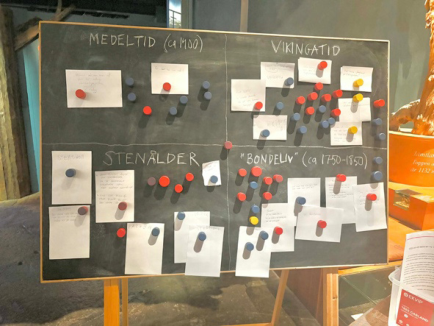
The Voting Concept. The theme of the experiment was time travel, inviting visitors to reflect on which historical era they would like to visit. Choosing a destination in history could potentially reveal something about their values, and thus about their preferred futures. In this iteration, the blackboard was divided into four squares, each with a different voting option: the Middle Ages, the Viking Age, the Stone Age, and the period 1750–1850, which in Jämtland County was a time of economic growth. These eras were selected because they are represented in the exhibitions at the Jamtli Museum and therefore easy for visitors to visualise. To vote, visitors were asked to place a magnet in one of the four squares on the blackboard. Red magnets representing visitors aged 0-18, blue magnets ages19–64, and yellow magnets for 65 and over. Optionally, they could write a brief motivation on a small piece of paper and attach it beneath their magnet (Fig. 5).
The Refrigerator Poetry Concept. It was suggested that visitors could be provided with a limited set of words–much like the popular “refrigerator poetry” of the early 2000’s. NCK printed 36 words and attached them to magnetic bricks. The words related to war, peace, family, reunion, reconstruction, and the future. This time, the magnetic blackboard was placed at the exit of an exhibition about the devastating Great Northern War of the 18th century. In the Jämtland region, this war culminated in the Carolean Death March, in which 3,000 Swedish soldiers perished in the mountains.
Nevertheless, about a generation later, the population, as well as folk music, art, and handicraft, flourished (Fig. 6).
Figure 5: The magnetic blackboard was also used for the Voting Concept. Photo: Charina Knutson.Figure 6: Visitors could arrange and rearrange magnetic words. Photo: Charina Knutson.
CONCLUSIONS
Taken together, these experiments allow for the formulation of general conclusions and broader indications to foster co-creation and inclusion in museums.
Co-creation is potentially an effective tool for encouraging personal interpretation and individual reflection; however, certain precautions must be taken into account.
As general observations, drawing on questionnaire responses and direct monitoring of participants’ behavior, it can be suggested that collective activities are better appreciated, and perceived as more engaging, than individual ones. Moreover, although museum visitors do not usually reflect on values, they show both the capacity and the willingness to do so.
The Case for Co-Creation to Mediate Cultural Heritage Museums 105 Some factors can encourage the participation in co-creative activities. First of all, a low threshold for participation (the task should not appear overly complex or demanding), that is an inclusive measure per se. For instance, when approached with the question “Would you like to take part in this experience?”, almost everyone agreed. Nevertheless, visitors usually are reluctant to articulate their views in a clear-cut and concise manner and therefore tend to add distinctions and clarifications. Conversely, some respondents did not provide further details about their choice: however, as the experience progresses, they proved able to articulate their choice in a personal and effective manner. In any case, the request to express one’s position on a given topic appears to be an appealing and inclusive way for visitors to engage and leave a comment in the exhibition. Although it does not entail deep reflection, it represents a positive outcome and may mark the initial stage of a longer sense-making process. Moreover, it constitutes an important indication for museum staff in the process of refining and more precisely orienting experience design.
Once the museum captured the visitor’s attention, there is scope for deeper engagement, especially when facilitated by a museum curator.
When visitors reflect on past periods, this appears to reveal something about their values and preferences - as well as their bias and simplified understanding.
The point during the visit at which such experiences are proposed, together with their perceived appeal, plays a crucial role. Design strategies—such as creating a dedicated or highly visible area—able to generate expectation and curiosity, are suggested. However, without a clear understanding of the activity’s objective, visitors may engage with it in a playful manner, rather than achieving the intended reflective outcome.
Finally, adopting an inclusive perspective also entails identifying scalable solutions that can be implemented across different types of museums, particularly smaller institutions, which tend to have more limited resources in several respects.
ACKNOWLEDGMENT
This paper is part of the research conducted in the framework of META- MUSEUM [101132488 – META-MUSEUM ‘Moving Emotions towards confidence in the Transformative Appropriation for a Meaningful Understanding of cultural heritage: a neuroScientific approach to European Museums’ – HORIZON-CL2-2023-HERITAGE-01] funded by the European Union. Views and opinions expressed are however those of the authors and do not necessarily reflect those of the European Union or European Research Executive Agency (REA). Neither the European Union nor the granting authority can be held responsible for them.
The authors wish to thank Fondazione Museo delle Antichità Egizie di Torino, Alésia MuseoParc and Jamtli Museum, Östersund for the willingness shown and the support given in sharing material and hosting the experiment and activities here described.
REFERENCES
Benente, M., Minucciani, V., Paganelli, F., & Mangano, D.J. (2025). Experiments conducted in the Egyptian Museum of Turin on public behavior and the potential of participatory activities for inclusive communication. AHFE HAWAII International Conference (AHFE HAWAII 2025). https://doi.org/10.54941/ahfe1006861 Bonacini, E. (2012). The participatory museum on the web: Forms of user
participation in cultural production and the creation of cultural value. CULTURAL CAPITAL. Studies on the Value of Cultural Heritage, 5, 93–125. https://doi.org/10.13138/2039-2362/201 Chesbrough, H., Vanhaverbeke, W., & West, J. (2006). Open Innovation: Researching A New Paradigm. Cummings, C., & Waelde, C. (2016). D7.1 Evidence-based policy reports and
recommendations. Füller, J. (2010). Refining Virtual Co-Creation from a Consumer Perspective.
California Management Review, 52(2), 98–122. https://doi.org/10.1525/ cmr.2010.52.2.98 Hellin-Hobbs, Y. (2010, July 1). The constructivist museum and the web.
Electronic Visualisation and the Arts (EVA 2010). https://doi.org/10.14236/ewic/ EVA2010.13 Ind, N., & Coates, N. (2013). The meanings of co-creation. European Business Review, 25. https://doi.org/10.1108/09555341311287754 Johnson, S. (2010). Where Good Ideas Come From: The natural history of innovation.
Riverhead Books - Penguin. Prahalad, C. K., & Ramaswamy, V. (2004). Co-creation experiences: The next practice in value creation. Journal of Interactive Marketing, 18(3), 5–14. https:// doi.org/10.1002/dir.20015 Sawyer, K., & Dezutter, S. (2009). Distributed Creativity: How Collective Creations
Emerge From Collaboration. Psychology of Aesthetics, Creativity, and the Arts, 3, 81–92. https://doi.org/10.1037/a0013282 Simon, N. (2010). The Participatory Museum. Museum 2.0. Smith, L. (2006). Uses of Heritage (1st ed.). Routledge. https://doi. org/10.4324/9780203602263 van Westen, R., & van Dijk, D. (2015). D4.2 Good practices and methods for co-creation. Visser, J. (2014). The Convincing Transformation Process of the Derby Silk Mill. The
Museum of The Future; Selected Blogposts about Museums in Times of Social and Technological Change. https://themuseumofthefuture.com/2014/07/21/the- convincing-transformation-process-of-the-derby-silk-mill/
LISTED IN THE AHFE DIGITAL BOOKSTORE CATALOGUE
Explore the complete digital volume
Universal Design and Design for Inclusion
Read this individual research paper free through the original publisher, or explore the full digital proceedings book.
ISBN 978-1-964867-85-4
Explore this ISBN in the AHFE Bookstore ↗Listed in the July 2026 bookstore catalogue; search by ISBN to confirm current availability · Digital book purchase optional