Satoshi Kose (2026). Accessibility of historic heritage reconsidered: The role of topography. In: Universal Design and Design for Inclusion. AHFE Open Access, vol. 209, pp. 83–89. https://doi.org/10.54941/ahfe1008021
Accessibility and usability of historical heritage is essential toward the realization of universal/inclusive design. How they can be achieved has been discussed extensively, and an International Standard is already published. Visiting various towns and cities that are designated as UNESCO World Cultural Heritage, however, reminded the author of the importance of the fundamental aspects of their livability – to consider the places not as a tourist destination but as a place where residents live. The author found that many of such towns and cities are up on a hill, because historically one of the essential requirements was to protect themselves from attack and invasion by the enemies, which meant they are not so easily accessible. In the contemporary context, the residents are much older than people have historically assumed. The issue of topography, i.e., ups and downs, therefore, need to be reconsidered for the betterment of everyday life of the residents, not just for tourists from inland and overseas. There have been ideas to overcome the difficulties, and this paper discusses some examples that could perhaps be applied elsewhere. The author will also discuss issues of accessibility and usability of public transportation – planning of itinerary at various occasions revealed the difficulty of finding suitable mode of transportation for those with mobility problems including wheelchair users, particularly in areas where railway systems are less convenient compared to coach buses – most coach buses have luggage area at the bottom, assuming that passengers can climb up stairs to be seated. Such assumptions are no longer valid.
Visiting overseas can sometimes give us awaking experiences. While I was fully employed, I did not have many chances to be out of major cities where I had to conduct my prime purpose of visit, mostly to attend research meetings. However, becoming among the pensioners enabled me to travel with less constraints on schedule. It also reminded me that I should visit places I would like to be before I get older and too frail to walk a long distance (Kose, 2014, 2015, 2021, 2022). It prompted me to plan trips to visit where I failed to be previously as outside of my business commitment. I am keener on accessibility and usability than before, but I realized that such information is not always easily available in smaller towns and villages.
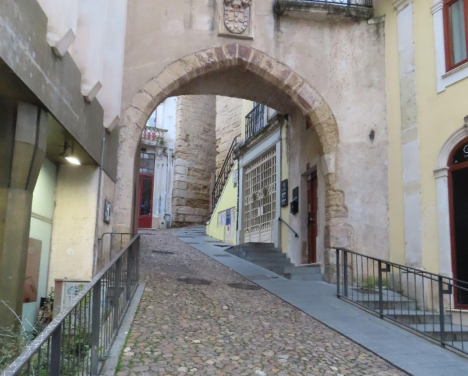
One of the most critical issues we are likely to encounter is stone pavement as we try to reach our destination. In Japan, we do not have many examples, but it is quite often the case in oversea places. The streets, including the pedestrian, are usually paved with local stones, which make us experience difficulties to handle our wheeled suitcase: The uneven stoned pavements can also become hindrance for wheelchairs. They were designed and made long before everyone came to drag suitcases.
Another difficulty we encounter is that many cities and towns are hilly, and the centers are quite often on top of a hill. Historically, people gathered to live on the hilltop, then they guarded themselves with walls against enemies. It is different from Japanese castles where people live outside of the castle – wall is protecting the castle where only the warriors protect themselves.
Of course, when population increases, the city boundary is expanded and people live outside of old city walls, and we can witness old town and new town. In many places, we see old city wall still existing, and it is quite often the case that moving within the old city wall is more difficult compared to new city area due to narrowness of the street and stone pavement.
Figure 1: Stone paved street climbing uphill at Coimbra, Portugal.
Over-Tourism: Rushing of Many Tourists I am among the visitors rushing into touristic spots. Time has changed, and many people come to places where very few visited in the older days. The COVID-19 pandemic once halted movement of people, but now that risk has receded, they move around far more than before. COVID-19 imposed many places to introduce advance reservation system, mostly on the net, to control the total number of guests, which usually continues. You must arrange your reservation well in advance to visit popular places: quite often, the reservation is full and you may have to give up, otherwise you pay premiums to travel agencies to gain reserved access.
Accessibility of Historic Heritage Reconsidered 85 It is also the case for accommodation if you wish to stay in a convenient place to your destination. In many cities, new construction is impossible in historic areas, resulting in a shortage of accommodation for tourists. To solve the issue, existing dwellings are often converted into tourist accommodations to meet the needs. If the buildings are of historic value, however, renovation might be restricted, preventing installation of elevators. It is understandable that attics are accessed only with stairs, but walking up several floors all the way is inconvenient, which is sometimes hindrance to mobility limited tourists.
Another problem caused is that original local residents are forced out of the old town because the building owners choose to let the tourists use the units (which is usually more profitable than to rent them for residential purposes), a kind of gentrification reported in Barcelona or Lisbon, for example.
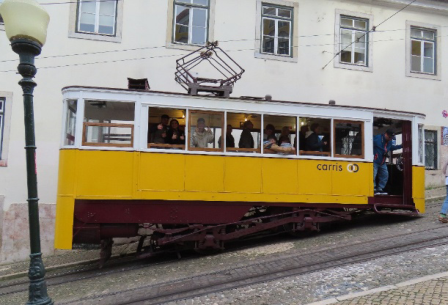
Situation of Transportation Over-tourism also brings about competition on transportation. If the town size is small enough, for example around several hundred meters in diameter, walking would suffice. It will not be the case with larger towns and cities. The problem is visible in Kyoto, Japan, and comparable situation is happening in Lisbon, etc., where tram is near full and senior residents are kept standing while they travelled several stations. None of the tourists occupying the seats gave up theirs to the seniors. Unlike metro systems, trams follow the topography, climbing up and down the hill through narrow streets, essential for everyday life in the city. Metro systems are designed for more distant travel, and some of the stations are quite deep underground, resulting in access to station platforms itself a challenging task. Major routes are served by escalators, but sometimes only stairs are available (elevator access is quite limited among routes). It is particularly the case with older lines, where renovation and installation of elevators and escalators are physically difficult or impossible. London and Paris, both hosted Olympics and Paralympics in 2012 and 2024 respectively, have had difficulty in making travel accessible for wheelchairs: London solved the problem by making major transportation with accessible buses. In crucial junction stations, elevators are necessary, and they are introduced in an acrobatic way, for example at Earls Court Station in London.
Compared to London or Paris, transportation systems in Tokyo, including underground, are better equipped, but still routes are limited. In Japan, redevelopment is more frequent, and once it is finished, elevators are likely to be added, and it would be more accessible for wheels – wheelchairs, baby buggies, and suitcases.
Ensuring Mobility on a Hilly Terrain Many larger cities are generally flat, but still there are ups and downs, needing climbing up the hill (During the ISO21542 document development stage, we were in Madrid, Copenhagen, Barcelona, and other cities, where topography was hilly with slope greater than 1/20, of which specialists insisted as maximum for wheelchairs). Smaller towns whose center is on a
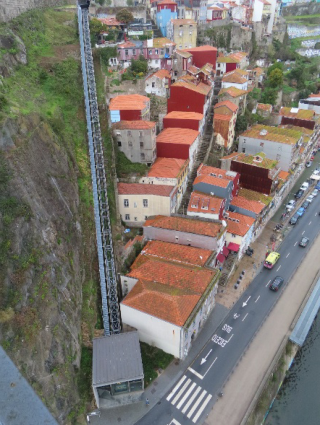
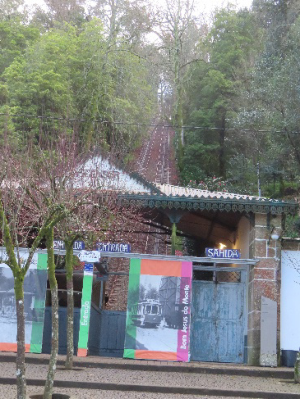
86 Kose hilltop, funiculars are sometimes installed. One of the reasons is that railway station is located lower down (for example, the railway runs along the river while the town center is on the hill). To go uphill, one must go around, which is not so difficult for automobiles, but climbing a steep slope is a challenging task for pedestrians and funicular is a helpful solution. In some touristic spots, it is planned for the benefit of visitors, but in other places, it is for residents to use. During my visit, I encountered funiculars and the like in Porto and Lisbon, Portugal, and in Orvieto, Italy. As a funicular for tourists, the Sanctuary of Bom Jesus do Monte, Portugal, and Montmartre, Paris can be named.
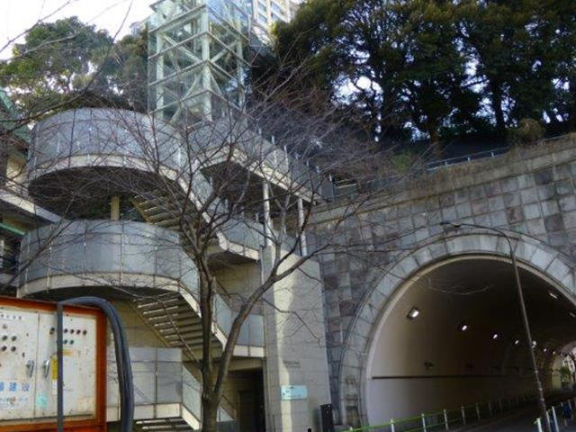
On other occasions, elevators are installed, like in Coimbra and Lisbon. There are some in Tokyo as well, such as one at Atago, Tokyo, where both Atago Shrine and NHK Broadcasting Museum are accessed. Both funiculars and elevators are expensive to build and maintain, and the fare is by no means cheap, usually (of course sometimes it is free).
Figure 2: Funicular from the riverside up at Porto, Portugal.Figure 3: Funicular tram Lisbon, Portugal.
Figure 4 & 5: Funicular, Orvieto, Italy, and Montmartre, Paris, France.
Figure 6: Funicular, Sanctuary of Bom Jesus do Monte, Portugal.
Figure 7 & 8: Elevators, Coimbra and Lisbon, Portugal.
Figure 9: Elevator, Atago, Tokyo, Japan.
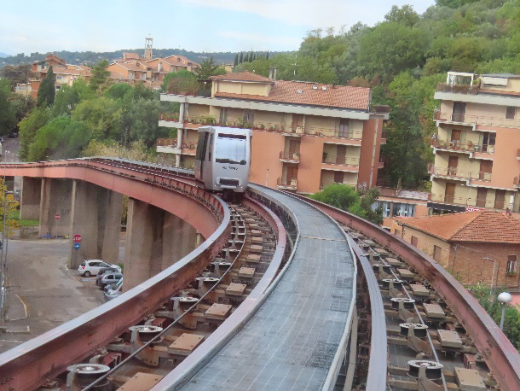
There are further possibilities to make the environments more accessible and usable. In Perugia, Italy, a mini-metro system is provided, which runs from the railway station to the city center. It is tiny and not all areas of the city are served, but it enables people to move around major places within a hilly terrain.
Other alternatives are found in London, and in Yokohama, Japan. They are cable cars that connect two points skipping the hustle and bustle below while experiencing a good aerial view from above. With the London cable car, you can also be connected to Uber boats along the River Thames (the shortest way between Tate Britain and Tate Modern was the boat).
Figure 10: Mini-metro, Perugia, Italy.
Accessibility of Historic Heritage Reconsidered 89 How Can Information on Accessibility Be Provided?
Presently, information on transportation by rail and by air is easily available, including accessibility features. However, long bus travel is usually far from satisfactory in terms of accessibility. Most of the buses are designed to house suitcases at the bottom, and passengers are expected to climb up several steps. Unless strict accessibility control by laws or regulations is in place, buses are not reliable, and extensive efforts are necessary to ensure wheelchair-accessible mode of transportation. I travelled Croatia in 2025, where I found it difficult to travel by train – long distance buses are the only practical option. Portugal, where I travelled also in 2025, I was able to locate several websites with accessibility information. I did not go further because I was not in need of wheelchair access at the time, and I have no details at hand now, but I can assume there are not many options for pensioners with reduced mobility.
It may be one of the reasons that many pensioners choose cruise ship for travelling since accessibility and usability is ensured. At the port of call, they can arrange accessible mode of transportation for visits, with no need to check in and out of hotels if it is a day trip.
CONCLUSION
It may take more time to search for necessary information according to one’s needs on accessibility, but there are some existing already. The difference of the accessibility levels between places may come from people’s awareness on accessibility – essential element of human rights. I do hope European Union’s determination will work to further improve accessibility and usability and become a role model of other countries.
REFERENCES
ISO 21542-2021 Accessibility and usability of the built environment. Kose, S. (2014) What Need to Be Done to Accommodate Overseas Visitors during the Olympics and Paralympics in 2020?: Toward Universally Designed Tokyo. Proceedings of the 5th International Conference for Universal Design in Fukushima & Tokyo 2014, pp. 1–7. Kose, S. (2015) Tourism For All: How Can Universal/inclusive Design Accommodate
Senior Travelers? Journal Of Universal Design In The Built Environment, 1:1 (2015) pp. 33–47, ISSN 2462-1668, (Print). Kose, S. (2021) Accessibility and Usability Standards on Built Environment Design: Struggle Toward Agreement in the Global Context, C. S. Shin et al. (Eds.): AHFE Advances in Industrial Design pp. 275–280 https://doi.org/10.1007/978-3-030- 80829-7_34 Kose, S. (2022) How Can We Ensure Accessibility of Cultural Heritage? Toward better
utilization of existing assets in Japanese context, in Transforming our World through Universal Design for Human Development, IOS Press, pp. 435–442. doi:10.3233/ SHTI220871.
LISTED IN THE AHFE DIGITAL BOOKSTORE CATALOGUE
Explore the complete digital volume
Universal Design and Design for Inclusion
Read this individual research paper free through the original publisher, or explore the full digital proceedings book.
ISBN 978-1-964867-85-4
Explore this ISBN in the AHFE Bookstore ↗Listed in the July 2026 bookstore catalogue; search by ISBN to confirm current availability · Digital book purchase optional