Pat Langdon, Roshan Dhonju (2025). The Design challenges of Finding Engineering Solutions for the Ingress and Egress of disabled Passengers into Small sub-Regional Aeroplanes. In: Human Factors in Design, Engineering, and Computing. AHFE Open Access, vol. 199, pp. 239–249. https://doi.org/10.54941/ahfe1006836
Examples of design solutions for the ingress and egress of wheelchair users into large and small passenger airplanes already exist on the market. However, they are predominantly ground-based, expensive, single-aircraft solutions. The Innovate UK Hydrogen Electric and Automated Regional Transportation (HEART) project addressed, as part of its programme, the design challenge of enabling wheelchair users to travel on smaller planes such as those used on sub-regional routes with 19 seats or fewer. The approach taken was systematic user-centred Inclusive Design methodology based on functional, analytical capability analysis (Langdon 2010) and an end-to-end design method exploring a design space of alternative technical and ergonomic design solutions, for implementation within an envelope of requirements (Stanton et al. 2021). The objective was to identify and rank design alternatives for assisting ingress and egress of small aeroplanes by passengers with physical capability ranges that led them to use a wheelchair.For this to succeed it was essential that the developed designs should align with the needs, expectations, and lived experiences of its intended users. The design process was therefore based around disabled users and their experience. The project prioritised user-centred design, ensuring that proposed solutions were not only technically feasible but also practically usable by single operators. The study engaged disabled collaborators, and key industry stakeholders. The design process commenced with a review of literature and current regulatory environments, and a benchmarking of market offerings for a range of aircraft and handling equipment. This was followed by a technical requirements analysis where key limits included anthropometrics, size, weight, de-mountability, single person usability, portability, and the necessity to carry inside the aircraft and be self-powered. Building on these insights, a design workshop based on Stanton et al. (2021), brought together diverse stakeholders, including an aircraft engineer, designers, a CAA regulator and wheelchair users. Participants engaged in a creative exercise to generate and then technically evaluate convergent solutions, which were documented in concept sheets. These concepts were then ranked using a Pugh Matrix scoring system and an inclusion audit assessing usability across vision, physical, hearing, thinking, and stamina categories.The paper presents the key findings at each stage focusing on the accessibility challenges in small aircraft. Key technical issues identified included: restricted space; vertical movement, such as reaching and descending from the aircraft door level, and rotational and horizontal movement required for passengers to enter the aeroplane and secure themselves as regulated.The trials with the manufactured prototype were successful in engineering terms and received positively by collaborating disabled users, suggesting that the operation of the lifting equipment was potentially beneficial for disabled passengers if scaled up to airline service. Further design work will examine variants for similar aircraft and conduct inclusive disability trials.Stanton, N.A., Revell K.M.A., and Langdon, P., (2021), Designing Interaction and Interfaces for Automated Vehicles: User-Centred Ecological Design and Testing. 2021: CRC.
The Hydrogen Electric and Automated Regional Transportation (HEART) project of the Innovate UK’s Future Flight Challenge included a design analysis exploring alternative mechanical and ergonomic design solutions for implementation in specific aircraft. This involved a series of workshops and carried out an online inclusion survey as part of the integrated methodology. The project was to support inclusive air travel for people with capability variations, such as low vision or physical movement difficulties, for example, wheelchair users. Design solutions for ingress and egress for wheelchair users existed in the market; however, they were not suited to all aircraft
and circumstances. The HEART Project was concerned with hydrogen- electric aircraft with 19 seats or fewer, single and/or multiple-engine piston land (ASSI, Part 135 Commercial Air Transport Operations (CATO)) (ASSI, 2024), (CAA, 2023). To fill this gap, the project explored alternative solutions for ingress and egress. The project also considered the potential to carry passengers who use a wheelchair and the associated requirements. An inclusive design methodology was utilised based on functional, analytical capability measurement (Persad et al., 2006).
There were two types of pertinent regulations to consider when designing for inclusive air travel. The first considers passengers’ rights, and the second considers airworthiness and safety. In the UK, the Equality Act 2010 contains a specific exclusion that the general duty to make reasonable adjustments for disabled passengers does not apply to transporting people by air. However, the European Commission (legislation.gov.uk, 2006) Regulation No 1107/2006 concerning the rights of disabled persons and persons with reduced mobility when travelling by air still applies in the UK (CAA, 2019). The Certification Specifications (CS) (EASA, 2023) vary according to the class of aircraft. For the design of the HEART Project, the relevant certification specifications were CS-23 for normal and utility commuter category aeroplanes, which provide the technical requirements for certification of small aeroplanes. Any design solutions for ingress and egress, or carrying a wheelchair in the cabin, needed to be developed in the context of the existing certification. Therefore, if any modification needed to be done, for example, modification for ingress and egress purposes, it must comply with CAA, CS-23. These specifications were important for wheelchair access and manoeuvrability. Furthermore, for design purposes, the height between the ground and the door needed to be considered for the range of aircraft.
RESEARCH GAP Solutions for ingress and egress for disabled people, especially wheelchair users, already existed in the market; however, they were not suitable for all aircraft and circumstances. As a result, the HEART project addressed a critical gap in aircraft accessibility, particularly for smaller aircraft operating with 19 seats or fewer under CATO (Controlled Airspace Take-Off and Landing Operations). Traditional ingress and egress solutions did not suit these aircraft due to their size with limited spaces (i.e. small fuselages and narrower doors) or operational environments (i.e. low ground clearance, which made traditional stairs or boarding ramps impractical or unsafe). To address this gap, the HEART project explored alternative solutions.
MATERIALS AND METHODS
The Technical and Design workshops were fundamental components of the Methodology. These workshops were conducted with 8 and 10 participants, respectively. Among the attendees, there was one person with known disabilities (paraplegia) and consortium partners who were stakeholders in the HEART Project. The participants included:
The Design Challenges of Finding Engineering Solutions 241
An ex-CAA regulator and Consortium Leader
A collaborating wheelchair user with an engineering background
A flight test engineer from the Britten Norman Aerospace company
A Product engineer with a background in artistic rendition
A Project Principal from Mott MacDonald Engineering consultancy
Two workshop facilitators and three researchers.
The methodology for the technical workshop was based on Stanton et al., (2021). It involved capturing themes and details of technical discussions through qualitative thematic analysis based on grounded theory (Goodman- Dean et al., 2010). The proceedings were recorded in video and audio formats and transcribed using automated transcription. These transcriptions were then error-checked and coded thematically using a Grounded theory approach and NVivo (V20) software and the results summarised. Researchers subsequently recoded after engineering discussions, and the report was enhanced with benchmarking of existing solutions.
The Design workshop methodology focused on identifying key design thinking themes and new concepts. Researchers reviewed and refined these concepts after the workshop, then filtered them according to engineering requirements that were previously established in a technical workshop.
EMERGENT DESIGN CONCEPTS The workshop participants were tasked with generating ideas aligned with the project’s aims. These ideas were detailed in concept sheets, the template for which included several key sections exemplified below.
DESIGN PROCESS The methodology centered on methods derived from a framework designed for human interfaces in automotive automation (Stanton et al., 2021). The design process presented the procedures used during the technical workshop. After determining the requirements discussed in the workshop, new design solutions were assessed according to these requirements at the conclusion of the session. The workshops resulted in alternative designs that fulfilled relevant engineering criteria. The concept development process was divided into two stages throughout the workshop. The objective was to produce a shortlist of viable design concepts. These concepts were then collectively reviewed to generate a narrower selection of options. The intention was to build solutions for subsequent evaluation that were engineering valid. For each shortlisted idea, an individual summary sheet was produced following the approach outlined. These designs were subsequently reviewed by disabled users, and discussed using qualitative and quantitative input from the HEART project.
EMERGENT CONCEPTS The design workshop was followed by technical meetings to review the engineeing, aiming to eliminate duplication and merge similar designs.
242 Langdon and Dhonju
Concept sheets were prepared for filtered ideas based on the workshop’s convergence principle. The finalised design concepts were verified by workshop feedback and then drawn in CAD or graphic rendition. Hence, the following design concepts in Table 1 were screened for further steps of consideration.
Table 1: Emerged design concepts.
Table available in the original PDF paper.
S.n. Design Concepts S.n. Design Concepts
11. Expandable airbag lift
1. Lifting equipment 7. Roof rail/Pulley 2. Swivel passenger seat 8. Are you sitting comfortably? 3. Sliding floor cassette 9. Front or rear-loading aircraft 4. Aircraft Kneeling 10. Conveyor belt/Tesco trolley ramp 5. Ramps (Turntable and Flex Bend)
6. Concertina bendy Ramp 12. The merged concept of Cassette and Turntable + Flex bend
Each of the above design concepts was summarised in a “Design Concept Summary Sheet”. The summary sheet was created from a template with the following titles and descriptions, illustrating the emerging concept BN Lift.
BN Lift Concept Summary The BN Lift had developed as a lifting device for physically disabled people, especially wheelchair users, to use on BN Islander aeroplanes. The idea was developed by considering the engineering requirements as discussed in the technical workshop, such as the height between the ground level and the ingress of the door and the distance between the wheel and the door, including securing straps to prevent falling from the platform and back support for stability and safe operation.
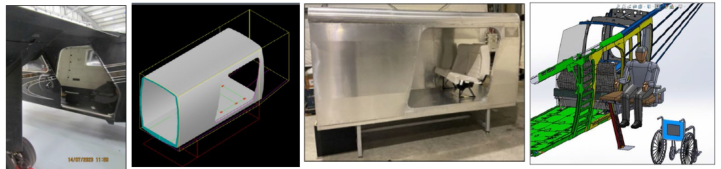
Assumptions With Schematic The images below display the BN Islander aeroplane, emphasising the significant distance between the wheel and the ingress door. This height difference from the ground presented a challenge for wheelchair users. Existing aviation solutions, such as the scissor lift, Ambulift, and Aviramp, were unsuitable due to size constraints and were only effective for larger aeroplanes. Consequently, a lifting device was conceived, illustrated in Figure 1. To ensure safety, the device included back support and straps for enhanced stability and security.
Concept Description The main purpose of this design was to lift wheelchair users from ground level to the sill level of the aeroplane door. This height was fixed, assuming a level surface during normal undercarriage operation. The upper fixing point was located on the seat rails next to the door, while the lower part of the lifting device rested on an adjustable rubber pad to account for variations in ground level.
The Design Challenges of Finding Engineering Solutions 243
Figure 1: BN Islander lifting device concept, (a) distance between the wheel and the ingress door, (b) model of the Fuselage construction, (c) fuselage rig with the seat, (d) BN Islander lifting device concept.
The sitting platform was securely attached to a lifting device, featuring components like an armrest and straps to ensure the wheelchair was safely secured. The platform was elevated gradually using a lead screw mechanism, which could be operated either manually or with a battery-powered device. The lead screw was actuated via a square drive at the top, such as with a cordless drill. Once the platform was raised to the level of the aircraft chair, the user could transfer to the aircraft chair using a sliding support panel. Additionally, the lifting device was designed to be packable and could be safely stored in the aeroplane’s storage area.
Operational Considerations Based on the engineering requirements, Britten Norman OEM1 (Original Equipment Manufacturer) adopted the lifting device solution as depicted in Figure 1. For safety, the sidebar armrests and straps to secure the user were discussed during the design workshop, which was developed during the trial session. These safety features were considered during the usage trials. Additionally, the number and positions of the handles were determined during live trials, based on user feedback. Operating this device required a trained individual to handle the electrical actuator and assemble the equipment After use, the entire lifting device could be folded and stored.
Inclusion Considerations According to the “National Care Service; Adult Social Care: Equality Evidence Review” by the Scottish government (Government, 2022), 50% of the adult population was over the mean population age. Many of these individuals were elderly and faced varying levels of difficulty in daily life. This underscored the necessity for new research to support inclusive air travel, ensuring that these solutions could be evidenced to support new regulations.
The development of this lifting device was meaningful for those who were physically disabled, especially those with wheelchairs. Wheelchair users were able to transfer to the seat provided on this device using a familiar movement. They were then secured using the straps. The device was provided with an armrest, back support, and a bar around the chair to hold if needed. This device helped wheelchair users get in and out of the aeroplane with ease.
244 Langdon and Dhonju
INCLUSION CATEGORIES A table categorising difficulty levels for each functional area was developed using inclusive design principles from “Designing a More Inclusive World” (Waller et al., 2010). As shown in Table 2, these tables were based on UK disability data (Martin and Elliot, 1992; Langdon et al., 2015) and maintained consistency across all design concepts. For example, the five common classifications of functional impairment were considered as: Category A: Low capability (purple colour category); Category B: Low to moderate capability (lavender colour category); Category C: “Moderate” to “light to moderate” capability impairment (orange colour category); Category D: “Light to moderate” to “no discernible difficulty”s.
Table 2: Example inclusion category card. B: low to moderate capability.
Table available in the original PDF paper.
The Design Challenges of Finding Engineering Solutions 245
Inclusion Audit Method All steps in the task analysis for ingress and egress were compared across the four different tables, and the matching category was selected.
Inclusion Audit for BN Lifting Equipment The inclusion audit was conducted for all functional categories of individuals performing different tasks, with their corresponding categories based on the category tables. The inclusion audit for the BN’s Lift is detailed in Table 3. For the BN Lift, the mental capability functional area was predominantly categorised as lavender colour. This indicated that individuals with low capability (purple colour category) could be assigned to this task, as the purple colour category implied no requirement for thinking or memorising sequences during the task. In terms of stamina, the orange colour category indicated that moderate strength was required for these tasks. However, in some cases, stamina was categorised as purple, meaning no strength was needed since the task involved merely sitting on the lifting platform.
Table 3: Inclusion of audit for the BN lift equipment.
Table available in the original PDF paper.
Tasks that required good vision, physical movement, and hearing were categorised as having “moderate to light moderate” to “light moderate to no difficulty”. Good vision was essential for reading signs, and identifying items such as platforms, armrests, and doorways. Physical movement, primarily involving the arms, was necessary for tasks like picking up and folding a wheelchair, as well as the reach and stretch required to hold the armrest and to maintain balance. Moderate hearing was important to follow instructions amidst the background noise.
DISCUSSION
Following the inclusion audit, most design concepts were marked with a purple colour for Stamina, while only a few had high demands for Mental capabilities. Predominantly, the design concepts were scored as lavender and orange colours, categorised using the four-card colour system.
246 Langdon and Dhonju
Table 4: Scores of design concepts based on inclusion audit.
Table available in the original PDF paper.
Based on the capability category cards, scores were assigned by counting the number of category colours in each design concept, as shown in Table 5. For example, design concepts needed to be economical, simple, safe, and possess face validity. From the task analysis, individuals needed at least one eye for vision to see instructions, doorways, pathways, straps, and locks. They also required dexterity and the use of both hands to roll a chair while holding the device arms. Stamina was necessary to slide onto and off the seat, along with the ability to bend. Thinking was required to understand sequences of movement. Sufficient hearing was required to perceive instructions from crew members in noisy environments.
Table 5: Scores of top rank design concepts based on the Pugh matrix S.No. Requirements/Design Concepts BN Lift Air Bag Conveyor Belt
Table available in the original PDF paper.
+ + +
Design related constraints 1 Engineering standard for door size, type and location
+ + +
2 Door and wing configuration + + + 3 Height between the ground level and ingress door + + +
4 Distance between the wheel under the wing and the ingress door
+ - -
5 Mechanism of lifting device, size and weight measurements, distances from undercarriage/ winds and load capacity by the lift
+ + +
6 Engineering stnadard for seating arrangement and fixing seat sizes
+ + +
7 The locking system of the wheelchair while lifting and inside the cabin to make it secure
+ + +
8 The position of the handrail to be held by the wheelchair user while they are being lifted by the lifting device
+ + +
9 The position of the handle to hold to get into the cabin and to hold while in the cabin
Continued
The Design Challenges of Finding Engineering Solutions 247
Table 5: Continued S.No. Requirements/Design Concepts BN Lift Air Bag Conveyor Belt
Table available in the original PDF paper.
+ + +
10 The connection strength of the handle on the body of the plane in the cabin
+ + -
11 Engineering specifications and standards for fixing handles and lifting devices
+ + +
12 The considerations of lifting a wheelchair using a battery power ( on aircraft or off aircraft)
+ - +
using a hand tools (e.g., cordless power drill) 13 Weight + + +
+ + -
General 14 Cost (low or high) + + - 15 Transportation charge (low or high) + + - 16 Weather sustainable (Yes or No) + + + 17 Manufacture difficulty (Yes or No) - - + 18 Materials availability (Easy or Difficult) 19 Safety + + + 20 Operation (easy or difficult) + + -
Educational and training 21 Carer/ Help needed (Yes or No) + + + 22 Training for operation (Yes or No) + + + Total (+) 22 20 17 Total (-) 1 3 6
To analyse the emerging design concept, the Pugh Matrix scoring system was used, as detailed in Table 6, with only a limited number of concepts (Pannell, 2023) shown. The requirements were divided into three constraints: “Design-related,” “General,” and “Training and education.” Engineering requirements were classified with terms like “Low,” “High,” “Yes,” “No,” “Easy,” and “Difficulty” for each design concept. After scoring, the concepts were ranked based on their alignment with engineering requirements.
CONCLUSION
The workshop aimed to broaden design options and foster innovative ideas for inclusive air travel equipment, particularly addressing wheelchair access to small aircraft. Experts tackled key technical challenges within regulatory and user requirements. Afterward, selected design concepts were summarised and evaluated, resulting in novel solutions that met both engineering and inclusion criteria for real-world application.
The BN Lift concept was determined to be the most appropriate for small aircraft such as Islanders, following evaluations conducted with the Pugh matrix, inclusion audit, and assessment form system. The BN Lift received only one negative among 23 design constraints, while others such as an
248 Langdon and Dhonju
expandable airbag system received three negatives. Results from the inclusion audit were similar for both concepts; however, the assessment form identified further differences in areas such as reach and stretch, bending, and standing, although these factors were only assessed for a limited number of best ranked options. Considering all criteria, including design constraints, the BN Lift concept design was predominant. Initial trials demonstrated that the lifting device effectively addressed the vertical access challenge and enabled the user to achieve horizontal access independently. This method was considered safe and non-stigmatic for accessing the aircraft. Additionally, it was established that the device could be introduced to the Islander aircraft without requiring modifications to the airframe. The project represents a significant first step towards developing a device that enhances accessibility for small aircraft over a wide range of capabilities. Further testing could involve trials on actual aircraft to evaluate their performance with the existing doorframe and within the confined space beneath the aircraft wing and between the door and the landing gear. The device is likely not suitable for all low capability passengers, so additional testing with a larger user group will be mandatory to determine the range of usage cases. Further trials could also identify the types of aircraft the device can best operate with, and explore the potential for modified versions of the device to be tested with these aircraft.
ACKNOWLEDGMENT
The authors acknowledge Innovate UK funding to the FFC3 Project HEART.
REFERENCES
ASSI 2024. Part 135 Commercial Air Transport Operations - Helicopters and Small Aeroplanes. In: International, A. S. S. (ed.). CAA 2019. Guidance on quality standards under Regulation EC 1107/2006. CAA 2023. The United Kingdom type rating and licence endorsement lists constitute
the class and type of aircraft categorisations in accordance with FCL.010. CS-25 2020. Subpart D – Design and Construction&Emergency Provisions, CS 25.803, Emergency evacuation. EASA 2023. CS-23 Normal, Utility, Aerobatic and Commuter Aeroplanes. Goodman-Dean, J., Langdon, P. & Clarkson, P. J. 2010. Key influences on the user-
centred design process. Journal of Engineering Design, 21. Government, S. 2022. National Care Service - adult social care: equality evidence review. Holloway, C., Thoreau, R., Petit, E. & Tyler, N. 2015. Time and force required for
attendants boarding wheelchair users onto aircraft. ELSEVIER, 48, 167–173. Langdon, P., Johnson, D., Huppert, F. & Clarkson, P. J. 2015. A framework for collecting inclusive design data for the UK population. Appl Ergon, 46 Pt B, 318–24. Legislation. GOV. UK 2006. Regulation (EC) No 1107/2006 of the European
Parliament and of the Council of 5 July 2006, concerning the rights of disabled persons and persons with reduced mobility when travelling by air. Martin, J. & Elliot, D. 1992. Creating an Overall Measure of Severity of Disability for the Office of Population Censuses and Surveys Disability Survey. Royal Statistical Society Series A, 155, 121–140.
The Design Challenges of Finding Engineering Solutions 249
P. Langdon, U. Persad & Clarkson, P. J. 2010. Developing a model of cognitive interaction for analytical inclusive design evaluation. Elsevier, 22, 510–529. Pannell, R. 2023. An Overview of the Pugh Matrix: What Is It and How Does It
Work? [Online]. Available: https://leanscape.io/an-overview-of-the-pugh-matrix- what-is-it-and-how-does-it-work/ [Accessed Sept 2025]. Persad, U., Langdon, P. & Clarkson, P. J. 2006. Inclusive Design Evaluation and the Capability-demand Relationship, Springer, London. Stanton, N. A., Revell, K. M. A. & Langdon, P. 2021. Designing interaction and
interfaces for automated vehicles: User-centred ecological design and testing, CRC Press. Waller, S., Langdon, P. & Clarkson, P. J. 2010. Designing a More Inclusive World.
Environment, Design and Rehabilitatin (EDR) Series, 18.
LISTED IN THE AHFE DIGITAL BOOKSTORE CATALOGUE
Explore the complete digital volume
Human Factors in Design, Engineering, and Computing
Read this individual research paper free through the original publisher, or explore the full digital proceedings book.
ISBN 978-1-964867-75-5
Explore this ISBN in the AHFE Bookstore ↗Listed in the July 2026 bookstore catalogue; search by ISBN to confirm current availability · Digital book purchase optional