Gilberto Almeida Jr., Regina Álvares Dias, Jairo José Drummond Câmara (2022). Material and Ergonomics in Chairs: Study Focusing on Identity of the Materials and Perception of Textures. In: Advances in Ergonomics In Design, Usability & Special Populations: Part I. AHFE Open Access, vol. 18. https://doi.org/10.54941/ahfe100774
This article discusses the relationship between the material properties perceived by individuals and the incorporation of their identity to the product, through studies of dining chairs. Its central focus is on ergonomics aspects related to materials from an experimental study with users participation. The method of study is composed of different tests, two of them have been chosen to present in this article dealing with issues related to materials with potential application in chairs. Criteria such as polymeric material texture, material identification and perceived surfaces by individuals, perception of different surfaces like metals and naturals, perception of distinct attributes associated with different material families and semantic evaluation of products made of different materials were evaluated. The study is part of a work as master research and its results will be presented showing that the product incorporates part of its material properties and interfere to the product’s identity, and consequently in the mechanisms of user’s perception, because there was reflected in the judgment of the chairs that had similar model.
The focus of this study is the relationship between the materials used to manufacture household chairs for dining table and its influence in ergonomics. The study is broader in other aspects, and proposes a method compound of subjective measuring scales, referring to user’s preference for the material used in the product (Almeida Jr, 2013). An experimental study conducted with participants was done to meet different issues related to user interaction and preference. At first was evaluated different textures in polymeric material, simulating its application in seat surfaces and backrests of the chairs. In a subsequent experiment, was measured how people identify and know the properties of the materials traditionally used for making chairs and furniture in general. Also was sought to know the perception of different surfaces of natural and metallic materials associated with use in chairs. Finally, was met the perception of the attributes associated with four types of material, applied in the same design model of chair for the dining table.
The search for improvements to the comfort of sitting activity has been the subject of many studies with different approaches, either by ergonomics, biomechanics, and anthropometry. Reed, Schneider and Ricci (1994) show that the first modern scientific job devoted to the study of seat comfort is Arkeblom (1948) and cite over seventy previous publications related to the theme. Since then, hundreds of articles on topics related to seat comfort were published, many of which include recommendations for seat design for added comfort. Most publications is Ergonomics In Design, Usability & Special Populations I (2022) https://openaccess.cms-conferences.org/#/publications/book/978-1-4951-2106-7 dedicated to the study of work chairs and in some cases related to automotive seats, aircraft, tractors, etc.
Countless are the necessary information to the ergonomic design of products that are related to physical, cognitive and organizational aspects of man-machine-environment system traditionally dominated by ergonomics as Iida (2005). More recently, in addition to the concerns mentioned, there is also greater attention to issues related to subjective wellbeing users when interacting with the product: comfort, discomfort, perceived product quality, practical, aesthetic, symbolic and emotional aspects involved.
From the standpoint of design, the product is made of several elements - form, scale, volume, color, material, texture, brightness, sound, smell and others - which, in indivisible manner, form the end device. One of the most important elements is the material, which "allows the immediate interface between artifacts and man" (Manzini, 1993). The materials play an essential role in the product design process: they can define their range of functions, durability, cost, and their final appearance. Likewise, the user experience has a predominant role in this process, since they interact with the product, establish sensory relationships - tactile, visual, auditory, olfactory or gustatory - that can be decisive in its conception. In this sense, the material of the chair, as well as the characteristics of its surface and its conformation are significant issues for the perception of subjective questions related to users’ welfare.
In this perspective, the experimental study of users to evaluate different materials and dining chairs made of different materials served to validate the model proposed by Almeida Jr (2013) "Evaluation of subjective aspects related to materials: proposed measurement method applied to furniture industry". It was considered that the subjective evaluations resulting from the research can be reversed on objective information, as, for instance, the definition of product characteristics, the technical specification of the materials, in setting textures and finishes, as well as in several applicative possibilities.
CHAIRS AND MATERIALS The chairs are the objects most exploited by designers and architects in their designs, making it difficult to identify any of these professionals who have not designed its own model. The diversity of shapes, colors, finishes and materials used represent well the myriad of possibilities for its application. The materials used in the manufacture of chairs are the most diverse – from the more rustic and traditional as solid wood, natural fibers until the materials processed through great technology as polymers and high-tech fibers that print particular characteristics of each object.
Throughout history, to this product has been assigned status and social position symbolism, being considered one of the most important objects of furniture. Dated as older chairs known, were Egyptian, demonstrating great wealth and splendor, easily recognized by the use of noble materials in its construction. They were made of ebony, ivory, gold and wood covered with precious metals.
Currently chairs and armchairs are made of numerous materials and manufacturing processes, which influence their form and meaning. Abreu et al (2001), commenting on the use of materials for the furniture industry of synthetic and artificial nature, as reinforced polymers with fiberglass or in the form of plastic laminated sheets for finishing on wood boards. They also say that the emergence of polyurethane foam upholstered boosted the sector, replacing effectively natural fibers used for seats and backrests; indicate the importance of metals in the form of tubes in structuring and manufacturing mechanical components; states that alternatives materials such as rattan and reed have contributed to the development of technology (products and processes) in furniture sector.
Numerous are the existing processes and ways of working with countless materials, which currently exceed 100.000 different types. The use of materials is not limited to these presented; the contrary, as new materials are developed and presented to professionals, a huge field for new designs expands.
Ergonomics In Design, Usability & Special Populations I (2022) https://openaccess.cms-conferences.org/#/publications/book/978-1-4951-2106-7
ERGONOMIC ASPECTS RELATED TO THE MATERIALS In the method developed by Dias (2009) called Perception of materials by users (Permatus) were listed 58 subjective attributes to assess the materials in general, as in FIG. 1a. These attributes serve to direct and support the qualitative perception surveys with users, and were grouped into aesthetic, practical, symbolic and others influencing factors. Among these attributes, Dias; Gontijo (2013) point out those that relate more directly to ergonomics, resulting in FIG. 1b.
The material aesthetic attributes are directly related to the aesthetic impression that is felt about an object through the senses. Equivalent to the physiological pleasure (Jordan, 2002) and the visceral level design, Norman (2005). Practical attributes of the material are directly related to the use, handling and user experience with the objects, resulting in pleasure and effectiveness, equivalent to the psychological pleasure (Jordan, 2002), which is related to the cognitive, mental and emotional reactions of individuals and behavioral design of Norman (2005). The symbolic attributes are related to aspects of esteem, psychological and social, and correspond to social and ideological pleasure proposed by Jordan (2002) and reflective design defined by Norman (2005).
(a) (b)
Figure 1 - (a) Profile Material: possible subjective attributes measurable and (b) selection of attributes related to ergonomics
(Dias, 2009; Dias, Gontijo, 2013)
Ergonomics is defined as "the multidisciplinary field of knowledge that studies the characteristics, needs, abilities and skills of human beings" (Sanahuja et al, 2004, p. 16). According to the authors, the main goal of ergonomics is to adapt products, tasks, tools and spaces to capacity and needs of people. In order to analyze the factors involved in the ergonomic seats, it takes into account the relationship with the material used, the main movements performed by the user, the time of the activity, the pressure exerted by other bodies and other factors that will influence in the chair design.
Following, some attributes will be discussed highlighting matters concerning the context of ergonomics and design aspects of chairs.
Ergonomics In Design, Usability & Special Populations I (2022) https://openaccess.cms-conferences.org/#/publications/book/978-1-4951-2106-7
Textures The texture corresponds to the sensory aspect of things, the more tangible quality of objects, more immediate than the color or shape, according Ninio (1991). Texturing can be perceived by sight and/or touch - by visual sense the geometry is perceived, brightness, contrasts of patterns that can be bi or three-dimensional. By tactile sense to realize the superficial physical characteristics of the material as a three-dimensional relief. Your perception by touch depends on many variables such as: contact position with the body, passive or active touch, skin characteristics, speed of touch, pressure and vibration.
Researchers at Southampton Solent University (UK), coordinated by Zuo, studied the textures of the materials, whose results are available on the site "Matrix - Material Aesthetics" (Zuo et al, 2001; Zuo, Jones, Hope, 2004; Zuo, 2005a, Zuo, 2005b). It is a narrative-visual database with information about the human perception of aesthetics and materials. To Zuo et al (2001), the textures can be described subjectively, based on four dimensions: geometric, physical-chemical, emotional and associative. In one study conducted by Zuo (2005a) it was found the perception of materials in the laboratory from two situations: first one, participants were invited to explore the samples blindfolded and describe their sensations and perceptions. In another stage, did the same test using vision and touch. The results show that perception of the material by the touch increases sensitivity to some physic-chemical characteristics, particularly the relationship of hot-cold, wet-dry, and hard-soft. The vision, on the other hand, increases and enriches the geometric perception and strengthens the emotional feelings.
Other research also in design is the doctoral thesis of Sonneveld (2007) "Aesthetics of tactual experience" and is based on the theories of Katz (1989), by Klatzky and Lederman (1987). According to the researcher, the tactile properties of the products can be verified from four areas: (i) the material substance (felt by hardness, temperature, weight, elasticity and plasticity); (ii) its surface (textures and patterns); (iii) structure or geometric space of product (overall shape, volume and balance); and (iv) their moving part (dynamics, ie, how the parts move with each other, including the force required to move them). Sonneveld (2007) also highlights what is felt through touch in products. Physical pleasure includes a dual aspect: on one side the lust and desire, of another, the pain and disgust. Vulnerability refers to the ability of the material to bring physical harm to the user, how to hurt, burn or stick. Affective reactions may be of two types: positive (user demonstrates enjoy and take pleasure in use) or negative (reactions of discontent or aversion to the material). In consonance, the trend of shares follows the affective reaction: if it is positive, proceedings are approaching and accept, and if it is negative, the trend is that the shares are to depart and reprobate.
When a material is touched, previous self-experiences reflect our knowledge and reactions in interaction. In general, the familiar materials are more accepted than unknown materials, because they are strangers to our personal experience. The bodily reaction is related to the affective reaction and their resulting actions. Thus, the touch of a soft and comfortable material suggests that the body reaction is relaxation. Instead, the touch of a rough and dry material suggests that the bodily reaction is tension.
Sound The sound emitted by materials may provide us with informations about their nature, if it is crystal or glass, if it is solid wood or wood veneer on a hollow content. Experts are able to identify the type of a product plastic from your sound. Norman (2006) refers to the use of sound for visibility - "the sound can tell us if things are working properly or need maintenance or repair". Thus, the sound tells us about things we can not see when our eyes are busy with other activities. Natural sounds reflect the complex interaction of objects: how a piece moves against another, the material from which the parts are made of and their properties - solid or hollow, wooden or metal, hard or soft, rough or smooth.
Smell The natural materials of animal and vegetable origin have their own smells, inherent to each material, such as the smell of the woods, bamboo, fiber, leather and rubber. The presence of organic compounds determines the scent of natural materials of vegetable origin. It is possible to identify some species of woods only by its characteristic odor, on the other hand, ink, varnish or lac neutralize the smell of the wood, or better, make it artificial, eliminating its natural olfactory characteristic. The metals have no smell since they are nonvolatile, and other materials of mineral origin such as stone, marble, ceramic, glass are also odorless. The unpleasant odor of artificial materials was, for
Ergonomics In Design, Usability & Special Populations I (2022) https://openaccess.cms-conferences.org/#/publications/book/978-1-4951-2106-7 many decades, one of the reasons for their refusal to manufacture products with certain materials. However, as said Manzini (1993) it is possible to impart sensory properties to plastics and elastomers by the addition of flavorings in mass of the polymer. This solution can be used both to neutralize unpleasant odors, as to bring new olfactory qualities to certain objects. It is important to remember that the odors of the materials are directly related to the environment where it will be used - the humidity and temperature are factors that influence olfactory perception. Furthermore, if the material is used in contact with the body (clothes, shoes and accessories), the skin type, the body temperature and sweating are other factors to consider.
Temperature The thermal effect is inextricably linked with the experience of our bodies (Zaccai, 1999). Every material has an intrinsic temperature which can vary with environmental conditions. The warmest materials are nicer and make the products and spaces most welcoming. However, both the intense heat, as the cold conditions are negatively perceived. The surface area of contact particularly influences the feeling of "hot-cold", called "thermal touch". The material selection can be based on the insulating ability of the material or its properties as a conductor of heat, not only to meet the technical or security requirements, but also to provide sensory stimulation.
Identity With the growing number of products available in the market, as well as applications in materials, increases the difficulty of recognition not only of objects but also of materials that compose them. Manzini (1993) points out that a new object is not to say a new material, however, all new material disrupts the object recognition. The appearance of plastic, explains Dormer (1995), also changed our understanding of how things are produced. Most people have an idea, or some knowledge, of how to work or carve the wood, or how to shape the clay, but hardly imagine how to process the artificial materials like plastic or rubber. Thus, the latest objects appear coated with an "appearance" that allows us maximum to mean by "what looks like", but it is really difficult to say what they are made of. Given this new situation, the user when interact with any material will experience the relationship between their use and performance. However, the user will not be able a priori to predict other properties besides the detected ones and even to assign them cultural significance.
Usability The material to be selected must comply with a number of attributes that meet specific needs, such as being soft (comfort), adherent (insurance), be thin and sturdy (allow a fine touch) and so on. All these attributes served will provide the user a sense of wellbeing, satisfaction of use, especially if the operation is longstanding, performed frequently or continuously. The visual and tactile texture applied to polymeric materials, can provide the following practical effects: the first is the texture known as "soft look" that gives a soft and velvety visual appearance to the material and also pleasant to the touch. The second is used for objects which the grip movement is required (key, pen, toothbrush, cable tools and controls), where the texture of tactile character is soft and nonskid. The usability problems are those that reflect the difficulty of user about the proper use of the object. Therefore, usability has a close relationship with the perception of pleasure and positive emotions, according to Jordan (1998).
Anthropometry According to Herman Miller (2007) is possible to conclude that the difficulty in securing an ideal situation is the fact that people vary widely in all its dimensions, beyond their customs, cultural factors and priorities are different according to the country, gender and even age. In this context, work significantly ergonomics aspects of seating is a way to ensure the comfort and health of the user. Products to meet specific audiences, such as athletes, children, elderly, people with disabilities, should receive special attention of designers due to specific demands of ergonomics and specific biometric and biomechanical characteristics for each group.
Affordance The objects designed properly are easy to interpret and understand. They contain visible indications of its operation, while poorly designed objects can be difficult and frustrating to use, as expressed by Norman (2006). This term was first created by Gibson (1979) and refers to a real object, especially those that convey messages about their possible uses, actions and perceived properties and functions. In other words, they provide strong indications for the
Ergonomics In Design, Usability & Special Populations I (2022) https://openaccess.cms-conferences.org/#/publications/book/978-1-4951-2106-7 operation of objects. A chair "serves" as a support, so lets sit, but can also be carried. The glass used to see through it, be transparent and to break. Wood is used for strength, opacity, support or carving. Flat, porous and smooth surfaces are for writing about them. Thus, wood is also used to write on it.
Context of use The context of use is related to the product/material and the environmental, roominess, of property, privacy and frequency of use. Products can be for domestic use, but also for professional use; may be owned or not by user (private or public), can be used by one person, but also shared with others, and the environment can be internal or external. A chair, for example, can be used daily, occasionally or seldom. This issue is related to the selected materials, because it interferes on durability, aging and disposal thereof. Environmental conditions in which the product is used influence the sensory properties of materials, such as roughness, viscosity, brightness, temperature, humidity, among others. For example, holding a toothbrush or a knife with handle in dry condition will probably be quite different to hold them wet. Thus, the selection of materials and textures for these products must satisfy the senses of operators in both situations. Using silky and fine clothes in a moderate room temperature perhaps provide a comfortable and pleasant feeling. However, wearing the same clothes in a very hot environment can result in an uncomfortable sensation due to sweating body.
Comfort and discomfort Several researches have been developed in order to find the seat that best fits to the various questions considered by the ergonomics and biomechanics. Branton (1969) mentions that it is foolish to say that comfort is a measure of unbearable pain and excellent wellness. Once the chair is susceptible to transmit a negative physical sensation, user opinion goes from indifferent to the extreme uncomfortable. Therefore, the aim of the chair's design should be to reduce or eliminate factors that cause discomfort to the user rather than to trigger feelings of wellbeing only.
To Vink (2005) discomfort relates to the physical characteristics (ideal dimensions of the backrest and seat cushion, ideal pressure distribution and settings), since the term comfort covers less tangible, issues such as emotion and experience. Some researchers have suggested that the comfort associated with pleasure and which has wrong defined borders with usability and functionality (Slater, 1995; Jordan, 2002; Rabbit & Dahlman, 2002). Another theory advocates that comfort and discomfort are multidimensional properties, or should be treated and measured separately as Zhang, Helander, Drury (1996) and Helander, Zhang (1997), and both studies were performed with chairs and workstations. The results showed that the comfort is associated with feelings of relaxation and wellbeing and discomfort linked to biomechanical factors such as fatigue, aches, fatigue, injuries, numbness, among others.
Similar studies conducted in Brazil dealing with the "Comfort and discomfort: are they opposite constructs" (Linden, Kunzler, 2001) and studies that relate chairs to the perception of comfort (Linden, Guimarães, Tabasnik, 2005). The aim of the first study was to verify the hypothesis of one-dimensionality of comfort/discomfort shaft and was not related to any particular product or special situation, and the results of the study confirmed trends of positive and negative associations pointed out by previous authors. The second assessed the relative perception of three materials applied in high chairs of work that was used to build groups of descriptors related to materials.
The choice of materials, especially for coating a chair, influences not only the durability, quality and price of the product, but also the perception and satisfaction of users (Jul, 2007). The intensity of contact between surface and users makes the magnitude of sensory relations established between the product and the user is much higher (Dias, 2013). Bearing in mind that the upholstery and fabrics have direct contact with users through the seats, the choice and application of materials with certain insulating properties are able to mitigate or even nullify many of discomfort factors that affect their use. In terms of acoustic comfort, noise caused by friction between user and seat, or the very structure of the chair can be more than just a nuisance.
Manzini (1993) comments that in the 60’s and 70’s there was a radical innovation in "soft" domestic objects, highlighting the capabilities of formability and adjustability of certain materials as protagonists of this movement. The upholstery now have not only different forms, but also to communicate new ways of sitting and a new conception of home, such as furniture in soft geometry, organic and anthropomorphic. The surface characteristics and tissue structure are also important in determining the comfort. Generally, the discomfort is associated with a feeling of "sticky" and "annoying" in tissue contact with the skin when there is presence of sweat.
Ergonomics In Design, Usability & Special Populations I (2022) https://openaccess.cms-conferences.org/#/publications/book/978-1-4951-2106-7
Security and protection It should also highlight the importance of safety to be combined with the comfort. The materials are directly related to the perception of risk in many objects: the fact that a car be built by columns, girders and steel body provides the user the perception to be moving in a safe, secure and robust object. The texture of a nonstick ceramic floor plan or slope is perceived as safer than a flat floor and, similarly, a shoe with smooth leather sole has less grip than a nonstick sole and textured rubber. Another aspect concerning the safety of materials with respect to their burning. The materials have characteristics like: be combustible, be flammable, be flame resistant and has flame retardant.
Cleaning and Hygiene Each material has its own characteristics of cleanability, in other words, the ability to remove surface dirt, and is closely related to the surface structure (roughness and porosity). Some materials are associated with hygiene and cleanliness by properties - be waterproof, odorless, does not oxidize easily - as are ceramic enameled objects used in the sanitary bathrooms, ceramic coatings for wet locations of buildings, glass, stainless steel for areas in contact with food. Other important aspects of the materials with respect to hygiene and cleanliness: resistance to chemical attack, resistance to abrasives (cleansers) and stain resistance. Plastic materials are delicate and differ from natural materials (stone, wood and metals, which can be polished, which makes the brightest). Thus, the plastic does not stand up to abrasive and polishing; instead of cleaning or polishing, the surface is scratch and its appearance becomes aged and damaged. Fisher (2006) conducted a study on the perception of plastics by users and found that the sticky feeling is the primary downside of the material, leading to even disgust your use. The use of plastics in food containers entails drawbacks such as impregnation of fat; staining with the coloring of certain foods (such as tomatoes), the smell of plastic contamination on food and also the reverse - the plastic retains smell of certain foods. The use place of the object also affects the aspects of hygiene. The moisture, particularly water vapor, can contribute to the proliferation of fungi and bacteria. Currently, many classes of material gain new properties that facilitate effective cleaning, sanitation and others.
Reliability and durability Reliability is an important point to keep a sort of "link" between the user and the product. The fact that the material has a reliable quality has a positive effect on the perception of overall quality, which ensures the product functional performance capacity without failure or malfunction under certain conditions and within a certain period. The durability of a product has a close relationship with the types of materials used to its manufacture and can be perceived throughout the lifetime of the product for its integrity, strength, stability and conservation. From the point of view sustainable, the durability of a product is related to the extension of their functions and their proper use, ie, increasing its useful life. This requires a more conscious policy on the part of society in producing goods with greater meaning and utility and drastic reduction in the consumption of unnecessary products. According to Jordan (1998), the weakness is one of the factors that reflect negative emotions of users to evaluate the degree of satisfaction of the product. In this aspect, the materials and manufacturing processes have a high importance on the final product quality.
EXPERIMENTAL STUDY The central focus of the studies is related to aspects of ergonomics and comfort in the context of materials from an experimental study with users. From four tests applied in the method of study, two of them are described here. A test assesses issues related to polymer with possible applications in chairs (ABS) and other test measures the perception and appropriateness of different natural (wood) and metallic materials for the manufacture of chairs according to the users' opinions.
Test 1: Assessment of perception of textures
Materials and methods
The objective was to the evaluate the appropriateness of the use of texture samples of polymer, simulating their application in the seat surfaces and backrests of chairs in two stages: blindfold test and visual test. For this images of Ergonomics In Design, Usability & Special Populations I (2022) https://openaccess.cms-conferences.org/#/publications/book/978-1-4951-2106-7 three chairs constructed with polymeric material representing the use of the material was provided. The test was conducted with the participation of 30 individuals, consisting of 20 men and 10 women, aged between 18 and 60 years. The materials and methods were similar to those of the tests already carried out and validated in Zuo et al studies, as described in Zuo et al (2001), Zuo, Jones, Hope (2005a, 2005b). Features of Acrylonitrile Butadiene Styrene copolymer (ABS) is hard, durable, lightweight thermoplastic, with some flexibility and strength in impact absorption, very common in the manufacture of molded products for various uses.
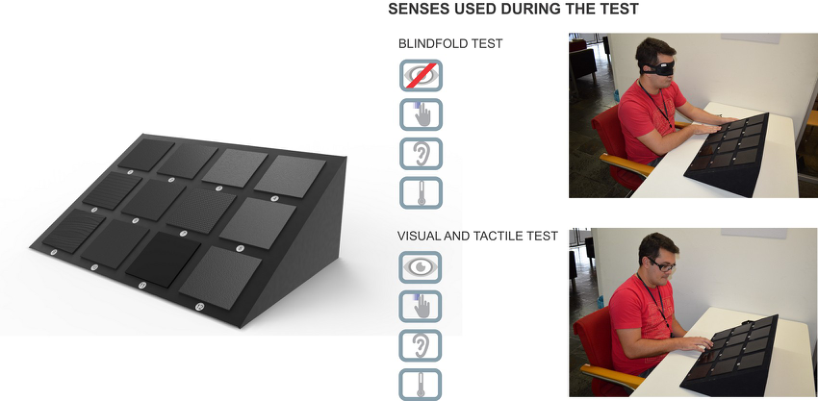
The test is divided into two stages: blindfold test and visual test. In both the procedure is the same, and during the first, the participant evaluates the textures using only the sense of touch, and in the second stage, the band is removed from eyes and the test applied again to review the textures, using touch and vision. Samples of 12 texture of ABS were selected, arranged in random order and with the same format of 100 x 100 mm; thickness of 3 mm, weighing approximately 30 g, and all the samples in black color to not influence the perception of some attributes to be evaluated.
The unique properties different of samples are the geometric pattern of texture and surface roughness. The selection criterion was based on two attributes - the design of the pattern and degree of roughness. So, it was proceeded, first, the measurement of roughness to create a scale - with interesting contrasts of tactile surfaces. Regarding the geometric pattern, the selection was based on a consideration of different types defined by Di Bucchianico and Vallicelli (2007). For each texture was measured its roughness using specific equipment for this purpose, a digital Surface Roughness Tester Model TR100. The 12 samples of surface textures showed differentiation of salient elements of its surface and was arranged in random order to carry out the tests. Each unit was fixed on a wooden support with inclined plane to facilitate tactile and visual survey of the subjects during testing as shown in FIG. 2a.
Figure 2: (1) Support for the texture samples; (2) test performed in two stages: blindfold test and visual and tactile test The test aimed to evaluate the materials according to four patterns intrinsic properties: geometrical properties, physicochemical properties, and emotional and associative dimension. It was listed and selected the descriptors that best related to the tested material, according to the classification of Zuo et al (2001). Considering how such patterns always change the perception of the material in the chair, were selected the opposite descriptors and to each one of them was described pairs of attributes corresponding.
To use the proposed scale, volunteers should indicate their perception of each one of the 12 textures evaluated. The extreme indicate opposite values for each one of the selected attributes and then showing a degree of intensity, for example, if the selected attribute was ugly, the intensity must be specified as very, medium or little, according with the instruction of filling the scale presented above it. The model still had sound and camera icons in upper corner, indicating to the evaluator that in that point a behavior or relevant information should be revised later during audiovisual analysis of tests.
Ergonomics In Design, Usability & Special Populations I (2022) https://openaccess.cms-conferences.org/#/publications/book/978-1-4951-2106-7
Figure 3 - Selected descriptors and test scale with pairs of opposite attributes
Discussion of results The results of Test 1 showed that the information about the attributes evaluated in texture revealed repetitions of patterns on the visual blindfold test. The durability and cleanability criteria were the most outstanding. Durability showed low variation over the blindfold test and with no band on eyes (Fig. 4a). Only one sample, number 11, had decreased sensation of perceived durability by the test volunteers. Regarding cleanability (Fig. 4b), there was a significant change in the classification of samples evaluated in the two stages of evaluation. It was noticed that for test evaluators, most samples transmitted to be less easily cleaning when they were seen.
a) b)
Figure 4 – (a) Comparative analysis of durability attribute and (b) cleanability during the test 1 Three textures identified as 5, 7 and 11 are always repeated and presenting an inversely proportional conduct. Only the attribute adherence showed unchanged results in both tests. However, we can not say that much has changed between the others, just alternating two textures in the same classification. In the blindfold test, users identified all textures to be equal in the attribute durability, but on the visual test, the sample 11 showed a reduction in its rating, going to have the lowest value among the others while remaining a positive value.
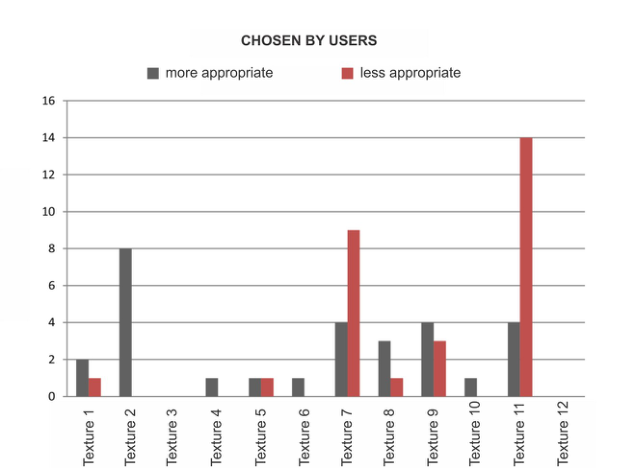
According to the users' perception, two textures were chosen as one more and another less suitable for application in a chair (Fig. 5). The texture indicated as 2 showed the most positive values, and according to users’ reports, it was the one that presented more stable and balancing relief transmitting that met the criteria evaluated positively. The texture of number 11 was given as the least appropriate and it was assigned as disadvantages attributes: little adherence, temperature and insecurity. On voice and video record, users submitted comments and behavior during the interaction with the samples. Regarding durability, it was common to see some people hitting the fingertips or nails in texture before responding, even though they were all of the same material. This is a behavior that combines hardness and sound resistance of the material.
Ergonomics In Design, Usability & Special Populations I (2022) https://openaccess.cms-conferences.org/#/publications/book/978-1-4951-2106-7
Figure 5: Classification of adequacy of textures according to perception of evaluators Test 2: Evaluation of perception of material for chairs
Materials and methods
The objective of the second study was to evaluate the perceptions of users about 10 different samples of two families of materials and identify the associative terms given to each sample, according to the perception of the volunteers. Also was considered its suitability for use in chairs. The test was conducted with the participation of 30 individuals, consisting of 20 men and 10 women, aged between 18 and 60 years.
a) b) Figure 6: (a) holders with samples, (b) Test 2 conducted with two groups of materials: natural and metal Five samples of natural and metal materials welre chosen as shown in FIG. 6. Among the family of natural ones were solid wood, plywood coated with natural wood laminated, MDF coated with artificial laminated wood, MDP coated with melamine and lacquered wood. In the group of metallic five materials selected were natural galvanized steel, anodized stainless steel, polished stainless steel, brushed stainless steel and stainless steel with automotive paint. To perform the test was necessary that the user had contact with the material, and all forms of interaction was permitted (Fig. 7). Some individuals made use of different senses to identify the materials’ properties.
Ergonomics In Design, Usability & Special Populations I (2022) https://openaccess.cms-conferences.org/#/publications/book/978-1-4951-2106-7
(a) (b) (c) Figure 7 – (a) Interaction with materials: evaluation of weight and texture, (b) odor perception and (c) temperature analysis Discussion of results
Materials indicated as most appropriate for use in chairs are solid wood and brushed stainless steel and stainless steel painted with a small difference between them. The terms assigned to the materials were transformed into word clouds showing its impact as seen in FIG. 8. Words oversize indicate large numbers of repetitions and words of smaller size had few repetitions. Here are exemplified materials greater acceptance in case the solid wood and brushed stainless steel.
a) b)
Figure 8 - Word clouds of related attributes: (a) solid wood, (b) brushed stainless steel The attributes associated with solid wood that justify and indicate the material as preferred for use in chairs is part of your warm, sturdy and rustic character that relates to turn resistance, strength and hardness. Regarding the brushed stainless steel the material was associated with high frequency mainly to terms cold, ease cleaning, durability, lightness, nobility, strength and beauty. As the painted stainless steel also presented next index relative to brushed stainless steel, is important to note that it had some properties that are not associated with the family of metallic materials, such as being fun and cheerful. It is noticed that a very common term associated with metallic samples is the word "cold", which should not necessarily be interpreted as a negative value.
CONCLUSIONS
The discussions presented in this article demonstrate that the materials are relevant to the disciplines of design and ergonomics, and interfere in the relationship between users and products. The studies were presented as important means of knowledge about materials, products and users. Knowledge of the attributes most valued by a group of individuals allows the construction of a semantic map about the materials, proving if its technical characteristics correspond with how they are perceived by people. Major advances in relation to the research allowed to draw conclusions about the method, the relationship between users with materials and significant differences between profiles of individuals.
The identification of different types of materials denote that users can easily get confused about the origin of materials and consequently about their properties and physical characteristics. The user unaware about the material Ergonomics In Design, Usability & Special Populations I (2022) https://openaccess.cms-conferences.org/#/publications/book/978-1-4951-2106-7 can misjudge or make an improper use of a product, contributing to a negative and erroneous assessment. It was also possible to prove the assertion Ashby and Johnson (2011) that "the product incorporates some of the properties of its materials" because there was reflection of their characteristics in the trial of the chairs, since they were all similar in format.
REFERENCES
Abreu, A. F.; Cândido, G. A.; Teixeira, J. A. (2001). “A utilização dos materiais no design e a competitividade da indústria moveleira da Região Metropolitana de Curitiba: um estudo de caso”. Produção. São Paulo. v. 11, n. 1, p. 17-30. Almeida Jr, G. (2013). “Avaliação dos aspectos subjetivos relacionados aos materiais: proposta de método de mensuração
aplicado ao setor moveleiro”. 184 f. Dissertação (Mestrado) - Escola de Design, UEMG, Belo Horizonte. Akerblom, B. (1948). “Standing and sitting posture, with special reference to the construction of chairs”. Doctoral dissertation.
Nordiska Bokhandeln, Stockholm. Ashby, M. F.; Johnson, K. (2011). “Materiais e design: arte e ciência da seleção de materiais no design de produto”. São Paulo: Elsevier. Branton, P. (1969). “Behaviour, body mechanics and discomfort”. Ergonomics, v. 12, n. 2, pp. 316-327. Coelho, D. A.; Dahlman, S. (2002). “Comfort and pleasure”. In: Green, W.; Jordan, P. W. Pleasure with products: beyond
usability. London: Taylor & Francis, pp. 321-331. Di Bucchianico, G; Vallicelli, A. C. (2007). “Evaluation of tactile pleasure of antiskid deck surface of a sailing yacht”. In: Berlin; Bligård (ed): Proceedings of Nordic Ergonomics Society Conference. 39., Oct 1-3. Dias, R. A. (2009). “Percepção dos materiais pelos usuários: modelo de avaliação Permatus”. 352 p. Doctoral thesis,
Engineering and Knowledge Management, UFSC, Florianópolis. Dias, R. A.; Gontijo, L. A. (2013). “Aspectos ergonômicos relacionados aos materiais”. Ergodesign & HCI, v. 1, p. 22-33. Dormer, P. (1995). “Os significados do design moderno: a caminho do século XXI”. Lisboa: Centro Português de Design. Gibson, J. J. (19790. ‘The ecological approach to visual perception”. Boston, Houghton Mifflin. Helander, M. G.; Zhang, L. (1997). “Fiel studies of comfort and discomfort in sitting”. Ergonomics, v. 40, n. 9, London: Taylor & Francis, pp. 895-915. Herman Miller. (2007). “The anthropometrics of fit ergonomic criteria for the design of the Aeron Chair”. Solution Essay, EUA. Iida, I. (2005). “Ergonomia: projeto e produção”, São Paulo, Edgard Blucher. Jordan, P. W. (2002). “Designing pleasurable products: an introduction to the new human factors”. London: Taylor & Francis. Jordan, P. W. (1998). “Human factors for pleasure in product use”. Applied Ergonomics v. 29, n. 1, pp. 25-33. Jul, L. (208). “Adding values: smart textile options for automotive applications”. The Nordic Textile Journal, Borås, pp. 147-157. Katz, D. (1989). “The world of touch”. New Jersey: Lawrence Erlbaun Associates. Klatzky, R. L.; Lederman, S. J. (1987). “The intelligent hand”, The psychology of learning and motivation. San Diego: Academic
Press, v. 21. Langenhove, L.; Hertleer, C. (2004). “Smart textiles in vehicles: a foresight”, Journal of Textile Apparel, Technology and Management, US, vol. 3, issue 4, winter 2004. Leyva, P. H.; Sanahuja, J. S. (2009). “Thermal comfort laboratory for automotive seats”. Cuadernos de Biomecánica, Instituto de
Biomecánica de Valencia (IBV), Spain, n. 51, pp. 21-24. Linden, J. C. S. V; Guimarães, L. b, M.; Tabasnik, R. (2005). “Conforto e desconforto são construtos opostos?”. In: III Congresso Internacional de Pesquisa em Design, Rio de Janeiro: Anped. Linden, J. C. S. V; Kunzler, L. S. Q. (2001). “A seleção de materiais e o conforto percebido em produtos: investigação da
percepção relativa a três materiais utilizados em cadeiras-altas de trabalho”. In: Proceedings of VI Congresso Latino- Americano de Ergonomia, ABERGO, Gramado, RS. Norman, D. A. (2005). “El diseño emocional: por qué nos gustan (o no) los objetos cotidianos”. Barcelona, Ediciones Paidós Ibérica. Norman, D. A. (2006). “O design do dia-a-dia”. Trad. de Ana Deiró. Rio de Janeiro, Rocco. Reed, M. P.; Schneider, L. W.; Ricci, L. L. (1994), “Survey of auto seat design recommendations for improved comfort,
Technical Report, US, University of Michigan, Transportation Research Institute. Michigan. Slater, K. (1985). “Human comfort”. Springfield (Illinois): Charles C. Thomas. Sonneveld, M. (2007). “The tactual experience of object”. In: Schifferstein, H. N. J.; Hekkert, P. (Editores). Product Experience, Elsevier Science, pp. 41-68. Vink, P. (2005). “Comfort and design: principles and good practice”. CRC Press, Boca Raton. Zaccai, G. (1999). “Cultura, consciência e crescimento”. In: Design é tudo. Cadernos de Design, ano 7, n. 19/20. Lisboa: CPD -
Centro Português de Design. Zhang, L.; Helander, M. G.; Drury, C. G. (1996). “Identifying factors of comfort and discomfort in sitting”. Human Factors, v.
38, n. 3, pp. 377-389. Zuo, H. et al. (2001). “An investigation into the sensory properties of materials”. In: Proceedings of the International Conference on Affective Human Factors Design, 2001, London. pp. 500-507. Zuo, H.; Jones, M.; Hope, T. (2004). “A Matrix of material representation”. In: Proceedings of Futureground, Design Research
Society International Conference. Melborne. Zuo, H . (2005a). “Material texture perception in product design’. In: The Art of Plastics Design. Berlin. Zuo, H. (2005b). “The selection of materials to match human sensory and aesthetic expectation in product design”. In: Ergonomics In Design, Usability & Special Populations I (2022) https://openaccess.cms-conferences.org/#/publications/book/978-1-4951-2106-7
International Design & Engagability Conference (IDEC). 2.,Edinburgh.
Ergonomics In Design, Usability & Special Populations I (2022) https://openaccess.cms-conferences.org/#/publications/book/978-1-4951-2106-7
LISTED IN THE AHFE DIGITAL BOOKSTORE CATALOGUE
Explore the complete digital volume
Advances in Ergonomics In Design, Usability & Special Populations: Part I
Read this individual research paper free through the original publisher, or explore the full digital proceedings book.
ISBN 978-1-4951-2106-7
Explore this ISBN in the AHFE Bookstore ↗Listed in the July 2026 bookstore catalogue; search by ISBN to confirm current availability · Digital book purchase optional