Susanna Aromaa, Juhani Viitaniemi, Kaj Helin, Arto Vento (2022). Ergonomic Evaluation of Cab Design Employing Digital and Physical Mock-Ups. In: Advances in Ergonomics In Design, Usability & Special Populations: Part I. AHFE Open Access, vol. 18. https://doi.org/10.54941/ahfe100813
This paper introduces the advantages and disadvantages of the use of digital and physical mock-ups (DMUs, PMUs) in the evaluation of human factors/ergonomics (HFE) in machine cab design. In order to gather information, participatory design, contextual inquiry, observation and interviews were applied in the studies. The main result of the studies was that there is a need for both types of mock-ups when evaluating HFE and validating user requirements. The context of the use is better delivered in DMUs due to the visualisation of the environment and ability to perform the real task. However, depending of the technical set up of the DMU, some deficiency of sensor feedback (etc. haptic) can negatively affect the user’s behaviour. Advantages in PMUs are that they are typically more realistic and provide a better immediate understanding of the cab space. One disadvantage is that often the physical environment around the PMU is not natural enough. It is important to know when, why and how to use different type of mock-ups so as to gain faster time-to-market and better HFE.
Mock-ups are used during the design stage for studying, training or testing the functionality of the system. They are useful in human-product interaction evaluation and for collecting feedback from the users. Mock-ups provide the possibilities to evaluate usability and human factors/ergonomics (HFE) before real products are manufactured. Digital mock-ups (DMUs) in particular have been recognised as being usable in HFE assessment (Kim et al., 2011; Wang, 2002). Bordegoni et al. (2009) says “ergonomics and usability assessment performed through virtual prototyping is effective in the case it offers some advantages and benefits compared to practices and methodologies that are traditionally used.” Additionally, several studies (Kalawsky, 1993; Helin & D’Cruz, 2011; Aromaa et al., 2012; Mas et al., 2013) show that DMUs are cost-effective, flexible, and safer for solving design- and operation-- related issues.
Recently, digital technologies such as virtual reality (VR) or virtual environment (VE) techniques (Kalwawski, 1993) have become widely used in the machine industry during product development (Leino & Riitahuhta, 2012; Mas et al., 2013; Aromaa et al., 2013; Gomes de Sá & Zachmann, 1999). The use of VEs enables the integration of users and other stakeholders into the design process and supports the participatory design approach (Muller & Kuhn, 1993). During the design reviews, it deepens the critical discussions on discovering and resolving flaws before manufacturing and assembly. Therefore, the time-to-market is reduced. Additionally, fewer physical mock-ups are built, which saves time and money and facilitates virtual validation.
The scope of HFE factors that need to be considered in the design, testing, and evaluation of any human-system interactions can be shown in the form of an ergonomics checklist (Karwowski, 2006). In industrial machine cab design, the goal is to optimize the operator’s well-being and the system’s overall performance. According to the operators (Kuijt-Evers et al., 2003), the cab comfort of the machine (such as wheel loaders and excavators) can be increased by improving seat comfort, by changing the cab design (including dimensions, ingress/egress), view, reliability and climate control.
In this paper, Kalawsky’s (1993) definition of VEs is used: “VEs are synthetic sensory experiences that communicate physical and abstract components to a human operator or participant”. The DMU is defined based on Wang’s (2002) description that the “DMU is a computer simulation of a physical product that can be presented, analysed, and tested from concerned product life-cycle aspects such as design/engineering, manufacturing, service, and recycling as if on a real physical model”. HFE is defined as “the scientific discipline concerned with the understanding of the interactions among humans and other elements of a system, and the profession that applies theoretical principles, data and methods to design in order to optimize well-being and overall performance’ (Dul et al., 2012).
This paper describes the feasibility of the digital and physical mock-ups for the HFE-evaluation in machine cab design. After the introduction, study methods and procedures are described. Study results are presented in Chapter Three. Chapter Four discusses the feasibility of the HFE assessment when using DMUs and PMUs, and Chapter Five shows conclusions. This paper presents the combination of real operator – virtual environment and real operator – reality cases. It does not consider the use of digital human models (DHMs).
HUMAN FACTORS / ERGONOMICS EVALUATION DURING CAB DESIGN Design review
The purpose of the first study was to review a cab design from the following points of view: operator’s field of view, safety bars outside the window and controls in the driving position. To carry out the assessment, a design review meeting was held in VEs by using the participatory design approach. The purpose of a design review is to ensure that the design is evaluated against various sets of criteria during the product development process. Eleven people from different responsibility areas took part in the design review. Areas such as design, maintenance, safety and usability were represented. During the design review, the model of the cab was provided in the VE which everyone was able to see (see Figure 1). One person acted as an operator while others could follow the operator and the cab model from the behind. Everybody was able to try the operator’s role.
Figure 1. Design review within a virtual environment
Figure available in the original PDF paper.
The technical set up of the VE system at VTT, Tampere (see Figure 1) includes (1) a system of three screens with active stereo (DepthQ DLP stereo projectors); (2) an optical tracking system (Vicon T20); (3) goggles or head mounted display (HMD - eMagin Z800); (4) game controls (joysticks), and (5) a real cab chair. Visualization software was Dassault Systèmes Virtools. The calculation of the visualisation and device management were distributed over two computers. Communication between subsystems was handled throughout the Virtual Reality Peripheral Network (VRPN). Devices were connected via the VRPN to this VE system. The fundamental idea behind the VE system established was that it was relatively low-cost, easily re-configurable, and the immersion level was reasonable enough for designing a cab. The cab model consisted of movable controls and displays and had different safety bar alternatives outside the windows. The machine model included the drilling machine with two different drills. In addition, cabs had two operation points. The human model was not used, but the operator was able to see his/her shoes.
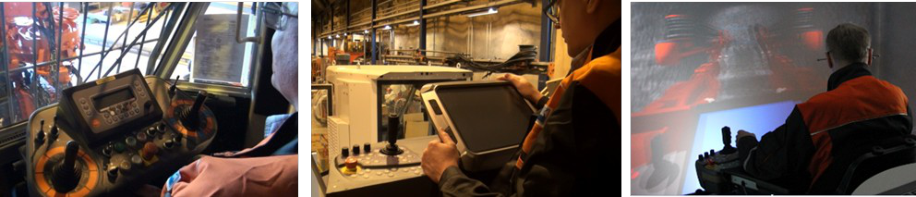
Observation The purpose of the second study was to understand the key HFE issues in cab design and to evaluate the current design in different mock-ups. The assessment was conducted in the company by observing (1) real machine cab; (2) digital mock-up of the machine, and (3) physical mock-up of the cab (see Figure 2). At the beginning, hierarchical task analysis was adapted in order to describe the task, and previously defined HFE requirements were checked. Contextual inquiry was used to collect data at the workplaces. Two HFE experts, operator, a project engineer and product manager took part in the discussions and visits. An operator was performing the task in all three cab environments and the performance was observed and video recorded and questions were asked.
Figure 2. Observation of different cab models (real old cab, physical mock-up and digital mock-up
The technical set up of the VE system at Sandvik, Tampere (see Figure 2) was CAVE-type, which includes (1) a four screen system (left, front, right and roof projections) with active stereo; (2) an optical tracking system; (3) active stereo goggles; (4) real controls, and (5) a real cab chair. Visualization software was Savant simulators Oy’s Hydra. The cab model consisted of a machine with real controls. In this case the human model was not used.
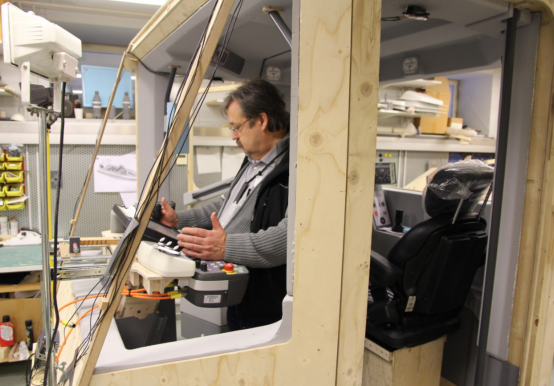
Usability testing The purpose of the third study was to evaluate usability and user experience (UX) of the cab design. A usability study was carried out by using a physical mock-up of the cab. The project manager and project engineer were moderators during the assessment and observed and communicated with the participants. There were 40 participants from different domains, such as operators, product line management, design engineers, safety engineers and assemblers. Several sessions were held, and between them some development to the mock-up took place. A physical mock-up (see Figure 3) was made from wood, and important controls and the chair were real (three different kind of chairs). Lights were provided inside and outside of the cab.
Figure 3. Physical mock-up of the cab.
RESULTS
The main results of the HFE assessment are described below. Results are categorized based on the studies: (1) design review with the DMU; (2) observation with the real old machine, DMU and PMU, and (3) usability testing with the PMU.
In the design review (with DMU) it was found that visibility was good other than towards the ground area. An operating display was blocking some of the areas of vision in the operation and driving positions. One of the safety bar versions was selected. One horizontal support bar was directly in the line of sight. Safety bar thickness and colour requirements were discussed. The display position in the driving position was not good. It was found that there was not enough room/lockers for equipment. In addition, there was not enough leg room (shoes and knees) when sitting in the operating position.
Observation (real old machine, DMU, PMU): The size and location of the operating display needs more consideration. The wrist position was occasionally twisted when using the touch screen. Support for hands, such as armrests or rests near controls, need to be provided. The task requires that access in and out should be easy and effortless to use (stairs, door, chair, etc.). Proper lighting to the target is important. More storage for the operator’s equipment is needed. In addition, the operator’s safety boots need more room in the sitting position. Lighting should be adjustable inside. The operator needs to be able to carry out tasks with their gloves on. Dust dispersion may reduce the quality of the air in the cab. Communication between operator and other people needs to be provided.
Usability testing (PMU): The direction in which the door opened was defined. The front window was too narrow. The position of the pedals was not good. Three different chair options were tested and one of them was chosen. Suggestions and comments related to layout, size and location of the buttons, displays and joysticks were collected. The position, direction, intensity and brightness of the interior lightning was tested and decided upon.
DISCUSSION
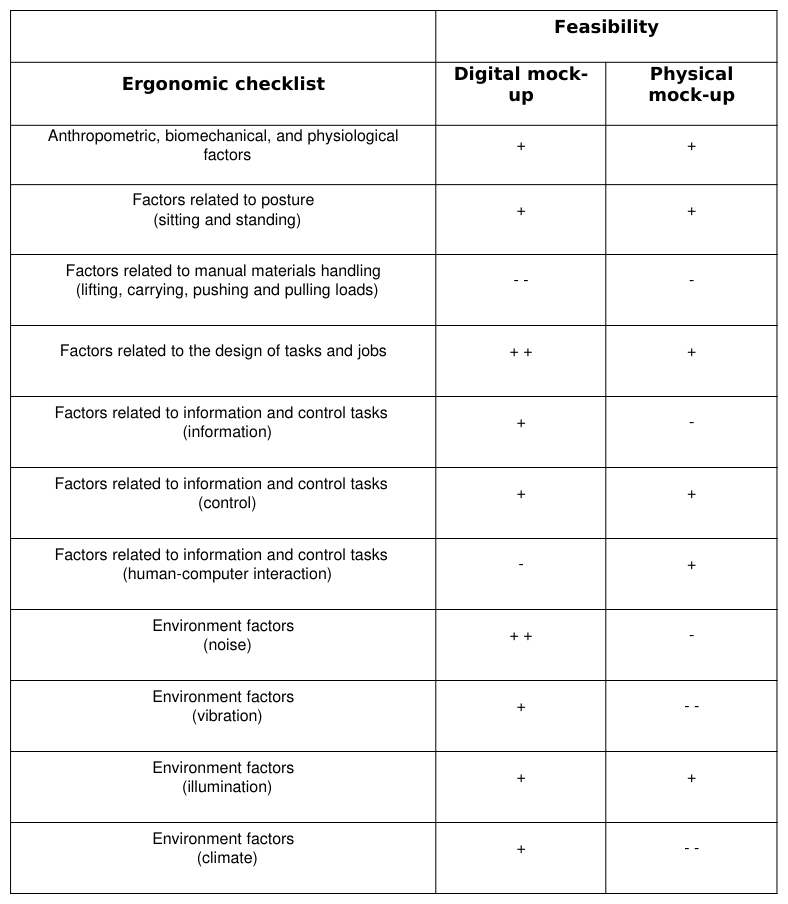
Based on the results of the studies, comments from the users and expert observation, the feasibility of the DMUs and PMUs for the HFE assessment in the cab design is presented in the table (see Table 1). Nevertheless, the table is only directional because the maturity and features of the different mock-ups have a strong effect on the HFE assessment. The feasibility is based on the assumption of what could have been done with the current maturity of the mock-ups in these studies. Digital human models and haptics were not available. The scope of HFE factors that need to be considered in the design, testing, and evaluation of any human-system interactions are based on Karwowski’s (2006) ergonomic checklist. The table presents the feasibility of the mock-ups for certain HFE evaluation on a scale of: (++) suitable, (+) suitable in some restrictions, (-) not so suitable, or (--) not suitable at all.
Table 1: Feasibility of the digital mock-up and physical mock-up in HFE assessment of the cab design
Both DMU and PMU are suitable with some restrictions for anthropometric, biomechanical, and physiological factors assessment. In both cases it is possible to gain an understanding of the basic body dimensions and movements with respect to the working environment. Nevertheless, PMU gives operators a better understanding of the cab space. With both mock-ups, variations in operator postures and movements can be considered. Nevertheless, it is difficult to ascertain differences in human body size if a human model is not used. Muscular effort and energy consumption is also difficult to assess without analysis or measurements.
It is possible to evaluate factors related to posture (sitting and standing) with both DMU and PMU. DMU is easily modifiable and therefore it is easy to try out different work heights and reachability. Additionally, different postures are easy to evaluate. However, often a real physical cab chair is not available, so sitting posture evaluations are only directional. The evaluation of the access to the cab (doorway and stairs) is not easily possible either. Additionally, some cab interior dimensions are difficult to understand (e.g. the experience of the space, reflections, visualization). With PMU it is possible to gain an understanding of the dimensions especially inside the cab. It is easy to touch and reach, for instance, cab walls, and it is also possible to check getting in/out (stairs and doorway). Addition, it is possible to test the human fit to the place, for instance, leg room. PMU’s disadvantage is that it takes time to change the mock-up such as the control panel height or angle.
There are not many tasks in cab environment that need lifting, carrying, pushing or pulling loads. Nevertheless factors related to manual materials handling can be evaluated in PMU if real parts/materials are provided. If the real material is not provided, the results are only directional. In DMU it is difficult to handle loads. Haptics can provide some feedback from manual handling, but it is not possible to provide lifting and carrying.
DMUs are usable when evaluating factors related to the design of tasks and jobs. With DMU it is easy to perform the task because it is possible to provide a context (machine, environment, and task) to the user and create dynamic model characteristics in the DMU. Tasks and DMU can be varied easily. It also provides a safe environment in which to test hazardous situations. In PMUs, dynamic characteristics are usually lacking. Additionally, the outside of the cab and the environment are not provided.
Communication is challenging in both mock-ups. It is possible to introduce factors related to information and control tasks (information) in DMUs in general, for instance by adding camera views for the operator to see. Depending on the DMU quality, sometimes details are not easy to evaluate. Usually the information illustrated in the PMUs is static and there are no dynamic characteristics.
Factors related to information and control tasks (control) can be assessed with DMUs with some restrictions. Location of the controls and reachability can be checked. Interaction with the controls is more difficult due to a lack of natural haptic feedback. Additionally, often the joysticks the operator is using in a DMU differ from the ones in the future cab (e.g. game joysticks). Furthermore, collision detection is not always provided and therefore the operator can put his/her hand through controls or panels. In the PMU there are same advantages and disadvantages over the DMU. The only difference is in the challenge posed by sense of touch, namely that controls are not real (no dynamic behaviour) and they might be presented just on paper.
Human-computer interaction was not evaluated during the studies. Therefore the suitability of DMU and PMU to assess factors related to information and control tasks (human-computer interaction) is only directional here. In DMU the visualization of the computer functionalities might be too laborious. Additionally, the use of touch screens needs haptic feedback. In both mock-ups it is possible to use real computers and, therefore, to evaluate the human- computer interaction (HCI). However, often this is not cost-effective and mock-ups may not add value for the HCI evaluation.
Environmental factors such as noise can be checked in DMUs. It is possible to record sounds from the real cab environment and repeat them in DMU. The sound can also be simulated and it is dynamic, for instance, engine noise follows the use of the gears. These approaches are still laborious and only directional (do not provide an absolute real sound environment). In the PMU sound environment it is not possible to do this in the same way as in the DMU, because it lacks dynamics.
Concerning environmental factors (vibration), in the DMU it is possible to provide natural vibration by using a motion platform, for instance. However, the quality of the motion depends of the motion platform. Typically, this is not possible in the PMU, because PMUs are usually quite heavy and structurally weak to be put on top of motion platforms.
Environmental factors (Illumination) are generally easy to understand in DMUs. It is easy to change the light parameters and positions to evaluate different lighting alternatives. Reflections are possible to achieve, but to gain fully realistic illumination conditions can be laborious. It is also easy to provide lights outside the cab and evaluate whether the target outside can be seen. In the PMU it is possible to check some illumination conditions, but it is challenging to provide a realistic environment in the sense of, for example, real environment, reflections, shadows and materials.
Environmental factors (climate) estimations based on calculations can be visualized in a DMU, for instance by marking the hot surface with red colour or visualizing air flow with lines. It is not possible to provide any real sense of climate for the operator. In the PMU it is not possible to provide enough valid climate conditions assessment either.
CONCLUSIONS
This paper describes the feasibility of digital and physical mock-ups for human factors/ergonomics evaluation in machine cab design. It highlights the advantages and disadvantages of the use of DMUs and PMUs. Many (such as Karkee et al., 2011; Bordegoni et al., 2009; Kim et al., 2011) emphasize that the use of PMUs is costly and time consuming compared to the use of DMUs. Nevertheless, based on these studies, we argue that, currently, DMUs cannot fully replace PMUs when evaluating HFE during the cab design. If we employ real users in testing, DMUs are not currently technologically able to provide all the sensory feedback required for assessment. In addition, the design process needs to manage many trade-offs such as time and money and, therefore, one must consider at what level the digital mock-ups need to be built (fully immersive, haptics, acoustics, etc.).
The feasibility of DMUs for the HFE evaluation depends on the maturities of the models applied. In general, DMUs are better in early evaluation, flexible control placements, task performance and visualisation of context (environment and task). PMUs are better when evaluating more tangible matters, understanding the space and moving in/out of the cab. These main results are clear but more research is needed to be able to fully apply them in any cab or other human-machine interaction design. In addition, digital human models need to be considered in the use of DMUs for HFE assessment.
These results show that currently none of these mock-ups are better than the other. Therefore, we suggest moving towards the approach of mixed reality mock-ups so as to be able to tackle the deficiencies of DMUs and PMUs. It is also important to pay attention to the timing during the design process because DMUs are most beneficial in early design phases. There are also many unsolved issues concerning the required level of mock-up features and also the use of mixed reality applications. Future research should concentrate on combining the most suitable features of DMU and PMU for mixed reality environment for assessing HFE. In addition, research into the use of haptics and DHM is required.
ACKNOWLEDGMENTS
The study was funded by Tekes (Finnish Funding Agency for Innovation) and carried out in the EFFIMA-LEFA research project under FIMECC (Finnish Metals and Engineering Competence Cluster). The authors are grateful to all researchers and company representatives who have contributed to and supported the work presented in this publication.
REFERENCES
Aromaa, S., Leino, S.-P., Viitaniemi, J., Jokinen, L., Kiviranta, S. (2012). ”Benefits of the use of Virtual Environments in product design review meeting”. 12th International Design Conference, Dubrovnik, Croatia, May 21 – 25, Zagreb: University of Zagreb, 8 p. Aromaa, S., Leino, S-P., Viitaniemi, J. (2013). “Are companies ready for the revolution in design – modelling maturity for
virtual prototyping”. 19th International Conference on Engineering Design (ICED13). Seoul, August 19–22.
Bordegoni, M., Cugini, U., Caruso, G., Polistina, S. (2009). "Mixed prototyping for product assessment: A reference framework".
International Journal on Interactive Design and Manufacturing, 3(3), pp. 177-187. Dul, J., Bruder, R., Buckle, P., Carayon, P., Falzon, P., Marras, W. S., Wilson, J. R., van der Doelen, B. (2012). “A strategy for human factors/ergonomics: developing the discipline and profession”. Ergonomics, 55(4), pp. 377–395. Gomes de Sá, A., Zachmann, G. (1999). “Virtual reality as a tool for verification of assembly and maintenance processes”.
Computer & Graphics 23(3), pp. 389-403. Helin, K.., D'Cruz, M. (eds.). (2011). “Current and Future Perspectives of Virtual Reality, Augmented Reality and Mixed Reality: Industrial and Poster Track”. Joint VR Conference of euroVR and EGVE, 2011, VTT Symbosium: 269, VTT, Espoo, 115 p. Leino, S-P. Riitahuhta, A. (2012). “State of the Art of Virtual Engineering Based Human-Machine System Lifecycle Knowledge
Transfer and Management”, Proceedings of TMCE Tools and Methods of Competitive Engineering, Karlsruhe, May 7 - 11 2012, Delft: Delft University of Technology, pp. 573 – 586. Kalawsky, R. S. (1993). “The Science of Virtual Reality and Virtual Environments”. Addison-Wesley, 405 p Karkee, M., Steward, B. L., Kelkar, A. G., Kemp II, Z. T. (2011). “Modeling and real-time simulation architectures for virtual prototyping of off-road vehicles”. Virtual Reality, 15(1), pp. 83-96. Karwowski, W. (2006). “The Discipline of Ergonomics and Human Factors”. in: G. Salvendy (Ed.), Handbook of Human
Factors & Ergonomics. (Edition 3rd); New York: John Wiley. pp. 1-25. Kim, C., Lee, C., Lehto, M. R., Yun, M. H. (2011). ”Effective evaluation of user impressions using virtual product prototyping”.
Human Factors and Ergonomics in Manufacturing & Service Industries, 21(1), 1–13. Kuijt-Evers, L.F.M., Krause, F., Vink, P. (2003). “Aspects to improve cabin comfort of wheel loaders and excavators according to operators”. Applied Ergonomics, 34(3), pp.265-272. Mas, F., Menéndez, J.L., Oliva, M. Ríos, J. (2013). ”Collaborative Engineering: An Airbus Case Study”, in: Juan J. Aguilar-
Martín and José A. Yagüe-Fabra (eds.) The Manufacturing Engineering Society International Conference, MESIC 2013, pp. 336-345. Muller, M. J., Kuhn, S. (1993). ”Participatory design”. Communications of the ACM, , 36, pp.24-28. Wang, G.G. (2002). “Definition and Review of Virtual Prototyping”. ASME Journal of Computing and Information Science in Engineering, 2(3), pp. 232-236.
LISTED IN THE AHFE DIGITAL BOOKSTORE CATALOGUE
Explore the complete digital volume
Advances in Ergonomics In Design, Usability & Special Populations: Part I
Read this individual research paper free through the original publisher, or explore the full digital proceedings book.
ISBN 978-1-4951-2106-7
Explore this ISBN in the AHFE Bookstore ↗Listed in the July 2026 bookstore catalogue; search by ISBN to confirm current availability · Digital book purchase optional