Ismail Abdul Rahman (2022). The Evaluation of Workers Satisfaction on Usability of Manual Handling Equipment Among Warehouse Workers in Malaysia. In: Usability and User Experience. AHFE Open Access, vol. 39, pp. 242–250. https://doi.org/10.54941/ahfe1001713
Numerous researchers have found that heavy physical demand and improper posture when performing the tasks in various sectors such as manufacturing and warehouse might contribute to the musculoskeletal disorders (MSDs) especially when the tasks involving lifting, pushing and pulling activities. In order to reduce high risk manual handling activities, effectives and usable manual handling equipment (MHE) should be introduce to lower the physical demand of manual material handling (MMH) activities. However, most of the MHE studies previously is not really focus on usability evaluation. So, this study intends to evaluate the usability of current MHE used in manufacturing warehouse operation in term of efficiency, comfortability, energy expenditure, safety aspect, design, productivity, effectiveness and user friendliness. A usability survey was conducted among warehouse workers in manufacturing company at southern region of peninsular Malaysia. Besides that, the prevalence of back pain among the warehouse workers was measured through Modified Nordic Discomfort Assessment tools that are incorporate in the usability survey. Result for the most least agreement in user usability for pallet jack was energy expenditure (3.73), efficiency (3.96) and comfortability (3.99); for load carrying cart was energy expenditure (3.62), design (3.74) and comfortability (3.90); for forklift was comfortability (3.87), design (3.93) and safety (4.08); for pallet stackers was energy expenditure (3.79), design (3.82) and user friendliness (3.82); for conveyor system was productivity (3.50), comfortability (4.00) and safety (4.00). It was also found that the highest prevalence of MSDs among warehouse workers was lower back, followed by legs (left and right) and shoulders (left and right). In conclusion, most MHE available in manufacturing warehouse operation lacking in term of energy expenditure, efficiency, comfortability, design and user friendliness. It is clear that the first stage in design criteria for MHE should be developing an understanding of the user usability requirement to ensure the aids are suitable for the tasks.
The Evaluation of Workers Satisfaction on Usability of Manual Handling Equipment 243
INTRODUCTION
Industrial sector offers more opportunity in job and career development. Increase in the demand of industrial workers may result in an increase on the number of occupational injuries and diseases in the real life. Work rela- ted musculoskeletal disorders (WMSDs) are among the occupational diseases most widely identified worldwide and also recognized as economics situ- ation on community (Amell & Kumar, 2001). Studies had been done in United States, United Kingdom and Malaysia indicates that WMSDs are the most common disease (Bhattacharya, 2014; Cheng et al., 2011; Md Zein et al., 2019). Previous research works found that heavy physical demand and improper posture while performing the task can cause WMSDs especially in manufacturing and warehouse (Sue et al., 2012; Marras et al., 1999, Basa- hel, 2015; Gardner et al., 1999; Kraus et al., 1997). The excessive physical demands placed on the human operator under these working conditions on continuous basis have shown to be a major contributor to WMSD (Sue et al., 2012; Marras et al., 1999). Warehouse operations are closely related to MMH activities. Loading, unloading, transporting and picking material constitute a huge part of the activities. In order to prevent back disorders related to high-risk manual handling activities, attempts to control these disorders should focus on asses- sing and redesigning the tasks of manual material handling and equipment used (Patrick, 1999; Vincent et al., 2005). In warehouse, utilizing material handling equipment (MHE) is required in order to handle material properly as well as to contribute value to the material, the operator and the envi- ronment. There a lot of definition for MHE that exist and this expression return to the definition of material handling itself. In certain paper that discussed regarding on the problem of MHE, it is regarded as being the fact of moving product from a point to another, while storing it on racks or manipulating it (Matson & White, 1982). The planning and choice of right material handling equipment rely on materials to be handled, quanti- ties and distances to be moved, routing and workplaces facilities and layout. Based on the study by Wurzelbacher et al in 2020, additional research that examines the effectiveness of ergonomic engineering interventions need to be conducted.
Various case study has shown that well designed MHE can help to reduce workload and the risk of injuries (Chaffin et al., 1989; Bobick et al., 1987). However, despite the attraction of the solution in reducing the risk of manual handling and the wide spread use of MHE in various industries, very lit- tle attention seems to have been paid to ergonomics aspect of the MHE design. Without proper attention to the ergonomics factors when purcha- sing the MHE, more problems and danger may arise, possibly in introducing new stresses and risk to the operator (Rerndsen, 1990; Nilson & Dahlman, 1994). The main objective of this paper is to evaluate workers satisfaction on MHE at warehouse operation through usability study because most of the high significant task related to ergonomics exist at warehouse and few stu- dies show that warehouse personnel experienced body discomfort and pain
(Menzel, 2001; Snook & Webster, 2007), despite some prior research that indicates ergonomic material handling equipment can reduce biomechanical risk factors for musculoskeletal disorders (Lowe et al., 2020; Mirka et al., 2002; Bongers, 2001). In this study, usability evaluation will help workers to measure how effectively a product can accomplished their goal and function. Usable product provides the right function, easy to be understand and enable task to be completed quickly.
METHODOLOGY
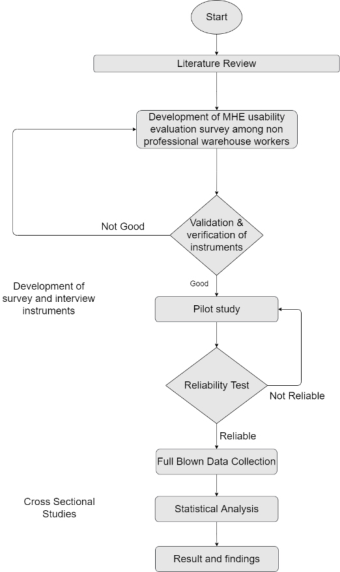
A quantitative usability survey was conducted to one hundred twenty-three (123) warehouse operator in manufacturing industry at southern region of peninsular Malaysia. A valid and reliable usability survey questionnaire was used in this study as the survey validity and reliability has been tested and published (Abdul Rahman et al., 2022). The survey questionnaire consi- sted of four main section which are demographic profiles of the respondents, nature of jobs and tasks of the respondent, history of body discomfort and pain and lastly the workers satisfaction on usability of MHE based on several usability attributes. A face-to-face survey was conducted among the respon- dent which consist of warehouse operator and supervisor that frequently used MHE whiles performing the task at warehouse operation. The IBM SPSS statistics software for windows version 21.0 Armonk, NY: IBM Corp was used for the statistical analysis. Descriptive analysis, mean comparison analysis and chi square analysis was used in order to determine the finding of the study. Besides, analysis of the body discomfort and pain was simpli- fied by collapsing all reported pain into eleven body sites. Figure 1 shows the framework used in this study.
Sample size Statistical data from Department of Statistic Malaysia (2019) shows that the number of workers in Malaysia manufacturing industry as in September 2019 are about 1,087,179 persons. Using Krejcie and Morgan table (1970), the sampling size should be considered is 384 for the sampling population size over 100,000 population (Krejcie & Morgan, 1970). The unit of analysis for this study is worker. However, due to the response rate of the respon- dent in this study is not under control which may be lower or higher than the one expected respondent rate, it is decided that a response rate of 20% (77 respondents) is considered as a good response rate, while a 30% response rate (116 respondents) is considered to be really good.
Ethic Approval Ethical approval for all relevant aspects of the development process was received from the National Institute of Occupational Safety and Health (NIOSH) Malaysia Ethics Committee. This ethic was applied under “The Study on Ergonomics Intervention Control for Manual Material Handling in Manufacturing Sector (Reference number: NIOSH/03/JEP/2020(8))”.
The Evaluation of Workers Satisfaction on Usability of Manual Handling Equipment 245
Figure 1: Framework of the study.
RESULT AND DISCUSSION
Instrument Administration and Respondent Profiles The survey was conducted at manufacturing company in southern region of peninsular Malaysia with a different type manufacturing sector. A total of 123 respondents from warehouse operation were selected to participate in the survey. A face-to-face interviews session were conducted between the respondents and researchers in order to fill in the questionnaire. Most of the respondent are Malaysian citizen that working at various type of manufactu- ring sector which involve at incoming and receiving area, storing area, order picking or kitting and also at packaging/delivery/outgoing area. Details on the demographic profiles of the respondent in this study were summarize in Table 1.
Most of the respondent are using MHE while working with a pallet jack was identified as the most frequent used MHE among the respondent with the percentage of 32.73% (used by 74% of the respondent). Following that, forklift was considered as the second most used MHE among the warehouse workers with the percentage of 24.82% (used by 56.1% of total respon- dents) followed by load carrying cart with the percentage of 24.46% (used by 55.3% of total respondents), pallet trucks or stackers with the percentage of 15.11% (used by 34.1 % of total respondents) and lastly con-veyor system with the percentage of 2.88% (used by 6.5% of total respondents).
Table 1. Demographic profiles of respondents.
Table available in the original PDF paper.
Profiles Frequency Percentage (%)
54 43.9
Gender Male 108 87.8 Female 15 12.2 Citizen Malaysia 93 75.6 Non-Malaysia 30 24.4 Sector Petroleum, coal, chemicals, plastics and rubber
18 14.6
Primary metal / metal fabrication/machinery
5 4.1
Food/ Beverage / Tobacco 18 14.6 Transportation 18 14.6 Furniture & Fixture 10 8.1 Electrical equipment / Electronics Age < 20 Years 3 2.4 20-29 Years 55 44.7 30-39 Years 39 31.7 40-49 Years 17 13.8 > 50 Years 9 7.3 Designation General Workers 105 85.4 Supervisor 12 9.8 Others 6 4.9 Workstation area Incoming / Receiving 19 15.4 Storing 19 15.4 Order picking / Kitting 18 14.6 Packaging / Delivery / Outgoing 61 49.6 Others 6 4.9 Working experience < 1 Year 11 8.9 1-5 Years 66 53.7 5-10 Years 30 24.4 > 10 Years 16 13
Body Discomfort and Pain Analysis The prevalence of musculoskeletal symptom among the respondent was high- est for the left and right shoulder, lower back and both left and right foot. The highest mean rating for upper extremities discomfort pain was lower back (2.94), right shoulder (2.11), left shoulder (2.05) and upper back (2.04). For the categories of lower extremi-ties, left foot (2.16) and right foot (2.11) shows the high rating for the body discom-fort. A correlational strength betw- een age and discomfort were calculated using chi square analysis and the result shows that lower back (p = 0.002), shoulder right (p = 0.029) and upper back (p = 0.043) was most strongly correlated with discomfort and pain.
User Usability Among Available MHE The workers agreement and satisfaction on the user usability attribute for each of the MHE used by the respondents in warehouse operation was
The Evaluation of Workers Satisfaction on Usability of Manual Handling Equipment 247
Table 2. User usability descriptor in MHE.
Table available in the original PDF paper.
User usability attributes Descriptors Energy Expenditure The workers use minimum of energy while operating the equipment Effectiveness The equipment used is able to operate accurately in every task performed Efficiency The equipment is able to function well even when using minimum energy Productivity The worker able to get the work (target) that has been set while using the equipment Design The design of the equipment in line with the workers anthropometrics measurement and ergonomics aspects User Friendly The equipment was easily operated and understand while performing the task Safety The equipment is safe and free from hazards Comfortability The worker able to operate the equipment without any discomfort to the limbs
evaluated. A 5-point Likert scale usability questionnaire was used to evalu- ate the agreement of the user usability attributes which consists of energy expenditures, effectiveness, efficiency, productivity, design, user friendli- ness, safety and comfortability as shown in Table 2. Mean comparison analysis was used to compare the result for each of the usability attributes among MHE. The higher the mean indicate the higher the agreement of the workers.
Figure 2 shows the agreement and satisfaction on user usability attribu- tes among available MHE at warehouse operation. Result for the pallet jack shows that effec-tiveness (4.19) was the highest mean followed by user fri- endly (4.13), productivity (4.10), safety (4.06), design (4.06), comfortability (3.99), efficiency (3.96) and lastly energy expenditure (3.73). As for the load carrying cart, the highest agreement on the usability among the respondents are user friendliness with the mean score of 4.03. Following that, the mean usability agreement for effectiveness was 4.00, productivity was 3.98, both safety and efficiency was 3.93, comfortability was 3.90, design was 3.74 and energy expenditure was 3.62.
The usability evaluation result for forklift shows productivity has the high- est mean value with 4.35, follow in order by effectiveness (4.30), energy expenditure (4.21), efficiency (4.15), user friendliness (4.08), safety (4.08), design (3.93) and comfortabil-ity (3.87). For pallet trucks or stacker, the high- est agreement on the usability among the respondents was effectiveness and productivity with the same value of mean which are 4.08. Following that, the mean usability agreement for the efficiency was 3.97, safety (3.95), comfor- tability (3.92), user friendliness (3.82), design (3.82) and energy expenditure (3.79). Most of the mean value for each of the conveyor usability attributes was more than 4.00 except for productivity.
Pallet Jack
Comfortability
Pallet Truck / Stacker
Safety
User Friendly
Design
Load Carrying Cart
Productivity
Efficiency
Conveyor System
Effectiveness
Energy expenditures
Forklift
Figure 2: Agreement and satisfaction on user usability attribute among MHE.
Figure available in the original PDF paper.
CONCLUSION
There is an increasing demand and used of MHE in warehouse operation. However, the survey result has shown that some of the MHE currently in used are not achieving the standard and satisfaction from the user’s point of view. Moreover, the findings shows that most MHE especially manuable type of MHE are not helping in term of reducing the use of energy expenditure which indicates the risk related to the ergo-nomics issue is still unavoidable defeating the primary objective for the introduction of the MHE. The provision and used of MHE also has not guaranteed the pain and discomfort level on the body are reduced. If more attention was paid to usability and ergonomics design factor in the product development process, a significant improvement in reducing the used of energy and reduction in the number of body injuries should be achievable.
ACKNOWLEDGMENT
The authors would like to acknowledge National Institute of Occupational Safety and Health (NIOSH) Malaysia for providing grant, supports and assi- stance in per-forming this project. Authors thanks the collaboration from UTM and UTHM (No X158) for supportive contribution.
REFERENCES
Abdul Rahman, I., Azis, N. A., Mahmood, S., Mohd Rohani, J., Zaidi, N. A. F., Mohd Sukri, S., & Mohd Zain, M. A. A. (2022). Development of a Survey Instrument for Measuring Workers Satisfaction on Usability of Manual Handling Equipments at the Warehouse: A Pilot Study. In Human-Centered Technology for a Better Tomorrow (pp. 583–592)
The Evaluation of Workers Satisfaction on Usability of Manual Handling Equipment 249
Amell, T., & Kumar, S. (2001). Work-related musculoskeletal disorders: design as a prevention strategy. Journal of Occupational Rehabilitation.11, 255–265. Basahel, Abdulrahman M. (2015). “Investigation of Work-Related Musculoskeletal
Disorders (MSDs) in Warehouse Workers in Saudi Arabia.” Procedia Manufactu- ring 3(Ahfe): 4643–49 Bhattacharya, A. (2014). Costs of occupational musculoskeletal disorders (MSDs) in the United States. International Journal of Industrial Ergonomics, 44(3), 448–454 Bobick, T.G., Unger, R.L. and Conway, E.J. (1987) ‘Reducing manual materials hand-
ling in underground coal mining with mechanicalassist devices’ in Proceedings of the Human Factors Society 32s Annual Meeting, New York, 19–22 October, Human Factors Society, Santa Monica, pp. 457-461 Bongers, P.M., Luijsterburg, P., Van den Heuvel, F., De Vroome, E., Miedema, M.C., Douwes, M., (2001). Evaluation of New Working Methods for a Team of Bricklayers: Heightened Bricklaying and Mechanisation of Transport. Hoofddorp: Nederlandse Organisatie Voor Toegepast-Natuurkundig Onderzoek (TNO) ChaffIn, D.B., Wolstad, J.C. and Ali, I. (1989) ‘Low-back reactions associated with
the pushing and pulling of material handling assist devices’ in Mital, A. (ed) Advances in Industrial Ergonomics and Sufery I Taylor & Francis, London, pp 639-645 Cheng S, Douwes J, Ellison-Loschmann L, McLean D, Pearce N (2011) Prevalence of musculoskeletal symptoms in relation to gender, age, and occupational/industrial group. Int J Ind Ergon 41:561–572 Department of Statistics Malaysia DOSM (2019). Monthly Manufacturing Statistics
Malaysia, website: https://www.dosm.gov.my/v1/index.php?r=column/cthemeBy Gardner, L.I., Landsittel, D.P., Nelson, N.A., (1999). Risk factors for back injury in 31,076 retail merchandise store workers. American Journal of Epidemiology 150 (8), 825–833. Kraus, J.F., Schaffer, K.B., McArthur, D.L., Peek-Asa, C., (1997). Epidemiology of
acute low back injury in employees of a large home improvement retail company. American Journal of Epidemiology 146 (8), 637–645. Krejcie, R. V, & Morgan, D. (1970). Small-Samlpe Techniques. The NEA Research Bulletin, 30, 607–610 Lowe, B.D., Albers, J., Hayden, M., Lampl, M.P., Naber, S., Wurzelbacher,
S.J., (2020). Review of construction employer case studies of safety and health equipment interventions. J. Construct. Eng. Manag. 146 (4), 1–1 Matson J.O. and White J.A., (1982)"Operational research and material handling," European Journal of Operational Research, vol. 11, pp. 309-318 Marras, W.S., Granata, K.P., Davis., K.G., Allread, W.G., Jorgensen, M.J., (1999).
Effects of box features on spine loading during warehouse order selecting. Ergonomics 42 (7), 980–996 Md Zein, R., Rohani, J. M., Abidin, N. Z., & Rahman, I. A. (2019). Financial impact and causes of chronic MSD cases in Malaysia based on SOCSO claims record. In Advances in Intelligent Systems and Computing (Vol. 820). Springer International Publishing. Menzel, N. N. (2001). Manual handling workload and musculoskeletal discomfort
among warehouse personnel. ProQuest Dissertations and Theses, December, 212 Mirka, G.A., Smith, C., Shivers, C., Taylor, J., (2002). Ergonomic interventions for the furniture manufacturing industry, Part I. Int. J. Ind. Ergon. 29 (5), 263–273.
Nilsson, S. and Dahlman, S. (1994) ‘Factors influencing the adoption of ergonomically improved working tools - a study comparing two “equivalent” types of lifting carts’ in McFadden, S., Innes, L. and Hill. M. teds) Proceedings of the 12th Triennial Congress of the Internatictna/ Elgortumics Associurion. Toronto, 15–19 August 1994. Vol. 4. Human Factors Association of Canada. Mississauga. Ontario, pp. 35–37 Patrick GD. Utilizing criteria for assessing multiple-task manual materials handling
jobs. Int J Ind Ergon. 1999; 24:405–416. Rerndsen, M.B. (1990) ‘Appliances for paviours: an evaluation of purchase and use’ Ergonomics 33(3), 361–366 Sue A. Ferguson, William S. Marras, W. Gary Allread, Gregory G. Knapik, Riley E.
Splittstoesser (2012). Musculoskeletal disorder risk during automotive assembly: current vs. seated. Applied Ergonomics 43 (2012) 671–678 Snook, S. H., & Webster, B. S. (2007). The cost of disability. Clinical Orthopedics, 221, 77–84. St-Vincent, M., Denis, D., Imbeau, D., Laberge, M., 2005. Work factors affecting
manual materials handling in a warehouse superstore. International Journal of Industrial Ergonomics 35, 33–46
LISTED IN THE AHFE DIGITAL BOOKSTORE CATALOGUE
Explore the complete digital volume
Usability and User Experience
Read this individual research paper free through the original publisher, or explore the full digital proceedings book.
ISBN 978-1-958651-15-5
Explore this ISBN in the AHFE Bookstore ↗Listed in the July 2026 bookstore catalogue; search by ISBN to confirm current availability · Digital book purchase optional