Jannatul Hur, Anirban Biswas, Adar Chowdhury, Sheikh Fuzael Rahman, Vincent Nyamollo, Dipankar Nandy, Yueqing Li (2026). Enhancing Learning Efficiency and Ergonomic Well-Being: A Comparative Study of Handwritten, AI-Assisted, and Digital Structured Note-Taking. In: Human Factors and Systems Interaction. AHFE Open Access, vol. 230, pp. 39–48. https://doi.org/10.54941/ahfe1007975
In an intense and demanding academic setting, note-taking is a core part of learning, where students must concentrate for long periods of time. While traditional handwritten notes are usually associated with deeper learning, newer digital and AI-assisted tools are increasingly used to reduce effort and improve efficiency. From a human factor perspective, it is a bit difficult to compare these different note-taking methods when both learning outcomes and workload are considered together. Most existing studies focus on either learning performance or how technology works, making it difficult to understand the trade-offs when we switch between different methods. This study looks at how handwritten, stylus-based digital, and AI-assisted note-taking methods affect learning retention and perceived cognitive workload using a within-subjects pilot study(N=11). Learning performance was measured using immediate and delayed retention quizzes, and workload was evaluated using the NASA Task Load Index (NASA-TLX). The results show no significant differences in immediate recall. Otter.Ai, an AI-assisted notetaking tool, has higher learning retention than the stylus-based condition for delayed recall (F2, 20 = 4.30, p = 0.028), while the handwritten method didn’t differ significantly from any other. Significant effects were also observed in physical demand (F2, 20 = 6.85, p = 0.005), effort (F2, 20 = 7.25, p = 0.004) and in frustration (F2, 20 = 4.44, p = 0.025). Together, these results show a clear trade-off between learning and workload. The study emphasizes the need to evaluate and ensure the correct usage of technology to help learn deeply, not just the efficiency.
Note-taking is the core cognitive activity in an academic setting, especially in high-demand environments like STEM, where students must listen, interpret, select, and record information simultaneously for hours. These multitasking demands working memory and attention, presenting a significant challenge related to human factors. When the mental effort required for a task exceeds
available cognitive resources, cognitive overload occurs, hindering the brain’s ability to store and process information effectively (Sweller, 1988).
Handwriting has always been linked to deeper thinking and superior learning as it encourages active participation instead of just copy-pasting (Mueller & Oppenheimer, 2014; Shi et al., 2022). Neurocognitive evidence further supports this statement. Handwriting activates the hippocampus (the brain’s memory centre) more effectively than digital input (Umejima et al., 2021). However, new technology is now changing things. Tablet-based stylus offers a middle ground for modern students. Recent studies suggest that AI-assisted tools might be better than assumed. Despite the transition to digital tools, students demonstrated recall performance on par with traditional handwriting (Wiechmann et al., 2022). Simultaneously, AI is changing how we use our minds for daily tasks, reducing the workload by delegating tasks to automated systems (Gerlich, 2025). It allows cognitive offloading but also leads to passive learning and weaker critical thinking ability (Gerlich, 2025). Similar situations have been observed in group work. Sharing a task reduces individual effort but simultaneously increases the stress of staying coordinated (Costley and Fanguy, 2021). From a human factor perspective, choosing a note-taking tool is a serious decision that affects both learning effectiveness and cognitive load. Many current studies examine only learning scores or workload, or compare paper and devices (Mueller & Oppenheimer, 2014; Wiechmann et al., 2022). Some focus on the tool efficiency but not on the learning outcomes (Shi et al., 2022; Costley & Fanguy, 2021). While AI tools are becoming popular among students for speed and convenience, they also raise concerns about shallow learning (Gerlich, 2025; Huq et al., 2025). Few studies integrate memory and workload in a within-subjects design.
This study fills this research gap by employing a within-subjects design to evaluate three note-taking methods: traditional handwriting, stylus-based, and AI-assisted. The study tracks the students’ memory immediately and after a 24-hour delay through quizzes. It also uses the NASA Task Load Index (NASA-TLX) to measure workload. The goal is to identify trade-offs between reducing effort and supporting deep learning, thereby clarifying which tools balance efficiency without compromising understanding.
BACKGROUND
How Cognitive Load Theory Explains the Way People Take Notes Cognitive Load Theory (CLT) explains that our brain’s working memory is limited (Sweller, 1988). Successful learning outcomes depend on three types of mental effort: the difficulty of the topic (intrinsic load), the distractions from the tool (extraneous load- the wasted brain power), and the brain power used to build a deep understanding (germane load- the good brain power) (Sweller, 1988). A poorly designed tool creates extraneous cognitive load or wasted effort, which prevents the brain from doing important work. Note-taking is a demanding workload as it requires listening, processing, and recording simultaneously, at once often for hours. An inefficient method can easily drain the available resources needed for understanding. Sweller (1988) argued that surface-level data processing creates a high amount of extra
Enhancing Learning Efficiency and Ergonomic Well-Being 41 mental work, encouraging passive notetaking approaches like AI-assisted tools which prioritize the record over the comprehension.
Paper vs. Screen Note-Taking: How Writing Style Affects Memory Early research showed that handwriting is great for understanding complex ideas. Mueller and Oppenheimer (2014) found that students who took handwritten notes did better on tests than laptop users, mainly because handwriting requires active processing rather than just copy pasting. However, that only compared keyboards to paper. It ignored modern digital tools. Later studies looked at brain activity. Umejima et al. (2021) found through brain scans that handwriting activates the hippocampus (the brain’s memory center) more than devices. Moving a pen uses more parts of the brain than just typing on screen, which glues the information in our memory (Marano et al., 2025). More recent studies have found mixed results. Wiechmann et al. (2022) studied medical students and found no significant differences in memory test across handwritten, tablet-based, and laptop note- taking methods. However, that study allowed students to choose their own methods, limiting the interpretation. Research on stylus-based digital writing might offer handwriting benefits with digital perks, but evidence remains inconsistent (Al-Sharman et al., 2025). Overall, existing studies suggest that learning outcomes depend on specific tasks and context, highlighting the need for controlled experiments across modern tools.
The Hidden Costs of AI: Automated Note-Taking Affects the Brain Recent studies show that AI tools and teamwork reduce the cognitive effort required to take notes. An automated transcription is a form of cognitive offloading where a system captures data. Huq et al. (2025) demonstrated that an AI-supported tool significantly reduced student stress and physical writing effort but didn’t examine long-term memory. Efficiency often comes with a cost. Offloading tasks to a system leads to passive learning and stops critical thinking (Gerlich, 2025. Similar effects are also observed in group settings, where sharing reduces load but adds the extra workload of staying coordinated (Costley and Fanguy, 2021). Few studies show that teamwork can reduce “wasted effort” (Shi et al., 2022), yet most existing studies use small samples or short timeframes and rarely measure memory and workload simultaneously. This study bridges that gap using a within-subjects design, measuring immediate and 24-hr-delayed memory alongside NASA-TLX. This study aims to identify the trade-offs between reducing workload and supporting meaningful learning. Efficiency is only helpful if it does not get in the way of real and durable learning.
METHODOLOGY
Participants Eleven participants (N = 11) were recruited for this pilot study. Participants were a combination of male and female students enrolled in undergraduate and graduate-level programs (master’s or PhD level), primarily aged 22–35, with the majority between 28–35. They were specifically selected from high-demand academic environments because of the dense technical work and mental effort
involved, consistent with how other note-taking research in advanced student populations (Wiechmann et al., 2022; Al-Sharman et al., 2025). All participants were fluent in English and had normal vision. Everyone signed off on informed consent, and the study stayed within the ethical lines for low-risk educational research.
Materials
Three note-taking methods were tested. The handwritten condition used pen and paper, representing an active method that requires summarizing information (Mueller and Oppenheimer, 2014). The stylus-based method used a tablet with a stylus, a hybrid mix of handwriting and modern technology (Al-Sharman et al., 2025). The AI-assisted condition used Otter.ai to automatically generate bullet-point notes or descriptions depending on the users’ requirements, representing cognitive offloading through an automated system (Huq et al., 2025).
The learning materials consisted of three open-access YouTube videos, each about 15 minutes long, on similar topics. Videos were downloaded, shared individually for each condition, and counterbalanced to ensure comparable intrinsic cognitive load, following CLT (Sweller, 1988) and other video-based note-taking studies (Mueller and Oppenheimer, 2014; Wiechmann et al., 2022).
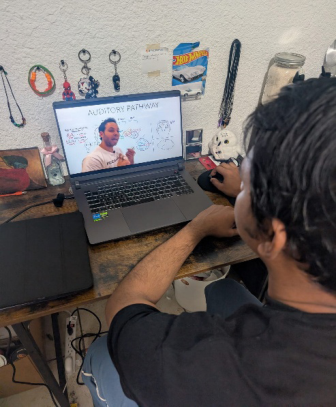
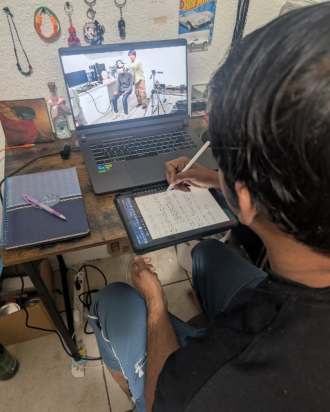
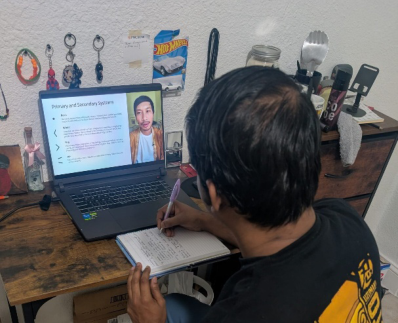
Experimental Design A within-subjects design was used, where each participant completed all three note-taking methods (see Figures 1, 2, and 3). This design allows each student to be compared against themselves, and it controls the individual differences across different methods.
Independent Variable (IV): The Note-Taking Method (Handwritten, Stylus, and Otter.ai).
Dependent Variables (DV): Learning Scores (Quiz 1 and Quiz 2) and Workload (NASA-TLX).
Figure 1: Participants taking notes in digital stylus.Figure 2: Participants taking notes Otter.AI.Figure 3: Participants taking notes through handwriting.
Workload was measured using the NASA Task Load Index (NASA-TLX), which assesses Mental Demand, Physical Demand, Temporal Demand, Performance, Effort, and Frustration (Hart and Staveland, 1988). This tool was selected because of its sensitivity to workload differences in digital and educational environments (Huq et al., 2025; Biondi, 2024).
Procedure The study spanned four days. On Days 1, 2, and 3, students watched one randomly selected video each day and took a quiz immediately afterward (Quiz 1). On Days 2, 3, and 4, they completed a second quiz (Quiz 2) exactly 24 hours later to assess their retention of the material. This allows for measuring recognition and conceptual recall, respectively, following existing note-taking studies (Mueller and Oppenheimer, 2014).
RESULT
The study evaluated the impact of three note-taking methods: handwriting, stylus-based, and Otter.AI, on learning outcomes and cognitive workload. Data was analysed using a one-way ANOVA for each DV at a 0.05 significance level.
Learning Scores Delayed Recall (Quiz 2)
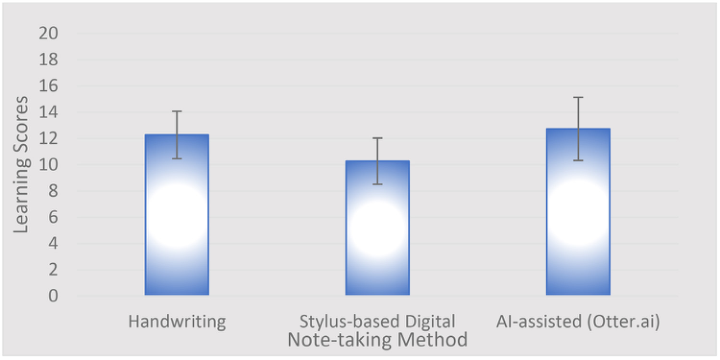
The results showed a significant main effect of the note-taking method on the delayed recall scores (F2, 20 = 4.30, p = 0.028). The post hoc Tukey test indicated that the AI-assisted condition (M = 12.73, SD = 4.82) was significantly higher than that for the Stylus-based (M = 10.27, SD = 3.52). However, there was no significant difference observed between the Handwriting (M = 12.27, SD = 3.61) condition and either the Ai-assisted or Stylus-based conditions (see Figure 4).
Figure 4: Quiz 2.
Immediate Recall (Quiz 1) The results didn’t reveal a significant main effect in immediate recall across note-taking methods. The mean scores were 14.55 for Handwriting, 14.09 for AI-assisted, and 13.91 for Stylus-based note-taking.
Workload (NASA-TLX) Mental Demand
The results didn’t show any significant main effect of the note-taking method on mental demand. The mean mental demand scores were 7.77 (SD = 5.09) for the AI-assisted condition, 10.27 (SD = 4.15) for the handwriting condition, and 8.23 (SD = 3.20) for the stylus-based condition.
Enhancing Learning Efficiency and Ergonomic Well-Being 45 Physical Demand
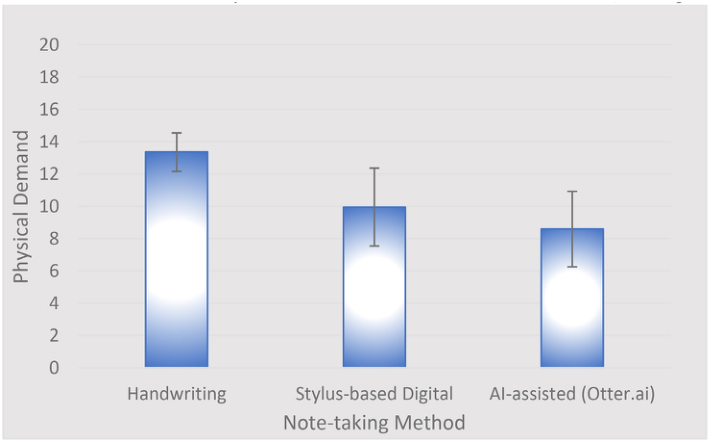
The results showed a significant main effect of the note-taking method on physical demand (F2, 20 = 6.85, p = 0.005). The post hoc Tukey test indicated that the handwriting condition (M = 13.36, SD = 2.38) resulted in significantly higher physical demand than both the stylus-based (M = 9.95, SD = 4.82) and AI-assisted (M = 8.59, SD = 4.67) conditions. However, no significant difference was observed between the stylus-based and AI-assisted conditions (see Figure 5).
Figure 5: Physical demand.
Temporal Demand The results didn’t reveal a significant main effect of the note-taking method on temporal demand. The mean scores for the three methods were 9.09 for Handwriting, 7.95 for Stylus-based, and 5.59 for AI-assisted notetaking.
Performance The results didn’t reveal a significant main effect of the note-taking method on perceived performance. The mean scores for the three methods were 10.05 for AI-assisted, 9.64 for Stylus-based, and 9.45 for the Handwriting condition.
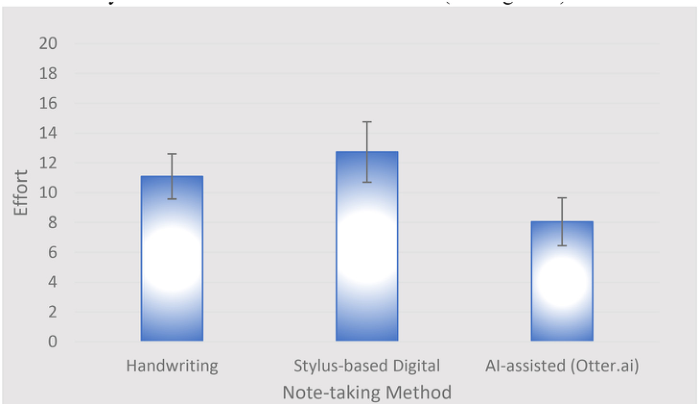
Effort The results showed a significant main effect of the note-taking method on effort (F2, 20 = 7.25, p = 0.004). The post hoc Tukey test indicated that the mean effort for the Stylus-based method (M = 12.73, SD = 4.05) was significantly higher than that for the AI-assisted method (M = 8.05, SD = 3.20). However,
the handwriting condition (M = 11.09, SD = 3.02) did not differ significantly from either the stylus-based or AI-assisted conditions (see Figure 6).
Figure 6: Effort.
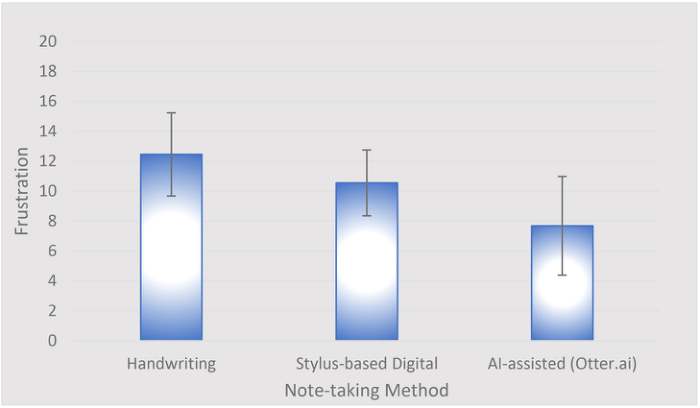
Frustration The results showed a significant main effect of the note-taking method on frustration (F2, 20 = 4.44, p = 0.025). The post hoc Tukey tests indicated that the handwriting condition (M = 12.45, SD = 5.54) resulted in significantly higher frustration than the AI-assisted condition (M = 7.68, SD = 6.60). However, the stylus-based condition (M = 10.55, SD = 4.41) did not differ significantly from either the handwriting or AI-assisted conditions (see Figure 7).
Figure 7: Frustration.
DISCUSSION
This study compares handwritten, stylus-based digital pen and tablet, and Otter.ai- an AI-assisted note-taking method to see how it affects the memory and workload in high-demand academic settings. Results show that there is no best method or perfect tool. Instead, there is a clear trade-off between learning effectiveness and cognitive effort, which is consistent with a human factor perspective.
There were no significant differences in immediate recall, showing that note-taking method doesn’t really impact short-term performance (Mueller & Oppenheimer, 2014; Wiechmann et al., 2022). Significant impacts were observed in delayed recall, where the AI-assisted method resulted in higher retention than the stylus-based method. However, handwriting did not show a significant difference from either approach. Handwriting needs active processing and deeper understanding through summarization, which benefits long-term memory (Mueller & Oppenheimer, 2014; Umejima et al., 2021). On the other hand, AI-assisted notetaking reduces extraneous cognitive load by offloading tasks, which helps preserve cognitive resources for later time (Gerlich, 2025; Huq et al., 2025). Stylus-based notetaking appears to provide neither sufficient workload reduction nor strong cognitive engagement, resulting in weaker delayed retention.
Workload results further support these patterns. Handwriting is often linked with higher physical demand. AI-assisted notetaking showed lower effort and frustration, indicating improved ergonomic well-being. These results align with Cognitive Load Theory, which suggests that excessive extraneous load limits learning by limiting the brain capacity for germane processing (Sweller, 1988). From a human factors point of view, these results show that the importance of educational technologies should be evaluated not only for efficiency, but also for how they shape workload and learning outcomes (Costley & Fanguy, 2021; Shi et al., 2022).
CONCLUSION
This study evaluated the effects of handwritten, stylus-based, digital, and AI-assisted note-taking methods on learning outcomes and workload in academic settings that require sustained concentration, particularly among STEM majors. The results indicate that there is no best note-taking method, but a trade-off between learning effectiveness and cognitive effort for each method.
Handwritten note-taking supported long-term retention but was associated with higher physical demand and frustration. Otter.AI reduced effort and frustration, improving ergonomic well-being, but supporting delayed learning. Stylus-based digital note-taking generally yielded inconsistent results, suggesting it may not fully capture the benefits of either active engagement or workload reduction.
The results highlight the importance of evaluating note-taking technologies beyond efficiency through the Human Factor lens. While tools that reduce workload can support learning by preserving meaningful cognitive engagement, high-effort methods may enhance retention at the
cost of increased stress. Although this was a pilot study with a small sample size, the findings provide initial insight into how note-taking technologies influence both cognitive performance and ergonomic well-being. Future research with larger samples and longer-term learning measures is needed to further explore these trade-offs and guide the design of effective and efficient human-centered learning tools.
ACKNOWLEDGMENT
This study was inspired by the course “Human Factor”, and we thank Dr. Yueqing Li for his valuable guidance throughout the entire duration of the project and all the participants for their enthusiastic participation.
REFERENCES
Al-Sharman, Alham. Shalash, Reime Jamal. Omran, Taif A. M. et al. (2025).
Exploring the impact of note taking methods on cognitive function among university students, BMC Medical Education, Volume 25. Biondi, Francesco N. (2024). Adopting Stimulus Detection Tasks for Cognitive Workload Assessment: Some Considerations, Human Factors, Volume 66, No. 12. Costley, Jamie and Fanguy, Mik. (2021). Collaborative Note-Taking Affects
Cognitive Load: The Interplay of Completeness and Interaction, Education Tech Research Dev, Volume 69. Gerlich, Markus. (2025). AI Tools in Society: Impacts on Cognitive Offloading and Critical Thinking, Societies, Volume 15, No. 6. Huq, Faria. Samee, Abdus. Lin, David Chuan-En. Tang, Alice Xiaodi. Bigham,
Jeffrey P. (2025) “No Teeline: Supporting Real-Time, Personalized Notetaking with LLM-Enhanced Micronotes”, proceedings of the 30th International Conference on Intelligent User Interfaces (IUI ’25), Cagliari, Italy. Marano, Giuseppe. Barone, Pierpaolo. Cincotta, Massimo et al. (2025). The Neuroscience Behind Writing: A Review of Sensorimotor and Cognitive Mechanisms, Life, Volume 15. Mueller, Pam A. and Oppenheimer, Daniel M. (2014). The Pen Is Mightier Than the
Keyboard: Advantages of Longhand Over Laptop Note Taking, Psychological Science, Volume 25, No. 6. Shi, Yinghui. Yang, Huiyun. Yang, Zongkai. Liu, Wei. Wu, Di and Yang, Harrison Hao. (2022). Examining the Effects of Note-Taking Styles on College Students’ Learning Achievement and Cognitive Load, Australasian Journal Of Educational Technology, Volume 38, No. 5. Sweller, John. (1988). Cognitive Load During Problem Solving: Effects on Learning,
Cognitive Science, Volume 12, No. 2. Wiechmann, Warren. Edwards, Robert. Low, Cheyenne. Wray, Alisa. Boysen- Osborn, Megan and Toohey, Shannon. (2022). No difference in factual or conceptual recall comprehension for tablet, laptop, and handwritten note- taking by medical students in the United States: A survey-based observational study, Journal of Educational Evaluation For Health Professions, Volume 19. Umejima, Keita. Ibaraki, Takuya. Yamazaki, Tetsuya and Sakai, Kazuhiko. (2021).
Paper Notebooks vs Mobile Devices: Brain Activation Differences During Memory Retrieval, Frontiers In Behavioral Neuroscience, Volume 15.
LISTED IN THE AHFE DIGITAL BOOKSTORE CATALOGUE
Explore the complete digital volume
Human Factors and Systems Interaction
Read this individual research paper free through the original publisher, or explore the full digital proceedings book.
ISBN 979-8-950676-06-2
Explore this ISBN in the AHFE Bookstore ↗Listed in the July 2026 bookstore catalogue; search by ISBN to confirm current availability · Digital book purchase optional