Md Mahabub Hasan, Nadia Islam Tanha, Sayeda Sufia Sumi, Kazi Saiful Islam, Yueqing Li (2025). Assessing the Impact of Backpack Carrying Styles on Users’ Discomfort. In: Physical Ergonomics and Human Factors. AHFE Open Access, vol. 185, pp. 112–121. https://doi.org/10.54941/ahfe1006471
The increasing awareness about the impact of backpack usage on musculoskeletal health, particularly the spine and associated muscles, has driven research on how different carrying styles, like single-strap and crossbody, contribute to users’ discomfort. This study preliminarily examined the discomfort experienced by college students using various school bag-carrying methods and the role of chest and waist straps in optimizing load distribution and reducing discomfort. The study used a controlled treadmill walking test to evaluate users’ discomfort across three carrying configurations: one-strap, two-straps, and four-straps. Four participants without any history of musculoskeletal issues walked on the treadmill under these three scenarios, each carrying a load equivalent to 15% of their body weight. Discomfort was measured on a scale from 0 to 10, ranging from no discomfort to unbearable discomfort for key body areas such as the neck, upper back, lower back, right shoulder, left shoulder, knee, and ankle. A standardized questionnaire was used to record discomfort, ensuring an objective assessment of the load’s influence on each participant. The results showed that the carrying method affected discomfort levels. Participants experienced substantial discomfort with the one-strap configuration due to the uneven distribution of the load, while the two-straps configuration provided more comfort due to better load distribution across both sides of the body. However, the four-straps configuration offered the most effective load distribution, minimizing muscle strain and discomfort compared to the one-strap and two-straps configurations. These findings are crucial for promoting the design and use of ergonomically enhanced backpacks for college students, especially in settings where heavy loads are frequently carried while promoting better postural stability.
The impact of backpack carrying on musculoskeletal health has drawn more attention because it is a common practice for college students. According to research, students carry their educational loads mostly in backpacks. The daily physical stresses associated with carrying backpacks cause significant forward lean of the head and trunk. It is assumed that daily discontinuous postural adaptations could lead in pain and disability in students Rai et al. (2013). The impact of various backpack-carrying styles, such as crossbody,
Assessing the Impact of Backpack Carrying Styles on Users’ Discomfort 113
single-strap, double-strap, and alternative designs, on muscle activation levels varies. Research indicates that the use of additional straps and better load distribution on load carriage systems has been shown to reduce strain, thereby potentially reducing the risk of muscle fatigue and strain during prolonged activities Faghy et al. (2022). Backpack-carrying discomfort is influenced by both the load of the backpack and the technique used to carry it, particularly impacting muscles critical for stability and posture such as the erector spinae and trapezius. Mosaad et al. (2014) investigated the activity of the upper trapezius muscle in schoolchildren and found that using a backpack with double straps significantly reduces muscle strain compared to using asymmetrical or single-strap designs. While this study underscores the benefits of double-strapped ergonomic backpacks in reducing shoulder muscle strain, it does not explore the potential advantages of incorporating chest and waist straps. These additional straps are vital for stabilizing the load and promoting even weight distribution, which may further reduce muscular strain, suggesting a need for further exploration.
Moreover, different backpack-carrying techniques, such as front-pack, crossbody, double-strap, and single-strap, elicit varied muscular responses. Hardie et al. (2015) examined how these carrying styles affect muscle activation in the latissimus dorsi, erector spinae, and trapezius. Their findings indicate that single-strap backpacks cause uneven load distribution, increasing activity on one side of the trapezius muscle and potentially leading to discomfort and fatigue. However, their study leaves a gap as it does not consider whether adding chest and waist straps to double- strapped backpacks could help alleviate this strain. Similarly, Chen et al. (2021) reported that side backpacks cause a greater lateral shoulder tilt and spinal flexion, linked to increased postural strain and muscle activation, highlighting a limitation in existing studies regarding optimal backpack design. Another critical factor affecting muscular fatigue is the combination of load weight and carrying duration. Hong et al. (2008) observed that carrying a backpack weighing 15% of body weight for an extended period increases lower trapezius muscle activity and leads to muscle exhaustion, emphasizing the significant impact of load weight on muscular endurance and comfort over time. However, this study did not examine whether using chest and waist straps could mitigate fatigue and improve endurance by stabilizing the load, thus leaving a gap in recommendations for endurance-focused backpack designs. Optimal load distribution has been demonstrated to enhance postural stability and decrease compensatory movements. Mosaad et al. (2018) found that double-sided backpacks improve children’s postural balance by evenly distributing weight, thereby reducing spinal deviations and forward head posture. They support the guideline that backpack weights should not exceed 10% to 15% of body weight, noting that heavier loads increase muscle activation and fatigue. However, their research does not address whether features like chest and waist straps could alleviate issues caused by uneven load distribution. Additionally, while some studies emphasize ergonomic designs for children, they overlook the specific benefits of chest and waist straps for this demographic (Mosaad et al., 2014; Chen et al., 2021). In the context of minimizing muscle discomfort, Khan
et al. (2022) and Sultana et al. (2020) emphasize the importance of design considerations to mitigate adverse effects on muscle tissues.
The purpose of this study is to compare the user’s discomfort of various backpack-carrying systems, with a focus on the function of the waist and chest straps. By keeping the backpack steady on the body, these straps may improve weight distribution and reduce discomfort. This study aims to assess the impact of various backpack-carrying styles on user discomfort, focusing on the role of waist and chest straps in load distribution. It will investigate the discomfort levels across different carrying techniques including single-strap, double-straps, and four-straps supported styles. The goal is to identify which method minimizes discomfort and offers insights into optimal backpack usage. This research is motivated by the prevalent issue of shoulder and back pain among frequent backpack users, especially college students, and aims to provide ergonomic recommendations to prevent chronic musculoskeletal conditions by studying the benefits of supportive straps in load distribution and injury prevention.
This article presents a novel approach to ergonomic backpack design by demonstrating the benefits of incorporating chest and waist straps to reduce discomfort in heavy-load scenarios. The existing studies typically recommend limits of 10–15% of body weight and consistently advise against carrying heavy loads due to the risk of musculoskeletal strain and discomfort (Mackie et al., 2008; Hong et al., 2008; Rai et al., 2013; Chen et al., 2021). This study tries to find the solution to this amount of load. Key contributions of the article are:
This study uniquely explores and substantiates how integrating chest and waist straps can distribute weight more evenly across the body, thereby reducing the discomfort associated with this amount of load.
This study uniquely assesses one-strap, two-straps, and four-straps configurations under controlled conditions, providing insights into how each impacts user discomfort.
This study also investigates the underexplored role of chest and waist straps in enhancing load distribution and reducing discomfort.
This study identifies four straps as optimal strap configurations that minimize discomfort, contributing actionable insights toward the design of backpacks that could prevent chronic musculoskeletal conditions, particularly for college students.
The rest of this article is structured as follows: Methodology, Discomfort scale, Analysis, Post Experiment Questionnaires, and Conclusion. The analysis section presents and discusses the results, including the discomfort comparison between one-strap, two-strap, and four-straps configurations of backpacks.
METHODOLOGY
This study employed a randomized controlled trial and investigated the effects of different backpack-carrying techniques on muscular activity, focusing particularly on the impact of additional chest and waist straps on
Assessing the Impact of Backpack Carrying Styles on Users’ Discomfort 115
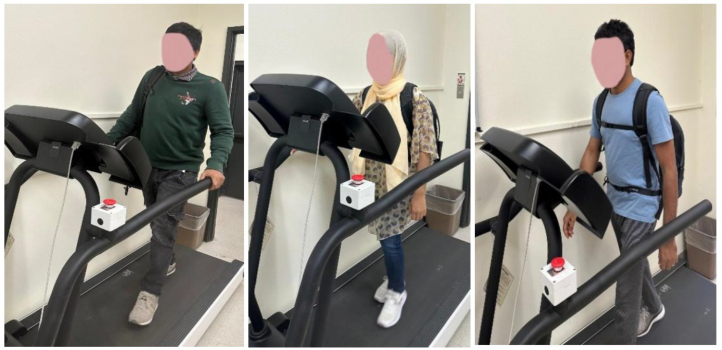
load distribution. We recruited a group of four participants from a university campus, ensuring a diverse sample of ages, genders, and body types to support the generalization of our findings. The equipment used included a treadmill to maintain consistent walking trials, backpacks equipped with adjustable one- strap, two-straps, and four-straps configurations, and a standardized load set at 15% of each participant’s body weight, following the recommendations of the previous research (Motmans et al., 2006; Mosaad et al., 2014). The study’s independent variable was the backpack carrying style: one strap, two straps, and four straps. The dependent variable was discomfort levels, assessed through a questionnaire focused on the neck, upper back, lower back, right shoulder, left shoulder, knee, and ankle. The procedure involved participants first completing a demographic questionnaire. They then walked on the treadmill at 2 km/hr, carrying the backpack in one of the three styles (one-strap, two-straps, four-straps) for 15 minutes each, following the recommendations by Kuo et al. (2010) (Figure 1). To prevent muscle fatigue and ensure accurate results, a 10-minute break was provided between consecutive trials. After each trial, participants filled out a post-experiment questionnaire to record their experiences and any muscle activity variations.
Figure 1: Participants walking on the treadmill carrying different styles of strap.
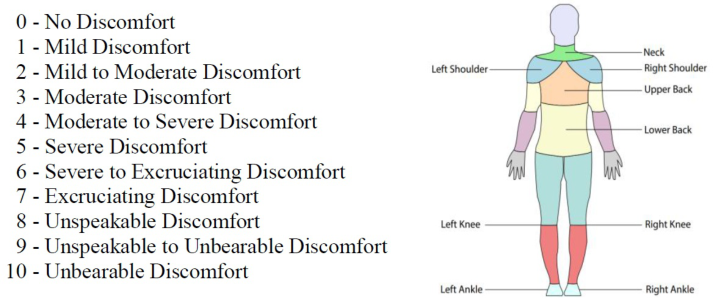
DISCOMFORT SCALE In this study, we meticulously collected discomfort data for various body regions to understand the impact of different backpack strap configurations on user comfort. The Discomfort Questionnaire was specifically designed to capture detailed feedback on the following body areas: Participants rated their discomfort on a scale from 0 to 10, where each number corresponds to a specific level of perceived discomfort for Neck, Upper Back, Lower back, Right Shoulder, Left Shoulder, Knee, Ankle (Figure 2).
Figure 2: Anatomical study regions for load impact and muscle discomfort analysis.
ANALYSIS The study utilized a randomized controlled trial methodology to investigate the impact of different backpack-carrying techniques on user discomfort, focusing on the addition of chest and waist straps for optimal load distribution. Participants carried backpacks in three configurations (one- strap, two-straps, four-straps) while walking on a treadmill, and discomfort was quantitatively assessed using a standardized questionnaire that focused on several body areas including the neck, shoulders, back, and legs. Data on discomfort levels was then analyzed to determine which backpack configuration minimized user discomfort effectively.
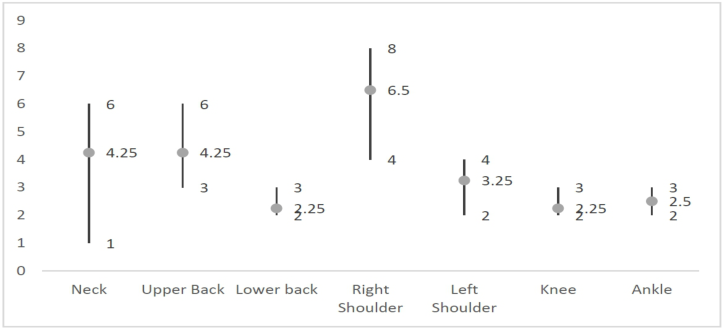
ONE-STRAP CONFIGURATION The results showed higher discomfort scores across all body parts, with the most notable discomfort in the right shoulder (average score of 6.5). Both neck and upper back region also show notable discomfort, averaging scores around 4.25 (Figure 3).
Figure 3: Discomfort scores by body part for one-strap backpack configuration.
Assessing the Impact of Backpack Carrying Styles on Users’ Discomfort 117
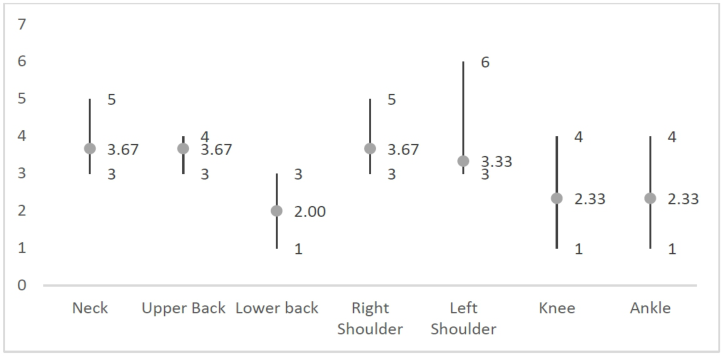
TWO-STRAPS CONFIGURATION The two-straps configuration generally results in moderate discomfort levels and shows a noticeable reduction in discomfort compared to the one-strap configuration. In this setup, the neck, upper back, and right shoulder experience the highest discomfort, with average scores of 3.67 (Figure 4).
Figure 4: Discomfort scores by body part for two-straps backpack configuration.
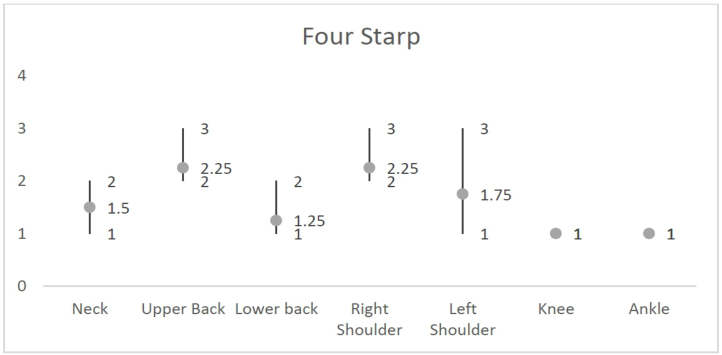
FOUR-STRAPS CONFIGURATION The four-straps configuration demonstrates the lowest discomfort scores across nearly all body parts, indicating improved load distribution and decreased strain. However, a slight discomfort was noted in the right shoulder and upper back, with an average score of 2.25 (Figure 5).
Figure 5: Discomfort scores by body part for four-straps backpack configuration.
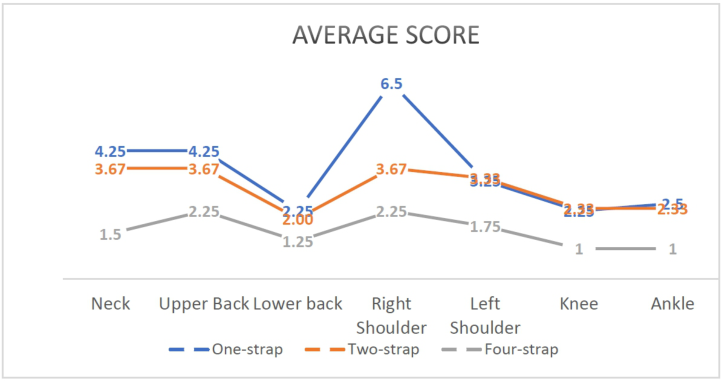
AVERAGE SCORE COMPARISON The line chart illustrates that transitioning from backpacks with one-strap to those with two and four straps generally results in lower discomfort scores (Figure 6). This trend supports the hypothesis that additional straps help distribute the load more effectively, thus reducing discomfort. The highest levels of discomfort are observed with one-strap configurations, particularly affecting the lower back and shoulders, which underscores the impact of poor load distribution. The data also indicates that the four-straps configuration offers the most comfort across most body parts, showcasing its effectiveness in minimizing discomfort.
Figure 6: Average scores by body part for each backpack configuration.
POST-EXPERIMENT QUESTIONNAIRES To estimate the subjective experience and satisfaction of the participants regarding different backpack configurations, we conducted a series of post- experiment questionnaires (Table 1). These questionnaires were designed to capture direct feedback from the participants on various aspects of comfort. Below is a summary of the feedback collected, which provides valuable insights into user preferences and the practical implications of our findings.
Table 1: Post-experiment questionnaires and feedback.
Table available in the original PDF paper.
Questionnaires Feedback Which backpack configuration did you
All participants: Double Straps with
find most comfortable?
Chest and Waist Straps Which carrying style was the easiest to
All participants: Double Straps
use?
Continued
Assessing the Impact of Backpack Carrying Styles on Users’ Discomfort 119
Table 1: Continued Questionnaires Feedback
Table available in the original PDF paper.
How satisfied were you with the comfort
Single Strap: 1P, Double Straps: 2P, Double Straps with Chest and Waist Straps: 4P
provided by each carrying style? (Rate on a scale of 1 to 5, where 1 = Very Dissatisfied, 5 = Very Satisfied) How likely are you to change your
Neutral 2P, very likely 1P, Likely 1P
backpack-carrying style based on this experiment?
Which carrying style would you
All participants: Double Straps with Chest and Waist Straps
recommend to others for reducing muscle discomfort?
Equation reproduced from the original PDF.
The post-experiment questionnaires highlighted that participants favored the double straps backpack configuration with chest and waist straps for its superior comfort and satisfaction, rating it highest in terms of comfort provided. In contrast, the single-strap configuration was rated the lowest for comfort, indicating significant discomfort due to uneven weight distribution. The double straps configuration alone was noted for its ease of use, although adding chest and waist straps greatly increased overall satisfaction. These findings suggest that ergonomic design features, such as additional straps, are crucial for enhancing comfort and could influence future consumer choices in backpack design.
DISCUSSION
This study highlights the impact of backpack-carrying styles on musculoskeletal discomfort, advocating for ergonomic designs with chest and waist straps. It reveals that single-strap configurations cause notable discomfort due to uneven load distribution, while two-strap designs offer an improvement due to better load distribution. The four-straps setup, including chest and waist straps, most effectively minimizes discomfort through improved load stabilization and reduced muscle strain.
The results support existing research on the importance of proper weight distribution to prevent postural issues and long-term musculoskeletal problems. By comparing different carrying styles, this study highlights the benefits of ergonomic backpacks for those frequently carrying heavy loads, reducing muscle strain, fatigue, and improving postural stability. These findings are crucial for students, professionals, and backpack manufacturers, suggesting that enhanced designs with additional straps can improve posture and overall musculoskeletal health. This research advocates for informed choices in backpack usage, promoting designs that prioritize comfort and prevent injuries. The study’s rigorous methods and precise results pave the way for future improvements. Our future research will include a larger sample size and apply statistical analyses to validate the observed differences.
CONCLUSION
This study on backpack-carrying styles highlights the impact of strap configurations on user discomfort. The one-strap setup causes notable discomfort due to uneven load distribution, while the two-straps and particularly the four-straps configurations improve comfort by better distributing the load. The four-straps option emerged as the most effective, reducing discomfort. These findings validate the benefits of additional straps for enhanced load distribution and underscore the need for ergonomic backpack designs, particularly beneficial for college students and frequent backpack users. Participants favored the double straps with chest and waist straps for prolonged use. Furthermore, this study had a limited participant pool, consisting mainly of college students without pre-existing musculoskeletal issues. Future research should aim to include a broader demographic to enhance the generalizability of these findings. Future studies could benefit from a larger sample size or the use of advanced technology like EMG to precisely quantify how strap configurations influence body posture and muscle activation. Importantly, no statistical test has been conducted in our research, which suggests that the conclusions drawn should be viewed as preliminary and indicative rather than definitive. This acknowledgment is crucial for setting the stage for more detailed studies that could employ statistical analyses to validate and expand upon our findings.
REFERENCES
Chen, Y. L., Nguyen, H. T. and Chen, Y., 2021. Influence of school bag loads and carrying methods on body strain among young male students. International Journal of Industrial Ergonomics, 82, p. 103095. Faghy, Mark A., Ren-Jay Shei, Nicola CD Armstrong, Mark White, and Mitch
Lomax. “Physiological impact of load carriage exercise: current understanding and future research directions.” Physiological Reports 10, no. 21 (2022): e15502. Hardie, Rebecca, Rachel Haskew, Joel Harris, and Gerwyn Hughes. “The effects of bag style on muscle activity of the trapezius, erector spinae and latissimus dorsi during walking in female university students.” Journal of human kinetics 45 (2015): 39. Hong, Youlian, Jing-Xian Li, and Daniel Tik-Pui Fong. “Effect of prolonged walking
with backpack loads on trunk muscle activity and fatigue in children.” Journal of Electromyography and Kinesiology 18, no. 6 (2008): 990–996. Khan, Mohammad Monirujjaman, Arifa Sultana, Mehedi Masud, Gurjot Singh Gaba, and Hesham A. Alhumyani. “Miniaturized Novel UWB Band-Notch Textile Antenna for Body Area Networks.” Computer Systems Science & Engineering 40, no. 3 (2022). Kuo, C. Y., and W. H. Lin. “The Effects of Schoolbag Style on Muscle Activation in Lower Extremities during Level Walking and Hill Walking in Primary School Students.” In 6th World Congress of Biomechanics (WCB 2010). August 1-6, 2010 Singapore: In Conjunction with 14th International Conference on Biomedical Engineering (ICBME) and 5th Asia Pacific Conference on Biomechanics (APBiomech), pp. 317–319. Springer Berlin Heidelberg, 2010. Mackie, H. W., and S. J. Legg. “Postural and subjective responses to realistic
Assessing the Impact of Backpack Carrying Styles on Users’ Discomfort 121
Mosaad, Dalia M., Heba El-Sayed Nabawy, And Wadida H. El-Sayed. “Influence of load carriage on electromyographic activities of upper fibers of trapezius in school students during walking.” Med J Cairo Univ 8, no. 2 (2014): 61–65. Mosaad, Dalia Mohammed, and Amr Almaz Abdel-Aziem. “Postural balance and
neck angle changes in school children while carrying a traditional backpack versus a double-sided bag.” Biomedical Human Kinetics 10, no. 1 (2018): 59–66. Motmans, R. R. E. E., S. Tomlow, and D. Vissers. “Trunk muscle activity in different modes of carrying schoolbags.” Ergonomics 49, no. 2 (2006): 127–138. Rai, Avantika, and Shalini Agarawal. “Back problems due to heavy backpacks in
school children.” IOSR J Hum Soc Sci 10 (2013): 1–5. Sultana, A., and M. M. Khan. “Design of UWB Band Notch Textile Antenna for Body-Centric Wireless Network with the Comparison of Five Different Textile Substrate.” International Journal on Communications Antenna and Propagation 10, no. 5 (2020).
LISTED IN THE AHFE DIGITAL BOOKSTORE CATALOGUE
Explore the complete digital volume
Physical Ergonomics and Human Factors
Read this individual research paper free through the original publisher, or explore the full digital proceedings book.
ISBN 978-1-964867-61-8
Explore this ISBN in the AHFE Bookstore ↗Listed in the July 2026 bookstore catalogue; search by ISBN to confirm current availability · Digital book purchase optional