Md Arafat Sikder, Shirin Begum, Minhazur Rahman Bhuiyan, Fagbemi Ayodeji Princewill, Yueqing Li (2024). Effect of variable cordless stick vacuum weights on discomfort in different body parts during floor vacuuming task. In: Physical Ergonomics and Human Factors. AHFE Open Access, vol. 147, pp. 44–52. https://doi.org/10.54941/ahfe1005176
Cordless stick vacuum cleaners designed for ease of use and maneuverability, making them a popular choice for household cleaning. Among cordless stick vacuum cleaners, two distinct styles exist: one with the center of mass (CoM) near the user's hand and another with the CoM near the brush. The popularity of upright vacuum cleaners for home use is declining in favor of lightweight cordless stick vacuum cleaners, particularly those with a center of mass (CoM) positioned close to the handle. Despite their popularity, user discomfort has emerged as a concern, particularly during extended cleaning sessions. This discomfort stems from the weight distribution and design of the vacuum cleaners, potentially leading to pain and fatigue in various body parts. This study investigates user discomfort in various body parts through qualitative questionnaires, focusing on the impact of weight and vacuuming duration of cordless stick cleaners. Twelve participants engaged in vacuuming tasks using three cordless stick vacuum cleaners weighing 5.2 lbs, 7.4 lbs, and 9.6 lbs respectively, on carpeted floors within an actual classroom setting. These sessions occurred at two durations: 5 minutes and 10 minutes. Discomfort levels were assessed across various body parts (shoulder, upper arm, lower back, forearm, wrist etc.) using a scale ranging from 0 (no discomfort) to 9 (unbearable discomfort).To analyze the data ANOVA was conducted, the results of this study suggest that both vacuum weight and usage time significantly impact discomfort levels in all body parts. As the weight and time increase, participants’ discomfort significantly increases. However, the strength of these effects varies depending on the body part. For example, wrist discomfort is extremely sensitive to both weight and time, while forearm discomfort is less impacted by both factors. Additionally, the interaction between weight and time is significant in some body parts, such as the shoulder, upper arm, lower back indicating that the effect of weight varies in different duration of the task.Hence, the data underscores that during prolonged vacuuming sessions, the wrist endure the most notable discomfort in contrast to areas such as the lower back, shoulder, forearm, or upper arm. This highlights the necessity for substantial ergonomic enhancements invacuum cleaner design targeted specifically at alleviating discomfort in these critical areas.
Effect of Variable Cordless Stick Vacuum Weights on Discomfort in Different Body Parts 45
INTRODUCTION
Vacuuming is a highly repetitive activity that involves continuous physi- cal exertion, including walking, pushing, and pulling. A previous study on the muscular demands of vacuuming using heavy upright vacuum cleaners found that carpet vacuuming can be a physically challenging task for non- professional household users (Bak, D’Souza, & Shin, 2019). A worldwide survey involving 28,000 participants from 23 countries revealed that 33% vacuumed their homes 2 to 5 times a week, while 46% engaged in vacuuming for 30 minutes to an hour (Electrolux, 2013).
Vacuum cleaners for household use come in various forms, including upright, canister, stick, robotic, and central vacuum systems. Upright vac- uum cleaners, characterized by their bulkier design, are primarily utilized for carpet cleaning due to their superior suction power and larger dustbin capac- ity. Conversely, canister vacuums are frequently preferred for bare floors, offering quicker and smoother push/pull motions on non-carpeted surfaces. Cordless stick vacuums have gained significant traction in recent years, owing to their lightweight, compact design, and enhanced versatility compared to traditional upright and canister vacuum cleaners (Qin et al., 2021). Recent advancements in suction power and battery efficiency have further propelled their popularity, making them a compelling choice for household cleaning (Mortram, 2019).
While upright vacuum cleaners still hold the largest share of the home vacuum cleaner market, cordless stick vacuums are rapidly gaining ground. Their maneuverability, portability, and ease of use make them particularly well-suited for modern lifestyles and diverse cleaning needs. According to Global Market Insights (2020), the market for household vacuum cleaners was about $20 billion in 2019 and is projected to grow to $30 billion by 2026. The market share of cordless stick vacuum cleaners is about 25%. Cordless stick vacuums typically feature a center of mass (CoM) located near the handle. Our previous study investigated the impact of CoM position on muscular exertion during back-and-forth vacuuming motions. Findings revealed significantly higher muscular loads in the upper extremities when using a high CoM vacuum cleaner compared to a low CoM model (Choi and Shin, 2018). These results suggest that floor vacuuming with high CoM cordless stick vacuums may not be as effortless as anticipated, despite their lighter weight.
Vacuum cleaners stand apart in their need for sustained physical engage- ment, requiring more muscular exertion compared to other household appli- ances. In the past, research has explored the musculoskeletal risks linked to regular floor vacuuming, particularly in the context of professional cleaning. Studies indicate that engaging in vacuum cleaning tasks at work, especially with commercial cleaners, may increase the likelihood of upper extremity musculoskeletal disorders, attributed to repetitive pushing and pulling move- ments (Bell and Steele, 2012; Weigall et al., 2005). While floor vacuuming is commonly perceived as physically taxing for non-professional users, limited information exists about the specific level of physical challenge, particularly concerning the newly introduced high CoM cordless stick vacuum cleaners.
Hence, this study aimed to assess the physical discomfort associated with vacuuming carpeted floors using high CoM cordless stick vacuum cleaners of varying weights over different durations within a real classroom setting. Subsequently, participants were asked to rate their discomfort levels (on a 0-to-9 scale) for various body parts following the vacuuming task. We anticipate that the findings of this study will inform design recommen- dations aimed at enhancing the user-friendliness of these everyday products and guide users in selecting appropriate vacuum cleaners for their specific needs, ultimately promoting safer and more comfortable daily housekeeping activities.
METHODS
Participants Twelve participants (9 male and 3 female) were recruited from the university community (Table 1). They had no physical disability in conducting vacuum- ing cleaning in standing in a classroom carpet floor setting and they all are right-handed. Participants engaged in a preliminary trial session to familiar- ize themselves with the vacuuming tasks prior to the commencement of data collection.
Table 1. Participant information.
Table available in the original PDF paper.
Group Age (years) Height (cm) Weight (lbs) All (n = 12) 32.34 170.35 167.38 Male (n = 9) 28.67 177.12 184.99 Female (n = 3) 36.00 163.57 149.77
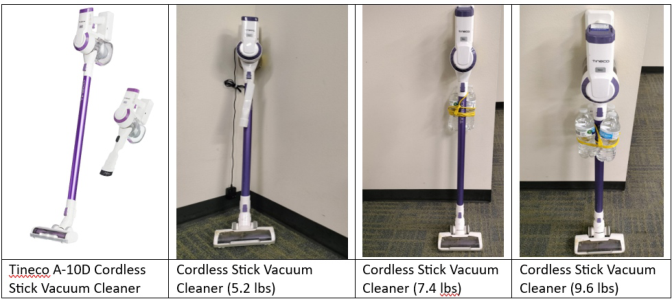
Equipment Three distinct cordless stick vacuum cleaners from the Tineco A-10D Cord- less Stick Vacuum brand were selected for the study (Table 2, Figure 1). These vacuum cleaners were specifically chosen to represent three weight categories: light, medium, and heavy. To achieve the medium and heavy weight cate- gories, two and four filled 1.1 lb water bottle was added to the 5.2 lb cordless stick vacuum cleaner, resulting in weights of 7.4 lb and 9.6 lb, respectively. The center of mass (CoM) for both stick cleaners is located near the handle of the main body.
Effect of Variable Cordless Stick Vacuum Weights on Discomfort in Different Body Parts 47
Figure 1: Vacuum cleaners used in the study (light, medium and heavy).
All cordless stick vacuum cleaners in this experiment exhibited identi- cal performance parameters: 90 W maximum suction power, 0.4 L dustbin capacity, and 300 W motor capacity.
Each participant completed both 5-minute and 10-minute vacuuming tasks with every vacuum cleaner in a randomized order. A mobile stopwatch was employed during the vacuuming sessions to measure the duration.
Independent Variables This study employed a 2 × 3 factorial design. There were two independent variables, weight (light, medium, heavy), and time (5 minutes, 10 minutes).
Dependent Variables Post-experiment, participants were queried about discomfort levels in various body parts (shoulder, upper arm, lower back, forearm, wrist, etc.) using a scale from 0 to 9. The gathered discomfort data was analyzed for further insights and processing.
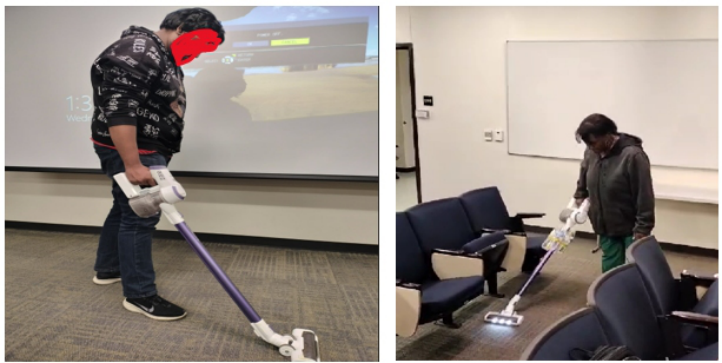
Experimental Task and Procedure Each participant completed six vacuuming tasks, comprising a combination of three cordless stick vacuum cleaners of varying weights (light, medium, and heavy) and two different durations (5 minutes and 10 minutes). The vacuuming tasks were performed on a carpet floor in a realistic classroom setting (Figure 2). The three cordless stick vacuums chosen for this study rep- resent light, medium, and heavier models of high CoM cordless stick vacuums available in the market (Fig. 1, Table 2).
Participants used each vacuum cleaner (light, medium, and heavy) for both durations (5 minutes and 10 minutes) in a randomized order during the exper- iment. To minimize carryover effects, a 2-minute rest break was provided between consecutive tasks. Participants were instructed to vacuum the floors at their preferred speeds for a given condition.
Figure 2: Vacuuming in the classroom.
Prior to the experiment we will ask demographic detail from every partic- ipant. Participants acclimated themselves to the experimental tasks and the vacuum cleaners used in the study by engaging in a preliminary practice trial.
RESULTS
In an extended analysis of the study examining the effects of different weights of cordless stick vacuum cleaners on user discomfort during floor vacuuming tasks. ANOVA was conducted with type I error 0.05. Listed below are the discomfort analysis of different body parts.
Shoulder The results showed a significant main effect of weight on the discomfort of shoulder (F2,22 = 22.15, p <0.0001). The post hoc Tukey test indi- cated that the mean of shoulder discomfort with heavy weight (M = 1.29, SD = 0.86) was significantly higher than that with medium weight (M = 0.75, SD = 0.79), which was also significantly higher than that with light weight (M = 0.29, SD = 0.55).
The results also showed a significant main effect of time on the shoulder discomfort (F 1,11 = 6.71, p = 0.0251). The post hoc Tukey test indicated that the mean of shoulder discomfort with long time (10 minutes) (M = 0.92, SD = 0.87) was significantly higher than that with short time (5 minutes) (M = 0.64, SD = 0.80).
The results didn’t reveal a significant interaction effect between weight and time on the shoulder discomfort (F2,22 = 0.42, p = 0.6646).
Upper Arm The results showed a significant main effect of weight on the discomfort of upper arm (F2,22 = 15.50, p<0.0001). The post hoc Tukey test indicated that the mean of upper arm discomfort with heavy weight (M = 1.25, SD = 0.94)
Effect of Variable Cordless Stick Vacuum Weights on Discomfort in Different Body Parts 49
was significantly higher than that with medium weight (M = 0.63, SD = 0.77) and light weight (M = 0.33, SD = 0.70). However, there was no significant difference in the upper arm discomfort between medium and light weight.
The results also showed a significant main effect of time on the upper arm discomfort (F1,11 = 11.99, p = 0.0053). The post hoc Tukey test indi- cated that the mean of upper arm discomfort with long time (10 minutes) (M = 0.92, SD = 0.97) was significantly higher than that with short time (5 minutes) (M = 0.56, SD = 0.77). The results didn’t reveal a significant interaction effect between weight and time on the upper arm discomfort (F2,22 = 0.37, p = 0.6960).
Lower Back The results showed a significant main effect of weight on the discomfort of lower back (F2,22 = 28.21, p<0.0001). The post hoc Tukey test indi- cated that the mean of lower back discomfort with heavy weight (M = 2.08, SD = 1.06) was significantly higher than that with medium weight (M = 1.25, SD = 0.90), which was also significantly higher than that with light weight (M = 0.42, SD = 0.72).
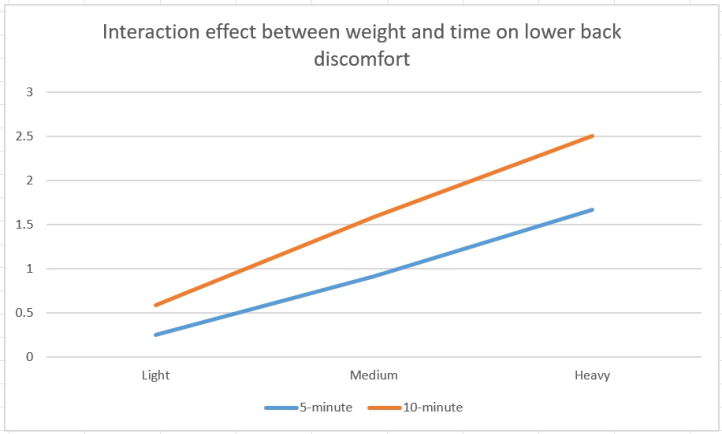
The results also showed a significant main effect of time on the lower back discomfort (F1,11 = 25.11, p = 0.0004). The post hoc Tukey test indi- cated that the mean of lower back discomfort with long time (10 minutes) (M = 1.56, SD = 1.16) was significantly higher than that with short time (5 minutes) (M = 0.94, SD = 1.01). The results further revealed a signifi- cant interaction effect between weight and time on the lower back discomfort (F2,22 = 5.50, p = 0.0116). As weight increases, lower back discomfort has bigger increase with long time (10 minutes) than short time (5 minutes).
Figure 3: Lower back discomfort in-terms of weight and time interaction.
Forearm The results showed a significant main effect of weight on the discomfort of forearm (F2,22 = 17.70, p<0.0001). The post hoc Tukey test indicated that the mean of forearm discomfort with heavy weight (M = 1.58, SD = 1.18) was significantly higher than that with medium weight (M = 0.79, SD = 1.02), and light weight (M = 0.25, SD = 0.61). However, there was no significant difference in the forearm discomfort between medium and light weight.
The results also showed a significant main effect of time on the forearm discomfort (F1,11 = 8.19, p = 0.0155). The post hoc Tukey test indicated that the mean of forearm discomfort with long time (10 minutes) (M = 1.06, SD = 1.15) was significantly higher than that with short time (5 minutes) (M = 0.69, SD = 1.04).
The results didn’t reveal a significant interaction effect between weight and time on the forearm discomfort (F2,22 = 0.45, p = 0.6464).
Wrist The results showed a significant main effect of weight on the discomfort of wrist (F2,22 = 65.36, p<0.0001). The post hoc Tukey test indicated that the mean of wrist discomfort with heavy weight (M = 3.04, SD = 1.23) was significantly higher than that with medium weight (M = 1.79, SD = 0.88), which was also significantly higher than that with light weight (M = 0.88, SD = 0.95).
The results also showed a significant main effect of time on the wrist dis- comfort (F1,11 = 42.12, p<0.0001). The post hoc Tukey test indicated that the mean of wrist discomfort with long time (10 minutes) (M = 2.33, SD = 1.43) was significantly higher than that with short time (5 minutes) (M = 1.47, SD = 1.13).
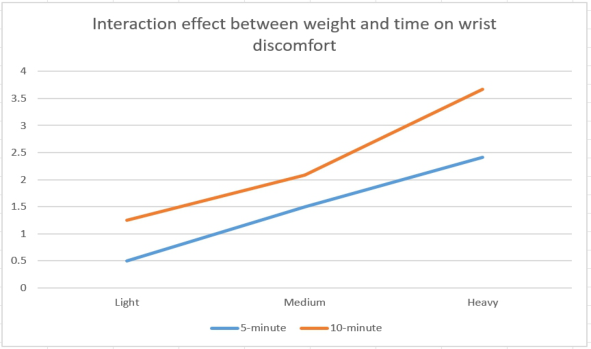
The results further revealed a significant interaction effect between weight and time on the wrist discomfort (F2,22 = 3.76, p = 0.0393). As weight increases from medium to heavy, wrist discomfort has bigger increase with long time (10 minutes) than short time (5 minutes).
Figure 4: Wrist discomfort in-terms of weight and time interaction.
Effect of Variable Cordless Stick Vacuum Weights on Discomfort in Different Body Parts 51
DISCUSSIONS The study highlighted the important role of vacuum weight and usage length in producing physical discomfort. Result showed that there is signif- icant increasing discomfort during vacuuming as weight increases and time extends. The discomfort in wrist and lower back is more noticeable than in other locations, such as the forearm, shoulder etc. Therefore, it is evident from the data that prolonged vacuum cleaning sessions and heavy vacuum predominantly affect the wrist and lower back compared to other anatomical regions. This indicates that ergonomics should be considered when design- ing vacuum cleaners, a point that has been highlighted in earlier ergonomic research but hasn’t always been explicitly related to certain body parts. The findings of this study are consistent with the larger body of literature on the ergonomic design of household equipment. The findings highlight the need of considering the ergonomic design of vacuum cleaners as well as maybe other domestic and commercial instruments utilized in comparable situations, regarding the weight and duration of usage. This comparison with earlier studies highlights both the unique contributions of this research in the field of ergonomics and its practical implications for improving user safety and comfort in everyday appliances.
Regression analyses were conducted to examine the relationship between discomfort (lower back, wrist, shoulder, forearm, and upper arm) and the Center of Mass (CoM) and weight. The results indicate that, none of the predictors were statistically significant at the 95% level for the lower back, shoulder, forearm, and upper arm.
However, in case of wrist, the predictor “Weight (lbs)” showed statistically significant, it indicates that discomfort tends to increase with greater weight, though the significance level is only marginal.
The R-squared values for the models were 0.372 (lower back), 0.470 (wrist), 0.225 (shoulder), 0.239 (forearm), and 0.182 (upper arm), suggest- ing that weight and CoM location explain a very moderate portion of the variation in discomfort.
CONCLUSION
Considering the preliminary findings from this experimental study, the phys- ical discomfort associated with floor vacuuming utilizing cordless vacuum cleaners appears to be comparable to, or in some cases exceeds, that caused by occupational tasks inducing fatigue or musculoskeletal issues. Despite potentially shorter exposure durations or frequencies in comparison to these occupational tasks, daily usage of cordless cleaners during floor vacuuming may lead to considerable physical discomfort. The stark contrast in discom- fort metrics across various body areas, notably highlighting the prevalence of discomfort in the wrist and lower back compared to other anatomical regions, emphasizes the critical need for targeted ergonomic improvements in vacuum cleaner design. Addressing these specific areas could significantly mitigate discomfort and contribute to a more ergonomic and user-friendly vacuum cleaner design.
ACKNOWLEDGMENT
This study was inspired by the occupational ergonomics class, and we express our gratitude to Dr. Yueqing Li for his invaluable support throughout the entire duration of the project.
REFERENCES
Bak, H., D’Souza, C., & Shin, G. (2019). Upper extremity muscular load during carpet vacuuming with household upright cleaners. Applied ergonomics, 79, 38–44. Bell, A. F., Steele, J. R., 2012. Risk of musculoskeletal injury among cleaners during
va cuuming. Ergonomics 55, 237–247. Choi, S., & Shin, G. (2018). Effects of the center of mass of a stick vacuum cleaner on the muscle activities of the upper extremity during floor vacuuming. Applied ergonomics, 70, 1–5. Electrolux, 2013. Electrolux Global Vacuuming Survey 2013 Report. https: //www.electroluxgroup.com/wp-content/uploads/sites/2/2013/10/Electrolux- Global-Vacuu ming-Survey-2013-Full-report.pdf/. (Accessed 6 March 2022). Global Market Insights, 2019. Household Vacuum Cleaners Market Size by Product,
by Sales Channel, Industry Analysis Report, Regional Outlook, Growth Potential, Competitive Market Share & Forecast, 2020–2026. Retrieved February 14, 2020. Kang, E., Yu, H., & Chang, J. (2020). Effects of weight distribution in a handle of a cordless stick-type vacuum cleaner: Muscle activity and subjective discomfort of the upper limb. International Journal of Industrial Ergonomics, 80, 103054. Kwon, Y., & Shin, G. (2022). Upper extremity muscle activity when vacuuming
floors with cordless stick vacuum cleaners. Applied Ergonomics, 104, 103821. Mortram, K. (2020, December 21). 10 best cordless vacuum cleaners, from Dyson to Hoover. Good Housekeeping. Mortram, K., 2019. Best Stick Vacuum Cleaners: Top 10 Cordless Vacuums for Every
Budget. Retrieved February 14, 2020 from https://www.goodhousekeeping.com/ uk/product-reviews/house-garden/g685066/the-top-5-best-stick-vacuums/ Qin, D., Dong, Z., Liu, Y., Wang, D., & Qin, S. (2021). How Does the COM Position of a Vacuum Cleaner Affect Muscle Activities While Vacuuming? In Human Interaction, Emerging Technologies and Future Applications III: Proceedings of the 3rd International Conference on Human Interaction and Emerging Tech- nologies: Future Applications (IHIET 2020), August 27–29, 2020, Paris, France (pp. 344–350). Springer International Publishing. Weigall, F., Simpson, K., Bell, A. F., Kemp, L., 2005. An Assessment of the Repetitive
Manual Tasks of Cleaners. WorkCover NSW, Sydney.
LISTED IN THE AHFE DIGITAL BOOKSTORE CATALOGUE
Explore the complete digital volume
Physical Ergonomics and Human Factors
Read this individual research paper free through the original publisher, or explore the full digital proceedings book.
ISBN 978-1-964867-23-6
Explore this ISBN in the AHFE Bookstore ↗Listed in the July 2026 bookstore catalogue; search by ISBN to confirm current availability · Digital book purchase optional