Yuliana Tónix Cuahutle, Donovan Esqueda Merino, Ricardo Jaramillo Godinez, Hector Rafael Morano Okuno, Luis Enrique Villagómez Guerrero, Oliver Gómez Meneses (2024). Developing anthropometrics competency-based learning with a simplified CAD model of a person. In: Physical Ergonomics and Human Factors. AHFE Open Access, vol. 147, pp. 128–137. https://doi.org/10.54941/ahfe1005185
In today's competitive markets, companies must prioritize user needs to ensure the preference and recommendation of their products. This paper explores the evolution of product development from Raymond Loewy's era to modern times, emphasizing the crucial role of ergonomic factors for both end users and labor workers. Today, as we navigate highly competitive markets, the preference and recommendation of a company's products over competitors' offerings lie in the hands of discerning consumers. The journey from pioneers era to the present has witnessed a paradigm shift, where the development of materials, aesthetics, and, most critically, human factors, has become instrumental not only for end-users but also for the well-being of labor workers.Modern engineers face the challenge of considering not only customer desires but also essential human factors that impact product usability and overall user experience. Human factors, encompassing physiological, psychological, cognitive, and organizational aspects, have become pivotal in product design since the industrial era. Ergonomics and anthropometrics play a key role in physical product and workstation design, influencing comfort, safety, and long-term health. The importance of realize and connect with reality how software can not only simplify the task but also help to develop better models and prototypes considering design aspects and developing a systematical thinking is relevant for the activity developed at class and the one we discuss.This study emphasizes the significance of incorporating these factors into the design process, employing a human-centered design approach. Through the use of some Computer-Aided Design models requiring the adaptation of the team's measurements, this paper emphasizes the importance of bridging the gap between theoretical knowledge and practical application in mechatronic engineering education. By integrating anthropometric design activities in their undergraduate junior year, students can develop a deeper understanding of human factors, contributing to their preparedness for the dynamic challenges of the industry. This approach not only enhances students' academic journey but also fosters a systematic design mindset, prompting reflection on the 'why' of design creation alongside the 'how.'To validate the results, students filled-up an entry and an exit survey in a Likert-Scale. This survey focused on the understanding and empowerment of human factors in product design. Looking at the data we identified that while most students marked a higher empowerment in relation to the entry survey, some of them indicated a lower value possibly due to the fact that they realized that accounting for human factors is more complicated than what they originally thought. Academically, new generations of students would benefit from these practices where they would be able to connect with the principal requirements for product, service or system design that are in their immediate environment and from where they could obtain the principal insights assists by accurate software. Professionally, future professionals and the industry will complement each other to work together and make the better for the human needs in an industry that is constantly growing and that needs to consider every aspect of human life; therefore the use and development of anthropometric aspects would be consider as a medullar part of human centered design and how design and engineering converse in an universe where both are disciplines that can converge in and out a classroom. From exercises like the one presented here our graduates will be adept in the agile management of multidisciplinary projects, showcasing their versatility and capacity to navigate the complexities inherent in collaborative endeavors.
This paper delves into the intersection of design, ergonomics, and human factors, advocating for a comprehensive methodology that not only incorpo- rates user feedback throughout the development process but also embraces the multidisciplinary collaboration of experts from various domains.
In the actual evolving technological landscape, the success of product development hinges on a nuanced understanding of user needs, a principle that has been used since the days of design pioneers such as Henry Dreyfuss
Developing Anthropometrics Competency-Based Learning With a Simplified CAD Model 129
or Raymond Loewy who work in generate strategic design thinking more in the needs of the object both persons. Today, as we navigate highly competitive markets, the preference and recommendation of a company’s products over competitors’ offerings lie in the hands of discerning consumers. The journey from pioneer’s era to the present has witnessed a paradigm shift, where the development of materials, aesthetics, and, most critically, ergonomic factors, has become instrumental not only for end-users but also for the well-being of labor workers.
In the early 1930s is USA, innovation, industry, and, above all, con- sumption experienced a decline due to the crisis of 1929. Consequently, it became imperative for companies to sell their products to confront the crisis. The competitive capitalist position shifted towards a monopolistic capitalist model, giving rise to impure forms. During this period, many prod- ucts were created without due consideration for basic aspects of design or anthropometrics.
Is at this time where Styling was born once the First World War ended. Companies and industries needed more effective systems to attract attention centered in strategy and methodologies to develop products. In the United States there was a desire to create American styles, so Raymond Loewy cre- ated Styling or the stylization of the object. This transformative movement gained prominence in the United States, where there emerged a fervent desire to establish distinctively American styles. The concept of styling, often syn- onymous with the stylization of objects, became a pivotal element in the strategic arsenal of companies seeking to distinguish themselves and appeal to the evolving tastes of consumers.
Loewy introduced a design philosophy centered on the notion that making a product visually appealing was key to its successful sale but not only that but take notice of the needs of the user at that moment. With this philosophy becomes evident that this transformative approach not only shaped the aes- thetics of products but also fundamentally altered the dynamics of consumer engagement in the broader socioeconomic context.
With this antecedent, derived from this crisis, most designs were not thought out or developed under a specific methodology, resulting in prod- ucts that were unfriendly to the environment and the user. Universities such as ULM or Bauhaus were among the first to implement methodologies and curricula that connected the needs of users and companies with design and what was learned in the classroom.
The new educational model at Tecnológico de Monterrey which we develop during this exercise with students is learning competency-based, starting in 2019, an education model based on a curricular framework that shows various types of competencies that any professional should graduate with and that should be demonstrated throughout their professional career. Competency-based education prioritizes the comprehensive training of the student so that, with an ethical and civic commitment, they undertake, con- tribute, and solve the problems of the global and local environment in a sustainable way (Olivares Olivares et al., 2021).
The Learning Assessment Model is based on the following characteristics:
Focused on evaluating competencies, and not exclusively on granting qualifications. This is through challenging situations where the student demonstrates mastery of a level of competence (Challenge Block).
Oriented to offer personalized feedback and continuous reflection, which allows the student to recognize their progress and achievements.
Thus, within the Tec21 Model at Tecnológico de Monterrey, a compe- tency is “the conscious integration of knowledge, skills, attitudes, and values that allow you to successfully face both structured and uncertain situations and that may involve higher-order mental processes. According to the objec- tives of the educational model, students must demonstrate the development of disciplinary and transversal competencies to achieve the challenge that is focused on their educational development. And this is one of the focused themes where we try to demonstrate at classroom by teaching anthropomet- rics in engineering product development comparing methodologies applying educational innovation that may evolved to new studies plan.
Competency-based learning is centered around educating through the implementation of challenges, requiring students to demonstrate the acqui- sition and application of knowledge through the development of practical skills.
Over the past decade, design education has undergone a significant trans- formation, embraced new perspectives, and aspired to a more forward- thinking vision. Addressing the imperative for a curriculum renewal grounded in competencies and forward-looking principles, this paper delin- eates the process of developing anthropometrics Competency-Based Learning curriculum.
Teaching Anthropometrics in Engineering Product Development In our modern days, the development of products requires that companies pay close attention to their users’ needs, as being in highly competitive markets can only pay off when the customers prefer, and recommend, the company’s products over those of their competitors. Since the times of Rey- mond Loewy, the most remarkable difference for the consumer to choose products start with the new develop of materials, aesthetics but overall ergonomic factors, taking care not only for the final user but for the labor workers.
Moreover, besides what customers might define as desires, there is a set of requirements that modern engineers must be careful to consider, as they will impact the usability, and in such a way, the overall user experience of a product (Bridger, 2017). These requirements are related to what the human being has done naturally since the first tools were invented, but that became a field of study after the industrial period arrived: human factors.
Human factors investigate improving human performance through the manipulation of variables that improve the physiological, psychological, cog- nitive, and organizational state of the human (Fanger, 1973). These might include easy to measure variables such as the level of noise for acoustics, but also others that might be more subjective such as the thermal comfort, which require subjective evaluations such as the one presented by Fanger.
Developing Anthropometrics Competency-Based Learning With a Simplified CAD Model 131
When speaking of physical products or workstation design, two rele- vant human factors to look at are ergonomics and anthropometrics (Bridger, 1995), the former focusing on the physical comfort of the person and the lat- ter in the adaptation of the system to the user’s body dimensions. Both become even more relevant with the understanding that a bad design can bring mus- culoskeletal injuries mid- or long-term (Clark et al., 2018), whereas a good design can improve safety and comfort (Zagloel et al., 2015).
Design works from a methodology that covers most of these insights and requirements as part of the design process, getting approach to developing interactive systems that aims to design products so that they are useful and easy to use for users. To do this, it focuses attention specifically on users, their desires, and expectations, considering the human factor, as well as knowl- edge and methods related to, to these we called it usability. Human-centered design also provides us an approach to interactive systems development that aims to make systems by applying human factors/ergonomics, and usability knowledge and techniques.
A study by Dias et al. (2015) has shown that students often overlook ergonomics and anthropometrics since they consider that aesthetics and functionality are more relevant than minding about ergonomics and anthro- pometry. On the other hand, when educational institutions expose their students to ergonomics and anthropometrics in the design process, students become aware of the benefits (Davies and Bingham, 2013).
These research findings collectively advocate for a comprehensive and collaborative design approach that prioritizes user needs, incorporates ergonomic considerations, and recognizes the significance of educating and sensitizing designers, particularly students, to the intricacies of human fac- tors in product development. This approach not only enhances the academic journey of students but also contributes to the broader goal of advancing a systematic design mindset within the design and engineering disciplines.
Thus, many educational institutions use CAD software tools to sensitize students in ergonomics and anthropometrics. For example, Baier et al. (2015) used NX to identify the optimal driver height and weight for their race car, while Gunther and Quintero-Durán (2015) used Tecnomatix Jack for posture analysis. Moreover, these tools might even benefit from specialized cam- eras like Microsoft Kinect (Endo et al., 2010), but have certain limitations related to the measurements and analysis that can be carried out, besides the availability of software licenses. For this reason, some educational insti- tutions have developed their own software according to their needs (e.g. Jellema et al., 2019; Endo et al., 2014). Having the possibility to adapt more dimensions than just the height and the weight opens the possibility to study other populations and even adapt to a very specific user case.
Even though this customized software might be able to cover a wider range of populations and dimension requirements than regular CAD add-ins, students might not get access to it once they are in their professional envi- ronment. Thus, it is important to use software-agnostic customized tools. As shown in Esqueda et al. (2020) standardizing assessments and methodolo- gies for the human factors improves the student’s learning journey, and in a similar way, standardizing tools and making the students understand the
way to develop those tools might be more helpful for them in their future professional activities.
The importance of realize and connect with reality how software can not only simplify the task but also help to develop better models and prototypes considering design aspects and developing a systematical thinking is relevant for the activity developed at class and the one we discuss.
Design of an Anthropometrics Experience for Engineers The study presents the results of implementing the anthropometric design activity, including pre- and post-activity surveys measuring students’ under- standing and empowerment regarding human factors. The findings indicate a positive impact on students’ perception of the relevance of human factors in product design, although variations in empowerment levels suggest the complexity of incorporating these factors.
The present activity falls within the course of Mechatronic Design, a redesign under the Tec21 model of studies based on a similar course with the same name from the old model (Esqueda et al., 2019). The redesigned course is instructed on the junior year of the Mechatronics Engineering Major at the University. This course lasts 5 weeks, for a total of 20 hours of work, and it is expected that students learn about product development methodologies and propose an innovative solution for a problem they identify.
Before their junior year of the major, students are sensitized in some human-centered design by learning Design Thinking in one of their courses of their sophomore year. Likewise, as they start with Computer-Aided Design, considering the human as part of the Engineering Product loop is done with the help of the same tools. An example of this can be seen in Morano et al. (2023), where a manikin was designed to be used along with an elliptical machine.
At Greater Mexico City campus, the course is taught with an empha- sis related to human factors and user experience, both in the previous and present educative model, so that Mechatronic Engineers increase their aware- ness in user-centered design. This course being taught annually and for the first time under the new model in 2021. In the 2023 iteration, a total of 38 students enrolled in said course at our campus at Greater Mexico City.
While on the first two editions some theoretical knowledge was given to the Engineers, there was no practical exercise to strengthen their learning experience on the topic. Thus, a new activity was designed to be applied in the 2023 edition. The activity, focused on anthropometric design, consisted of the following steps:
Fill-up an entry survey consisting of two questions: “I understand the relevance of human factors (for example, anthropometrics) in product design.” and “I feel empowered so that my mechatronic product designs can consider the human factors related to the target population for whom they are directed.”
Students would separate in teams of 3–4 people.
Developing Anthropometrics Competency-Based Learning With a Simplified CAD Model 133
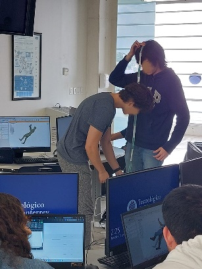
Figure 1: Students defining the tallest and shortest member of their teams.
All students in the team would measure their height to define who would be the tallest and the shortest member of the team (see Figure 1).
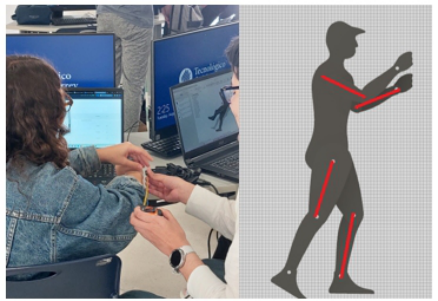
For the tallest and shortest team members, students would measure and log the following lengths associated to the joints of the manikin: from foot to knee, from knee to the hips, from shoulder to elbow and from elbow to wrist.
Students would import twice the mannikin into the CAD software: Autodesk Fusion360. For each one, they would scale the figure so the distance between joints matched the dimensions taken for the tallest and the shortest persons respectively (see Figure 2).
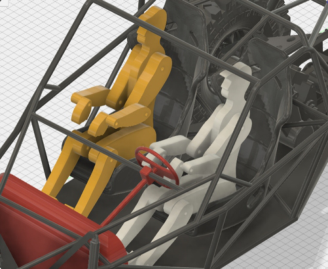
Students would then import the CAD of an all-terrain vehicle (ATV). They would move the body parts so that both manikins could be comfortably sitting in the ATV seats.
Figure 2: Students measuring the body parts (left) that corresponded to the distances between joints (right), represented here by red lines.
Students would need to design a steering wheel. Then they would need to validate that both their manikins would reach said steering wheel. This could be done as they find suitable, but the two prevailing ideas were:
making a telescopic system for the steering wheel (see Figure 3) or design- ing a rail system so that the seat could be moved back and forth. In any case, they would need to define dimensions so that the small person could reach and the tall person could fit.
Students would fill up an exit survey with the same questions as the entry survey.
Figure 3: Scaled manikins (yellow and white) of one of the teams, sitting down in the ATV (gray). The steering wheel and its base (in red) were designed with a telescopic support to account for both mankins.
Both the entry and exit survey were defined on a 5-point Likert Scale (Nemoto & Beglar, 2014). Results can be observed in Table I. We can observe that in average, even if their sense of understanding of the topic and their empowerment in relation to human factors was appreciated by them as strong, there was an increase in their average perception. However, standard deviation from the second question in the exit survey shows that variations were more important. Looking at the data we identified that while most stu- dents marked a higher empowerment in relation to the entry survey, some of them indicated a lower value in the Likert scale in comparison to the entry survey, which could possibly indicate that they realized that accounting for human factors is more complicated than what they originally thought.
Table 1. Results from the entry and exit survey.
Table available in the original PDF paper.
Entry Survey Exit Survey Average Standard Deviation Average Standard Deviation
4.59 0.67 4.70 0.69
I understand the relevance of human factors (for example, anthropometrics) in product design.
4.27 0.68 4.35 0.78
I feel empowered so that my mechatronic product designs can consider the human factors related to the target population for whom they are directed.
Developing Anthropometrics Competency-Based Learning With a Simplified CAD Model 135
CONCLUSION
Academically, new generations of students would benefit from these prac- tices where they would be able to connect with the principal requirements for product, service or system design that are in their immediate environment and from where they could obtain the principal insights assists by accurate software. Professionally, future professionals and the industry will comple- ment each other to work together and make the better for the human needs in an industry that is constantly growing and that needs to consider every aspect of human life; therefore the use and development of anthropometric aspects would be consider as a medullar part of human centered design and how design and engineering converse in an universe where both are disciplines that can converge in and out a classroom. The actual scenario needs to move forward a systematic design, that is, in its totally, consideringly places, meth- ods, techniques and tools available for the development for design products whereas they are physical, graphic and/or virtual, and asks us the question, not only from the methodological point of view of how to design, but also why is needed to be created in the first place.
The design process, as highlighted in various research studies, plays a piv- otal role in modern product development, necessitating a holistic approach that integrates user-centered principles and considers multifaceted aspects such as ergonomic factors and human factors. In Norman (2013) an empha- sis is put in the importance of incorporating user testing throughout the entire product development process, underscoring that user feedback should be an integral part of design from the initial stages of creating paper sketches or mockups.
Students need to comprehend that the design undergoes refinement and enhancement through user-centered assessment. This principle underscores that user testing should not be relegated to the final stages of development; rather, it should be seamlessly integrated into the entire product development process. User feedback must be considered from the initial stages, such as the creation of preliminary sketches or mockups.
The design team should comprise individuals possessing diverse skills and perspectives, necessitating the inclusion of experts from various disciplines. We think that only by working together designers, engineers, programmers, and usability experts, each contributing their unique viewpoints, can blind spots be identified, ensuring the successful execution of a human-centered design project.
More important, innovations like this at our classrooms will lead to prove the importance of competencies-based learning and will shows the lead to understand the principal way to take to design future study plans at Tecno- logico de Monterrey, what kind of competences need to be developed in the future in our students and at our classroom? The future in design and using technology as software as CAD will lead to a graduation profile that looks for more interdisciplinary teams and the use of technology to resolve com- plex problems that may consider new methodologies that involves the use of competencies that considers not only the needs of the user but the planet and cultures as well.
The future of the next competencies that our students will develop must be conscious integration of knowledge, skills, attitudes, and values that allow us to successfully face structured and uncertain situations. These competencies integrate both knowledge and procedures specific to the discipline, as well as attitudes and values that allow us to be participatory professionals committed to society.
We are looking for the next study plan looking to transfer this educational model to the real world where we can realize that there are a variety of competencies with which a professional could be evaluated or with which their performance could be measured. Our graduates will be equipped with strong disciplinary competencies, including the ability to conduct rigorous research and systems thinking that considers the product life cycle, cultural, environmental, and human context. In addition, they will be experts in the agile management of multidisciplinary projects and will be prepared to face uncertainty.
Transitioning this educational model to real-world application unveils a diverse spectrum of competencies by which professionals can be evaluated and their performance measured. The comprehensive training received by our graduates ensures the acquisition of robust disciplinary competencies. They emerge equipped with a refined ability to conduct meticulous research, demonstrating a deep understanding of systems thinking that extends beyond the product life cycle looking to develop engineering products in a more conscious way. Moreover, our educational framework instills in them an acute awareness of the broader context, encompassing cultural, environ- mental, and human considerations, thereby fostering a holistic approach to problem-solving in real-world scenarios.
From exercises like the one presented here our graduates will be adept in the agile management of multidisciplinary projects, showcasing their ver- satility and capacity to navigate the complexities inherent in collaborative endeavors. This multidisciplinary approach is paramount in addressing the multifaceted challenges prevalent in contemporary industries, where suc- cess often hinges on the ability to adapt swiftly and effectively to evolving circumstances. The educational journey is designed to instill resilience, strate- gic thinking, and the ability to devise innovative solutions in the face of ambiguity and we strongly believed that by cultivating these competencies.
ACKNOWLEDGMENT
The authors would like to acknowledge the financial support of Writing Lab, Institute for the Future of Education, Tecnologico de Monterrey, Mexico, in the production of this work. We would also like to thank Sebastian Barrio, Iker Arzola and Andrea Magaña Peón for sharing their work to illustrate this research.
REFERENCES
Baier, W., et al. (2015). Using NX CAD software to optimize driver positioning in a Formula SAE race car. Society of Automotive Engineers Technical Paper, 2015– 01-0392.
Developing Anthropometrics Competency-Based Learning With a Simplified CAD Model 137
Bridger, R. S. (1995). Introduction to ergonomics. International Editions. Bridger, R. S. (2017). Introduction to human factors and ergonomics. CRC Press. Clark, P., Denova-Gutierrez, E., Razo, C., Rios-Blancas, M.J., Lozano, R., The burden of musculoskeletal disorders in Mexico at national and state level, 1990- 2016: estimates from the global burden of disease study 2016. In Osteoporosis International 29: 2745. (2018). Davies, P., & Bingham, G. (2013). The importance of common sense: Ergonomics in
design education. In Proceedings of the 15th International Conference on Engi- neering and Product Design Education (E&PDE 2013). Institute of Technology. Dias, J. M., et al. (2015). Integrating ergonomics into the product design and development process: A case study in the automotive industry. Applied Ergonomics, 47, 245–257. Endo, Y., Tada, M., & Mochimaru, M. (2010). Development of virtual ergonomic
assessment with human models. In 3rd International Digital Human Modeling Symposium. Tokyo, Japan. Esqueda, D., Villagómez, L. E., Tónix, Y., & Velilla, A. (2020). Inducing the learning of ergonomics and anthropometric design using motion capture and virtual simulation in an industrial context. In CSEDU (2), 74–83. Esqueda-Merino, D. M., Delgado Cepeda, F. J., Morano Okuno, H., & García,
A. (2019). Engineering product design education with a mixed design-thinking & lean start-up approach. In DS 95: Proceedings of the 21st International Conference on Engineering and Product Design Education (E&PDE 2019). Glasgow. Fanger, P. O. (1973). Assessment of man’s thermal comfort in practice. British Journal of Industrial Medicine, 30(4), 313. Gunther, T., & Quintero-Durán, M. (2015). Evaluation of Jack as a tool for posture
analysis. International Journal of Occupational Safety and Ergonomics, 21(1), 9–18. Jellema, A., et al. (2019). Development of an open-source, Python-based software tool for anthropometric measurements. Journal of Open Source Software, 4(36), 1318. López, M., De la Vega, E., Ramirez, E., Characa, A., Velarde, J., & Baez, G. (2019).
Antropometría para el diseño de puestos de trabajo. Morano-Okuno, H. R. Sandoval-Benitez, G., Caltenco-Castillo, R., Esqueda-Merino, D., Solís-Cordova, J. de J. & García-García, A. D. (2023). Simplified CAD Model of a Person for the Simulation of Their Movements. Nemoto, T., & Beglar, D. (2014). Likert-scale questionnaires. In Proceedings of the JALT 2013 conference, 1–8. Norman, D. A. (2013). The design of everyday things. MIT Press. Olivares Olivares, S. L., et al. (2021). Modelo Educativo Tec21: retos para una
vivencia que transforma. Editorial Digital del Tecnológico de Monterrey. Zagloel, T. Y. M., Hakim, I. M., & Syarafi, A. M. (2015). Pre-Eliminary Design Adjustable Workstation for Piston Assembly Line Considering Anthropomet- ric for Indonesian People. International Journal of Industrial Manufacturing Engineering, 9, 1584–1588.
LISTED IN THE AHFE DIGITAL BOOKSTORE CATALOGUE
Explore the complete digital volume
Physical Ergonomics and Human Factors
Read this individual research paper free through the original publisher, or explore the full digital proceedings book.
ISBN 978-1-964867-23-6
Explore this ISBN in the AHFE Bookstore ↗Listed in the July 2026 bookstore catalogue; search by ISBN to confirm current availability · Digital book purchase optional