Hector Rafael Morano-okuno, J Enrique Chong Quero, Ricardo Jaramillo Godinez (2023). Exploring a software application to simulate rigid bodies to have fast conceptual designs. In: Human-Centered Design and User Experience. AHFE Open Access, vol. 114, pp. 436–445. https://doi.org/10.54941/ahfe1004262
There are various software tool applications to design and simulate the operation of a product. However, knowing its capabilities and scope helps us make computational resources more efficient, decrease learning times, and reduce savings in purchasing licenses. This work presents the experiences obtained when using a software tool application to generate conceptual designs of prototype mechanisms, in which it was required to simulate their movements quickly and easily without investing too much time in learning to use said tool application. Through three case studies, the advantages and disadvantages of the software application explored are shared. With the first case study, the alternative of using a single sketch to model the side view of a prototype thoroughly was evaluated. The second case study analyzed the types of restrictions necessary to make assemblies and generate the movement simulation. The third case study evaluated the possibility of representing the force of gravity and creating the effect of contacts between moving solids. Among some of the results obtained is that the software tool application explored 1) allows the use of a single sketch to generate the side views of a prototype, 2) the assembly restrictions are the same as those used to generate a simulation of movement, which facilitates its definition and 3) the effect of the force of gravity can be obtained through the use of different assembly constraints. At the beginning of the article, an introduction is presented about the topics related to the simulation of rigid bodies; subsequently, the restrictions that can be represented in the software tool application explored are identified, then the three case studies used are described, and finally, the conclusions and future work are mentioned.
Currently, there are several works that focus on the evaluation of different tool applications to determine their usefulness. The areas of these appli- cations can be from engineering software to video games. Some of these works use the Gray FUCOM approach to explore player satisfaction and its relationship with the increase in profits due to this factor (Nemati et al., 2023). The results indicate that the greater the game customization, the pos- sibility of multiplayer, the use of maps, different missions, and challenges,
Exploring a Software Application to Simulate Rigid Bodies 437
the greater the interest of the players and, therefore, the developers’ prof- its. Other works focus on evaluating human–computer interaction through artificial intelligence and electromyographic hand gesture estimation (Wang et al., 2023). Convolutional neural networks are used to interpret hand move- ments, and through three layers of classifiers, the main characteristics of each movement are identified. Other research analyzes user participation in competitive video games about sports (Kordyaka et al., 2023). Based on the expectancy theory and achievement motivation, it was found that women have greater motivation to achieve their goals. The above is influenced by the cultural level where they grow up. Other works evaluate users’ emotional reactions through the comments they make during their reviews (Guzsvinecz and Sz˝ucs, 2023). These works are based on the type of comments, the num- ber of words, and their positive, negative, or neutral connotation. It has been found that the first comments are negative and later change to neu- tral and finally to positive. This study used the NRC Emotion Lexicon with the R tool application package. It has also examined how global events, such as the COVID-19 pandemic, may affect the interaction between users and software tool applications during this period; Boldi and Rapp (2023) found that video games not only helped people distract themselves from the cri- sis of the moment but also increased periods of reflection and appreciation of their environment. Concerning the effects of the pandemic, other studies have focused on developing simulators to analyze the interaction between the biomechanical mechanisms of the kinetics of clot contraction in patients with COVID-19 (Michael et al., 2023). This work can be extrapolated to other studies to understand the interaction between other types of cells embed- ded in fibrous networks on different substrates. On the other hand, software tool applications have also been evaluated in the Architectural Engineer- ing and Construction sector (Lucchi, 2023) through interaction with Digital Twins. The above has been done thanks to the use of bibliometric analy- sis. The results have been classified into four areas of digital twins: 1) 3D scanners, 2) virtual reality, 3) heritage Building information models, and 4) Internet of Things. Other works reported in the area of urbanization are the one presented by Han et al. (2023), which is based on virtual reality applied to urban cultural creative design. Through a simulation platform, they improve the gesture recognition algorithm so that designers can bet- ter project the representation effects, turning the architectural design into a more intuitive platform. Other areas explored are software tool applications related to haptic feedback to perceive greater realism when users load or push heavy objects (Lorenz et al., 2023). These focus on simulators to rehabilitate patients subjected to hip or knee prosthesis surgery, where moving objects greater than 60N are required. The development of haptic devices that offer the user a better perception of the objects they manipulate is based on the human interaction between the user and the tool application software. In biomechanics, simulators are also evaluated to study the movements of peo- ple and everyday objects such as wheelchairs (Loisel et al., 2023), which are represented by the behavior of the rigid bodies that make them up. In these works, simulator models are developed to study the movements of users and the interaction between real and virtual behavior. In the area of robotics, the
behavior of rigid bodies is also explored using different software tool appli- cations such as ADAMS 2019 (Chen et al. 2023), which was used to analyze the movement of an underwater beaver-like robot and determine the interac- tion between the movement of the legs and the posture of the body during its propulsion.
RIGID BODY SIMULATIONS Other works evaluate human motion simulation to compare it with the real movements of people and be able to extract speech recognition during sporting events (Ma and Han, 2023). The above is done by simplifying the manipulation of the human body’s members as rigid bodies; these can be arms, legs, and trunks. The recurrent neural network algorithm is used to classify the movements, and accelerometers are used to capture the move- ments of rigid bodies. The data is processed with a deep learning algorithm and convolutional action recognition model. The movements of rigid bodies such as airplanes during flight have also been explored (Kyuchukov, 2023). Through a mathematical model, simulations of aerial maneuvers are carried out to improve strategies in double-back straight somersaults with twists. Another work exploring human interaction with software applications is the one mentioned by Gao et al. (2023), where the behavior of the sand during its displacement was analyzed by applying a biaxial shear. The above is done using a simulator that defines the contact forces between the particles form- ing it and the behavior of rigid bodies when rolling. Linked to the study of rigid bodies, applied to the behavior of rock degradation due to defrosting, is the work of Gong et al. (2022), where the Rigid Body Spring Method is used to estimate the damage suffered by a selected type of marble. Another work that evaluates the behavior of rigid bodies, applied to robots that emu- late the movement of animals, is carried out by Chen et al. (2022) when analyzing how biped animals in nature can run. They do the above by sim- ulating a bionic ostrich robot where the joints that help them increase speed when running are studied. In the area of robotics, within the applications of the Stewart Platform, there is the work developed by Yang et al. (2022), in which the behavior of rigid bodies is used to study the different links that make up these platforms, the kinematic restrictions are also defined to allow the movement of the different degrees of freedom. On the other hand, rigid body transformations have been used to analyze and record the movement of the human body (Miyakoshi et al. 2021); through this methodology, it is possible to recover a marker in the rigid body if at least the position is avail- able of at least three other markers. The above helps us to simulate the rigid bodies studied when part of the collected information is missing. Another example where the analysis of rigid bodies and their kinematic and dynamic restrictions is used is crash test simulations with dummies (Ja´skiewicz et al. 2021). In these virtual tests, human bodies are generated to represent the effects of speed and acceleration of vehicles when they impact another solid. It is also necessary to consider the effects of the force of gravity throughout the body.
Exploring a Software Application to Simulate Rigid Bodies 439
CONCEPTUAL DESIGNS Linked to the analysis of rigid bodies is their conceptual design, which involves the different design stages. Currently, the life cycle of products is concise, so new designs are required in less time, hence the term fast concep- tual designs (Morano-Okuno et al. 2020). In the last decade, this need for conceptual designs has grown in different productive sectors in household consumer goods and research areas, where rapid prototypes are required for experimentation. An example of the above is again the area of robotics where conceptual designs of Crawler Tree Planting Robots are created (Tatar et al. 2023) to prevent and counteract the effects of climate change. Another exam- ple is using artificial intelligence to generate novel conceptual designs through Deep Learning (Yang et al. 2020), a self-defined loss function, and the manip- ulation of 3D model data. Another area that has been explored is the creation of conceptual designs through the morphodynamic factors-driven approach (Zhang et al. 2021), a design method based on a software tool application focused on generating 2D sketches to facilitate the creation of 3D geometries.
Currently, there are several commercial tool applications to generate the conceptual design of products, and each of them has different capabilities, which make their work more accessible for the user (Morano-Okuno et al. 2020). Some of these tool applications are more robust than others and, there- fore, more expensive. However, having identified the advantages of each one represents a saving in the time invested in selecting one of them, in addi- tion to knowing which one to use for a specific task. For this work, it was decided to explore Fusion 360 since during its two years in teaching diverse subjects of the Mechatronics Engineering degree at Tecnologico de Monter- rey, multiple benefits have been found, which will be identified throughout this article. For this work, within the methodology used, initially, the restric- tions that can be defined in Fusion 360 to generate the movement of rigid bodies are described; subsequently, the three case studies that were used to explore the capabilities of the software tool application are detailed; finally, the conclusions and future work are mentioned.
METHODOLOGY
The methodology used consisted of three case studies to explore the capa- bilities of the software tool application Fusion 360 to create fast conceptual designs and generate the simulation of their movements expeditiously.
Restrictions to Generate Movement The assembly restrictions that can be defined in Fusion 360 are 1) Rigid joint to combine two components, the movement between them is eliminated although they continue to remain as independent bodies; 2) Slider joint allows prismatic movement between two components in one direction, 3) Revolute joint defines a rotation movement between two components, around an axis, clockwise or counterclockwise, 4) Cylindrical joint generates two movements between two components, one rotation and the other prismatic along an axis or linear entity, 5) Pin-Slot joint defines a rotational movement around an axis and a prismatic movement about a linear entity, 6) Planar joint allows
prismatic movement between two components, in perpendicular directions, it also generates a rotation around an axis or linear geometric entity, and 7) Ball joint creates three rotations around three axes orthogonal to each other (see Table 1).
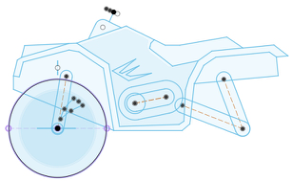
Case Study 1 - Ease of Work With a Single Sketch The first case study consisted of the modeling of an ATV. What was intended to be evaluated was the possibility of using a single sketch to model all the contours of the vehicle’s side view. Figure 1 shows the results with a single sketch. The dimensions were hidden to be able to visual- ize the different geometric entities. Only one tire was drawn, and sub- sequently, the mirror operation was used to copy the entity to the other positions of the four tires. To generate the details of the wheels, circular pattern operations were used. The different contours of the vehicle were extruded at different depths to achieve distinct thicknesses. Some contours were extruded, and material subtraction was carried out to obtain cavities or gaps.
Top-down modeling was used to generate all the components of the ATV. Later, other sketches were developed in the front and top view to create the headlights, bumper, markings on the tires, and the geometry of the handle- bars. Other operations, such as fillets, produced radius at the corners and edges.
Figure 1: Top-down modeling of the side view of the ATV using a single sketch.
Exploring a Software Application to Simulate Rigid Bodies 441
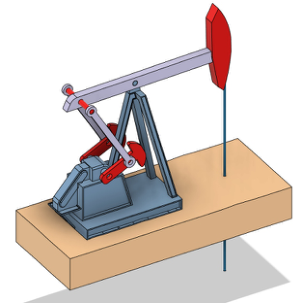
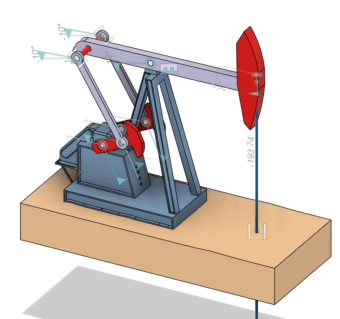
Case Study 2 - Assembly Constraints and Movement Simulation Generation Top-down modeling was also used for the second case study to implement the Rod lift system mechanism (see Figure 2). With this method, each component remains in the assembly position, and thanks to the As-Built-Joint option of Fusion 360, it is possible to define the assembly restrictions so that each component has the appropriate movement to represent the operation of the mechanism. The advantage of this option is that the parts do not move when defining the assembly constraints; only the components that intervene in the joint are selected, and the position of the degree of freedom is specified, either at the center, at a vertex, or the intersection of two geometric entities. With this option, it is not necessary to hide parts to select the precise location of the joint. Figure 3 shows the position of the different joints in the Rod lift system mechanism; these are revolute, cylindrical, slider, and rigid.
Figure 2: Rod lift system mechanism.Figure 3: Rod lift system mechanism with joints.
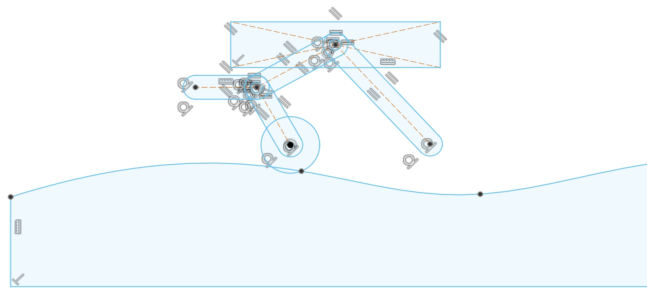
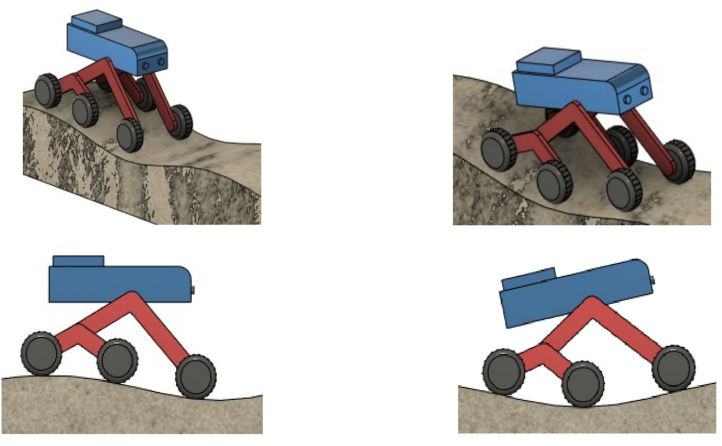
Case Study 3 - Consideration of Gravity Force and Contacts Between Solids The third case study required evaluating whether a vehicle could drive on undulating terrain and whether its structure or chassis could adapt to the terrain as it moved. For this reason, it was decided to model, in a simplified way, a vehicle with rocker-bogie suspension, like the one used in the rovers sent to Mars. Again, top-down modeling was used with a single sketch to create the side view (see Figure 4). In the sketch, it can be seen the symbols of the geometric restrictions of the different entities that form the contour of the solid bodies: coincidence, parallelism, and perpendicularity.
Figure 4: Single Sketch to model the vehicle’s side view with rocker-bogie suspension.
By requiring the vehicle’s suspension to adapt to the undulating road, it was necessary to use the representation of the effects of the force of gravity. Fusion 360 does not perform kinematics analysis, but it allows the definition of tangents between the surfaces of solids. Initially, the wheels and the road were modeled, and the tangents of the wheel surface with the undulating surface of the road were defined. On the other hand, so that the wheels did not overlap with the road, contacts between solids were enabled. The results are shown in Figure 5; it can be seen how the suspension adapts to the undulating road.
CONCLUSIONS AND FUTURE WORK Fusion 360 makes it easy to use a single sketch to generate all the details of a view and then be able to apply different extrusions or cuts at different depths.
An advantage of assembly constraints is that they are the same ones used to perform motion simulations. There are two methods to define assembly constraints: 1) Joint mode, used when the parts are not in the position of movement; they are separated, as the constraints are defined, the parts move to be assembled; 2) As-Built-Joint mode, when the parts are in the final assembly position, only the restrictions are defined so that the parts can move.
Fusion 360 allows the definition of tangency between solid surfaces and enables contact between solids so they do not overlap.
Exploring a Software Application to Simulate Rigid Bodies 443
Figure 5: Adaptation of the rocker-bogie suspension on the undulating road.
Suppose it is necessary to simulate the effects of the force of gravity in 360 fusion, such as the fall of objects. In that case, it is necessary to explore the alternative of using parametric design to evaluate the possibility of programming the behavior of objects through equations.
It is suggested to examine the creation of scripts to assess the possibility of creating equations that modify the graphic environment, the geometry of the solids, and the parameters of the different operations, such as circular or rectangular patterns.
To simulate automated manufacturing systems, it would also be nec- essary to investigate how to communicate through OPC with other tool applications, such as Matlab or TIA Portal.
ACKNOWLEDGMENT
The authors would like to acknowledge the financial support of Writing Lab, TecLabs, and Tecnologico de Monterrey, Mexico, in producing this work.
REFERENCES
Boldi, A., Rapp, A. (2023) ‘Making sense of the pandemic: Multiple functions of commercial video games during one year and a half of COVID-19 cri- sis’, International Journal of Human-Computer Studies, Volume 180, 103141. https://doi.org/10.1016/j.ijhcs.2023.103141 Chen, G., Peng, W., Wang, Z., Tu, J., Hu, H., Wang, D., Cheng, H., Zhu, L. (2023)
‘Modeling of swimming posture dynamics for a beaver-like robot’, Ocean Engi- neering, Volume 279, 114550. https://doi.org/10.1016/j.oceaneng.2023.114550
Chen, G., Wei, N., Li, J., Lu, H. (2022) ‘Design and simulation analysis of a bionic ostrich robot’, Journal of Biomechanics and Modeling in Mechanobiology, Volume 21, No.6, pp. 1781–1801. https://doi.org/10.1007/s10237-022-01619-9 Gao, Y., Chen, Q., Yuan, Q., Wang, Y.-H. (2023) ‘The kinematics and micro
mechanism of creep in sand based on DEM simulations’, Journal of Computers and Geotechnics, Volume 153, 105082. https://doi.org/10.1016/j.compgeo.2022. 105082 Gong, F., Wang, Z., Zhou, Y., Yang, L., Ueda, T. (2022) ‘Mesoscale simulation of frost damage to rock material based on Rigid Body Spring Method’, Journal of Cold Regions Science and Technology, Volume 201, 103621. https://doi.org/10. 1016/j.coldregions.2022.103621 Guzsvinecz, T., Sz˝ucs, J. (2023) ‘Length and sentiment analysis of reviews about top-
level video game genres on the steam platform’, Journal of Computers in Human Behavior, Volume 149, 107955. https://doi.org/10.1016/j.chb.2023.107955 Han, S., Liu, S., Ren, L. (2023) ‘Application of human–computer interaction virtual reality technology in urban cultural creative design’, Journal Scientific Reports, Volume 13, No. 1, 14352. https://doi.org/10.1038/s41598-023-41566-8 Ja´skiewicz, M., Frej, D., Matej, J., Chaba, R. (2021) ‘Analysis of the head of a sim-
ulation crash test dummy with speed motion’, Journal of Energies, Volume 14, No.5, 1476. https://doi.org/10.3390/en14051476 Kordyaka, B., Pumplun, L., Brunnhofer, M., Kruse, B., Laato, S. (2023) ‘Gender disparities in esports – An explanatory mixed-methods approach’, Journal of Computers in Human Behavior, Volume 149, 107956. https://doi.org/10.1016/ j.chb.2023.107956 Kyuchukov, I. (2023) ‘Two strategies in relative movements in the flight phase of
a horizontal bar dismount’, Journal Series on Biomechanics, Volume 37, No. 1, pp. 74–80. https://doi.org/10.7546/SB.10.01.2023 Loisel, J., Rouvier, T., Hybois, S., Bascou, J., Sauret, C. (2023) ‘Optimal Control Formulation for Manual Wheelchair Locomotion Simulations: Influence of Anteroposterior Stability’, Journal of biomechanical engineering, Volume 145, No. 11, 111012. https://0-doi-org.biblioteca-ils.tec.mx/10.1115/1.4063274 Lorenz, M., Hoffmann, A., Kaluschke, M.,... Zachmann, G., Bullinger, A. C. (2023)
‘Perceived realism of haptic rendering methods for bimanual high force tasks: original and replication study’, Scientific Reports, Volume 13, No. 1, 11230. https://doi.org/10.1038/s41598-023-38201-x Lucchi, E. (2023) ‘Digital twins for the automation of the heritage construction sector’, Journal of Automation in Construction, Volume 156, 105073. https://doi.org/10.1016/j.autcon.2023.105073 Ma, J., Han, J. (2023) ‘Value evaluation of human motion simulation based on speech
recognition control’, International Journal of System Assurance Engineering and Management, Volume 14, No. 2, pp. 796–806. https://doi.org/10.1007/s13198- 021-01584-z Michael, C., Pancaldi, F., Britton, S.,... Weisel, J. W., Alber, M. (2023) ‘Combined computational modeling and experimental study of the biomechanical mecha- nisms of platelet-driven contraction of fibrin clots’, Communications Biology, Volume 6, No. 1, 869. https://doi.org/10.1038/s42003-023-05240-z Miyakoshi, M. (2021) ‘Correcting whole-body motion capture data using rigid
body transformation’, European Journal of Neuroscience, Volume 54, No. 11, pp. 7946–7958. https://doi.org/10.1111/ejn.15531
Exploring a Software Application to Simulate Rigid Bodies 445
Morano-Okuno, H., Sandoval-Benitez, G., Caltenco-Castillo, R., Villagomez- Guerrero, L., Garcia-Moran E., Garcia-Garcia A. (2020) ‘An Alternative to Create Fast Conceptual Designs in Mechatronics Engineering’, International Confer- ence on Computation, Automation and Knowledge Management (ICCAKM), pp. 317–321. https://doi.org/10.1109/ICCAKM46823.2020.9051465. Nemati, A., Hashemkhani-Zolfani, S., Khazaelpour, P. (2023) ‘A novel gray FUCOM
method and its application for better video games experiences’, Journal of Expert Systems with Applications, Volume 234, 121041. https://doi.org/10.1016/j.eswa .2023.121041 Tatar, A. B., Tanyildizi, A. K., Tasar, B. (2023) ‘A Conceptual Design of Two DoF Crawler Tree Planting Robot with Helical Digging Arm’, Proceedings of 14th International Conference on Mechanical and Intelligent Manufacturing Technologies, pp. 8–11. https://doi.org/10.1109/ICMIMT59138.2023.10201123 Wang, Y., Zhao, P., Zhang, Z. (2023) ‘A deep learning approach using attention
mechanism and transfer learning for electromyographic hand gesture estimation’, Journal of Expert Systems with Applications, Volume 234, 121055. https://doi.or g/10.1016/j.eswa.2023.121055 Yang, F., Tan, X., Wang, Z., Lu, Z., He, T. (2022) ‘A Geometric Approach for Real- Time Forward Kinematics of the General Stewart Platform’, Journal of Sensors, Volume 22, No. 13, 4829. https://doi.org/10.3390/s22134829 Yang, Z., Jiang, H., Zou, L. (2020) ‘3D Conceptual Design Using Deep Learning’,
Advances in Intelligent Systems and Computing, 943, pp. 16–26. https://doi.org/ 10.1007/978-3-030-17795-9_2 Zhang, Z., Su, J., Li, X., Yang, W. (2021) ‘Product form innovation: a morphodynamic factors-driven approach’, International Journal of Arts and Technology, Volume 13, No. 3, pp. 228–254. https://doi.org/10.1504/IJART.2021.120764
LISTED IN THE AHFE DIGITAL BOOKSTORE CATALOGUE
Explore the complete digital volume
Human-Centered Design and User Experience
Read this individual research paper free through the original publisher, or explore the full digital proceedings book.
ISBN 978-1-958651-90-2
Explore this ISBN in the AHFE Bookstore ↗Listed in the July 2026 bookstore catalogue; search by ISBN to confirm current availability · Digital book purchase optional