Donovan Esqueda Merino, Oliver Gómez Meneses, Hector Rafael Morano Okuno, Ricardo Jaramillo Godinez, Daishi A Murano Labastida, María De Los Angeles Ramos Solano, David Higuera Rosales, Rafael Caltenco Castillo, Karla Rodríguez Gómez, Iván Díaz De León Rodríguez (2024). Prompt my prototype: NaiVE Framework for Artificial Intelligence use in Engineering Product Development. In: Artificial Intelligence and Social Computing. AHFE Open Access, vol. 122, pp. 156–166. https://doi.org/10.54941/ahfe1004652
Through this paper we present a framework aimed into helping educators to incorporate the Artificial Intelligence in their classes, particularly focused in Engineering Product Development. As students become more acquainted with the possibilities of Artificial Intelligence, it brings challenges in the way they learn, research and analyze the information supplied by the A.I. systems. This NaiVE framework puts emphasis in the students' use of their technical expertise and critical thinking by explicitly requesting to follow a set of steps that will guide them through obtaining the best out of the Artificial Intelligence outputs. The framework was validated with three different case studies including students from different engineering majors, seniorities and courses carrying out a 5-week project with an industrial partner: the first one being "Dynamical Design" for mechanical engineers in their sophomore year, who used generative design with Autodesk Fusion360 to propose new solutions for an All-Terrain Vehicle; the second one, "Mechatronic Design", was a course for Mechatronic Engineers in their junior year, who had to come up with an innovative proposal for warehouse logistics and provide a Product Requirements Document (PRD), some Product Design Specifications (PDS), and a prototype of their solution (for this, they were instructed in the correct use of ChatGPT and Teachable Machine); the third course, named "Technological Entrepreneurship", was an optative course for senior year undergraduate students of the robotic, mechatronic, mechanic, computer science, chemical, biotechnology, nanotechnology and data science majors working together with senior marketing students of a course in Analytics and Advanced Market Intelligence: the project consisted in developing a technological solution to raise brand awareness for a Civil Association amongst younger generations, and the use of Mid journey was the AI tool used to adapt the proposal to the aesthethics of the training partner and generate eye-catching results.
As students become more acquainted with the possibilities of Artificial Intel- ligence, it brings challenges in the way they learn, research and analyze the information supplied by the A.I. systems. For example, Shijing and Xiaoqing (2023) presented 8 different indicators in the teaching of Human- Centered A.I. in Education, including the misunderstanding of the concept, misuse of resources and mismatch of A.I. pedagogy, among others. Likewise, Huang et al. (2021) present specific challenges in applying A.I. on educa- tion, such as the necessity of ensuring fairness, paying attention to ethical and safety uses and the mastering of new digital teaching skills.
Existing research focuses a lot on applying technology to assist teaching, building smart campuses, and developing intelligent learning, teaching and
Prompt My Prototype: NaiVE Framework for Artificial Intelligence Use 157
management (Huang et al. 2021). However, frameworks are rather focused on the future producers of A.I. systems. For example, Langley (2019) presents a set of principles in order to build a framework that helps students under- stand A.I. as a cumulative set of developments, rather than as a collection of isolated algorithms. This includes presenting the interaction of mechanisms to produce intelligence, encoding representational content and the construc- tion of algorithms from simpler components. In a similar way, much of the existing literature focuses on the development of Artificial Intelligence (A.I.) curricula from K-12 level (Wong et al. 2020; Yang, 2022) to higher educa- tion (Ghnemat et al. 2022, Allen et al. 2021), including the development of platforms (Thongprasit & Wannapiroon, 2022; Cao et al. 2020).
However, professors from other disciplines are increasingly incorporating A.I. as consumers in their courses, which highlights the importance of having an adequate framework for making sure that students use it the right way. Besides, the use of embedded systems even makes it possible to combine A.I. with cobots or humanoid robots, as well as chatbots, to enable or improve instructional quality (Chen et al. 2020). This brings a whole set of possibilities that can be beneficial for the students if directed correctly.
Through this paper we present a framework aimed into helping educators to incorporate Artificial Intelligence in their classes, particularly focused in Engineering Product Development.
FRAMEWORK The proposed framework puts emphasis on the students’ use of their tech- nical expertise and critical thinking by explicitly requesting to follow a set of steps that will guide them through obtaining the best out of the Artificial Intelligence outputs. It follows a set of 5 steps that the educators can use to improve their teaching of product development and management with the assistance of Artificial Intelligence.
Narrow Down As expressed by Sellier et al. (2011), creativity can be boosted by constraining the problems. This is why the first step of the framework implies limiting the possibilities in the use of artificial intelligence in the classroom.
For this matter, it is important that the educator defines as clear as possible to the student:
The objective of the learning experience.
The best tool (i.e. generative, creativity, interactive, automation, predictive analytics, decision support, among others) that can help with the learning experience.
The context in which the student is doing the activity.
A guiding example or activity for the student to follow and learn the tool.
A basic explanation of the underlying technology.
Adapt Once the students have learned the basics of using the tool, it is important that they use their skills to correctly define the problem to solve. The adaptation
implies the formulation of the problem in a way in which they translate the context into the specific requirements of Artificial Intelligence. While the term “intelligence” might be misleading, they must understand that they must be clear about this problem definition since an ill-conditioned problem or the use of wrong data will definitely result in a bad output.
Implement The next step implies executing the order in the A.I. tool. The use of a guiding example in the Narrow Down step should be instructional enough for the students to advance. However, in order to promote some soft skills in the students, a good practice is to let them discover some additional functions on their own, whenever they get into a part of the problem that wasn’t solved in the leading example.
Validate This is one of the most important steps. As students obtain a result from the A.I., it is important that they make sure that it makes sense. Depending on the tool, this could be done for example by asking them to double check the infor- mation it has provided (i.e. in the case of AI language models) or confronting them to finding a machine that could build the resulting additive manufac- turing output of a generative design and to make a cost-benefit analysis in contrast with other ways of traditional manufacturing. After that, students should be instructed to make decisions, such as modifying the result to a sim- ilar one that can satisfy additional constraints not known by the Artificial Intelligence platform.
Externalize As a last step, students should be given the opportunity to discuss the results, along with the positive and negative implications in the use of the technology.
CASES AND RESULTS Dynamic Design
Dynamic Design is an 80-hour course for undergraduate mechanical engi- neers taught during the last 5 weeks of their sophomore year. This course presents some dynamic design key concepts, to later introduce design methodologies, computer-aided product validation and manufacturing form- ing processes.
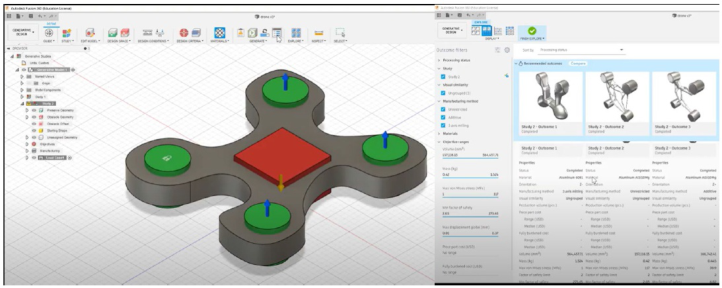
During the February-June 2021 semester, the course was taught to 22 stu- dents. Motorhub, an advanced mobility centre in Greater Mexico City, was chosen as training partner for the experience. Motorhub works with All- Terrain Vehicles (ATVs) and they wanted to understand the possibilities and limitations of using Generative Design to propose a new roll bar cage con- figuration, which would be adapted for an electrical powertrain. To this aim, students were taught the use of the CAD software Autodesk Fusion360. The module of Generative Design was explored to propose the chassis of a simple quadcopter, as presented in Figure 1.
Prompt My Prototype: NaiVE Framework for Artificial Intelligence Use 159
Figure 1: Generative design quadcopter exercise used to introduce the tool.
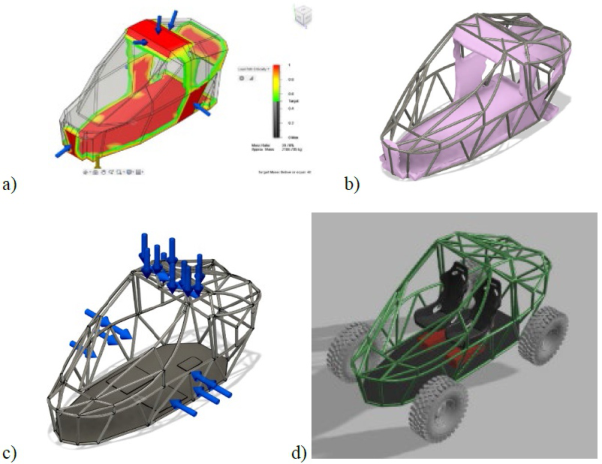
Throughout the 5 weeks, students were divided into teams of 5 people, each of them providing a different solution to the stated problem. Motorhub would provide information on the points of stress that these vehicles might have during the most common accidents. By using open-source generic infor- mation on ATVs, students would then generate an initial shape to begin the optimization process. After an initial solution was provided, students would use their engineering knowledge on design and manufacturing to propose a roll bar cage with tubular profiles similar to the generative design solution, which would be then validated by applying the forces that helped define the new solution (see Figure 2).
Figure 2: The process that students followed was: a) create a general shape that covers the initial design requirements for the optimization, b) based on the solution, gener- ate an alternative using tubular profiles, c) validate the new solution with the original forces and d) integrate other components to validate the spatial design. Pictures courtesy of Team 5.
On the last day of classes, Motorhub’s Engineers were invited to participate in the final evaluation, along with the professors who taught the class. Results from such evaluation are presented in Table I.
Table 1. Evaluation checklist where C means “complied”, PC means “partially complied” and DC means “Didn’t comply”.
Table available in the original PDF paper.
Checklist Criteria \ Team 1 2 3 4 5
C C C C C
The chosen components provided by Motorhub for an electric powertrain were used for dimensioning the solution.
C PC C C C
The roll bar cage has space for 1) The given electric motor, 2) the number of batteries required to activate that motor & 3) two seats In the proposal, the roll bar cage can withstand the forces C C C C C
C C C C C
The design was made using any of the 5 possible steel alloys defined by Motorhub
C C C DC C
The ATV supports the following additional loads: weight of the electrical motor, weight of the battery kit, weight of the seats, weight of the pilot and copilot, reactions to the suspension in the 4 wheels
C C C C C
The rollbar cage supports the following impact loads: a) top: 77,000 N; sides (top): 77,000 N; sides (bottom): 38,500 N The CAD model has adequate finishings and joints DC PC PC PC PC
C C C C C
The initial mass of the cage was compared against a commercial one
C C C C C
It was shown there was a methodological, ordered and logical sequence to solve the problem
As we can observe, most of the teams complied with the original design requirements provided by Motorhub, except for the aesthetic requirements, where none of the teams adequately complied.
Mechatronic Design Mechatronic Design is a 20-hour course offered yearly during the first 5 weeks of the junior year of the Mechatronics Engineering major. This course provides an understanding on design methodologies, as well as the tools to adequately identify a problem and provide a technological solution’s potential architecture.
In the 2023 edition, 38 students enrolled in the course. Divided in 12 teams, all of them were working towards the development of warehouse-oriented logistic solutions. Aware of the impact of Artificial Intelligence in Product Development and Management, we decided to use the proposed methodology for two different activities: first, by teaching the pros and cons of prompting with ChatGPT to generate information for a Product Design Specifications (PDS) and a Product Requirements Document (PRD); second, by showing
Prompt My Prototype: NaiVE Framework for Artificial Intelligence Use 161
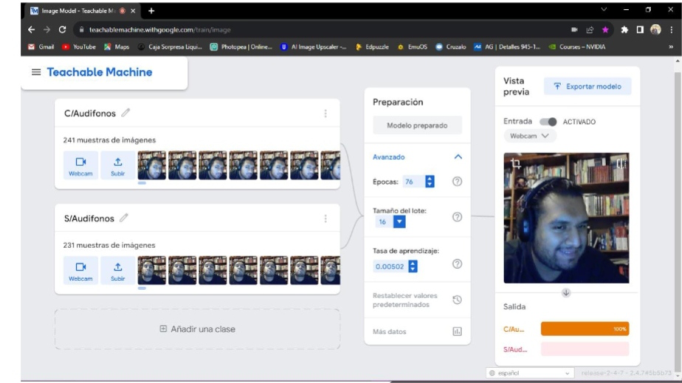
how Google’s Teachable Machine (see Figure 3) could be used for image recognition, followed by a discussion of the potential uses and limitations for human factors, supply chain and quality control.
Figure 3: Example of the use in the teachable machine by Prof. Ricardo Jaramillo.
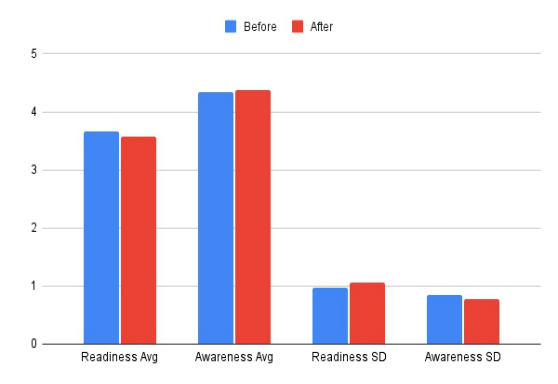
In this course, we decided to implement an entry and an exit survey, to evaluate student’s self-efficacy on the awareness and readiness in the imple- mentation of AI for product management. 35 out of 37 students participated in this survey, from which we can observe the following results in Figure 4.
Figure 4: Results on self-efficacy related to the questions: “I feel very qualified to use artificial intelligence optimally in topics oriented to product engineering” (readi- ness) and “I understand the limitations of artificial intelligence related to product engineering” (awareness).
As we can observe, the changes were slight, probably since it was just a small amount of time that was allocated to the activities. Nevertheless, we can see that while the readiness average diminished, the standard deviation increased, showing that the results were more scattered than before (and thus, students felt more confused about their readiness self-efficacy). On the other hand, the average in awareness grew slightly with a lower standard deviation, showing more confidence in the result obtained.
By looking closer at the results in the way they evaluated their readiness to implement the technology we identified three subgroups of very similar sizes: 10 felt less confident, 12 felt more confident, and the rest didn’t express any change in relation to how they felt in the entry survey. This is interest- ing because it might demonstrate that, even when the exercises were short, about two thirds of the students realized that they were not as ready as they thought: for some of them, the exercise could have given them more con- fidence while for others it might have given them more consciousness into what was required to adequately implement A.I. in Product Management.
Technological Entrepreneurship The third course in which this methodology was applied was in a yearly opta- tive named “Technological Entrepreneurship”. This course is offered at the beginning of the second half of the senior year for undergraduate students of different engineering majors: robotic, mechatronic, mechanical, computer science, chemical, biotechnology, nanotechnology and data science. In this 120 hour-course, students learn how to define a technological entrepreneur- ship from scratch (i.e. starting at the problem definition and until they pitch an adequate business model together with a virtual prototype).
In the 2023 edition of the course, 71 students enrolled. They would be working in solving the need of a reputed Civil Association that was reced- ing in brand awareness in the younger generations. These students would team up with an additional group of marketing students from the Analytics and Advanced Market Intelligence class, having the same time frames as the Technological Entrepreneurship course, to find a way assisted by technology in which the Civil Association could improve its brand awareness.
The project involved grouping the students together in 14 teams to provide scalable ideas that would help the non-profit reach wider audiences via digital and/or onsite activations. The proposals presented by the teams were data and function-oriented with no focus on human-centred, graphic, web, or user experience design.
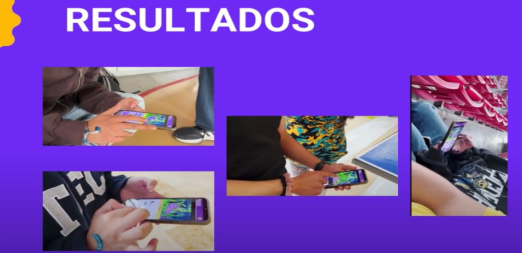
To this aim, professors introduced some basic Design concepts like the Gestalt Principles. Moreover, using the present methodology, they introduced an Artificial Intelligence tool called “Mid journey”during the user experience design module to help the students maximize time and generate eye-catching results that would be part of their prototype proposal. Figure 5 presents an example of a mock-up app they built for an A/B test after generating images with the help of Mid journey.
As part of their proposal to the Civil Association, the engineering students had to build a physical and/or virtual prototype for a marketing activation.
Prompt My Prototype: NaiVE Framework for Artificial Intelligence Use 163
Part of the requirements was to adapt the prototype to the Association’s cur- rent branding. For this, the students used Mid journey to generate ideas of how their solution might look like. The prototype would first be presented to high-school students in order to validate market awareness and engagement.
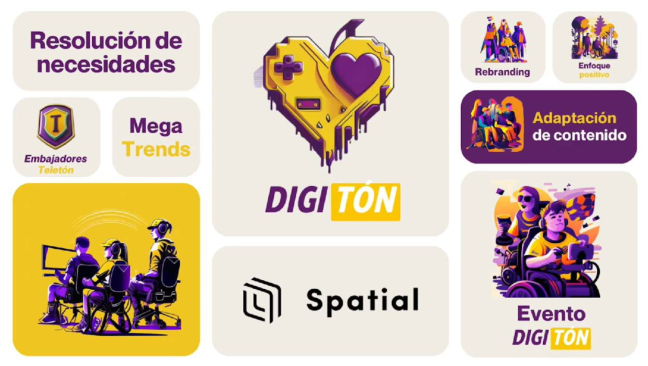
Figure 5: As a practice activity, students generated pictures with the help of Mid jour- ney to develop a mock-up app. Then, they would carry out an A/B test to see what was more interesting to other people.Figure 6: Example of project proposal for the civil association. In this case, the students made a videogame to raise brand awareness in a younger generation. Courtesy of team 2.
Mid journey was shown successful in solving the graphic and user expe- rience design issues, thus providing something more representative than a rough low-fidelity prototype. The results were then presented to both the non-profit partner who provided the challenge and the university’s business incubator, who were unaware of which tools or topics were seen in class, and evaluated the resulting proposals with different criteria. An example of a project’s proposal is presented in Figure 6. While there was no quantifiable analysis done for this project, the feedback from the Civil Association guests was very positive for most projects.
CONCLUSION
Through this paper we present a framework aimed at helping educators to incorporate Artificial Intelligence in their classes, particularly focused in Engineering Product Development. We present 3 study cases involving dif- ferent groups of engineering undergraduate students using a diverse set of A.I.-based tools to attain some of the classical activities that might arise in product development and management. In all cases, the use of A.I. was as consumers of technology and not as producers.
From the first case, we validated that students were able to adapt the needs of a company in order to make a new proposal of a roll bar cage for an All- Terrain Vehicle, based on the solution initially provided by a 3D Generative Design. For the company the results were satisfactory, even though students would forget to make the finishing details as requested.
In the second case we introduced a couple of well-known tools that could support both the documentation and the image processing for a logistics problem. While it was a real short course, it was enough to sensitize a major- ity of students on the challenges that arise with A.I.-based tools, and how they should be careful when implementing them.
Lastly, from the third case, we saw how students could power up in skills they don’t usually have, such as the ability to define adequate aesthetics that match with the needs of an existing brand. However, by teaching them adequately how to prompt at the tool, they were able to produce very nice proposals that gave a great lasting impression to the Civil Association.
ACKNOWLEDGMENT
The authors would like to acknowledge the financial support of Writing Lab, Institute for the Future of Education, Tecnologico de Monterrey, Mexico, in the production of this work. We would also like to thank all the students in the aforementioned courses for their amazing work that illustrated this research.
REFERENCES
Allen, B., McGough, A. S., & Devlin, M. (2021). Toward a framework for teaching artificial intelligence to a higher education audience. ACM Transactions on Computing Education (TOCE), 22(2), 1–29. Cao, W., Wang, Q., Sbeih, A., & Shibly, F. H. A. (2020). Artificial intelligence based
efficient smart learning framework for education platform. Inteligencia Artificial, 23(66), 112–123. Chen, L., Chen, P., & Lin, Z. (2020). Artificial intelligence in education: A review.
Ieee Access, 8, 75264–75278. Esqueda-Merino, D. M., Delgado-Cepeda, F. J., Morano-Okuno, H., & García, A.
(2019). Engineering product design education with a mixed design-thinking & lean start-up approach. In DS 95: Proceedings of the 21st International Confer- ence on Engineering and Product Design Education (E&PDE 2019), University of Strathclyde, Glasgow. 12th-13th September 2019.
Prompt My Prototype: NaiVE Framework for Artificial Intelligence Use 165
Esqueda-Merino, D., Gómez, O., Mondragón, D., Villagómez, L. E., & Morano-Okuno, H. (2022). Education in a Swipe: A User-Experience Framework for Designing Social Network Stories for Engineering Education. In Human Inter- action, Emerging Technologies and Future Systems V: Proceedings of the 5th Inter- national Virtual Conference on Human Interaction and Emerging Technologies, IHIET 2021, August 27-29, 2021 and the 6th IHIET: Future Systems (IHIET- FS 2021), October 28-30, 2021, France (pp. 676–683). Springer International Publishing. Esqueda-Merino, D. M., González-Sarmiento, G. A., Morano-Okuno, H. R., San Vicente-Cisneros, A. R., López-Rojas A. D. & Quintero-Fernández D. A. (2023). Developing Industry 4.0 Skills: A case study for Engineering students. Technological Advancements & Innovations of Future of Education: Select Pro- ceedings of FOE 2023, In press. Esqueda-Merino, D., Jaramillo-Godínez, R., Miranda-Mendoza, J., Contreras-Domínguez, D., FRACTAL methodology for Industry 4.0 & Society 5.0-Driven New Product Development: empowering engineering students for startup innovation (2024). 12th International Conference on Information and Education Technology. In press. Esqueda-Merino, D. M., Mondragon-Ugarte, D., Vargas-Olivares, A., Chong-Quero, J. E., & Herrera-Corral, J. A. (2023). Role: Role-Oriented Learning Environment: Innovative Educational Approach for Engineering Edu- cation. In Proceedings of the 2023 8th International Conference on Information and Education Innovations (pp. 55–61). Garcia-Moran, E., Esqueda, D., Solis-Cordova, J. D. J., Villagomez, L., Morano, H.,
& Ramírez, R. (2021). Industry 4.0 Competencies as the Core of Online Engineer- ing Laboratories. Design and Technology Education, 26(3), 30–51. Ghnemat, R., Shaout, A., & Al-Sowi, A. M. (2022). Higher Education Transformation for Artificial Intelligence Revolution: Transformation Framework. International Journal of Emerging Technologies in Learning, 17(19). Huang, J., Saleh, S., & Liu, Y. (2021). A review on artificial intelligence in education.
Academic Journal of Interdisciplinary Studies, 10(206). Langley, P. (2019). An integrative framework for artificial intelligence education. In Proceedings of the AAAI Conference on Artificial Intelligence (Vol. 33, No. 01, pp. 9670–9677). Miranda Mendoza, J., Esqueda Merino, D. M., & Ramírez Montoya, M. S. Edu-
cation 4.0 supporting remote, hybrid and Face-to-Face teaching-learning systems for academic continuity during the COVID-19 global pandemic. Miranda, J., Navarrete, C., Noguez, J., Molina-Espinosa, J. M., Ramírez-Montoya, M. S., Navarro-Tuch, S. A., Bustamante-Bello, M. R., Rosas-Fernández, J. B. & Molina, A. (2021). The core components of education 4.0 in higher education: Three case studies in engineering education. Computers & Electrical Engineering, 93, 107278. Sellier, A. L., & Dahl, D. W. (2011). Focus! Creative success is enjoyed through restricted choice. Journal of Marketing Research, 48(6), 996–1007. Shijin, L., & Xiaoqing, G. (2023). A Risk Framework for Human-centered Artificial
Intelligence in Education: Based on Literature Review and Delphi-AHP Method. Educational Technology & Society, 26(1), 187–202. Thongprasit, J., & Wannapiroon, P. (2022). Framework of Artificial Intelligence Learning Platform for Education. International Education Studies, 15(1), 76–86.
Wong, G. K., Ma, X., Dillenbourg, P., & Huan, J. (2020). Broadening artificial intelligence education in K-12: Where to start?. ACM Inroads, 11(1), 20–29. Yang, W. (2022). Artificial Intelligence education for young children: Why, what,
and how in curriculum design and implementation. Computers and Education: Artificial Intelligence, 3, 100061.
LISTED IN THE AHFE DIGITAL BOOKSTORE CATALOGUE
Explore the complete digital volume
Artificial Intelligence and Social Computing
Read this individual research paper free through the original publisher, or explore the full digital proceedings book.
ISBN 978-1-958651-98-8
Explore this ISBN in the AHFE Bookstore ↗Listed in the July 2026 bookstore catalogue; search by ISBN to confirm current availability · Digital book purchase optional