Francesca Tosi, Mattia Pistolesi, Claudia Becchimanzi (2024). Elderly and digital health technologies: the relationship between Gerontechnology and Design for active and healthy ageing. In: Human Factors in Aging and Special Needs. AHFE Open Access, vol. 133, pp. 51–60. https://doi.org/10.54941/ahfe1004893
The rise of new interactive, digital and connected objects is bringing about significant transformations in our world, generating new ways of living and new channels of access to communication. The healthcare sector is one of the sectors most affected by this digital revolution.Gerontechnology, a relatively recent field of research, studies the interaction between increasing longevity combined with a decreasing birth rate and the development of emerging healthcare technologies (Bouma et al., 2007; Chen, 2020).Therefore, from a theoretical point of view, digital health technologies (wearable devices, social media, robotics, smart devices, virtual technologies, etc.) can support successful ageing (van Bronswijk et al., 2009; Lee et al., 2020), but in practice, the results achieved do not live up to the expectations of elderly users, as the elderly population is less able to access new technologies as they are less open to innovation (Loges & Jung; 2001; van Dijk & Hacker, 2003; Manchester & Jarke, 2022).The EU's 2022 report (European Commission, 2022) on the Digital Economy and Society Index (DESI) places Italy 18th among the 27 EU Member States, which can be attributed to the relative lack of literacy of the Italian elderly population, although, compared to 2021, Italy gained two points (20th place). In order to limit the Grey Digital Divide, gerontechnology design in recent years has been influenced by the anthropocentric approach, a design approach that places the elderly within the design process (Baker et al., 2019; Vines et al., 2015; Wallace et al., 2020) considering them as a social resource and not as frail, sick and dependent. Design, and in particular the Human-Centred Design approach, can play a crucial role both in understanding the needs of the elderly population and in translating these needs into digital products that are more suitable and relevant to their purpose. For these reasons, in this article we introduce the first results of the research carried out by the Ergonomics and Design Lab. (LED) of the University of Florence within the research programme "Age-It Ageing well in an ageing society", an extended partnership financed within the PNRR (National Recovery and Resilience Plan, Funded by the Italian Government with the European funds Next Generation Eu Mission 4 "Education and Research" Component 2 "From Research to Enterprise"). The Age-It programme, in which 25 partners, including Universities and Research Centres, participate, is led by the University of Florence and consists of 10 spokes. LED researchers are involved in spoke 9, which aims to study advanced gerontechnologies for active and healthy ageing. The objective is therefore to reduce the digital divide between generations through the development of design guidelines that can help the elderly to use digital health technologies consciously and safely.The article will discuss the research questions, method, results and future developments.
The potential and opportunities offered by scientific progress and techno- logical innovation make it possible, on many levels, to address present and future challenges, including environmental crisis, global waste management, new pandemics, migration and, finally, the ageing and growing world popu- lation. According to the latest United Nations projections (2021), the world population could grow to around 8.5 billion in 2030, 9.7 billion in 2050 and reach 10 billion in 2100. As in the rest of the world and other European countries (EU, 2023), an ageing population is evident in Italy. Data show an increasing number of older adults in Italy, which may continue in the future (Istat, 2022a; Istat, 2022b), placing it among the countries with the most older adults in the world. While demographic trends differ among the world’s countries, population ageing and its well-known consequences are becoming more of a challenge in both developed and developing countries.
The digital revolution, which has as one of its direct consequences the proliferation of new interactive, digital and connected objects, is bringing about significant transformations in the world we live in, generating new ways of living and new channels of access to communication. The health and wellness sector is most affected by this change. There is, therefore, a shift from caring - to taking care. This gives rise to the need and demand for products and services that improve health conditions and thus promote active and healthy ageing.
The gerontechnology sector is gaining interest, showing potential in pro- moting the well-being of the older adults and facilitating active ageing. For these reasons, in this paper the authors describe the first results of the research project “Age-It Ageing well in an ageing society” funded within the frame- work of the National Recovery and Resilience Plan. The project aims to reduce the digital divide between generations by developing project guide- lines that can help older adults use digital health technologies consciously and safely.
THE ROLE OF GERONTECHNOLOGY IN SUPPORTING WELL-BEING AND HEALTH Gerontechnology is defined by Graafmans and Bouma (1993) as “the research and development of techniques and technological products, based on the knowledge of aging process, for the benefit of a prefereed living and work- ing environment and adapted medical care for the elderly”. It is a relatively recent field of research (Bouma et al., 2007; Chen, 2020) and is regarded as a response to an ageing population and the rapid advancement of technology (van Bronswijk et al., 2009).
There is no universally accepted classification of gerontechnology in the scientific literature. Halicka & Surel (2021) divide gerontechnology into nine domains: Health (i.e. products and services to monitor and care for human health and well-being), Education (i.e. products and services intended for education and learning), Interpersonal Communication (i.e. products and ser- vices to support communication between older adults); Safety (i.e. products and services for monitoring and security inside and outside the home), Mobil- ity (i.e. products and services for the mobility of older people such as aids and assistive technologies), Care (i.e. products and services for the care of older people such as social robots), Leisure Care (i.e. products and services for leisure), Housing (includes products and services for the safety of older people such as monitoring, detection, alarm and communication devices) and Digital Accessibility (includes highly digitised products and services such as smart- phones, tablets and wearables). At the same time, van Bronswijk et al. (2009) divide gerontechnology into four intervention domains: enrichment and sat- isfaction, prevention and engagement, compensation and substitution, care support, and care organisation. The four application domains combine with the five intervention domains of human activities, including health and self- esteem, housing and daily living, mobility and transport, communication and governance and work and leisure. Other authors (Peek et al., 2014; Haufe et al., 2019) categorise gerontechnology as assistive technologies intended
Elderly and Digital Health Technologies: The Relationship Between Gerontechnology 53
for the support of daily activities, facilitation of social ties, communication, mobility, personal health, physical and cognitive activity and finally, safety. Ultimately, gerontechnology encompasses the field of products and services applied to human beings, insofar as they aim to increase the quality of life in the most advanced segments.
Table 1. Classification of gerontechnologies on the basis of intended use.
Table available in the original PDF paper.
Purpose of the artefact
Author (s) (year of publication)
Domains of application and scope of gerontechnology
9 Domains of application
Halicka & Surel (2021)
1. Health 2. Education 3. Interpersonal communication 4. Safety 5. Mobility 6. Leisure 7. Care 8. Housing 9. Digital Accessibility 4 Domains of application
van Bronswijk et al. (2009)
1. Enrichment and satisfaction 2. Prevention and engagement 3. Compensation and substitution 4. Care support and care organiza- tion 6 Domains of application
Peek et al. (2014) Haufe et al. (2019)
1. Everyday activities 2. Facilitation of social ties 3. Communication 4. Mobility 5. Personal health 6. Physical and cognitive activity
TECHNOLOGY ACCEPTABILITY It is evident that gerontechnology can be a valuable tool to support active and healthy ageing. However, several studies highlight the problems of products and services developed for older people. Indeed, sometimes there is a lack of adaptation between the everyday life of older people, their needs and the available technologies (Greenhalgh et al., 2015; Sanders et al., 2012). In other cases, low product adoption rates by older people may be due to inefficient interface design, privacy or security concerns (Yusif et al., 2016) or economic or socio-cultural barriers (Wang et al., 2016). Many solutions are identified in the greater inclusion of older people and formal and/or informal caregivers in the design processes, e.g. through co-design sessions (Beringer et al., 2011), but also through an evaluation of such systems based on the age and real needs of the end-users (Pietrzak et al., 2014).
In fact, over the past two decades, gerontechnology design has been shaped in part by approaches such as the human-centred approach (Manchester &
Jarke, 2022), an approach to gerontechnology design that questions assump- tions about older adults and includes them in the design process, taking their daily lives and concerns seriously (Baker et al., 2019; Vines et al., 2015; Wal- lace et al., 2020). The acceptability of technology, especially for older adults, is currently a sensitive issue, the evaluation parameters of which offer many challenges to design research. The higher the level of acceptance, the more frequently a technology will be used. According to Richardson (1987), extrin- sic and intrinsic factors can determine acceptability. They are of two types: the characteristics of acceptable technologies, i.e. those identified by Rogers (2010) and the characteristics of accepting users. The latter, concerning the study by Alavi & Joachimsthaler (1992) are:
cognitive style (how individuals process and use information);
personality traits (people’s need for success, level of defensiveness, control and propensity to take risks);
demographic variables (age and education);
user-specific variables (training, experience and involvement).
Gray Digital Divide Accepting the thesis that gerontechnology can be crucial for an ageing society, the scientific literature focuses on the gap in digital access, skills and opportu- nities of older people, called the Gray Digital Divide. This concept highlights how older people have more significant difficulties interacting with digital technologies and the internet than younger people and identifies new chal- lenges to be addressed and solved in the near future to improve the health, well-being and social participation of older people in everyday life. The EU (European Commission, 2022) report on the digitisation of the economy and society (DESI) places Italy 18th among the 27 EU Member States (20th place in 2021), which can be attributed to the relative lack of literacy of Italian older adults.
Several authors (Manchester, Jake, 2022; Manchester, 2021; Peine et al., 2015; Wanka, Gallistl, 2018) suggest that technology designs for an ageing society have not lived up to expectations, and there are increasing calls for new approaches to technology design that do not view older people as neces- sarily vulnerable, in need of care or unskilled in the use of technology. These persistent negative images of the older adults stand in the way of profound changes being made to better design for older people. This is especially true for the design of digital technologies, tools and services, whose designers often have the misconception that older people are not, or have not been in the past, very technologically adept. However, Mitzner et al. (2010) do not point out that it is a misconception to think that the over-50s are technologi- cally challenged and disconnected, but rather, older consumers are tech-savvy and eager to learn more.
THE ROLE OF DESIGN IN SUPPORTING ACTIVE AND HEALTHY AGEING In order to limit the Grey Digital Divide and increase the access, skills and digital opportunities of older people, the design of gerontechnology in
Elderly and Digital Health Technologies: The Relationship Between Gerontechnology 55
recent years has been influenced by the anthropocentric approach, a design approach that places older people within the design process (Baker et al., 2019; Vines et al., 2015; Wallace et al., 2020) by considering them as a social resource and not as frail, sick and dependent. Design, and in partic- ular the Human-Centred Design (HCD) approach, can play a crucial role both in understanding the needs of the older adults population and in trans- lating these needs into digital products that are more suitable and relevant to their purpose. For example, the Tangible Memories project (Manchester, Jarke, 2022) aimed to investigate technology’s use, effectiveness, and accept- ability in care settings. The project team explored older adults residents’ relationships with specific wrist sensors and alarms and found that, although problematic for some, they helped others feel safe to be alone in their rooms and flats. Other interesting projects are Amulet Device (Batsis et al., 2018) and CloudIA (Tosi et al., 2021), wearable devices that monitor people’s health status, movement, and falls. The Emilia-Romagna region has carried out the specific Pane and Internet programme (www.paneeinternet.it) to help older adults use and master new technologies through digital skills training.
The ReMember-Me project (www.aal-europe.eu) was launched by eight partners in six European countries to develop a solution to detect and prevent cognitive decline at an early stage. The solution consists of a robot, on-screen games and sensors, which acquire real-time data on a person’s state by engag- ing the user in interesting brain training schemes customised according to their routines and preferences. Leage (Nap et al., 2014) is a digital game project that aims to help older adults improve their skills by exercising and expanding their knowledge of history, geography, nutrition and health issues through motivating exercises and memory training. The TrentinoSalute 4.0 project (Barbabella et al., 2022) aims at valorising physical activity to main- tain good health in old age, as well as a social and recreational opportunity, through implementing a geocaching App for group walks. Finally, robotics is a fast-growing field in which the discipline of design, and ergonomics in par- ticular, are contributing to the design of technologies capable of responding to the needs of older adults. In the near future, robots could perform many of the tasks currently performed by healthcare professionals, such as helping older adults get around. Robear is a nursing robot that can help older adults by lifting them from a bed to a wheelchair and supporting them while stand- ing (www.riken.jp). At the same time, the Care-O-bot (www.care-o-bot.de) robot can help older adults in their daily lives. This affordable care option has six models that can be configured according to available budget and needs.
AGE-IT RESEARCH PROJECT The authors of the article are involved in the research programme “Age-It Ageing well in ageing society”, an extended partnership funded within the framework of the National Recovery and Resilience Plan, more specifically in Spoke 9, whose overall objective is the study of advanced gerontechnolo- gies for active and healthy ageing. The objective is to reduce the digital divide between generations by developing design guidelines to help older adults consciously and safely use digital health technologies.
For these reasons, the research focuses on persons aged 55 and over who are residents in Italy. The age limit focuses on the Active Ageing Index (UNECE, 2012), an indicator the European Community promotes to assess and monitor the results of active ageing in a specific geographical context. As argued in the previous paragraphs, technologies such as the internet, medical devices, and smart devices can support active and healthy ageing.
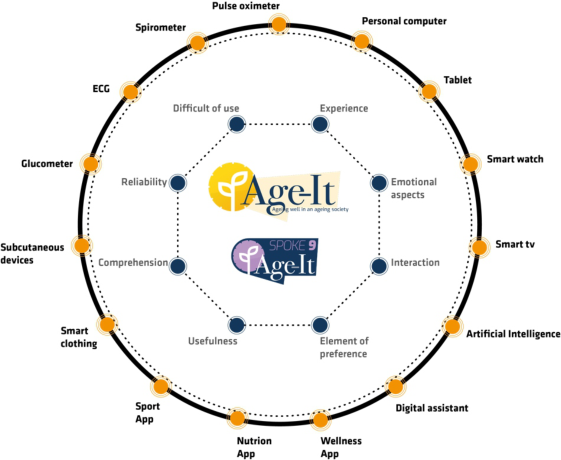
For the drafting of the guidelines, standard technologies will be consid- ered as the object of study, usable even without specific medical knowledge, suitable for the promotion and monitoring of the person’s state of health and well-being, including: personal computers, tablets, smartwatches, smart TVs, digital assistants (Google Home, Echo Dot Alexa, Home Pod, etc.), Artifi- cial intelligence (Siri, Cortana, etc.), well-being Apps, nutrition Apps, sports Apps, smart clothing, subcutaneous devices, glucometer, pulse oximeter, ECG and spirometer.
For each product, the following aspects will be assessed by applying HCD methods: experience, emotional aspects, interaction, element of preference, usefulness, comprehension, reliability and difficulty of use.
The emerging data will allow the research team to plan and draft design matrix guidelines in the coming months based on the analysis of extrinsic and intrinsic factors that may determine the acceptability of the technology from the end user’s point of view. Finally, the guidelines may support stakeholders (designers, engineers, R&D centres, SMEs, academies, and private and pub- lic institutions) during new healthcare technologies’ design and production phase.
Figure 1: Subject of study and areas of intervention of the research programme “Age-It Ageing well in ageing society”.
Elderly and Digital Health Technologies: The Relationship Between Gerontechnology 57
CONCLUSIONS AND FUTURE DEVELOPMENTS Scientific and technological progress has had and will impact people’s age- ing and longevity. This condition is confirmed by the literature review, as many currently developed health technologies (sensors, smart home, artifi- cial intelligence, smart products, Big Data, etc.) can have a twofold impact: (personal impact) they can be effective in the promotion, management and monitoring of a person’s state of health and wellbeing, especially for the older adult, thus promoting active and healthy ageing; (social impact) they can limit health care expenditures on national health services, as care, diagnosis and monitoring practices in the private home are favoured and opportuni- ties for involvement, inclusion and active participation in many spheres of the social sphere, such as the labour market, volunteering, social relations, lifelong education, leisure and hobbies are strengthened over time.
The scientific literature also highlights the generation gap, as the older adults population cannot access new health technologies. It, therefore, becomes necessary to design health technologies that are useful, usable and accessible to as many people as possible. In this regard, the discipline of Design, particularly the anthropocentric approach, in synergy with other scientific disciplines, allows designing for and with the end user through observation, empathy and active listening.
For these reasons, the research programme foresees, in the near future, the realisation of specific research activities, including: (phase 1) literature review (concluded); (phase 2) exploratory questionnaire with a national approach (ongoing); (phase 3) codesign sessions with a sample of residents in Tuscany; (phase 4) drafting of the guidelines; finally, (phase 5) dissemination of the results achieved.
AUTHOR CONTRIBUTIONS Scientific director of the research F.T.; Research planning M.P. and C.B.; All authors contributed to the draft and accepted the published version of the manuscript.
FUNDING Research was pursued within the Age-It Ageing well in an ageing society project (European Union NextGeneration EU, Ministreo dell’Università e della Ricerca, CUP B83C22004800006).
REFERENCES
AAL Europe (http://www.aal-europe.eu/projects/remember-me/). Alavi, M., Joachimsthaler, E. A. (1992) ‘Revisiting DSS implementation research: A meta-analysis of the literature and suggestions for researchers’. Mis Quarterly, pp. 95–116. Baker, S., Waycott, J., Carrasco, R., Hoang, T., Vetere, F. (2019) ‘Exploring the
design of social VR experiences with older adults’, Proceedings of the 2019 on Designing Interactive Systems Conference, San Diego CA, pp. 303–315. https: //doi:10.1145/3322276.3322361
Barbabella F., Cela E, Socci M., Lucantoni D., Zannella M. & Principi A. (2022) ‘Active Ageing in Italy: A Systematic Review of National and Regional Poli- cies’ Int. J. Environ. Res. PublicHealth, 19 (600). https://doi.org/10.3390/ijerph 19010600 Batsis J. A., Zagaria, A., Kotz, D. F., Bartels, S. J., Boateng, G. G., Proctor, P. O.,
Halter, R. J., Carpenter-Song, E. A. (2018), ‘Usability evaluation for the Amulet Wearable Device in rural older adults with obesity’, Gerontechnology, 17(3), pp. 151–159. https://doi: 10.4017/ gt.2018.17.3.003.00 Beringer, R., Sixsmith, A., Campo, M., Brown, J., McCloskey, R. (2011) ‘The “acceptance” of ambient assisted living: Developing an alternate methodology to this limited research lens’, International Conference on Smart Homes and Health Telematics, Berlin: Springer, pp. 161–167. http://dx.doi.org/10.1007/978-3-642- 21535-3_21 Bouma, H., Fozard, J. L., Bouwhuis, D. G., Taipale, V. (2007) ‘Gerontechnology in
perspective’, Gerontechnology, 6(4), pp. 190–216. Care-O-Bot 4 (https://www.care-o-bot.de/en/care-o-bot-4.html). Chen, L-K. (2020) ‘Gerontechnology and artificial intelligence: Better care for older people’, Archives of Gerontology and Geriatrics, 91, 104252. https://doi.org/10.1016/j.archger.2020.104252. European Commission, 2023, Digital Economy and Society Index (DESI) 2022, thematic chapters. Bruxelles: European Commission. Available at: https://digital-stra tegy.ec.europa.eu/it/policies/desi. European Union, Eurostat (2023) Key figures on the EU in the world, 2023 edition.
Publication Office of the European Union, Luxemburg. Available at: https://ec.e uropa.eu/eurostat/web/main/publications Graafmans, J. A., Bouma, H. (1993) ‘Gerontechnology, Fitting Task and Environment to the Elderly’, Proceedings of the Human Factors and Ergonomics Society Annual Meeting, 37, pp. 182–186. Greenhalgh, T., Procter, R., Wherton, J., Sugarhood, P., Hinder, S., Rouncefield, M.
(2015) ‘What is quality in assisted living technology? The ARCHIE framework for effective telehealth and telecare services’. BMC medicine, 13(91). https://doi. org/10.1186/s12916-015-0279-6 Halicka, K., Surel, D. (2021) ‘Gerontechnology — new opportunities in the service of older adults’, Engineering Management in Production and Services, 13(3), pp. 114–126. https://doi: 10.2478/emj-2021-0025 Haufe, M., Peek, S. T. M. & Luijkx, K. G. (2019) ‘Matching gerontechnologies to
independent-living seniors’ individual needs: development of the GTM tool’, BMC Health Serv Res, 19(26). https://doi.org/10.1186/s12913-018-3848-5 ISTAT (2022a) Storia demografica dell’Italia dall’Unità a oggi. Roma: Istituto nazionale di statistica. ISTAT (2022b) Annuario Statistico Italiano 2022, Roma: Istituto nazionale di
statistica. Manchester H., Jarke J. (2022) ‘Considering the role of material gerontology in reimaging technology design for ageing populations’, International Journal of Ageing and Later Life, 15(2), pp. 181–213. https://doi: 10.3384/ijal.1652– 8670.3531 Manchester, H. (2021) ‘Co-designing technologies for care: Spaces of co-habitation’.
In A. Peine, B. Marshall, L. Neven & W. Martin (eds.), Interdisciplinary Critical Studies of Age and Technology, pp. 213–228. Routledge: London.
Elderly and Digital Health Technologies: The Relationship Between Gerontechnology 59
Mitzner T. L., Boron J. B., Fausset C. B., Adams A. E., Charness N., Czaja S. J., Dijkstra K., Fisk A. D., Rogers W. A., Sharit J. (2010), ‘Older Adults Talk Technology: Technology Usage and Attitudes’, Comput Human Behav, 26(6), pp. 1710–1721. https://doi: 10.1016/j.chb.2010.06.020. Nap, H. H., Diaz-Orueta, U., Gonza’lez, M. F., Lozar-Man- freda, K., Facal, D.,
Dolnicar, V., Oyarzun, D., Ranga, M. M., de Schutter, B. (2014) ‘Older people’s perceptions and experiences of a digital learning game’, Gerontechnology, 13(3), pp. 322–331. https://doi: 10.4017/ gt.2015.13.3.002.00. Pane e internet (https://www.paneeinternet.it). Peek, S. T. M., Wouters, E. J. M., van Hoof, J., Luijkx, K. G., Boeije, H. R., Vrijhoef, H. J. M. (2014) ‘Factors influencing acceptance of technology for aging in place: a systematic review’, Int J Med Inform, 83, pp. 235–48. https://doi.org/10.1016/ j.ijmedinf.2014.01.004 Peine, A., Faulkner, A., Jaeger, B. Moors, E. (2015) ‘Science, technology and the
“grand challenge” of ageing – Understanding the socio-material constitution of later life’, Technological Forecasting & Social Change, 93, pp. 1–9. https://doi: 10.1016/j.techfore.2014.11.010 Pietrzak, E., Cotea, C., Pullman, S. (2014) ‘Does smart home technology prevent falls in community-dwelling older adults: a literature review’, Journal of Innovation in Health Informatics, 21(3), pp. 105–112. https://doi.org/10.14236/jhi.v21i3.64 Richardson, S. (1987), ‘Operationalising usability and acceptability-a method-
ological review’, New methods in applied ergonomics. New York: Taylor & Francis. Riken (https://www.riken.jp/en/news_pubs/research_news/pr/2015/20150223_2/). Rogers, E. M. (2010) Diffusion of innovations. New York: Simon and Schuster. Sanders, C., Rogers, A., Bowen, R., Bower, P., Hirani, S., Cartwright, M., Fitzpatrick, R., Knapp, M., Barlow, J., Hendy, J., Chrysanthaki, T., Bardsley, M., Newman, S. P. (2012). ‘Exploring barriers to participation and adoption of telehealth and telecare within the Whole System Demonstrator trial: a qualitative study’, BMC health services research, 12(220). https://doi.org/10.1186/1472-6963-12-220 Tosi, F., Cavallo, F., Pistolesi, M., Fiorini, L., Rovini, E., Becchimanzi, C. (2021).
‘Designing Smart Ring for the Health of the Elderly: The CloudIA Project’, Pro- ceedings of the 21st Congress of the International Ergonomics Association (IEA 2021). IEA 2021. Lecture Notes in Networks and Systems, 220. Cham: Springer. https://doi.org/10.1007/978-3-030-74605-6_48 United Nations Economic Commission for Europe (2012) Fact sheet on active ageing. Geneva: UNECE. Available at: http://www.unece.org/fileadmin/DAM/pa u/age/Ministerial_Conference_Vienna/Documents/Active_Ageing_Fact_Sheet_fin al__1_.pdf. United Nations, Department of Economic and Social Affairs, Population Division
(2021) Global Population Growth and Sustainable Development. New York: United Nation. Available at: https://www.un.org/development/desa/pd/content/g lobal-population-growth. van Bronswijk, J. E. M. H., Bouma, H., Fozard, J. L., Kearns, W. D., Davison, G. C., & Tuan, P-C. (2009) ‘Defining gerontechnology for R&D purposes’, Gerontechnology, 8(1), pp. 3–10. https://doi: 10.4017/gt.2009.08.01.002.00 Vines, J., Pritchard, G., Wright, P., Olivier, P., Brittain, K. (2015), ‘An age-old prob-
lem: Examining the discourses of ageing in HCI and strategies for future research’, ACM Transactions on Computer-Human Interaction (TOCHI) 22(1), pp. 1–27. https://doi.org/10.1145/2696867
Wallace, J., Duncan, T., Lawson, S., Trueman, J., Montague, K., Carvalho, L., Groot, L., Craig, C., Fisher, H., Koulidou, N. (2020) ‘Design research to support ongoingness’, Bereavement Care 39(2), pp. 88–92. https://doi: 10.1080/02682621.2020.1771969 Wang, J., Carroll, D., Peck, M., Myneni, S., Gong, Y. (2016) ‘Mobile and wear-
able technology needs for aging in place: perspectives from older adults and their caregivers and providers’, Stud Health Technol Inform, 225, pp. 486–490. Wanka, A., Gallistl, V. (2018), ‘Doing age in a digitized world – A material praxeology of aging with technology’, Frontiers in Sociology, 3(6). https://doi: 10.3389/fsoc.2018.00006 Yusif, S., Soar, J., Hafeez-Baig, A. (2016) ‘Older people, assistive technologies, and
the barriers to adoption: A systematic review’, International journal of medical informatics, 94, pp. 112–116. https://doi.org/10.1016/j.ijmedinf.2016.07.004
LISTED IN THE AHFE DIGITAL BOOKSTORE CATALOGUE
Explore the complete digital volume
Human Factors in Aging and Special Needs
Read this individual research paper free through the original publisher, or explore the full digital proceedings book.
ISBN 978-1-964867-09-0
Explore this ISBN in the AHFE Bookstore ↗Listed in the July 2026 bookstore catalogue; search by ISBN to confirm current availability · Digital book purchase optional