Claudia Becchimanzi, Francesca Tosi (2023). Design and Acceptability of Technology: introduction to "Robotics and Design - The tool to design Human-Centered Assistive Robotics". In: Human Factors in Robots, Drones and Unmanned Systems. AHFE Open Access, vol. 93, pp. 94–109. https://doi.org/10.54941/ahfe1003752
Assistive robotics is making significant progress in a wide variety of areas and will play a key role in the coming years as part of strategies for Ageing in Place and Active and Healthy Aging. Despite the demonstrated potential of technology to support the care of elderly and frail people, some elements still limit its application, such as the technology acceptability issue. The acceptability of technology, in particular for elderly and frail users, is a delicate issue, whose assessment metrics offer many opportunities for design research: in fact, the interaction that users establish with assistive technologies defines the very experience of aging (Forlizzi et al., 2004).The complexity of Human-Robot Interaction requires multidisciplinary collaboration that includes engineers, designers, health and social service associations and cooperatives, caregivers, economists, sociologists, lawyers, psychologists, therapists, and even end users such as the elderly and their families. In an effort to design for acceptability, it is therefore essential to make effective interdisciplinary cooperation among all professionals involved in the development of robotic systems. However, despite the common background in Human-Computer Interaction (HCI), the scientific and methodological approaches of Human-Robot Interaction (HRI) and Human-Centred Design (HCD) are significantly different in methods, philosophy and structure.The presented research is based on a general hypothesis: the HCD approach, if applied to the preliminary design phases of assistive robots, could lead to a deep understanding of needs, expectations and desires of people. Designers can use many methods (interviews, focus groups, ethnography, etc.) to explore people’s emotions and other abstract feelings that cannot be investigated through quantitative tools and statistical data. An appropriate knowledge of the user, of the context in which the interaction takes place and of the activities to be performed, could increase the attitude and intention of people to use assistive robots. This process would be even more effective if the designer knew the variables of acceptance in the HRI field. Designers often work within a multidisciplinary team composed of engineers, computer scientists, psychologists, sociologists, etc. Designers are catalysts for different professional skills involved in the project: consequently, they should also know the evaluation methods and intervention strategies in the field of HRI. This would lead designers to have a broader view on design processes and to recognize the most important variables of acceptability in robotics.On this basis, the tool "Robotics & Design: the tool to design Human-Centered Assistive Robotics," online at www.roboticsdesign.org, was developed. This tool, presented in this paper, has two main goals:- design purpose: to support the development of a cross-disciplinary collaborative process, to excerpt design patterns (Preece, 2015) from the results of scientific trials as they can be used by other designers according to users' features, activities, and contexts of use and then be translated into tangible design solutions;- theoretical and scientific purpose: to develop a methodological bridge between the HCD and HRI fields; and to provide designers and researchers in design with tools for agile consultation of the main methodologies and variables of acceptability in robotics and their intercorrelation.
Assistive robotics is making significant progress in a wide variety of areas and will play a key role in the coming years in strategies for Ageing in Place and Active and Healthy Aging. Despite the clear potential of technology to support healthy and active aging and the care of frail people, there are some elements that limit its application, such as the issue of acceptability of tech- nology. The acceptability of technology, especially for elderly and frail users, is a sensitive issue, whose evaluation metrics offer many opportunities for design research: in fact, the interaction that users establish with assistive technologies defines the very experience of aging (Forlizzi et al., 2004).
The complexity of Human-Robot Interaction requires multidisciplinary collaboration that includes engineers, designers, social and health service associations and cooperatives, caregivers, economists, sociologists, lawyers, psychologists, therapists, and even end users such as the elderly and families.
Therefore, with the aim of designing for acceptability, it is essential to make effective interdisciplinary cooperation among all professionals invo- lved in the development of robots. In fact, despite the shared background in Human-Computer Interaction (HCI), the scientific and methodologi- cal approaches of Human-Robot Interaction (HRI) and Human-Centered Design (HCD) are significantly different in methods, philosophy, and stru- cture. The methods of HCD mainly are about user needs analysis, focusing on experiences, expectations, desires but also on iterative evaluation of usability and quality of use of products/systems (Tosi, 2020). Instead, HRI methods allow for the evaluation of several factors after the project is completed (e.g., De Ruyter 2005; Looije et al., 2006; Heerink, 2010), often leaving out the iterative process that underlies a Human-Centred approach. In fact, HRI deals with the research on acceptability in relation to the physical and psychological characteristics of users and do not often include other factors such as organizational, legal, ethical, political, or emotional (Veruggio et al., 2016): this has the consequence of not putting human needs at the center of the design of robotic technologies that, instead, should satisfy users from multiple sides. HRI’s specific evaluation methods do not take into account all of the factors that contribute to define the complexity of Human-Robot Interaction. Moreover, there are few studies in robotics that have integra- ted qualitative and quantitative methods, similar to those provided by the HCD approach, such as those by Dautenhahn et al., (2013), Moshkina & Arkin, (2005), Multu et al., (2006), Kulic & Croft, (2007). However, the widespread use of social and assistive robots and the increasing comple- xity of Human-Robot Interaction highlight the importance of understanding users’ needs from the early stages of robot development (Krägeloh et al., 2019). From these statements emerges the contribution of HCD for the deve- lopment of robotic technologies based on usability, effective and intuitive interaction, absence of stigma, reliability and safety in order to ensure a positive user experience both from the hedonic and functional point of view. For this purpose, therefore, there is an urgent need to structure a scientific and methodological bridge between the areas of HCD and HRI.
METHODOLOGY AND GENERAL HYPOTESIS This research is grounded in the scientific disciplines of Ergonomics for Design and HCD. Indeed, through the theoretical and methodological tools of HCD, User Experience (UX) and Interaction Design (ID) (Preece et al., 2015; Benyon, 2014; Hassenzahl, 2013) the designer can play a key role for the development of robotics acceptability and for the conversion of user needs into tangible design solutions.
The Human-Centered Design approach, if applied to the preliminary design phases of assistive robots, could lead to a deep understanding of needs, beliefs, expectations and desires of people. Users involvement during the pre- liminary design phases makes the designer empathize with them. Designers can use many methods (interviews, focus groups, ethnography, observation,
96 Becchimanzi and Tosi
etc.) to explore people’s emotions, fears and other abstract feelings that cannot be investigated through quantitative tools and statistical data. An appropriate knowledge of the user, of the context in which the interaction takes place and of the activities to be performed, could increase the atti- tude and intention of people to use assistive robots. This process would be even more effective if the designer knew the variables of acceptance in the Human-Robot Interaction field. The designers almost always work within a multidisciplinary team composed of engineers, computer scientists, psycholo- gists, sociologists, etc. Designers are catalysts for different professional skills involved in the project: consequently, they should also know the evaluation methods and intervention strategies in the field of HRI. This would lead desi- gners to have a broader view on design processes and to recognize the most important acceptance variables, in relation to users, activities, contexts and type of interaction.
In this context, HCD’s contribution to robotics concerns both research and design, especially in terms of methodological approach: so the designer has a key role not only as a professional who can identify people’s needs and translate them into tangible solutions but also as one who is ethically and socially responsible for the use and dissemination of technologies desi- gned as a support and not as a replacement for human work and interaction. This research is based on a general hypothesis: the application of the HCD approach in the field of assistive and social robotics is essential for designing the acceptability of technologies. Moreover, the design of robot acceptability is based on different factors for engineers and designers. So, for designers, it would be strategic to have a tool for learning about acceptability vari- ables in HRI and for turning them into concepts such as morphological, behavioral, or interaction properties of robots, that are useful for design purposes.
THE SCIENTIFIC FRAMEWORK OF THE “ROBOTICS & DESIGN” TOOL Preliminary Analysis of Related Online Platforms
Preliminary analysis of related platforms was conducted in order to assess their overall quality and identify their strengths and critical issues for impro- vement, in order to define the design brief of the tool to be developed. The research and evaluation procedure consisted of two stages:
Identification of platforms/websites: during this phase, ten websites were identified that were potentially similar in purpose and/or architecture, goals, and target users to those of the platform to be developed. A descri- ption of each site was then developed indicating its target audience, scope and purpose. The sites were then grouped according to their functionality and structure. Finally, of the initial ten, six representative websites were selected, both from the point of view of theoretical-scientific and metho- dological approach in the field of design and robotics and from the point of view of design support and data collection/consultation;
Design and Acceptability of Technology 97
Overall quality assessment: this was conducted according to three main dimensions (Rocha, 2012) namely Quality of content, Quality of service and Technical quality.
The six websites analyzed are described below, divided according to the category they represent. Regarding platforms for training or consultin- g/service purposes in the area of design and supporting the application of methods (HCD, UX, Design Thinking, etc.), four most representative sites were analyzed:
Nielsen-Norman Group: it aims to improve the everyday experience of using technology. The platform offers consulting services in the form of project evaluation, team training and seminars. It also allows users to con- sult books and reports as well as attend events and conferences. Finally, it presents an extensive section of articles related to topics of interest such as user analysis or evaluation methodologies, UX mapping methods, or other information in the field of UX, Interaction Design, and design rese- arch. The latter section constitutes the most representative and interesting for the platform to be developed;
Interaction Design Foundation: it represents the largest open source library of literature in the field of UX and design, as well as having edu- cational purposes with dedicated courses and seminars. The section of greatest interest is in literature related to research and evaluation methods and tools;
IDEO Design Kit: a platform where you can browse the contents of the HCD Toolkit, a book for learning Human-Centered Design and getting practical tips on applying methods and tools peculiar to the HCD appro- ach in any context. The strength of the platform is the clear breakdown of methods for each stage of the design process and the ability to save favo- rite tools. Finally, the platform allows users to download worksheets and templates for each method;
Open Design Kit: is an open source repository of methods and best practi- ces for designing. The site, as well as providing practical information for each design method (broken down by the stages of the process in which they should be used) allows for downloads of templates and worksheets. The strength is the open source approach, which is also possible thanks to the Github profile.
As for platforms for the purpose of practical design support and data collection and consultation, two most representative sites were analyzed:
Design Sprint Kit: an open source resource for designers, developers or anyone who wants to run a Design Sprint (a design methodology develo- ped by Google Ventures). The website allows people to learn the method, plan its application and contribute by sharing their own original method or protocols for applying them. The latter is definitely the greatest strength of the platform, as it allows researchers and designers to communicate and share experiences and tools, also increasing the scientific-application content of the site;
ABOT: the Anthropomorphic roBOT database is a collection of anthropo- morphic robots created for research or commercial purposes. Currently,
98 Becchimanzi and Tosi
the collection includes more than 250 robots. The site is an interesting methodological tool for researchers and designers studying the psycholo- gical impact of anthropomorphism in robotics or designing such robots. The database allows users to browse and score anthropomorphism for new or existing robots, compare research results in which different robot models have been used, use images of standard robots as stimuli for rese- arch, and identify important factors that make a robot appear physically human.
The research clearly shows some limitations of the analyzed platforms, namely, (1) although they provide design and scientific methods and tools related to HCD, Interaction Design and User Experience, they do not pro- vide scientific approaches or tools to support cross-disciplinary collaboration for the development of robotic systems; (2) the tools and methods offered by the platforms only address one field (Design only or HRI only) but none of the platforms attempt to integrate the two areas; and (3) the platforms provide interesting theoretical content related to design but lack practical and customizable translation to design. Based on these considerations, the requi- rements of the tool presented in this paper were identified in order to fill the gaps in the existing platforms and implement cross-disciplinary collaboration and synergy of the tools offered by HCD and HRI.
Design Purposes and Target Audience of the Tool The purposes at the base of the development of the tool presented in this paper concerns the need for designers to use a scientific tool, method or approach to (1) find a scientific correspondence between the target users and the features of assistive and social robots tested in the literature; (2) extra- polate from this match the basic requirements for the design brief of a new robotic platform; (3) know and understand the relationships among the most important acceptability variables according to scientific experiments in HRI; (4) know the dimensions of acceptability and their evaluation through HRI’s specific methods; (5) identify the design requirements that may influence one or more of the acceptability variables; (6) apply a scientifically shared proto- col to translate the acceptability variables into design solutions; and (7) apply a scientifically shared rationale for structuring a cross-disciplinary collabo- rative process that effectively integrates the experience and design methods specific to HCD and HRI fields. From an operational point of view, moreo- ver, the hypotheses include the design of the architecture of the tool (8) based on an interactive database that, according to users, context and activities of the robot can provide specific guidelines for design or methods; (9) as a plat- form that can be implemented according to the open source approach, which allows the database to be expanded and constantly updated thanks to contri- butions from researchers around the world who can input their own research data and consult those of others.
From the design purposes, it appears the two-fold aim of the tool: on the one hand, the purely project-related one, intended to structure a process of cross-disciplinary collaboration, to extrapolate from the results of scienti- fic experiments design patterns (Alexander, 1977; Preece, 2015) that can be
Design and Acceptability of Technology 99
applied by other designers based on the features of users, activities and con- texts and then to translate them into tangible design solutions; on the other hand, the more theoretical-scientific one, whose purpose is to structure a methodological bridge between the disciplines of HCD and HRI, to provide designers with tools for agile consultation of the main methodologies and variables of acceptability in HRI and their interrelation, allowing an imme- diate connection between the scientific theories underlying the same variables and the design requirements that may influence them.
In terms of the platform’s target audience, the primary users are mainly designers, planners, and researchers in design and/or robotics and HRI. Thus, the tool is intended for both research institutions and organizations (mainly in the areas of design/engineering and engineering/robotics), companies ope- rating in areas related or collateral to robotics (and all areas in which it finds application), and freelancers/design firms in these areas. The areas of HRI and HCD are extremely multidisciplinary and involve collaboration among a variety of professionals: for this reason, the tool is also intended for those who are identified here as secondary users, i.e., researchers, professionals and companies working in fields such as sociology, psychology, medicine, anth- ropology, philosophy, etc. whose expertise is an essential part of teams in robotics and design.
Objectives, Development and Prototyping: The Two-Fold Theoretical-Methodological and Design Role of the Platform In order to meet the purposes described above, a number of theoretical-design goals have been identified. From a theoretical-scientific perspective, the obje- ctives of the tool are: (1) allow the user to immediately define the type of interaction and information required, i.e., to choose whether to consult scien- tific and methodological information or more technical/design information; (2) to structure the platform in such a way that the information and con- tent is adapted to the user profile, activities, and contexts involved. From a theoretical point of view, the tool offers customized content to structure a collaborative process based on the skills of the multidisciplinary team invo- lved and the project to be completed; (3) to design an architecture system that makes it easy to understand the relationships between HCD and HRI approaches and methods, that allows for immediate identification of possible relationships between methods in the two domains, and that emphasizes the importance of applying an iterative process to design in robotics; (4) to highli- ght the strong scientific and experimental component of the tool (5) to design an architecture that makes it easy to consult the main acceptability variables and their inter-relations; (6) to design an architecture that allows for agile consultation of user personas, acceptability variables, and their corresponde- nces, with the aim of suggesting a design-theoretic methodology applicable to different users, contexts, and activities.
The aims for developing the tool are (1) to design an interface that allows the user to identify the most appropriate HCD and/or HRI method for the specific project to be completed; (2) to design an architecture that allows the user to select the reference user archetype for their project, based on the
100 Becchimanzi and Tosi
scientific data, and to consult the relevant user personas; (3) to design an arch- itecture that allows for the selection of the social and assistive robots tested in the literature that are most acceptable to the target user and the in-depth analysis of the features and benefits tested in the literature; (4) to structure and sort the above contents within a dynamic database, which allows for fle- xible and personalized consultation of the data (5) to design a tool that allows to compare the most literature-tested robots with a set of User Personas, with their benefits, enhancements, and acceptability criteria; (6) to design an inter- face that allows for instant identification of acceptability criteria based on user type, contexts, and activities, in order to generate design suggestions; (7) to design an intuitive, graphically attractive, usable, and inspiring user interface.
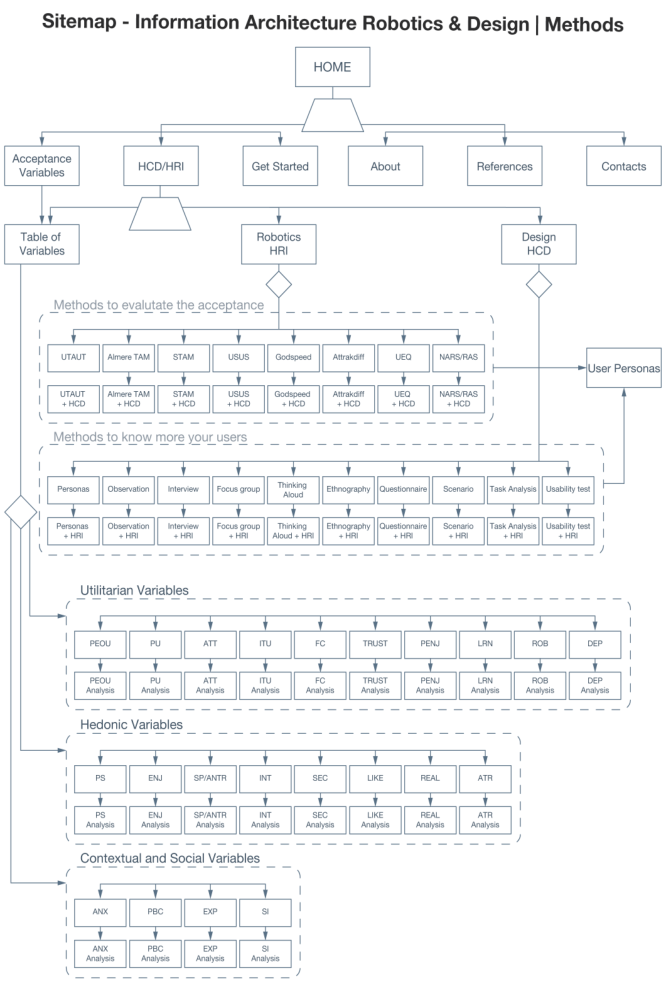
Based on the given purposes and once the criteria for prototyping were established, it was possible to proceed with the design the system architecture and the graphical user interface. The system architecture was developed from the objectives listed above, through the development of sitemaps, according to the visual vocabulary of Garrett, (2010), which served as the graphical reference for the production of the sitemap and its legend (see Figure 1).
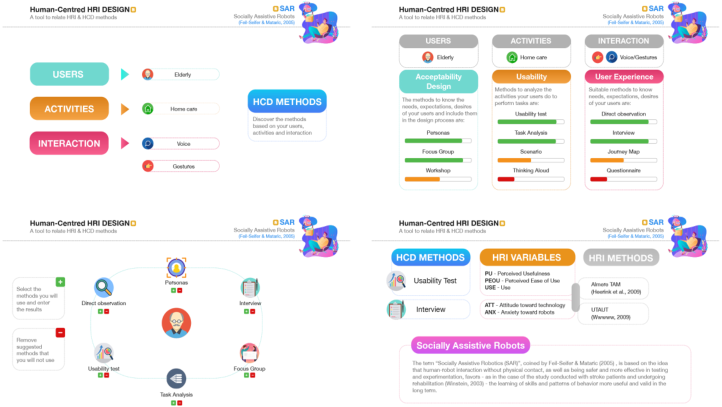
The visual vocabulary involves the use of rectangles to represent pages, i.e., the unit of measure in the Web domain; directional arrows to indicate relationships between elements; areas delineated with dashes to indicate a group of pages to which similar conditions apply; semicircles to indicate an action that has multiple simultaneous outcomes; rhombuses to indicate a decision point that can generate multiple outcomes; and trapezoids to indicate a conditional decision point, which can generate multiple mutually exclusive options. Contextually, the graphical user interface was developed according to Interaction Design principles (Preece, 2015) from wireframes, which were further developed through digital prototyping using Adobe Xd software (see Figure 2).
The development of a prototype of the tool allowed for an initial evalu- ation aimed at improving the architecture and interface. The entire design process was iterative, with evaluations and following improvements of both the architecture and the interface. Once the digital prototyping phase was finished, research related to the most effective tool for the development of the tool became necessary: CSM WordPress.org was chosen as one of the most popular, effective, flexible and adaptive open source platforms on the mar- ket. Then, the development of the website from the digital prototype involved further modifications and validations of the system. In summary, the develo- pment of the tool according to the objectives and requirements involved the following main phases: ideation/sketching; realization of the graphic model; prototyping; evaluation and iteration; usable digital model; and evaluation.
Architecture and Graphical User Interface of the Robotics & Design Platform The architecture of the Robotics & Design tool was developed from the dua- lity of the elements of the User Experience by Garrett, (2010, pp. 28–30): based on the strategies, goals, and objectives of the platform, a structure
Design and Acceptability of Technology 101
Figure 1: Sitemap of the tool “robotics & design” - section “methods”.
related to information architecture/sitemap (i.e., the navigation experienced by the user and the relationships between the various components of the site) and one related to Interaction Design (i.e., the graphical interface used by the user) was designed. Furthermore, the dual function of the platform required the simultaneous design of two system architectures, which are interdepen- dent and intended to be two sides of the same digital interface and sitemap.
102 Becchimanzi and Tosi
Figure 2: Digital prototyping of the tool “robotics & design” using the software adobe xd.
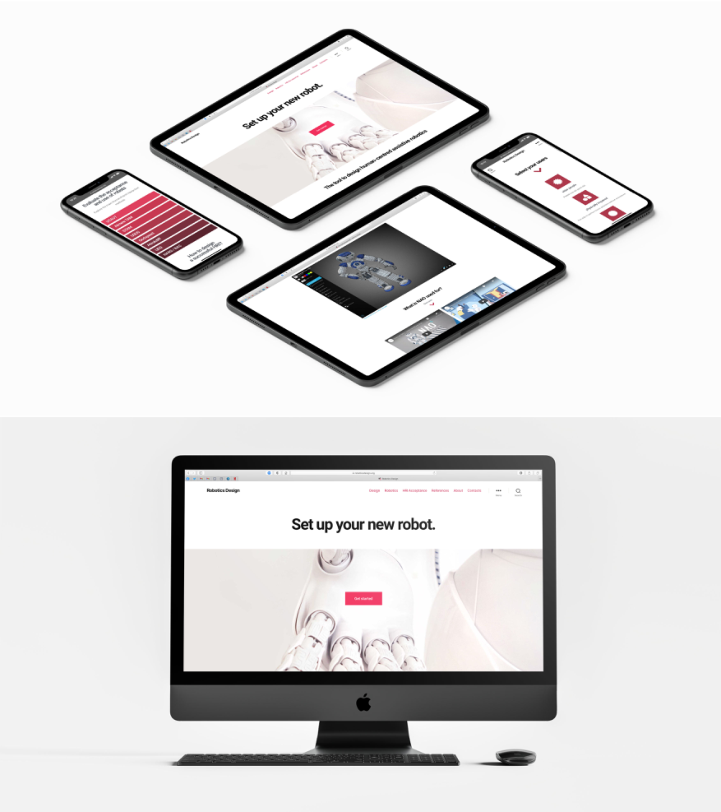
The first relates to the platform as a tool to support designers and multi- disciplinary teams approaching design in robotics; the second relates to the platform as an environment for disseminating and sharing theoretical know- ledge and methodology in HCD/HRI. Beta Version 1.0 does not provide for logins, with access to restricted areas: further implementations could include dedicated access for researchers or research institutions and another dedica- ted to designers, companies, professional firms, and freelance designers. In the first case, access from an institutional profile would allow the uploading or sharing of projects, research results, and experiments that would expand the database and, thus, improve the service offered. In the second case, the registration of designers and companies working in the field of robotic design would enable the structuring of an international network of professionals in various disciplinary fields, with common interests and related activities, with a view to possible collaborations. A further implementation concerns the development of a dedicated mobile application, a need partially met in the current version thanks to the responsive interface. Figure 3 shows a preview of the Graphical User Interface (GUI) of the Robotics & Design platform and its implementation within the actual website, the Beta Version 1.0 of which is up and running and available online at www.roboticsdesign.org as of June 2020. The interface is responsive for viewing from various types of computer screens, tablets, and smartphones.
The website provides a Home page from which it is possible to access the main menu. From the main menu it is possible to choose between the theoretical-methodological path and the more practical-application path. The latter is selectable through the “Get Started” button, which opens the page where you can select your reference users from a range of options and start the corresponding path. The “User Personas” page extrapolates from the database the user archetypes most related to the selected category, but
Design and Acceptability of Technology 103
Figure 3: A preview of the tool “robotics & design”.
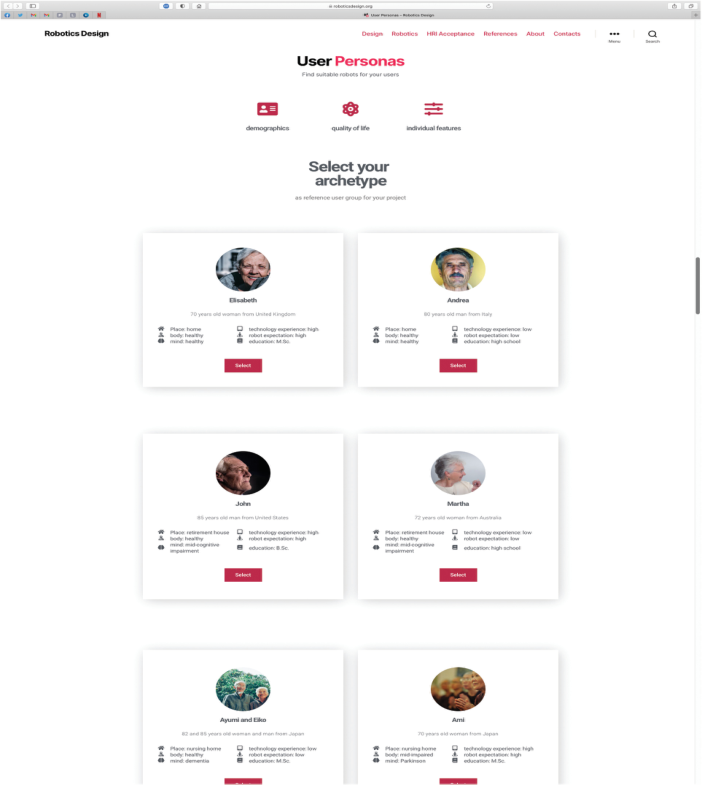
different enough from each other to cover all possible variables in relation to demographic characteristics, activities, technological experience, and quality of life (see Figure 4). At this point the system prompts the user to select, from the summary cards shown, the archetype most suited to his or her needs. Once the archetype has been selected, the platform contextually displays the selected User Personas and the corresponding User Variables Tab: this allows the user to have a complete overview of the user’s needs and characteristics but also of how these may determine and influence the variables of acce- ptability in the robotic environment. Following the selection and analysis of user requirements, the system processes (from the data in the database) the content that goes into the actual design support path. To improve the identi- fication of all parts of the process and allow the user to move easily between sections, the path was divided into three macro areas: the robot finder, the robot matcher, and the robot designer.
104 Becchimanzi and Tosi
Figure 4: The “user personas” page.
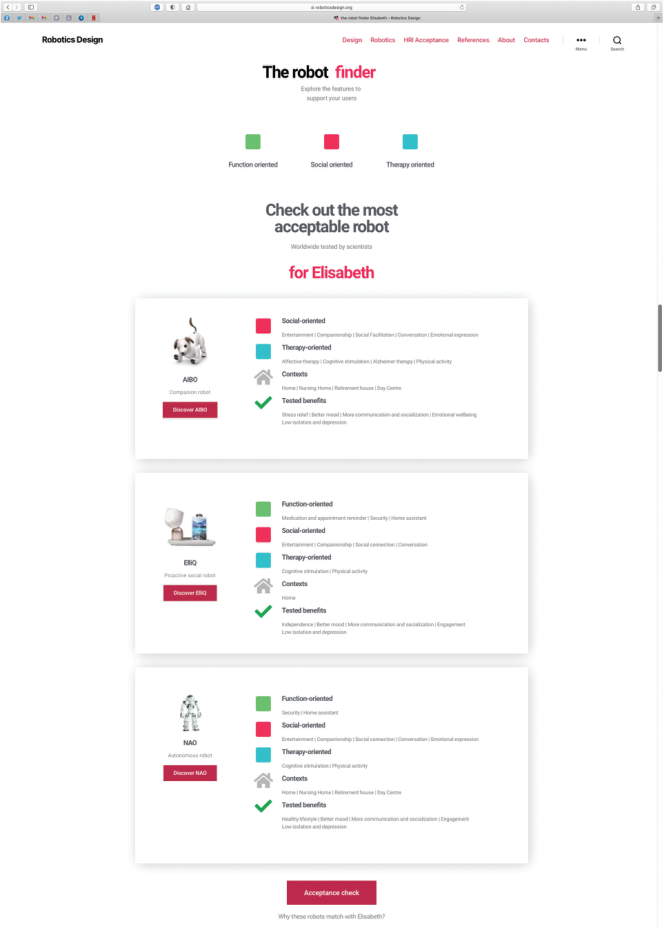
The Robot Finder After the identification of the most appropriate User Personas, the platform selects, within the database, the robots which are potentially most suitable, effective and acceptable to the target users (see Figure 5). The user can choose to immediately start the Acceptance Check, moving on to the next section, which involves an in-depth analysis of the elements that make the robot acce- ptable to the user, based on the experiments and scientific research in the database.
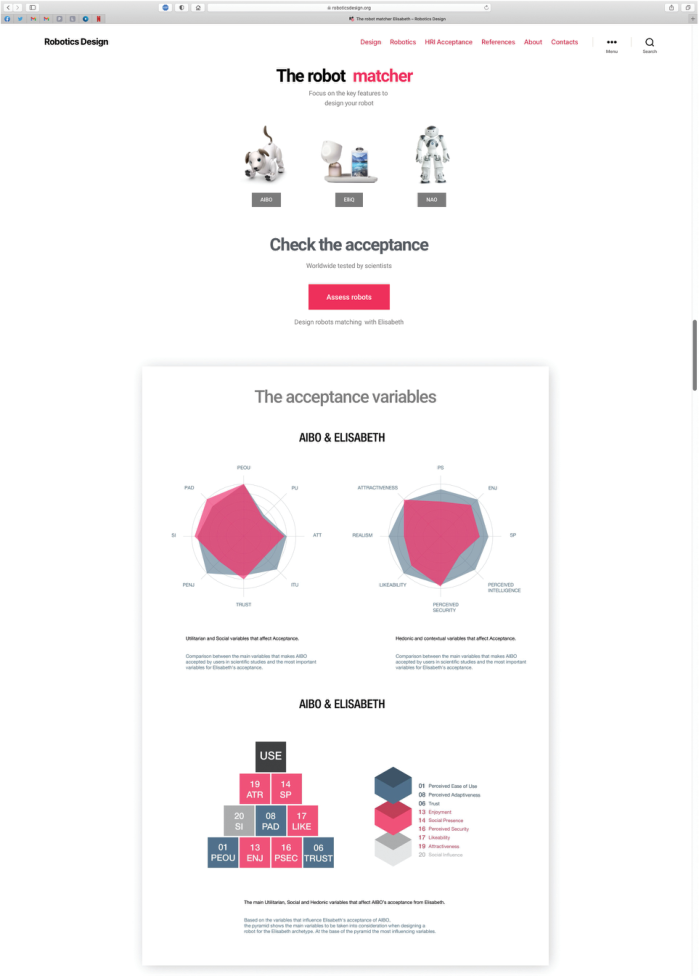
The Robot Matcher ”The robot matcher” section provides a more in-depth analysis of the ele- ments that make a given robotic platform more acceptable to the target users, both from the point of view of goals, activities, and contexts of use
Design and Acceptability of Technology 105
Figure 5: The robot finder section.
and the variables of acceptability (see Figure 6). Again, the user can decide to move immediately to the next section (through the “Compare robots” button), which offers purely design and application suggestions, or to delve deeper into the analysis of the dimensions of acceptability. Specifically, the in- depth analysis of that section performs a true comparison between the User Variables Tab and the Robotic Variables Tabs. In fact, through the Matching Tabs the user can verify, through radar graphs, the compatibility between the dimensions of acceptability possessed by the robot and those required by the
106 Becchimanzi and Tosi
Figure 6: The robot matcher section.
reference user, based on the scientific reference literature present within the database.
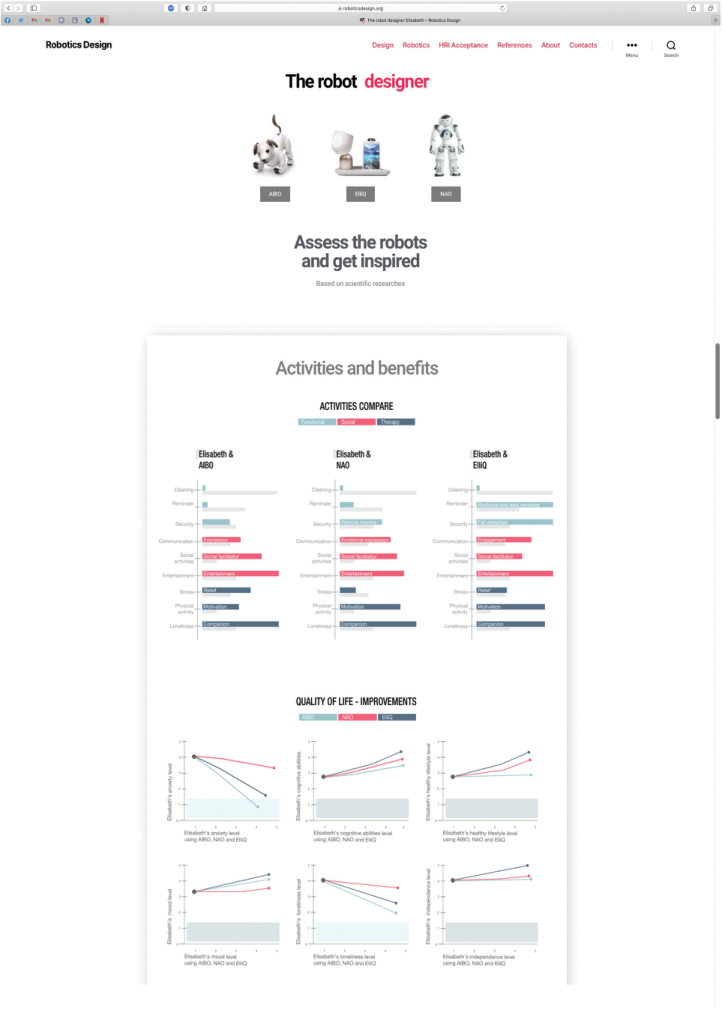
The Robot Designer “The robot designer” section investigates practical and application aspects that can provide designers with suggestions or design cues (see Figure 7). It provides a quick view of comparison sheets between the activities for which
Design and Acceptability of Technology 107
Figure 7: The robot designer section.
robots are most efficient and useful and those for which the target user would need support and assistance. For each robot, the platform offers the possi- bility to deepen the analysis by consulting the Quality of Life Benefits tabs, which show the improvements that the selected robot can bring to the user’s quality of life (in terms of health status, anxiety, stress, loneliness, independe- nce, etc.). Contextually, the Acceptance Criteria Tabs show for each robot the
108 Becchimanzi and Tosi
criteria (formal, behavioral, interactive, etc.) for which it is most acceptable to the target user.
Following the development of Beta Version 1.0, intermediate evaluations and tests were conducted with users and experts to gather feedback from potential users of the tool, both from a concept-theoretical perspective and from the perspective of usability and quality of interaction. The results of the evaluations and an in-depth description of the tool’s functionality will be covered in future papers.
CONCLUSION
The research and the tool presented in this paper are original and relevant to the state of the art as they support cross-disciplinary collaboration and can play an essential role in terms of optimizing the processes and methods of research and development of emerging technologies.
ACKNOWLEDGMENT
The authors would like to thank the participants in the survey and the University of Florence for supporting this research.
REFERENCES
Alexander, C. (1977). A pattern language: towns, buildings, construction. Oxford university press. Benyon, D. (2014). Spaces of Interaction, Places for Experience: Places for Experie-
nce. Morgan & Claypool. Dautenhahn, K. (2013). Human-robot interaction. In Soegaard, M., Dam, R. F.
(eds.) The Encyclopedia of Human-Computer Interaction, 2nd Ed. The Intera- ction Design Foundation, Denmark. Retrieved from: https://www.interaction-de sign.org/encyclopedia/human-robot_ interaction.html [07/05/2020]. De Ruyter, B., Saini, P., Markopoulos, P., Van Breemen, A. (2005). Assessing the effects of building social intelligence in a robotic interface for the home. Interacting with computers, 17(5), 522–541. Forlizzi, J., DiSalvo, C., Gemperle, F. (2004). Assistive robotics and an ecology of
elders living independently in their homes. Human-Computer Interaction, 19(1-2), 25–59. Garrett, J. J. (2010). Elements of user experience, the: user-centered design for the web and beyond. Pearson Education, London. Hassenzahl, M. (2013). User experience and experience design. The encyclopedia of
human-computer interaction, 2. Heerink, M., Kröse, B., Evers, V., & Wielinga, B. (2010). Assessing acceptance of assistive social agent technology by older adults: the almere model. International journal of social robotics, 2(4), 361–375. Krägeloh, C. U., Bharatharaj, J., Kutty, S., Kumar, S., Nirmala, P. R., Huang, L.
(2019). Questionnaires to Measure Acceptability of Social Robots: A Critical Review. Robotics, 8(4), 88. Kuli´c, D., Croft, E. (2007). Physiological and subjective responses to articulated robot motion. Robotica, 25(1), 13–27. Looije, R., Cnossen, F., & Neerincx, M. A. (2006, September). Incorporating
guidelines for health assistance into a socially intelligent robot. In ROMAN 2006-The 15th IEEE International Symposium on Robot and Human Interactive Communication (pp. 515–520). IEEE.
Design and Acceptability of Technology 109
Moshkina, L., Arkin, R. C. (2003, October). On tameing robots. In SMC’03 Conference Proceedings. 2003 IEEE International Conference on Systems, Man and Cybernetics. Conference Theme-System Security and Assurance (pp. 3949–3959). IEEE. Mutlu, B., Forlizzi, J., Hodgins, J. (2006a, December). A storytelling robot: Modeling
and evaluation of human-like gaze behavior. In 2006 6th IEEE-RAS International Conference on Humanoid Robots (pp. 518–523). IEEE. Preece, J., Sharp, H., Rogers, Y. (2015). Interaction Design, beyond human-computer interaction. John Wiley & Sons, New York. Rocha, Á. (2012). Framework for a global quality evaluation of a website. Online
Information Review, 36(3), 374–382. Emerald Group, Bingley, UK. Tosi, F. (2020). Design for Ergonomics. Springer, Cham. Veruggio, G., Operto, F., Bekey, G. (2016). Roboethics: social and ethical implications. In Springer handbook of robotics (pp. 2135–2160). Springer, Cham.
LISTED IN THE AHFE DIGITAL BOOKSTORE CATALOGUE
Explore the complete digital volume
Human Factors in Robots, Drones and Unmanned Systems
Read this individual research paper free through the original publisher, or explore the full digital proceedings book.
ISBN 978-1-958651-69-8
Explore this ISBN in the AHFE Bookstore ↗Listed in the July 2026 bookstore catalogue; search by ISBN to confirm current availability · Digital book purchase optional