Mariannys Rodriguez Gasca, Sanderson Macedo Barbalho (2024). Exploring the Influence of Industry 4.0 Technologies on Workplace Dynamics: A Literature Analysis. In: Human Aspects of Advanced Manufacturing, Production Management and Process Control. AHFE Open Access, vol. 146, pp. 40–49. https://doi.org/10.54941/ahfe1005149
The rapid advancement of technology globally, coupled with the unprecedented challenges posed by the COVID-19 pandemic in 2020, has significantly reshaped traditional production systems and the entire industrial value chain. Consequently, the complexity of tasks increased and substantially altered people's role in the production process. In this sense, the article examines the influence of Industry 4.0 technologies on work dynamics through an exhaustive literature review and bibliometric analysis. Key aspects related to human interaction in the business environment are addressed, and the implications of these emerging technologies on human factors are highlighted. The research identified an exponential growth in interest in human factors and ergonomics in i4.0 technologies from 2017 to 2022, suggesting the COVID-19 pandemic may have accentuated it. In addition, the review provides a comprehensive view of how Industry 4.0 influences the design of new workplaces, prioritizing worker safety and well-being through the study of diversity, skills and competencies of workers to improve adaptation and ergonomics, with a special focus on the intersection between technology and the human element in companies.
The rapid growth of technological development at a global level has brought disruptive changes in traditional production systems and the entire value chain in industries. In addition, the world economy has also been strongly affected by the appearance of the COVID-19 pandemic in 2020. Accord- ing to the Economic Commission for Latin America and the Caribbean (ECLAC), manufacturing is among the main sectors affected by the pandemic. The unleashed crisis made the shortcomings and weaknesses in the region’s productive structure more evident and amplified its economic, social, and environmental tensions. Increasing people’s learning and skills by adapting the educational systems to the structural changes needed for sectors with greater technological progress is stressed to avoid future productive losses such as those caused by the COVID crisis (CEPAL, 2020).
Exploring the Influence of Industry 4.0 Technologies on Workplace Dynamics 41
On the other hand, the accelerated market growth, the mass customiza- tion of products, and the increasing implementation of new technological tools in manufacturing have made organizations see the need to ensure proper technology integration. The Internet of Things (IoT), cloud computing, big data analysis, robotics, augmented reality, engineering and manufacturing simulation, and other smart technologies integrated into production envi- ronments are the so-called Fourth Industrial Revolution or Industry 4.0 (i4.0) (Hofmann & Rüsch, 2017) (Angelo et al., 2021). At a global level, the pen- etration of i4.0 technologies has accelerated the labor market’s growth and caused great changes in productivity and economic activities in the present and future industrial plants. These challenges and trends also require the development of new aspects related to competitiveness, such as the capabili- ties of the humans involved in the processes of the value chain of a product or service (Carmona et al., 2020).
In this context, workers must become part of the smart system to face the imminent digital transformation scenarios. Due to this, it is necessary to develop safe and ergonomic interactions between the operator and the system (Battini et al., 2022), focusing mainly on the needs of the operators and the characteristics that the technological support tools must have to allow the operator to adapt to it (Neumann et al., 2021). Therefore, using an approach that integrates the concepts of human factors and ergonomics as the main axis could be very beneficial in analyzing, understanding, and designing human work in i4.0 (Sallati et al., 2019).
The International Ergonomics Association (IEA) classifies some of the most relevant elements of human factors into three categories of special- ization: physical, cognitive, and organizational. Physical elements represent those physical interactions and activities. Cognitive elements focus on human mental processes and perception. Organizational elements optimize the surrounding organizational aspects workers operate (Reiman et al., 2021).
In 2018, a Brazilian research group started to wonder about this theme and conducted basic and applied research regarding Industry 4.0. The main con- cern initially was implementing i4.0 technologies (Silva & Barbalho, 2020). Some implementations used an action research approach to understand the contexts and problems highlighted when applying IoT and mobile technolo- gies in warehousing and picking (Dantas & Barbalho, 2021). A readiness- level diagnosing tool was conceptualized and deployed in an internet-based application form (Correa et al., 2021). Concurrently, a concept of an aug- mented reality tool for quality assurance in assembly lines was proposed and implemented (Thamm et al., 2020). This whole set of discussions brings a sci- entific curiosity to study the human factors in the i4.0 context deeply; once all applications started by the researchers found some important aspects of phys- ical, cognitive (mainly), or organizational as critical for the effective success of the endeavor.
Therefore, the main objective of this research is to collect information on the context of implementing i4.0 technologies in production environments and how this challenge should be managed to adapt the human factor to its new reality successfully. For this purpose, a systematic literature review of the documents published during the last six years was proposed. Initially, a search
42 Gasca and Barbalho
was carried out through the SCOPUS database to identify articles related to the topic of interest. Once the documents were selected, a bibliometric analysis was conducted using the VOSviewer software to discover the main trends in implementing the i4.0 paradigm focused on the user. Finally, some main trends for future research efforts were identified.
METHODOLOGY
The literature review carried out in this work was done in three conceptual stages: a systematic search, a bibliometric analysis, and the classification of the articles. This analysis was based on some recommended guidelines to obtain a high-quality review, including bibliographies with characteristics such as newer publication dates, high frequency of citations, and publications with high impact factors (Uemura Reche et al., 2020).
Systematic Search It was done with a search based on trial and error, as indicated in (Booth et al., 2016; Hussain et al., 2023), where keywords that could bring the expected results were selected. Subsequently, the combination of chosen keywords that presented greater effectiveness in the search was determined. Thus, after several attempts, it was possible to establish (TITLE-ABS-KEY (“Human Factor*”) AND TITLE-ABS-KEY (“Industry 4.0”)) as the combination that addressed documents with the greatest contribution to the subject. The next step was the definition of the Scopus database since it was the one that best adapted to the needs of the research once it provided access to a wide range of documents from different scientific journals. The Scopus filter of title, abstract, and keywords was applied for the first search. In addition to these filters, the Boolean operators OR and AND were used. The results yielded a total of 482 documents. Additionally, these results were refined by type of document (article, review, and conference paper) and year of publication (2017 to 2022). As a result, a total of 390 documents were obtained.
Bibliometric Analysis Data mapping used the VOSviewer, a bibliometric network visualization software. In this mapping, was a keyword co-occurrence analysis to reveal the cognitive structure of convergence among i4.0 technologies and human factors literature. For this, we carried out a general analysis of the entire keyword panorama that emerged from the systematic search. Afterward, we analyzed the number of publications in the period studied and the countries with the most contributions to this field of study. Finally, the categories are created according to the trends with the identified groups of keywords.
RESULTS
The main findings related to the proposed methodology are discussed in this section. From the 390 documents obtained, an overview of the research being developed can be ascertained.
Exploring the Influence of Industry 4.0 Technologies on Workplace Dynamics 43
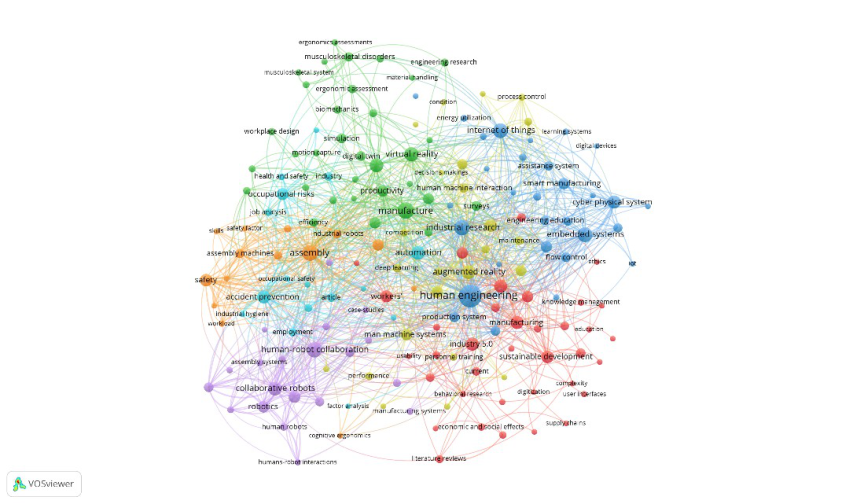
Keywords Analysis A keyword co-occurrence analysis was applied, where only terms that occurred at least five times were included. This first analysis covers the last six years, from 2017 to 2022. We identified 3175 terms in the titles, abstracts, and keywords, where 182 reached the established threshold. In Figure 1, the node size is proportional to the number of keyword occurrences, while the links represent the occurrence index.
The key terms used as search strings were excluded when generating the keyword map to give prominence to other terms related to the topic of inter- est. Based on these co-occurrence relationships, the keywords were grouped into seven groups represented by node colors. In some groups, keywords are larger than in others, meaning they have more occurrences within their net- work. A more detailed analysis of the keywords allows us to identify the frequency with which they appear together and the associations between them to determine the possible lines of research that follow the investiga- tions into the topic. In these nodes, we can see words with the most frequent occurrences, such as assembly, human engineering, safety, human-robot col- laboration, accident prevention, manufacturing, sustainable development, and some i4.0 technologies such as collaborative robots, embedded systems, automation, virtual reality, augmented reality, internet of things, artificial intelligence, and cyber-physical systems.
These results suggest that studies of human factors in Industry 4.0 are mostly focused on addressing the complexity of implementation, especially
44 Gasca and Barbalho
regarding worker health and safety, both from the point of view of risk pre- vention and the analysis of the consequences these systems could have on well-being. It also shows interest in the skills and training of workers and those who design such systems, particularly on assembly and maintenance lines. Additionally, it indicates that applications of Industry 4.0 technologies can assist decision-making processes, improve the efficiency and productivity of industrial processes, improve operators’ performance, and reduce errors.
Evolution of Publications by Year
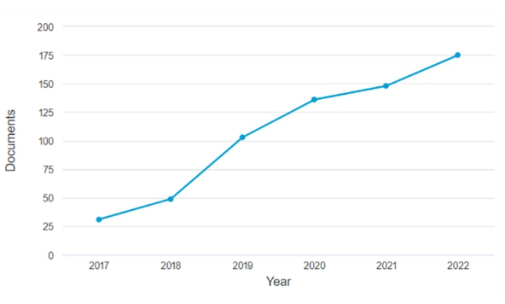
Figure 2 shows how the number of documents published on the topic has behaved from 2017 to 2022. Research has significantly increased in this period, with the highest peak in 2022, with a total of 175 documents, although the greatest increase occurred from 2018 to 2019.
Figure 2: Documents by year. Source: author.
According to these data, researchers are increasingly interested in the topic, given the increase in the implementation of the i4.0 paradigm. We could also say that this exponential growth could have been influenced by the pandemic, as discussed previously and corroborated by the high degree of digitalization suggested in CEPAL (2020).
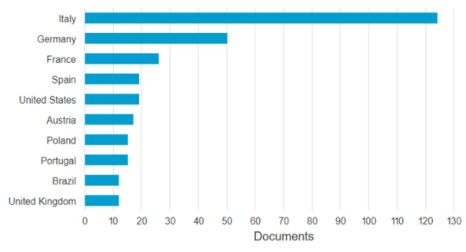
Documents by Country/Territory On the other hand, Figure 3 shows the documents’ distribution according to their geographical location. For the construction of this graph, the first ten countries with the highest number of publications were selected out of a total of 60 countries contributing with at least one publication. The minimum number for the classification was 12 publications. The list is headed by Italy (124 documents), Germany (50 publications), and France (26 publications). It can be observed that there is a great disproportion between the undisputed leader, Italy, and the other countries, amongst France, the United States, Aus- tria, Spain, Poland, Portugal, the United Kingdom, and Brazil, which have around 17 documents each.
Exploring the Influence of Industry 4.0 Technologies on Workplace Dynamics 45
Figure 3: Documents by country/territory. Source: author.
The country distribution shows that this topic is highly centered in Europe. Moreover, this classification shows the appearance of Brazil as the only Latin American country highlighted. Even summing up the United States studies, there is evidence that this topic needs to be better addressed outside Europe.
Research Trends
Table 1 shows the analyzed documents’ main topics and research trends according to the occurrence of keywords. The coding of the documents was divided into five categories considering the most repeated trends related to the terms industry 4.0 and human factors.
Table 1. Classifications by research trends.
Table available in the original PDF paper.
Category Description User-centered production systems design Focus on research on user-centered design methodologies, co-creation with workers, participatory ergonomics, user experience evaluation, etc. Wellbeing and safety Focus on health and safety in the work environment, including research on injury prevention, ergonomic risks, physical and cognitive ergonomics, etc. Work performance Focus on the human factor and its performance, including research on workforce diversity, development methods, and adaptation. Emerging technologies
Focus on industry 4.0 technologies and their impact on human factors, including research on applications of human-robot interaction, collaboration, acceptance, satisfaction, and adaptation of human beings and applications. Management systems Focus on integrating the human factor with I4.0 technologies for quality management and continuous improvement. Includes research on applying ergonomic norms and standards, risk assessments, ergonomic audits, maturity, etc.
46 Gasca and Barbalho
The first category comprises research on designing industrial systems with Industry 4.0 technologies or facilitating their implementation. These studies focus on developing design methodologies and principles for workstations, ergonomic tools, and human-machine interfaces, emphasizing operator par- ticipation in the design process. The study of these user experiences is carried out with existing production systems, suggesting they are aimed at redesigns or optimization. Typically, these studies also investigate technologies avail- able to monitor the user experience.
The second category encompasses documents examining the impact of the I4.0 paradigm on human factors, health, and safety. This involves assessing and mitigating ergonomic and cognitive risks, enhancing safety measures, and promoting operator well-being. Cognitive risks identified include men- tal strain and stress, while physical risks focus on evaluating posture, muscle tension, fatigue, and musculoskeletal disorders. Strategies to address these risks include job rotation, workload balancing, minimizing repetitive tasks, identifying emerging risks, biomechanical fatigue analysis, corrective actions, process and job ergonomic assessments, optimizing cognitive loads, and improving human-robot interactions. Additionally, factors like age, gender, individual worker anthropometry, and interface complexity are examined to mitigate ergonomic risks.
The third category focuses on human factors and work performance, including analyzing worker diversity and assessing employee readiness and skills for Industry 4.0. It explores changes in the labor market, tasks, and strategies for knowledge development. Studies also examine workers’ readi- ness for continuous learning and the curriculum development for engineering professionals. Additionally, it looks at physical capabilities, including accom- modating operators with special abilities or disabilities and leveraging older workers’ experience in Industry 4.0. Research also delves into improving decision-making, autonomy, and the impact of human factors on opera- tional excellence, particularly in manual assembly processes, and evaluates reliability and human error.
The fourth category investigates how emerging technologies can enhance ergonomics and performance. Key technologies include collaborative robotics, operator support systems, and IoT applications like sensors and cameras for motion capture and work monitoring. Virtual, augmented, and mixed reality are also explored for aiding manual assembly tasks. Addition- ally, artificial intelligence, cyber-physical systems, portable devices, digital twins and simulation techniques are examined. Some applications of these technologies range from deep learning, neural networks, computational mod- eling, digitized prototypes, digital drawings, computer-aided design (CAD), digital human modeling, machine learning, and smart gloves. These stud- ies primarily focus on improving worker adaptation, enhancing skills, and optimizing ergonomics through technology implementation. The industrial sectors with the most empirical research range from civil engineering and industrialized construction to the oil sector, textile industry, automotive industry, and aircraft assembly.
The fifth category focuses on i4.0 technology applications in quality management, process improvement, and productivity, emphasizing worker
Exploring the Influence of Industry 4.0 Technologies on Workplace Dynamics 47
involvement. It explores techniques like Lean Management, workflow opti- mization, and change management, aiming to enhance plant-level efficiency and employee participation. These studies highlight the benefits of combining intelligent technologies with human factors, including more efficient pro- cesses, customizable products, reduced energy consumption, and improved ergonomics.
CONCLUSION
The findings suggest that the issue had exponential behavior from 2017 to 2022, driven by the COVID-19 pandemic. It indicates that the topic has gained greater interest due to its importance in improving the productivity of companies in various industrial sectors. European countries dominated the theme, and Italy is the main origin for more valuable studies. Brazil and The United States are the American countries relevant to the issue.
The analyzed documents also allowed identifying trends of associations between some Industry 4.0 technologies and specific applications related to the human factor. On the other hand, research lines in this area have mainly focused on exploring design methods such as participatory ergonomics, co- creation, experience evaluation, and user-centered design for manufacturing systems based on human-machine interfaces. The design of these systems is aimed at assessing worker safety and health, preventing risks, reducing effort, and improving workplace well-being. Strategies to minimize these risks include, in addition to human-centered design methodologies, the study of diversity, skills, and preparation of workers to enhance adaptation and optimize ergonomics through the implementation of Industry 4.0 technology. Furthermore, these strategies aim to simultaneously reduce error occurrence and improve efficiency and productivity both individually and collectively.
The identified trends also showed the exploration of the association of Industry 4.0 technologies and techniques such as Lean Management, work- flow optimization, and change management, with the aim of improving efficiency at the plant level and employee participation. These studies high- light that the benefits of combining intelligent technologies with human factors include more efficient processes, customizable products, reduced energy consumption, and improved ergonomics.
This research allowed us to approach the study of human factors includ- ing Industry 4.0 technologies in production systems. However, there are some limitations as the systematic search was limited to a single database, which was SCOPUS. On the other hand, since there is no unrestricted method for evaluating authors and keywords, some of the findings may be indicative and further evaluation is suggested. Future work could also further explore, the- oretically and through simulations, the human factors and ergonomic trends found in this work.
ACKNOWLEDGMENT
The authors wish to acknowledge the contribution from the foundation for research support of the Federal District (FAP-DF), as well as the University of
48 Gasca and Barbalho
Brasilia and the mechatronic systems postgraduate program, for their support in participating in this event.
REFERENCES
Angelo, C., Maria, C. A., Vito, D. V., Mariangela, L., & Manuela, M. (2021).
Understanding and Defining Dark Data for the Manufacturing Industry. IEEE Transactions on Engineering Management. https://doi.org/10.1109/TEM.2021. 3051981 Battini, D., Berti, N., Finco, S., Zennaro, I., & Das, A. (2022). Towards industry 5.0: A multi-objective job rotation model for an inclusive workforce. Interna- tional Journal of Production Economics, 250, 108619. https://doi.org/10.1016/j. ijpe.2022.108619 Booth, A., Sutton, A., & Papapioannou, D. (2016). Systematic Approaches to a
Successful Literature Review (Second Edition). Carmona, R., Neto, J. A., & Ascúa, R. (2020). Industria 4.0 en empresas manufactureras del Brasil. www.cepal.org/apps. CEPAL. (2020). Informe Especial COVID-19 No 4: las empresas frente a la COVID-
19: emergencia y reactivación. Correa, B. F.; Barbalho, S. C. M.; SILVA, I. A.; HEINE, I.; ADAM, T.; SCHMITT, R. H. 3D-CUBE Readiness Model for Industry 4.0: technological, organizational and processes maturity enablers. Production & Manufacturing Research, vol. 10, pp. 875–937, 2022. Dantas, R., & Barbalho, S. C. M. (2021). The effect of islands of improvement on
the maturity models for industry 4.0: the implementation of an inventory manage- ment system in a beverage factory. Brazilian Journal of Operations & Production Management, 18(3), 1–17. https://doi.org/10.14488/BJOPM.2021.011 Hofmann, E., & Rüsch, M. (2017). Industry 4.0 and the current status as well as future prospects on logistics. Computers in Industry, 89, 23–34. https://doi.org/ 10.1016/j.compind.2017.04.002 Hussain, M., Zhang, T., & Seema, M. (2023). Adoption of big data analytics for
energy pipeline condition assessment - A systematic review. International Journal of Pressure Vessels and Piping, 206, 105061. https://doi.org/10.1016/j.ijpvp.2023. 105061 Neumann, W. P., Winkelhaus, S., Grosse, E. H., & Glock, C. H. (2021). Industry 4.0 and the human factor – A systems framework and analysis methodology for successful development. International Journal of Production Economics, 233, 107992. https://doi.org/10.1016/j.ijpe.2020.107992 Reiman, A., Kaivo-oja, J., Parviainen, E., Takala, E. P., & Lauraeus, T. (2021a).
Human factors and ergonomics in manufacturing in the industry 4.0 context – A scoping review. Technology in Society, 65. https://doi.org/10.1016/j.techsoc.2021. 101572 Sallati, C., de Andrade Bertazzi, J., & Schützer, K. (2019). Professional skills in the Product Development Process: The contribution of learning environments to professional skills in the Industry 4.0 scenario. Procedia CIRP, 84, 203–208. https://doi.org/10.1016/j.procir.2019.03.214 Silva, I. A. da, & Barbalho, S. C. M. (2020, November 4). Modelos de Maturidade
para Indústria 4.0 - Estudos de Caso. https://doi.org/10.14488/ENEGEP2020_ TN_STO_342_1751_41100
Exploring the Influence of Industry 4.0 Technologies on Workplace Dynamics 49
Thamm, S., Huebser, L., Adam, T., Hellebrandt, T., Heine, I., Barbalho, S., Velho, S.
K., Becker, M., Bagnato, V. S., & Schmitt, R. H. (2020). Concept for an augmented intelligence-based quality assurance of assembly tasks in global value networks. Procedia CIRP, 97, 423–428. https://doi.org/10.1016/j.procir.2020.05.262 Uemura Reche, A. Y., Canciglieri Junior, O., Estorilio, C. C. A., & Rudek, M. (2020).
Integrated product development process and green supply chain management: Contributions, limitations and applications. Journal of Cleaner Production, 249. https://doi.org/10.1016/j.jclepro.2019.119429
LISTED IN THE AHFE DIGITAL BOOKSTORE CATALOGUE
Explore the complete digital volume
Human Aspects of Advanced Manufacturing, Production Management and Process Control
Read this individual research paper free through the original publisher, or explore the full digital proceedings book.
ISBN 978-1-964867-22-9
Explore this ISBN in the AHFE Bookstore ↗Listed in the July 2026 bookstore catalogue; search by ISBN to confirm current availability · Digital book purchase optional