Iou-ren Lin, Chien-Hsiung Chen (2024). Application of Statistical Cluster Analysis in Design Process – the Case of Fabric Design. In: Human Aspects of Advanced Manufacturing, Production Management and Process Control. AHFE Open Access, vol. 146, pp. 123–128. https://doi.org/10.54941/ahfe1005158
There are many bed linen manufacturers in Taiwan. They want to success in the domestic bed linen collection market. However, the fabric designer always has the ideas with color and pattern by self-experience. For the fabric designer and manufacturer, they need a reference frame to communication. For this reason, we attempt to apply the statistical techniques for them to get more design understandings in the market of bed linen collections. We use the cluster analysis in a potential consumer survey to evaluate whether is the consumer’s lovely color and pattern with emotional preference.For the main bed linen buyers are the female in Taiwan market. The research focuses on 20-40 years old female interviewees. It collects more than 600 respondents’ data from three major cities in the northern, central and southern regions of Taiwan. The cities are Taipei, Taichung, and Kaohsiung. The interviewees choose the top 1 to 3 that they like the most and willing to buy from provided 16 photos of bed linen collection in different styles. Then, the result of the statistical cluster analysis shows that 16 collections can be grouped as 7 clusters with different favors. From the emotional preferences of color and pattern, we find out which collections are more suitable for different regions, and which ones are less popular among consumers. This can provide effectively the fabric designer with the direction of domestic consumer demand. And, also let manufacturer predetermine what combinations are suitable for some regional sales.In the past, fabric designers often used self-experience to design product. Now, we can try to conduct such surveys first, and then use more objective statistical results to help designers understand the bed linen design needs of consumers in different regions. At the same time, manufacturers can also better understand what types of products are suitable for sale in which region, also reduce inventory and slow-selling problems. Final, we hope to verify this statistical evaluation technique based on more manufacturers' sales data in the future, and whether it can improve their profits in practice.
There are many bed linen manufacturers and foreign brand agents in Taiwan. This market is very competitive (Anonymous, 2022). As we knowing, the bed linen relative industries should catch up with the trend. The manufacturer and fabric designer must communicate well on work. They have to develop the fabric design that focuses on consumer lovely color and pattern.
How to meet the target users’ aesthetic need becomes an important empha- sis of product design. Everyone has individual distinctive favour, people are influenced deeply by acquired environments (Bourdieu, 1984). Without suit- able design techniques, it is hard to understand all product consumer need for a designer. Designers and design commissioners often have minimal contact with users, so gaps in their knowledge about them appear (Zeisel, 1984). The concept of image board widely used by the designer (Blaich & Blaich, 1993). In the past, when working on product development and design, designer’s personal perspective and limited experience are often used to surmise user’s demand. However, the product design shall meet user’s need (Chang & Lin, 2007). Therefore, a designer should experience and understand different contents of taste, maybe never experienced before. However, some useful techniques help a designer catch the particular task, especially the design procedure (Lin, Chang & Chen, 2023).
The consumer preference for color and pattern of the bed linen collection should be quantifiable, and it could be useful in design process. The manufac- turers want to success in the domestic bed linen collection market in Taiwan. For this reason, they try to seek for alliances with scholarship, to get which unknown skills and developing process to accelerate the new fabric design of bed linen products.
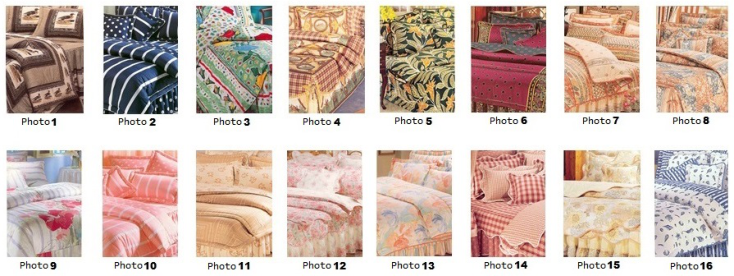
RESEARCH DESIGN For bed linen collections, the key successful factors are the color and pattern of fabric. But color and pattern are very abstract. For this reason, researchers attempt to apply the statistical technique to get more design understand- ings in this issue. Then, the researcher, fabric designer and brand manager work together and select 16 classical bed linen collection photos in different styles. Each style has its color and pattern. And these photos are marked with random number, as the interview material (see Figure 1).
In Taiwan bed linen product market, the main buyers are the mature female. The research focuses on 20 to 40 years old female as intervie- wees. They are the bed linen product potential consumers who are we care about. And the survey hires female interviewers. The reason is that we hope the female interviewee feel softly without pressure during the survey period.
The research collects respondents’ data from three major cities in the northern, central and southern regions of Taiwan. These cities are Taipei, Taichung, and Kaohsiung. The local bed linen enterprise sponsors 210 inter- viewees as survey samples in each city. Then, the research conducts interviews and records. In the face to face interview, the interviewees choose the top 1 to top 3 that they like the most and willing to buy from provided 16 photos. The all photos are showed randomly by our female interview- ers. At the same time, the survey also goes with demographic variables recoding.
Finally the research collects more than 600 respondents’ data and applies them to statistical analysis in the survey to evaluate whether is the consumer’s lovely color and pattern with emotional preference.
Application of Statistical Cluster Analysis in Design Process – The Case of Fabric Design 125
Figure 1: Photos with fabric color and pattern.
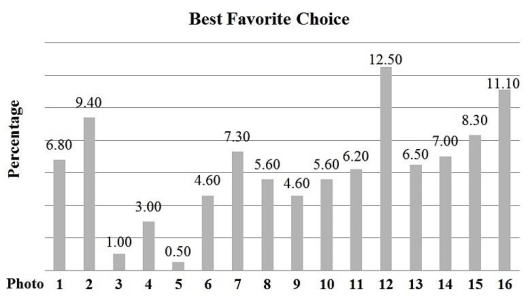
STATISTICAL ANALYSIS AND DISCUSSION After statistical analysis of the data, the research provided some useful results for manufacturers (see Figure 2). The statistical result has an overview of 16 bed linen photos with color and pattern by interviewees. It mostly meets the real sales data. Some detail analysis results involve commercial secrets and are required to be hidden by sponsors, but some results that can inspire the fabric design were agreed to be published.
Figure 2: The original statistical result by interviewees’ first priority choice percentage.
However, quantitative data from research is difficult to inspire and com- municate with the designer. It is easy for fabric designers to communicate with color and pattern. On the other hand, the color and pattern lack the persuasiveness to manufacturers, they always pay more attention to business data. From the past, the fabric designer always has idea with color and pat- tern by self-experience, not sales data. This causes both parties to spend more time communicating, which is like learning by trial and error. That is the issue for this study.
In order to solve this dilemma, this researcher thought of applying statis- tical clustering method, a qualitative and quantitative conversion technique,
126 Lin and Chen
to provide a solution. First, the survey collets interviewee’s data of their top 1 to 3 that they like the most preferred and willing to buy from 16 photos. For convenience, the original data codes: the best, secondary and third favorite independent variables are replaced by Top 1, Top 2, Top 3 codes.
And let the cluster analysis shows statistically significant distances between each cluster, these variables are weighted. Weighted parameters for Top1, Top 2 and Top3 are 3, 2, 1 times. Finally, the basic data of top 1 to top 3 are combined to the statistical cluster analysis. The statistical detail output shows on the statistical table.
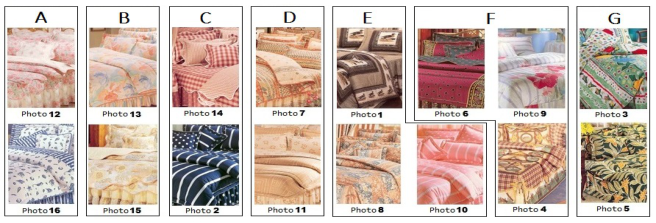
The result of the statistical cluster analysis shows that 16 photos can be grouped as 7 clusters with different photos. The color and pattern collection have their new meanings in the cluster. Now, the statistical clusters will be able to provide effectively understanding for a fabric designer (see Table 1). The clusters result indeed connects commerce predicts and design ideas.
Table 1. The cluster analysis result of potential consumers’ preference percentage.
Note: Top 1, Top 2, Top 3 represent the best, secondary and third favorite photos, and weighted 3x, 2x, 1x.
Statistical Cluster Result Supports Fabric Design a Reference Frame as Image Board For designers and manufacturers, they need a reference frame to commu- nication with fabric design. The statistical cluster result supports firms and fabric designers with an alternative reference frame of communication. Espe- cially for designers, they are familiar with the use of colors and patterns. Meanwhile the result of the statistical cluster analysis shows 7 clusters with different color and pattern groups, like the function of Image Board for design (see Figure 3). The elements of Image Board are collect by the designer’s sub- jective experience, a black box. The images of a cluster, which base on the real data, will be convincing and objective.
With the emotional preferences of color and pattern, the manufacturer and designer both can find out which cluster is more or less popular among
Application of Statistical Cluster Analysis in Design Process – The Case of Fabric Design 127
potential consumers. It also provides the manufacturer and designer the direction of domestic consumer demand effectively.
Figure 3: Grouping 16 photos to 7 clusters by the statistical result.
CONCLUSION
In the consumer market, bed linen products always face high competitive. Both of the fabric designer and manufacturer hope to understand consumers’ need, they need the way to develop bed linen collections into market. This research attempts to offer fabric designers and manufacturers a possible solution with the quantitative statistical analysis.
Those raw statistics are not easy to inspire designers. We recognize that data alone may not be suitable to guide designers to generate more ideas. Therefore statistical cluster analysis is applied to attempt to guide different directions. The statistical cluster result offers an alternative reference frame, like the Image Board. Each cluster has its style with color and pattern, also involving demographic data. Research involving the use of cluster analysis can be used for another design.
In the research, we conduct the survey and more objective statistical results to help designers understand the bed linen design needs of consumers. At the same time, manufacturers can also better understand what types of products are suitable for sale in Taiwan market. And, it also and reduce inventory and slow-selling problems. We hope to verify this statistical evaluation technique based on more manufacturers’ sales data in the future, and whether it can improve their profits more deeply.
Finally, it is worth mentioning that the research must exclude licensed car- toons or Disney styles products, although they are popular in the market. For consumer demands change rapidly, it maybe is the next issue for study. Fur- thermore, if viewed from another angle, some less popular clusters cannot be said to have no market, their uniqueness may become a niche market for a specific group. These topics require more studies. And it is also a possible direction of the next design research in the future.
ACKNOWLEDGMENT
Thanks for Hwa Erh May Co., Ltd. and id-PR Co., Ltd. generously support during the survey process.
128 Lin and Chen
REFERENCES
Anonymous. (March 25, 2022). Home Bedding Market Size, Share & Trends Analysis Report By Type (Bed Linen, Mattress, Pillows, Blankets), By Distribu- tion Channel (Online, Offline), By Region, And Segment Forecasts, 2022–2030. Global Information GII Website: https://www.gii.tw/report/grvi1068283-home-b edding-market-size-share-trends-analysis.html. Blaich, R., & Blaich, J. (1993). Product Design and Corporate Strategy: Managing
the Connection for Competitive Advantage. New York: MacGraw-Hill. Bourdieu, P. (1984). Distinction: A Social Critique of the Judgement of Taste (R. Nice, Trans.). London: Routledge & Kegan Paul. (Original work published 1979). Chang, W. C., & Lin, I. R. (2007, Oct, 10–12). The Application of Persona and
Scenario in Product Development and Design for the Specific Target Group. 2007 International Conference on Kansei Engineering & Emotion Research, Sapporo, Japan. (Presentation). Lin, I. R., Chang, W. C., & Chen, C. H. (2023, March, 7–9). How to Meet Product Design for Target User Aesthetic Need. The 9th International Forum on Advanced Technologies, Taipei, Taiwan. (Presentation). Zeisel, J. (1984). Inquiry by Design: Tools for Environment-Behavior Research.
New York: Cambridge University Press.
LISTED IN THE AHFE DIGITAL BOOKSTORE CATALOGUE
Explore the complete digital volume
Human Aspects of Advanced Manufacturing, Production Management and Process Control
Read this individual research paper free through the original publisher, or explore the full digital proceedings book.
ISBN 978-1-964867-22-9
Explore this ISBN in the AHFE Bookstore ↗Listed in the July 2026 bookstore catalogue; search by ISBN to confirm current availability · Digital book purchase optional