Shui Tsai-Yen, Chien-Hsiung Chen (2026). Human–Environment Interaction in a Supermarket Retail Service System: A Field Study. In: The Human Side of Service Engineering. AHFE Open Access, vol. 221, pp. 366–376. https://doi.org/10.54941/ahfe1007740
Recent retail research leverages computer vision and indoor positioning to quantify shopper paths and hotspots for layout and merchandising. However, in Asian supermarket alcohol zones, field evidence that contrasts festive and everyday contexts through a human–environment interaction lens remains limited. This study characterizes how spatial configuration, festive displays, and purchase goals shape entry routes, dwell allocation, and brand choice in the alcohol area of a large chain supermarket in Taiwan. Using non-intrusive observation, the area was partitioned into an entrance single-can display, a refrigerated end, an ambient multi-pack section, and promotional pallet stacks; movement sequences and dwell episodes were location-coded across time windows. Festive periods exhibited polarization: entrance-centered exploration versus downstream quick-grab paths with targeted stops near promotions. We propose an observation protocol integrating location coding and behavioral visualization to inform retail service system design and operational planning for alcohol merchandising.
Research Background In retail environment design, purchasing behavior is shaped by spatial configuration, visual/sensory cues, and temporal context. Festive periods raise foot traffic and introduce temporary promotions that shift in-store rhythms, especially in alcohol zones where high variety and ritualized/social consumption make the setting suitable for in-situ human–environment interaction. Consistent with Bitner’s (1992) servicescape model, physical and sensory cues influence affect and decision-making; Larson et al. (2005) and Underhill (2009) further show that circulation planning and perceived crowding affect search efficiency and dwell behavior. Hui and Bateson (1991) and Tombs and McColl-Kennedy (2003) also suggest that density and festive atmospheres elevate cognitive load, shifting decision speed and choice strategies. Yet prior work often relies on surveys or transaction records, limiting fine-grained
Human–Environment Interaction in a Supermarket Retail Service System 367 observation of festive versus non-festive differences—particularly in alcohol zones where task goals (e.g., replenishment, gathering preparation) intersect with sensory goals (e.g., brand impression, taste preference). Accordingly, this study uses field-based naturalistic observation to compare navigation sequences, dwell allocation, and decision patterns, translating findings into actionable retail space and service-system design strategies.
Research Objectives From a human factors perspective, this study tests how temporal context and zone configuration in an alcohol area influence purchasing behavior and translates the results into deployable design guidelines (Fig. 1). Specifically, it (1) tests the polarized purchasing-path hypothesis across three contexts (festive period, regular weekday, and weekend/holiday) (Fig. 2), examining whether dwell allocation concentrates at the entrance display and purchase incidence increases at the downstream refrigerated end (via dwell episodes/time and purchase counts/incidence); (2) quantifies time–zone differences by comparing midday versus evening conditions across Zones A–E using hotspot distribution, dwell concentration, and zone-to-zone transitions; and (3) develops an implementable frequency–configuration model by deriving single-can and case/multi-pack indices from brand occurrence counts and mapping them to facing allocation, promotional stacking, and replenishment rhythm for alcohol-zone merchandising and operations.
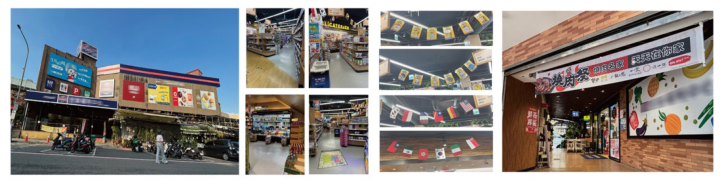
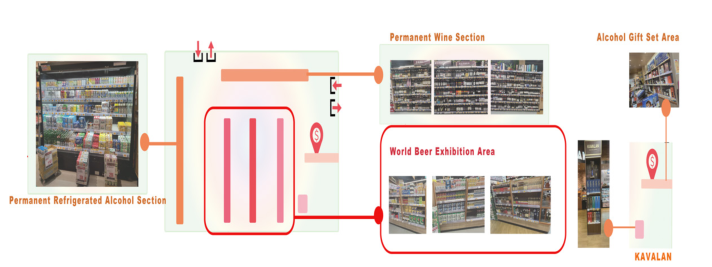
Figure 1: Observation-zone layout (zones A–E) in the alcohol area.Figure 2: On-site festive-context setting and wayfinding elements, including mid-autumn barbecue promotion and international beer-themed decorations.
METHODS
Method and Setting This study used non-participatory field observation to examine purchasing-behavior differences across three temporal contexts (festive period, regular weekdays, and weekend/holiday) from a human factors perspective. Compared with surveys or experiments, field observation captures shoppers’ movement sequences, dwell episodes, and decision-related behaviors in situ without disrupting operations, enhancing ecological validity and reducing interference from controlled manipulations (Bitner, 1992; Underhill, 2009). Observations were conducted in the alcohol zone of a large chain retailer in northern Taiwan, comprising an entrance display, longitudinal gondola aisles, a refrigerated end, and promotional pallet stacks. Data collection spanned the Mid-Autumn festive period, regular weekdays, and the Double Tenth long weekend to capture behavior under varying traffic pressure and service tempo. Wayfinding cues, layout, and festive decorations/promotional messaging were documented concurrently to support interpretation and design translation.
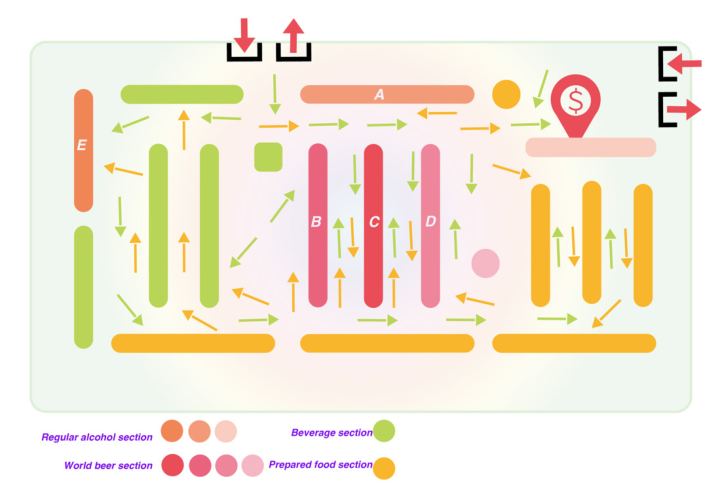
Study Site (Alcohol-Zone Configuration). The site was an alcohol zone adjacent to a main corridor, with an entrance display at one end and a refrigerated end near the exit at the other. The bounded area was defined as the fixed observation region and location-coded into five functional subzones (A–E) for behavioral annotation: A = entrance long-row display; B–D = longitudinal gondola aisles; E = exit-side refrigerated section plus adjacent promotional stacks. Entrance, exit, and checkout locations were also marked to assess flow direction and identify near-checkout decision points.
Observation Period and Sessions. A total of 14 non-participatory observation sessions were conducted, each lasting 60 minutes (see Table 1). Sessions covered two time windows—midday and evening—to capture different service rhythms and traffic intensities. By temporal context, 10 sessions were conducted during festive/weekend-holiday periods and 4 during regular weekdays.
Table 1: Overview of observation periods and sessions.
Table available in the original PDF paper.
Date Day Overall Timewindow(s) Session 1 Session 2 Session 3 10/04 Sat Afternoon, Evening 15:49–17:00 20:27–21:30
10/05 Sun Morning, Afternoon 11:20–12:30 15:57–17:00 17:18–18:30 10/05 Sun Evening 19:15–20:15 20:35–21:35
10/11 Sat Afternoon, Evening 17:00–18:00 19:30–20:30 Note: Observations comprised a total of 14 sessions (60 min per session). Times are reported in 24-hour
format (local time).
Human–Environment Interaction in a Supermarket Retail Service System 369 Measures and Coding
Spatial Zones. To quantify behavioral patterns, five zone codes (A–E) were used to label major display segments and end locations. For each session, zone-level dwell and purchase counts were recorded as the basis for hotspot maps and a purchase-frequency matrix. Group Composition and Behaviors. Observations focused on naturally occurring groups and visible behaviors; no personally identifiable information was collected. Recorded items included group composition (solo, dyad, ≥3), gender type (male, female, mixed), product interactions (pick up, read label, put back, place into cart), and co-occurring behavior (whether barbecue-related items were purchased concurrently, e.g., meat, grilling tools, sauces, disposables). Brand Frequency and Visualization. Brands were categorized as single-can versus case/multi-pack. Occurrence counts were computed to form ABC groupings. Outputs included brand-frequency plots, A–E hotspot maps by the three contextual groups, and an overall movement-path map for the alcohol area.
Data Aggregation and Analysis Each session record included date, time window, party size, dwell counts, group composition, gender type, dwell time, interaction counts, zone-level dwell/purchases (A–E), and brand occurrence frequency (single-can/case). After harmonized coding, data were aggregated in Excel and via hotspot mapping into three contextual groups (festive, weekday, weekend/holiday), and a “dwell × zone × purchase” matrix was generated to test the polarized purchasing-path hypothesis and support design inference.
RESULTS
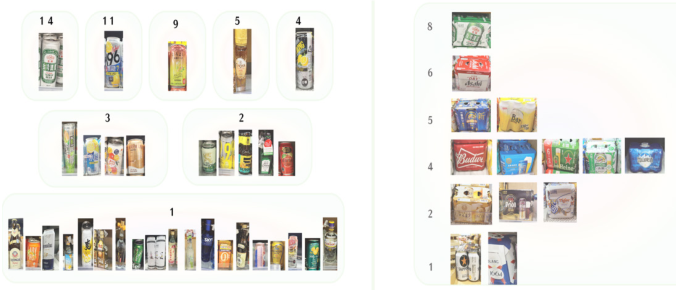
Brand Occurrence Frequency Single-Can Products (Entrance “World Beer” Display). Observations across festive and weekday periods showed a clear hierarchical distribution in single-can brand occurrence at the entrance “world beer” display (see Fig. 3, left). The highest-frequency tier was dominated by local and Japanese offerings, including a classic beer item (14 occurrences), a lemon RTD (11), and a fruit-flavored chuhai/sour (9). The mid-frequency tier comprised plum wine and a “Strong Lemon” item (4–5 each). The lower-frequency tier included high-ABV RTDs, fruit beers, and light ales (2–3 each). In addition, a long tail of more than 15 brands was observed, spanning products from Korea, Japan, Germany, and Belgium, indicating diversified flavor profiles and distributed country-of-origin representation.
Figure 3: Brand frequency distributions by package type and display location. Left: Single-can brand frequency tiers at the entrance display. Right: Case/multi-pack brand frequency distribution at the exit zone.
Case/Multi-Pack (Exit Refrigerated End and Promotional Stacks) Case/multi-pack products at the exit refrigerated end and adjacent promotional stacks showed high concentration and a stable brand structure (see Fig. 3, right). The highest-frequency brands were Taiwan Beer (8 occurrences), Asahi, and Heineken (6 each). The mid-frequency tier included KIRIN, Budweiser, Bar, and Tsingtao (4–5 each). A low-frequency long tail comprised brands such as Tiger, Orion, Sapporo, and 1664 (1–2 each). Overall, festive peak periods were associated with higher concentration on mainstream br ands, consistent with more task-oriented purchasing.
Brand Grouping (ABC Model). Brands were tiered using an ABC scheme based on cumulative share of occurrence counts (A: top 70%, B: next 20%, C: bottom 10%) to operationalize a hierarchy for merchandising decisions. For single-can products, Group A included Taiwan Beer, a lemon RTD, and a fruit-flavored sour; Group B included CHOYA and “Strong Lemon”; Group C comprised long-tail brands. For case/multi-pack products, Group A included Taiwan Beer, Asahi, and Heineken; Group B included KIRIN, Budweiser, Bar, and Tsingtao; Group C included Sapporo, 1664, Tiger, and Orion. This grouping supports quantification of facing allocation and replenishment frequency.
Differences Between Single-Can and Case/Multi-pack. Brand structure: single-can products were more trial-oriented, whereas case/multi-pack products were mainstream and task-oriented; task tendency: single-can interactions concentrated at the entrance with longer dwell, while case/multi-pack choices clustered near the refrigerated end with faster decisions; replenishment rhythm: single-can items required shorter- cycle replenishment, whereas case/multi-pack replenishment concentrated in the evening and prior to festive peaks; cross-placement: co-locating single- can and case/multi-pack of the same brand may trigger “upgrade” purchases.
Human–Environment Interaction in a Supermarket Retail Service System 371 Zone-Level and Temporal-Group Analysis
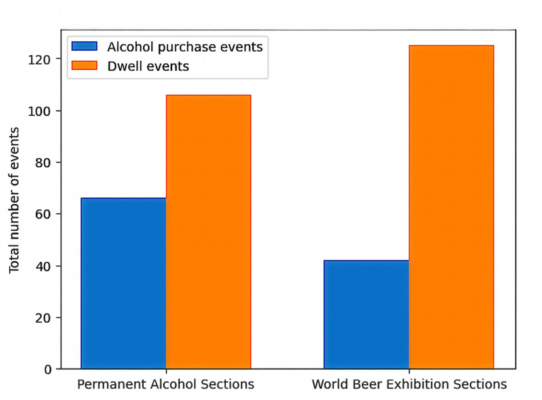
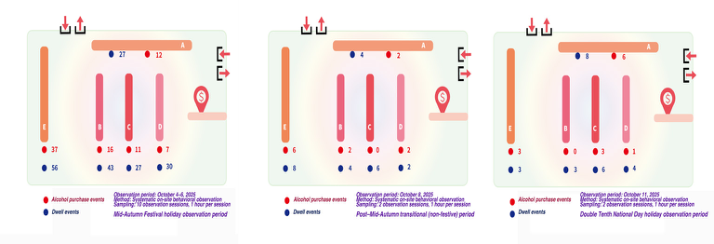
Festive Period (Mid-Autumn Long Weekend). Zones A (entrance) and E (refrigerated end) formed the primary hotspots, with dwell counts of 27 and 56, respectively, indicating a polarized structure (Fig. 4): entrance single-can selection followed by refrigerated-end case pickup. Zones B–D largely served as transition space, and evening purchases concentrated in Zone E.
Weekdays. Total dwell decreased to approximately 24, while the functional relationship among Zones A–E remained stable: Zone A retained its entrance- dwell role, and Zone E remained the quick-grab and replenishment node, suggesting persistence of the polarized structure.
Double Tenth Long Weekend. Total dwell further decreased (~11–13). Zone E continued to support purchases but showed limited activation. Overall behavioral intensity declined, consistent with demand cooling toward the end of the festive period.
Figure 4: Zone-type comparison of alcohol purchase and dwell events.
Shopper Segments and Contextual Characteristics Party Composition. During festive and evening sessions, the proportion of dyads and larger groups increased, with activity and purchases concentrating at the refrigerated end and promotional stacks. On weekdays, solo shoppers predominated and more frequently engaged in exploration and comparison near the entrance display.
Gender Distribution. Male shoppers showed higher dwell in evening and weekend/holiday sessions, with concentration in the case/multi-pack area. Female and mixed groups more frequently exhibited “pick up/read label” behaviors at the entrance display, consistent with more sensory- and information-oriented selection.
372 Tsai-Yen and Chen Product Interactions. In the “world beer” entrance area, a recurring interaction chain—pick up → read label → put back—was observed (more than 15 instances within a single session), suggesting that labeling and wayfinding cues can extend dwell. At the refrigerated end, interactions were dominated by placing items into a cart/basket, reflecting a decision-completion stage. Co-occurrence with Barbecue-Related Items. During the Mid-Autumn period, co-occurrence between alcohol purchases and barbecue-related items was high; Sessions 5, 6, and 10 recorded 13–17 instances. A typical sequence was: barbecue endcap → world-beer entrance → purchase at the refrigerated end → checkout. Co-occurrence decreased to a moderate level during the Double Tenth long weekend, indicating behavioral cooling after the festive peak.
Overall Movement Structure. The dominant route typically started at the world-beer entrance display, continued along the longitudinal gondola aisles, and ended at the refrigerated end before checkout (see Fig. 5). Midday behavior concentrated on entrance-side comparison, whereas evening behavior shifted toward refrigerated quick-grab, indicating that circulation and node placement directly shape task division in purchasing.
Figure 5: Integrated movement-path map for the full alcohol area.
BEHAVIORAL ANALYSIS AND HUMAN FACTORS DESIGN IMPLICATIONS Behavioral Logic of the Polarized Purchasing Path
During festive periods, shoppers exhibited a polarized pattern characterized by “entrance dwell, exit purchase.” The entrance side (Zone A/world-beer display) supported exploration, comparison, and information seeking, whereas the exit side (Zone E, refrigerated end) supported quick pickup, decision completion, and movement toward checkout. This can be interpreted as a staged decision process in which spatial nodes distribute search versus completion tasks. Accordingly, purchasing is shaped not only by brand/price, but also by layout structure and information visibility. Entrance signage and flavor variety encourage exploration; refrigerated quick-grab placement reduces acquisition costs and facilitates task-oriented completion.
Behavioral Modulation by Time and Context The three temporal groups showed clear contextual modulation. Festive peaks combined dense dwelling with frequent quick-grab behavior; evening sessions concentrated activity at the refrigerated end with faster decisions, reflecting a goal-oriented mode. In contrast, weekdays involved longer dwelling and more interaction, consistent with an explore-and-compare mode. Overall, density and temporal context co-shape decision tempo: higher pressure drives simplified, goal-directed behavior, whereas lower pressure increases exploration (indicators: dwell concentration; purchase counts).
Differences by Gender and Party Composition Decision strategies differed by gender and party composition. Male shoppers and larger parties more often completed purchases at the refrigerated end, consistent with task-coordinated and fast-completion behavior. Female shoppers and solo shoppers tended to dwell longer at the entrance and frequently displayed a pick up → read label → put back evaluation pattern. Therefore, alcohol-zone design should support both modes: quick decision/ quick-grab and information- or sensory-driven exploration (Indicators: entrance vs. refrigerated-end dwell; interaction-type distribution).
Product Interaction and Environmental Cue Design Interaction patterns suggest that informational cues (signage/wayfinding) directly influence dwell and decision behavior. The entrance area supports early-stage comparison through visual information, whereas the refrigerated end is dominated by “place into cart/basket” actions, consistent with decision completion and execution. Environmental cues thus serve two roles: structuring information during exploration and reducing operational load during execution. Accordingly, the entrance should emphasize clear flavor- group wayfinding, and the exit should maintain highly visible price and volume labels (Indicators: interaction-chain counts; proportion of “place into cart/basket”).
During festive periods, alcohol purchases frequently co-occurred with barbecue-related items, forming a cross-category task flow (barbecue endcap → entrance single-can selection → refrigerated-end case pickup → checkout) that suggests shoppers treat cross-category shopping as a single task set (see Fig. 6; indicators: co-occurrence counts; sequence frequency). Design recommendations therefore emphasize reducing comparison cost and supporting quick-grab demand under peak pressure: provide flavor-based wayfinding and “popular bundle” prompts at the entrance, place mainstream- brand promotional stacks at the transition segment from the entrance toward the refrigerated end, reserve a 60–80 cm replenishment corridor at the refrigerated end to reduce congestion, and tune festive conditions by increasing lighting and sign contrast during peaks to guide visual attention and distribute traffic.
Figure 6: Spatial comparison of alcohol-related purchase and dwell events across festive and transitional periods.
CONCLUSION
This study compared shopper behavior in an alcohol zone across three temporal contexts—festive peak (Mid-Autumn), regular weekdays, and a holiday period (Double Tenth long weekend)—and identified a consistent spatial role structure with varying intensity. The festive peak most strongly exhibited a polarized pattern of “entrance single-can selection, exit case quick-grab”; weekdays showed a scaled-down version, while the Double Tenth period reflected demand cooling with the structure intact. Evening behavior concentrated purchases at the refrigerated end, whereas midday behavior emphasized entrance-side flavor comparison. Brand-frequency results support task-based zoning: the entrance single-can area should prioritize high-frequency items while retaining long-tail variety, and the refrigerated case area should emphasize mainstream brands with selective long-tail coverage. We recommend ABC-based facing and replenishment allocation (A primary, B mid, C minimal) and cue design that improves entrance exploration efficiency while using transition-node stacks to capture quick-grab demand. Festive co-occurrence with barbecue items
Human–Environment Interaction in a Supermarket Retail Service System 375 formed a cross-category task flow (barbecue endcap → entrance single- can selection → refrigerated case pickup → checkout), indicating that festive shopping is executed as an integrated task set supported by layout and wayfinding continuity.
Methodologically, this work contributes a human factors–oriented field observation framework using location coding and occurrence- based measures to validate the polarized purchasing path and derive implementable merchandising, wayfinding, and replenishment guidelines for festive operations optimization. Limitations include a single store site, a short festive window, and the absence of POS or loyalty data; thus, findings primarily characterize behavioral patterns rather than purchase outcomes. Future work should extend to multiple store formats and festive events and incorporate computer vision or automated tracking to improve temporal resolution and generalizability.
ACKNOWLEDGMENT
The authors would like to acknowledge the retail site for permitting field observations and thank the staff members who facilitated on-site coordination.
REFERENCES
Bitner, M.J.: Servicescapes: The impact of physical surroundings on customers and employees. Journal of Marketing 56(2), 57–71 (1992). https://doi. org/10.1177/002224299205600205 Chandon, P., Hutchinson, J.W., Bradlow, E.T., Young, S.H.: Does in-store marketing
work? Effects of the number and position of shelf facings on brand attention and evaluation. Journal of Marketing 73(6), 1–17 (2009). https://doi.org/10.1509/ jmkg.73.6.1 Hui, S.K., Bradlow, E.T., Fader, P.S.: Testing behavioral hypotheses using an integrated model of grocery store shopping path and purchase behavior. Journal of Consumer Research 36(3), 478–493 (2009). https://doi.org/10.1086/599046 Hui, S.K., Fader, P.S., Bradlow, E.T.: Path data in marketing: An integrative
framework and prospectus. Marketing Science 28(2), 320–335 (2009). https:// doi.org/10.1287/mksc.1080.0400 Hui, M.K., Bateson, J.E.G.: Perceived control and the effects of crowding and consumer choice on the service experience. Journal of Consumer Research 18(2), 174–184 (1991). https://doi.org/10.1086/209250 Kotler, P.: Atmospherics as a marketing tool. Journal of Retailing 49(4), 48–64
(1973). Larson, J.S., Bradlow, E.T., Fader, P.S.: An exploratory look at supermarket shopping paths. International Journal of Research in Marketing 22(4), 395–414 (2005). https://doi.org/10.1016/j.ijresmar.2005.09.005 Martin, B., Hanington, B.M.: Universal Methods of Design: 100 Ways to Research
Complex Problems, Develop Innovative Ideas, and Design Effective Solutions. Rockport Publishers (2012). Norman, D.A.: The Design of Everyday Things, rev. and expanded edn. Basic Books (2013). Proshansky, H.M., Ittelson, W.H., Rivlin, L.G.: Environmental Psychology: Man and
His Physical Setting. Holt, Rinehart and Winston (1970).
376 Tsai-Yen and Chen Sorensen, H.: Inside the Mind of the Shopper: The Science of Retailing, 2nd edn.
Pearson Education (2016). Tombs, A., McColl-Kennedy, J.R.: The social servicescape: A conceptual model. Marketing Theory 3(4), 447–475 (2003). https://doi. org/10.1177/1470593103040785 Turley, L.W., Milliman, R.E.: Atmospheric effects on shopping behavior: A review
of the experimental evidence. Journal of Business Research 49(2), 193–211 (2000). https://doi.org/10.1016/S0148-2963(99)00010-7 Underhill, P.: Why We Buy: The Science of Shopping—Updated and Revised for the Internet, the Global Consumer, and Beyond. Simon & Schuster (2009).
LISTED IN THE AHFE DIGITAL BOOKSTORE CATALOGUE
Explore the complete digital volume
The Human Side of Service Engineering
Read this individual research paper free through the original publisher, or explore the full digital proceedings book.
ISBN 978-1-964867-97-7
Explore this ISBN in the AHFE Bookstore ↗Listed in the July 2026 bookstore catalogue; search by ISBN to confirm current availability · Digital book purchase optional