Ji-Xian Ho, Chien-Hsiung Chen (2026). The Silent Language of Priority Seating: Invisible Needs, Attention Barriers, and the Legitimacy Crisis in Public Transit. In: Usability and User Experience. AHFE Open Access, vol. 232, pp. 68–78. https://doi.org/10.54941/ahfe1008036
Priority seating in Taiwan aims to serve “those in actual need” but has increasingly become a site of potential conflict. Despite regulatory changes expanding eligibility, friction remains, indicating that current conflicts stem from deep-seated structural issues regarding interactional visibility and moral judgment. To address this, the present study utilizes a two-phase qualitative approach in the Taipei Metro. Non-participant observation of 26 episodes identified five key themes, including attention barriers and information asymmetry. Subsequently, semi-structured interviews (n = 10) elicited motivations and risk trade-offs overlooked by observation alone. Findings indicate that while visible needs usually prompt seat-yielding in the vast majority of observed cases, invisible needs frequently lead to failure. Notably, nearly all Seekers used passive strategies, and more than two-thirds of Givers exhibited attention barriers due to digital immersion. Furthermore, bystander intervention, while effective in some instances, often escalated moral tension. Consequently, this paper proposes actionable interventions: (1) privacy-preserving nonverbal signaling channels; and (2) de-labeled visual communication. These measures aim to reframe seat-yielding from a specific seat obligation to a collective behavioral norm, thereby mitigating social stigma.
Priority seating in Taiwan’s public transportation—once an emblem of prosocial mutual aid—has increasingly become a recurring flashpoint for social friction. Legislatively, the July 2025 amendment to Article 53 of the People with Disabilities Rights Protection Act officially rebranded thesex as “Priority Seats” and expanded eligibility to all with “actual needs.” Yet, these symbolic and visual updates have not prevented disputes from escalating into physical altercations. In September 2025, an incident on the Taipei Metro intensified when an older passenger demanded that a younger rider surrender a Priority Seat; on 18 October, a Taiwan Railways commuter service saw a similar dispute involving a pregnant woman with a young child. These conflicts point to a structural shortcoming in interaction design: current mechanisms depend heavily on ambiguous social norms and visual heuristics, implicitly assuming that need is readily perceivable. This dependence Received January 27, 2026; Revised April 1, 2026; Accepted April 15, 2026; Available online July 20, 2026
The Silent Language of Priority Seating: Invisible Needs, Attention Barriers 69 produces pronounced information asymmetry. People with invisible needs— including chronic pain, fatigue, or early-stage pregnancy—hold consequential private information about their bodily state that remains imperceptible to observers. From a “culture as communication” perspective (Hall, 1959), the “silent language” of behavior often resides “out-of-awareness.” When such nonverbal cues are further attenuated by attention barriers, such as immersion in mobile devices, the tacit “visual agreement” collapses. Consequently, seat- yielding negotiation incurs high interaction costs, amplifying social stress and stigmatization while increasing the likelihood of conflict escalation. Against this background, this study frames the negotiation of Priority Seats as an issue of interaction usability and User Experience (UX) within public transportation systems. This study pursues three aims:
1. First, to analyze the root causes of seat-yielding conflicts through a transdisciplinary review of prosocial inhibition, information asymmetry, and stigma; 2. Second, to validate these drivers using Contextual Design methods— specifically non-participant observation and contextual inquiry—to capture naturalistic behavioral evidence; 3. Third, to synthesize the findings via Affinity Diagrams to propose actionable design interventions that improve the usability and user experience (UX) of priority-seating service systems.
LITERATURE REVIEW
Inhibition and Alienation of Prosocial Behavior: Pluralistic Ignorance, Diffusion of Responsibility, and Cost–Benefit Analysis As a form of prosocial behavior, seat-yielding is theoretically motivated by altruism, expectations of reciprocity, or social identity (Penner et al., 2005). Yet, in high-density transit environments, such behavior is often systematically inhibited by group psychology and interactional risks. First, ambiguous signals of need can evoke pluralistic ignorance: passengers tend to rely on the reactions of others to define the situation, leading to a collective misreading of actual needs (Latané & Darley, 1968). Second, crowded settings foster a diffusion of responsibility, diluting perceived individual obligation to act by creating an expectation that “others will intervene” (Latané & Darley, 1968). Furthermore, specific actions are governed by a cost–reward appraisal: the psychological returns of seat-yielding (e.g., sense of achievement, moral self-consistency) must be weighed against the costs of action (e.g., loss of comfort, embarrassment, and risks of misjudgment or conflict) (Piliavin et al., 1969). Against a backdrop of existing social friction and media amplification, interactional errors are liable to be immediately moralized; this further escalates the costs of action, rendering “watchful inaction” a rationalized strategy for self-protection. Spatial conditions also reshape the feasibility of prosocial interaction. Hall (1966) indicates that in high-density
70 Ho and Chen environments, encroachment on individual territory triggers psychological and emotional stress. When nonverbal cues (eye contact, posture, distance) become difficult to decode in crowded spaces, communicative distortion and cultural uncertainty rise, increasing the risks of social awkwardness and conflict. Under these conditions, seat-yielding ceases to be merely a moral choice of “willingness” and becomes a complex negotiation constrained by composite factors of attention, space, and risk management.
Invisible Needs and Information Asymmetry: Conflicts Triggered by Non-apparent Conditions “Invisible disabilities” instantiate information asymmetry (Akerlof, 1970) within social interactions. Davis (2005) notes that such conditions encompass chronic pain, fatigue, cognitive functional differences, and specific sensory impairments. In the context of Priority Seats, when seat-yielding mechanisms over-rely on explicit visual cues as the primary criterion, individuals with invisible needs are systematically disadvantaged. Seekers hold private information about their physiological limitations, yet fellow passengers lack reliable means to verify this status, creating a sharp information gap. This disparity not only leads to failures in “seeing the need” but also invites misjudgment and accusation, positioning potential mutual aid as confrontation. Hall’s (1959) framework of integration levels offers a lens for this predicament: the formal level involves legal definitions; the technical level involves institutionalized communication like such; and the informal level comprises daily tacit agreements and subconscious reactions. Invisible needs often fall within the informal level—outside of conscious awareness— rendering critical interactional information hidden. This reflects the nonverbal complexity of the “hidden dimension” (Hall, 1959). In crowded, low-attention train cars, if interaction relies primarily on “distance receptors” such as vision, identification is prone to failure (Hall, 1966). Without a mediating mechanism that simultaneously protects privacy and bridges this cognitive gap, Seekers are forced to tradeoff between enduring discomfort and publicly disclosing private health information to claim rights, a choice accompanied by high psychological costs (Corrigan, 2004; Davis, 2005). This vulnerability exposes the seeker to the risk of stigmatization, defined as the convergence of labeling, stereotyping, and status loss that reinforces social separation and inequality (Link & Phelan, 2001).
User-Centered Design Methodologies: Non-participant Observation and Contextual Inquiry Within the User-Centered Design (UCD) framework, understanding user needs and experiences is the foundation of design decision-making. Non- participant observation allows researchers to record natural behaviors without disturbing the setting, thereby minimizing the observer effect (Lazar et al., 2017); this is conducive to capturing the “what” of interaction sequences. However, its limitation lies in the difficulty of directly accessing the underlying motivations and risk trade-offs behind behaviors. Contextual
The Silent Language of Priority Seating: Invisible Needs, Attention Barriers 71 inquiry combines observation with semi-structured interviews, enabling researchers to probe the “why” within the specific context and surface tacit knowledge and unmet needs (Holtzblatt & Beyer, 2017). Specifically, contextual inquiry techniques are designed to uncover implicit knowledge about practices that users might otherwise fail to articulate (Lazar et al., 2017). Furthermore, employing multiple data collection methods facilitates data triangulation, utilizing corroborating evidence from different perspectives to increase the validity of the interpretation (Lazar et al., 2017). In the context of Priority Seats—characterized as highly contextual, low-attention, and predominantly nonverbal—these two methods complement each other to support an analysis of both how interactions fail and why such failures are rationalized.
METHODS
This study adopts a two-phase qualitative design to examine the dynamic mechanisms and determinants of seat-yielding negotiations on the Taipei Metro (MRT). The research design integrates: (1) non-participant observation to capture naturally occurring complete seat-yielding episodes; and (2) semi-structured interviews informed by the principles of contextual inquiry to supplement understanding of motivations and risk trade-offs. The unit of analysis is a complete seat-yielding episode, defined as the sequence commencing from the moment a Seeker initiates a seat-seeking or standing strategy until a definitive resolution occurs: (a) successful acquisition of a seat, (b) acquisition via a third-party vacancy, or (c) the Seeker’s withdrawal or abandonment of the attempt. The dataset comprises 26 observed episodes (n = 26) and 10 interviews (n = 10).
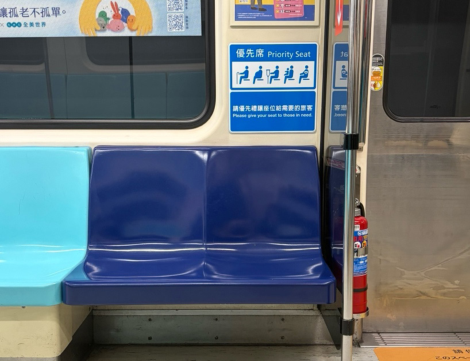
Non-participant Observation Observations were conducted on two high-volume Taipei Metro lines (Bannan and Tamsui–Xinyi) during peak (weekdays 07:30–09:30, 17:00–19:00) and off-peak periods. Each episode record included line and direction, time slot, carriage density (empty / moderate / crowded), and door location. The focal actors were: (1) Seekers, i.e., passengers perceived as needing a seat; (2) Givers, i.e., current occupants of Priority Seats or regular seats who may or may not yield; and (3) Bystanders, whose gaze, comments, or interventions shape the interaction climate. Seeker cues covered both visible need (e.g., older age, pregnancy, mobility aids, strollers) and possible invisible need (e.g., pallor, signs of pain or fatigue, early-stage pregnancy, heavy loads). These cues were recorded descriptively rather than as medical judgments. Figure 1 documents the in-car visual ecology of Taipei Metro Priority Seats (seat color, pictograms, and bilingual signage) as encountered in the field, providing a shared visual context for reporting episode locations and interactional sequences.
Figure 1: In-car priority seat area in the Taipei Metro, showing seat color and posted signage (pictograms and bilingual text).
Data Collection Protocol This study utilized the MRT Seat-Yielding Behavior Event Observation Record Sheet as the core instrument, employing event-oriented recording. Recording commenced when a Seeker began searching for a seat and concluded upon seat acquisition or abandonment. To minimize the observer effect, the researcher entered the field as a regular passenger and refrained from intervening in interactions. Data were recorded in real time using mobile phone memos, supplemented by thick qualitative notes written immediately after the event to preserve situational context.
Table 1: MRT seat-yielding behavior event observation record sheet.
Table available in the original PDF paper.
Basic Context Record ID, date, time, period, route, direction, and carriage crowding level (Empty / Moderate / Crowded).
Seeker’s Journey Need attribute (Visible / Invisible), behavioral sequence post-entry (scanning, moving, stopping), and inferred emotion (e.g., anxious, tired).
Giver’s Decision Seat type, demographic profile, pre-yielding activity (e.g., using phone, eyes closed), trigger (e.g., active observation, Seeker proximity), and response mode (e.g., immediate, hesitant).
Bystander Interaction Reactions such as staring, whispering, or active reminding.
Event Outcome & Qualitative Notes Success/failure of the event, interactional atmosphere (Natural / Awkward / Warm), and open-ended descriptive notes.
The Silent Language of Priority Seating: Invisible Needs, Attention Barriers 73 Data Analysis: Inductive Synthesis via Affinity Diagramming
The analysis employs affinity diagramming (Beyer & Holtzblatt, 2017) to perform an inductive synthesis of non-participant observation records and qualitative field notes. Data were first unitized into discrete behavioral fragments and verbal cues to facilitate rigorous cross-case comparison. Through an iterative process of clustering around interaction barriers and triggers, the team distilled the raw data into five insight tags: (1) Attention Barriers (e.g., digital immersion); (2) Invisible Needs and Information Asymmetry; (3) Bystander Intervention; (4) Legitimacy Crisis (e.g., fear of being questioned); and (5) Moral Pressure (the oppressive nature of the silent gaze). These tags serve as the conceptual bridge to Phase 2, providing a targeted framework for eliciting the “why” behind observed behaviors.
Semi-Structured Interviews: The Contextual Inquiry Framework Phase 2 utilizes semi-structured interviews grounded in the Master–Apprentice model of contextual inquiry to uncover latent motivations and psychological costs. The purposive sample (n = 10) represents three interactional positions: Seekers, specifically those with invisible needs (e.g., chronic pain, early-stage pregnancy) who face a paradox of disclosure; Givers (commuters and students) reflecting on labeling and stigmatization; and Bystanders weighing norm enforcement against diffusion of responsibility.
Interviews (10–15 minutes) used retrospective accounts to reconstruct specific seat-yielding episodes. By traversing the behavioral layer (“what”) and the motivational/risk layer (“why”), the researcher surfaced hidden dimensions of social negotiation that often reside out-of-awareness.
RESULTS
Across the 26 complete seat-yielding episodes, the overall success rate was 88.5% (23/26). Failed episodes were concentrated in situations involving invisible needs: when need cues were ambiguous or difficult to interpret, interactions were more likely to stall in a state of mutual waiting and inaction. Regarding Seeker strategies, most Seekers adopted passive spatial tactics (24/26), such as moving closer to the seating area, standing in front of seats, signaling discomfort through posture or hand movements, or repeatedly scanning the seats. Only two Seekers made a direct verbal request (2/26), and both occurred in crowded carriages where the risk of losing balance was particularly salient.
On the Giver side, clear attention barriers were observed in 18 of the 26 episodes (18/26), most commonly intensive phone use, wearing headphones, or closing one’s eyes. Attention barriers did not necessarily lead to failure; however, they raised the threshold for having the need noticed, making interaction more dependent on external triggers (e.g., Seeker proximity, bystander reminders, or collective staring). Bystander intervention played a decisive breakthrough role in a subset of successful cases (approximately 7/23). However, when such intervention took the form of direct pointing
Table 2: Behavioral patterns by role.
Table available in the original PDF paper.
Interactional Function Potential Risks
Role Common behaviors / Strategies
Uses distance and posture to “hint” at need, lowering the cost of speaking up
Cues remain unnoticed; behavior may be misread as “pressuring” or emotional manipulation
Seeker Scanning → moving closer → standing still → retreating to the door; leaning, gripping handrails tightly; avoiding eye contact
Evaluates costs under uncertainty and self- protection
Fear of misjudgment and of being judged; delayed reactions interpreted as indifference
Giver Immersion in phone / headphones / closed eyes; brief glances up; standing up or shifting only after being reminded Bystander Staring, whispering, applying gaze pressure; occasional verbal reminders or gestures Enforces norms and helps move the episode towards completion
Intervention may cause humiliation, escalate conflict, or trigger group judgement Based on interactional triggers and outcomes, the episodes were grouped into four types, with narrative notes summarizing key moments and atmospheres.
Table 3: Four types of seat-yielding episodes (tr.igger × outcome).
Table available in the original PDF paper.
Type Trigger Characteristics Typical Situation Common Outcome A. Spontaneous awareness Giver actively scans and notices need cues Usually smooth success with low interactional cost More visible need (older adults, pregnant passengers); medium crowding
Cues between visible and invisible; Seeker avoids speaking
B. Proximity cue Seeker signals by moving closer / lingering; Giver realises after being approached
Often successful, but with brief awkwardness or delay
C. Bystander-driven Bystander reminder, gesture, or gaze pressure triggers seat-yielding
Strong digital immersion or hard- to-read need
High success rate but increased risk of shame and judgement
D. Stalled failure No effective trigger; need ignored or misread
Ends in failure or seeker withdrawal
Invisible need, crowded carriage, fragmented attention; seeker retreats to door
The Silent Language of Priority Seating: Invisible Needs, Attention Barriers 75 Interview results: contextual inquiry and in-depth interviews (n = 10)
Core findings are illustrated below using thematic statements and representative excerpts from six interviewees (role codes: S = Seeker, G = Giver, B = Bystander).
Safety risks outweigh seat entitlement (Seekers / older adults) “The seat itself isn’t the main issue. What I really worry about is if the train suddenly jerks… I can’t afford a fall.” (S1) Silence as risk management, not absence of need (Seekers with invisible needs) “It’s not that I don’t want to ask. It’s that once I speak, I have to explain, and explaining feels like proving I’m ‘qualified’ to sit.” (S3) Digital immersion as self-regulation and a shield from scrutiny (Givers) “Wearing headphones doesn’t mean I don’t care. I just want a bit of rest. But I’m also afraid that if I look up and meet someone’s eyes, it’s like everyone is waiting for me to decide.” (G2) Fear of misjudgment pushes Givers toward caution: both offering wrongly and not offering can be condemned (Givers) “If you give up your seat, people might think you’re acting for show. If you don’t, you might get filmed and attacked online. In the end you just think: is there any way not to get dragged into this?” (G3) Bystander intervention as a double-edged sword: resolving deadlock but risking public shaming (Bystanders) “I speak up because I can see they’re really unsteady. But I also know that once I say something, it’s like naming names—everyone turns to look.” (B1) De-labeling expectations: shifting focus from ‘who deserves it’ to ‘how to care for each other’ (Cross-role consensus) “If every situation feels like an identity check, it doesn’t feel friendly. It’s more like we’re just trying to keep everyone safe together.” (G1) Taken together, the observations and interviews suggest that interactional breakdown is not merely a moral failure attributable to any single role. Rather, it emerges from the overlap of three uncertainties: uncertainty about need (it is not visible), uncertainty about awareness (attention is fragmented), and uncertainty about evaluation (actions are framed through moral judgment). Under these conditions, Seekers tend to adopt passive strategies to minimize self-disclosure; Givers rely on digital immersion or delayed responses to reduce the risk of being pulled into conflict; and Bystanders attempt to calibrate intervention intensity between helping” and “not humiliating those involved.
CONCLUSION
The Nature of the Conflict: This study demonstrates that the core seat- yielding predicament is rooted in need ambiguity, which produces pronounced information asymmetry. Seekers with invisible needs experience a persistent legitimacy crisis, whereas Givers face evaluation uncertainty and moral anxiety in the absence of reliable heuristics. In effect, this constitutes a structural usability failure: the public transportation system outsources critical information to visual heuristics and tacit social agreement. These findings align with the prosocial behavior literature, in which pluralistic ignorance and diffusion of responsibility foster watchful inaction (Latané & Darley, 1968; Piliavin et al., 1969). For Seekers, reliance on passive spatial tactics is a rationalized form of risk management; when requesting a seat becomes tantamount to self-disclosure and self-defense, the social cost of mutual aid becomes prohibitively high.
Verification via Design Research: The design analysis further suggests that attention barriers (e.g., digital immersion) function as mechanisms of self- regulation and avoidance of the oppressive gaze rather than as expressions of active malice. However, without mediated signals, such immersion often necessitates bystander intervention to catalyze interaction. While effective for norm enforcement, this introduces a secondary UX tension: gaze pressure or public identification can reframe assistance as a moral trial, thereby intensifying stigma for both the Giver and the Seeker. The current system therefore lacks a balancing mechanism between need visibility and shame avoidance.
Actionable Design Insights and Strategies: To restore system usability and reduce interaction costs, we propose two strategic directions:
1. Privacy-preserving nonverbal channels (reducing disclosure costs) If the core issue is that need signals fall outside of awareness and are unreadable, a gentle prompting channel that does not require public self- disclosure is needed to ensure needs are reliably conveyed.
Direction: Implement low-intrusion cues via mobile intermediaries (e.g., an app feature signaling “Someone nearby may need assistance”) or neutral, safety-focused symbols within the carriage.
Potential risk: If the prompting mechanism is poorly designed, it may generate new stigma or cause harassment; therefore, future work must evaluate acceptable prompt intensity through prototyping and contextual testing.
2. De-labeling via behavior-oriented visuals (reducing the judgmental frame) Labeling narrows mutual aid into a moral obligation for a select few, potentially triggering defensiveness. Shifting the focus from “Who is qualified?” to “How can we minimize risk together?” helps reduce anxiety about scrutiny.
Direction: Replace identity-based labels with inclusive, behavior- oriented prompts (e.g., “If you are seated, you can also be a reminder”), reframing seat-yielding as a shared social practice rather than a moralized, pointed obligation.
Potential risk: Excessive dilution of the Priority Seats concept may diminish the sense of security for those with visible needs. Thus, de-labeling does not equate to abolishing protection; rather, it aims to reduce the judgmental context and enable mutual aid to be practiced throughout the carriage.
RESEARCH LIMITATIONS Observation Visibility Constraints: Non-participant observation entails a pronounced visibility gap. Because this method relies exclusively on visible cues, the interpretation of implicit needs can only be described as “cues” and cannot definitively verify the actual physiological status. Although this study adopted a conservative approach to coding uncertainty, some scenarios may still be underestimated or misclassified.
Site and Route Constraints: Observations were concentrated on the Taipei Metro Bannan and Tamsui–Xinyi lines. While covering peak and off- peak periods, these do not represent all lines and time slots; variations in carriage models, station attributes, and passenger composition may generate differences.
Sample Size and Representativeness: The sample size (n = 26 episodes; n = 10 interviews) is sufficient for exploratory qualitative inquiry to generate preliminary insights, but it is not intended to be inferred as population parameters. Future research could combine larger-scale systematic observations or surveys to test the universality of these insights.
Intervention Strategies Not Yet Prototyped: The proposed “non-verbal prompting channels” and “de-labeled visual communication” remain design directions and have not yet undergone prototype testing. Future studies could employ situational theater, service prototypes, or A/B testing to evaluate their impact on conflict, feelings of humiliation, and realized seat-yielding rates.
REFERENCES
Akerlof, G. A. (1970). The market for “lemons”: Quality uncertainty and the market mechanism. Quarterly Journal of Economics, 84(3), 488–500. Corrigan, P. W. (2004). How stigma interferes with mental health care. American
Psychologist, 59(7), 614–625. https://doi.org/10.1037/0003-066X.59.7.614 Davis, N. L. (2005). Invisible disability. Ethics, 116(1), 153–213. Hall, E. T. (1959). The silent language. Doubleday & Company, Inc. Hall, E. T. (1966). The hidden dimension. Doubleday & Company, Inc. Holtzblatt, K., & Beyer, H. (2017). Contextual design: Design for life (2nd ed.).
Morgan Kaufmann. Latané, B., & Darley, J. M. (1968). Group inhibition of bystander intervention in emergencies. Journal of Personality and Social Psychology, 10(3), 215–221. Lazar, J., Feng, J. H., & Hochheiser, H. (2017). Research methods in human-computer
interaction (2nd ed.)
Sociology, 27, 363–385. Penner, L. A., Dovidio, J. F., Piliavin, J. A., & Schroeder, D. A. (2005). Prosocial behavior: Multilevel perspectives. Annual Review of Psychology, 56(1), 365–392. Piliavin, I. M., Rodin, J., & Piliavin, J. A. (1969). Good Samaritanism: An underground
phenomenon? Journal of Personality and Social Psychology, 13(4), 289–299.
LISTED IN THE AHFE DIGITAL BOOKSTORE CATALOGUE
Explore the complete digital volume
Usability and User Experience
Read this individual research paper free through the original publisher, or explore the full digital proceedings book.
ISBN 979-8-950676-08-6
Explore this ISBN in the AHFE Bookstore ↗Listed in the July 2026 bookstore catalogue; search by ISBN to confirm current availability · Digital book purchase optional