Guoping Jiang, Xiaojun Liu, Jin Shi (2024). Factors Affecting the Pillow Effect in Single-Point Incremental Forming. In: Human Aspects of Advanced Manufacturing, Production Management and Process Control. AHFE Open Access, vol. 146, pp. 97–104. https://doi.org/10.54941/ahfe1005155
Single-point incremental forming (SPIF) is a machining process that uses a tool to perform extrusion motion on a metal sheet blank, causing plastic deformation of the metal sheet blank to achieve the target model size accuracy requirement. The pillow effect, which occurs in the unformed region at the bottom of the part, significantly impacts the accuracy of the final product. Optimizing process parameters is necessary to minimize the impact of the pillow effect on accuracy. Conducting experiments to optimize the process parameters will inevitably increase research and development costs and extend the research and development cycle. However, using simulation models to simulate and optimize process parameters can effectively reduce research and development costs and shorten the research and development cycle. This work aims to study the effects of seven factors that affect the formation of the pillow effect in SPIF machining parts, including wall angle, diameter, height, wall thickness, downward step size, tool path interlayer connection method, and side wall shape. First, based on the ANSYS Workbench/LS-DYNA platform, a simulation model is constructed, and machining experiments and simulations are conducted to compare the results of the experiments and simulations by comparing the key points of the pillow effect profile curve to verify the feasibility of the model. Due to the layered machining characteristics of the single-point system, the pillow effect feature is easily formed in the unformed area at the bottom, and the pillow effect can be clearly seen to experience an increase zone, an upward zone, and a steady zone from the cross-sectional profile chart through the center axis. The simulation results show that the minimum pillow effect amount can be obtained when the process parameters are wall angle of 30°, bottom diameter of Φ50mm, forming depth of 30mm, plate thickness of 1mm, downward step size of 1mm, straight-line interlayer connection method, and hyperbolic side wall shape. Then, using the Taguchi method to set up an orthogonal experiment of L18(3^7), conduct simulation experiments, and obtain the measurement data of the pillow effect. The software used for the analysis of experimental signal-to-noise ratio data is Minitab-19, and the signal-to-noise ratio refers to the ratio of useful data read in the experiment to interference noise data. Variance analysis is performed on the obtained results to determine the optimal process parameter configuration of the seven factors. A prediction model is generated, and a confirmation experiment is conducted to validate the model. The confirmation experiment was conducted three times, and the average value of the measurement peak results was taken. The measurement results of the confirmation experiment were within the confidence interval of 95% confidence level. The results showed that the pillow effect decreases with an increase in wall angle and downward step size, and increases with an increase in bottom diameter, forming depth, and plate thickness. When the tool path is selected to be a straight-line interlayer connection method and the part side wall shape is a hyperbolic shape, a smaller pillow effect can be obtained.
In recent years, single-point incremental forming (SPIF) of metal sheets has gained considerable attention as an emerging advanced manufacturing technology. Based on the layer-by-layer manufacturing concept, SPIF is par- ticularly suitable for producing custom-made parts in small quantities (Li and Wang, 2022; Li et al., 2014). The SPIF process involves using a ball or flat-headed tool to shape a part along a pre-defined path (Kumar and Gulati, 2019; Ambrogio et al., 2006). Due to its high flexibility, low cost, and ability to process complex shapes, SPIF has shown great potential for applications in aerospace, automotive, and medical fields (Pandre et al., 2021; Sen et al., 2020; Sbayti et al., 2022). Currently, research on SPIF has extended to various types of materials, such as perforated sheets, high- density polyethylene sheets, and titanium alloy sheets (Bouzidi et al., 2022; Rosca et al., 2023; Frikha et al., 2022). Studies on SPIF have also focused on optimizing process parameters and planning machining paths (Mezher and Kovacs, 2022; Formisano et al., 2023). For instance, Manisn Oraon et al. investigated the effects of downward step size, tool end face area, and wall angle on machining quality (Oraon and Sharma, 2022). Miao Shang et al. studied the application of hydraulic systems in SPIF and determined the critical angle of uniform wall thickness corresponding to different sup- port pressures (Shang et al., 2023). Some studies have also examined the impact of process parameters on machining forces in SPIF (Duflou et al., 2007; Jeswiet et al., 2005). Ambrogio et al. proposed an industry-oriented method for detecting failure modes in incremental forming based on an anal- ysis of forming force trends (Ambrogio et al., 2006). Research on stress-strain magnitude and wall thickness reduction in single-point forming also demon- strated significant effects on improving machining accuracy and reducing metal sheet springback (Qadeer et al., 2023; Hassan et al., 2022; Singh et al., 2023a; Singh et al., 2023b). Xiaofan Shi et al. proposed a new non-interference spiral toolpath optimization method for expanding electri- cally assisted incremental forming to low-carbon steel DC04 metal sheets (Shi et al., 2013).
In practical applications of SPIF, the theoretical model’s bottom surface is often flat, and the flat surface is formed naturally after the theoretical model’s sidewalls are layered. However, the bottom surface may experience bulging due to plastic deformation during the machining process, which can affect the machinability of the part and the quality of the finished product (Pepelnjak et al., 2022). Therefore, it is essential to give sufficient attention to this issue and conduct further research on its forming mechanism and coun- termeasures. Prior studies on bottom surface bulging have been conducted by Najm et al., who used machine learning to investigate the effects of process parameters on sidewall and bottom surface bulging in single-point forming (Najm and Paniti, 2023).
This paper will construct a simulation model to study the bottom sur- face bulging phenomenon in SPIF and conduct experiments to validate the model.
Factors Affecting the Pillow Effect in Single-Point Incremental Forming 99
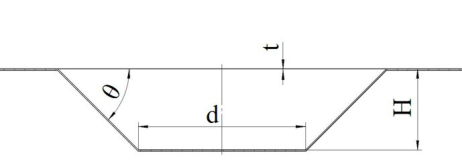
DESIGN OF EXPERIMENT FOR OPTIMIZATION OF PROCESS PARAMETERS As a method of machining metal sheets by using a tool to squeeze and deform them to achieve the required dimensions, single point incremen- tal forming (SPIF) belongs to the category of non-linear metal deformation due to the plastic deformation of the metal sheet during the machining process. Therefore, analyzing the deformation mechanism of SPIF using various finite element analysis software has become an important and cost- effective means. The finite element analysis software used in this article is ANSYS WorkBench/LS-DYNA, and the target model is a truncated cone (see Figure 1). Firstly, the three-dimensional model is constructed in the three- dimensional modeling software. Secondly, the three-dimensional model is imported into the finite element analysis software for boundary condition settings. Thirdly, simulation calculation is performed. Finally, the simulation results are analyzed.
Figure 1: Truncated cone and dimensions.
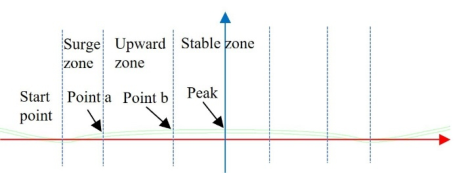
The pillow effect curve of the cross-section of the central axis of the finished product is shown (see Figure 2), where only half of the curve is dis- played due to the symmetrical nature of the bottom curve along the central axis of the frustum. From the graph, it can be observed that the pillow effect can be divided into three regions: surge zone, upward zone, and stable zone.
Figure 2: Pillow effect curve.
The pillow effect is influenced by many factors during the processing. This paper selects seven representative factors among them for research, including model wall angle θ (
), bottom diameter d (mm), forming depth H (mm), wall thickness t (mm), downward step 1z (mm), interlayer connection method, and model side wall shape (see Table 1). Among them, the model side wall
shape refers to three cases where the model side wall generatrix is a straight line, a parabola, and a hyperbola.
Table 1. Forming parameters for SPIF process.
Table available in the original PDF paper.
Symbol Input parameters Levels of input factors Level 1 Level 2 Level 3
A Forming angle θ(
) 30 45 60 B Diameter d(mm) 50 60 70 C Forming depth H(mm) 30 40 50 D Thickness t(mm) 1 1.2 1.5 E Step size 1z(mm) 0.6 0.8 1 F Connection method Linear Stepladder Jump G Sidewall shape Parabola Cone Hyperbola
Analysis of Mean Value and Signal-to-Noise Ratio The layout diagram of L27 orthogonal experiment and the response data, signal-to-noise ratio, and mean value obtained in each experiment are shown (see Table 2). The mean range value table in Table 3 and the signal-to-noise ratio range value table in Table 4 can be calculated based on Table 2.
Table 2. Layout of L27 OA with response data.
Table available in the original PDF paper.
Run Input parameters and their levels SN ratio Mean Sidewall shape Forming angle Diameter Forming depth
Analysis of Variance The mean of pillow effect obtained from Table 2 can be used as an input to perform variance analysis on various influencing factors to distinguish the significant factors affecting the pillow effect. The variance analysis table of the pillow effect (see Table 5) indicates that the significance factor P-value of the bottom diameter of the truncated cone is less than 0.05 at a 95% confidence level, which suggests that the bottom diameter of the truncated cone is a significant factor affecting the pillow effect.
Table 5. Analysis of variance for bottom pillowing.
Effects of Process Variables The simulation results show that the surface pillow effect decreases with the increase of the wall angle and the step size of the downward pressure. More- over, the pillow effect increases with the increase of the bottom diameter of the truncated cone. This is because the larger the bottom diameter, the greater the curve span of the pillow effect formed by the plastic deformation of the
tool during the processing of the bottom plate, and the higher the pillow effect height. The pillow effect increases with the increase of the forming depth and the thickness of the plate. Among the interlayer connection methods, the pil- low effect generated by the straight-line connection method of the tool path layer is the smallest. Among the side wall shapes, the pillow effect generated by the hyperbolic corresponding to the model side wall is the smallest.
The Predictive Model According to the range table and range chart, in order to minimize the pillow effect, the level of each influencing factor must be specified. Based on the analysis presented earlier, the optimal process parameters are as follows: wall angle of 30
, bottom diameter of 850mm, forming depth of 30mm, plate thickness of 1mm, step size of 1mm for downward pressure, linear interlayer connection mode, and hyperbolic side wall shape.
The optimal parameters were used as input parameters to perform the con- firmation experiment for the minimum pillow effect of 304 stainless steel plate on a single point incremental forming system. The confirmation experi- ment was conducted three times, and the average value of the measured peak points was taken. The measured results of the confirmation experiment were within the confidence interval of 95% at the confidence level.
CONCLUSION
Firstly, in this study, a simulation model of the pillow effect in single-point incremental forming (SPIF) was constructed and the effectiveness of the model was verified through experiments. Secondly, the Taguchi method was used to investigate the influence factors of the pillow effect in seven SPIF processes. Finally, three conclusions were drawn. Due to the layer-by-layer processing characteristic of SPIF, the pillow effect is likely to form in the unformed area at the bottom, and the profile of the pillow effect from the center axis clearly shows an increasing region, a rising region, and a stable region from the edge to the center. The simulation results showed that the minimum pillow effect could be obtained with a wall angle of 30
, a bottom diameter of 850mm, a forming depth of 30mm, a sheet thickness of 1mm, a downward step of 1mm, and a linear interlayer connection and hyperbolic sidewall shape. The pillow effect decreased with an increase in wall angle and downward step, but increased with an increase in bottom diameter, forming depth, and sheet thickness. A smaller pillow effect could be obtained by select- ing a straight interlayer connection and a hyperbolic sidewall shape for the tool path.
REFERENCES
Ambrogio, G., Filice, L. & Micari, F. 2006. A force measuring based strategy for failure prevention in incremental forming. Journal of Materials Processing Technology, 177, 413–416. Bouzidi, S., Ayadi, M. & Boulila, A. 2022. Feasibility Study of the SPIF Process
Applied to Perforated Sheet Metals. Arabian Journal for Science and Engineering, 47, 9225–9252.
Factors Affecting the Pillow Effect in Single-Point Incremental Forming 103
Duflou, J., Tunckol, Y., Szekeres, A. & Vanherck, P. 2007. Experimental study on force measurements for single point incremental forming. Journal of Materials Processing Technology, 189, 65–72. Formisano, A., Boccarusso, L. & Durante, M. 2023. Optimization of Single-Point
Incremental Forming of Polymer Sheets through FEM. Materials, 16. Frikha, S., giraud-Moreau, L., Bouguecha, A. & Haddar, M. 2022. Simulation-Based Process Design for Asymmetric Single-Point Incremental Forming of Individual Titanium Alloy Hip Cup Prosthesis. Materials, 15. Hassan, A. A., Kucukturk, G., Yazgin, H. V., Gurun, H. & Kaya, D. 2022. Selection
of Constitutive Material Model for the Finite Element Simulation of Pressure- Assisted Single-Point Incremental Forming. Machines, 10. Jeswiet, J., Duflou, J. R. & Szekeres, A. 2005. Forces in Single Point and Two Point Incremental Forming. Sheet Metal 2005, 6–8, 449–456. Kumar, A. & Gulati, V. 2019. Experimental investigation and optimization of surface
roughness in negative incremental forming. Measurement, 131, 419–430. Li, R. X. & Wang, T. 2022. Research on Single Point Incremental Forming Characteristics of Perforated TA1 Sheet. Metals, 12. Li, Y. L., Liu, Z. B., Daniel, W. J. T. & Meehan, P. A. 2014. Simulation and Experi-
mental Observations of Effect of Different Contact Interfaces on the Incremental Sheet Forming Process. Materials and Manufacturing Processes, 29, 121–128. Mezher, M. T. & Kovacs, B. 2022. An Investigation of the Impact of Forming Process Parameters in Single Point Incremental Forming Using Experimental and Numerical Verification. Periodica Polytechnica-Mechanical Engineering, 66, 183–196. Najm, S. M. & Paniti, I. 2023. Investigation and machine learning-based predic-
tion of parametric effects of single point incremental forming on pillow effect and wall profile of AlMn1Mg1 aluminum alloy sheets. Journal of Intelligent Manufacturing, 34, 331–367. Oraon, M. & Sharma, V. 2022. Deriving the functional relation of input parameters in single-point incremental forming through dimensional analysis. Frontiers in Mechanical Engineering-Switzerland, 8. Pandre, S., Morchhale, A., Kotkunde, N. & Kurra, S. 2021. Processing of DP590 steel
using single point incremental forming for automotive applications. Materials and Manufacturing Processes, 36, 1658–1666. Pepelnjak, T., Sevsek, L., Luzanin, O. & Milutinovic, M. 2022. Finite Element Simplifications and Simulation Reliability in Single Point Incremental Forming. Materials, 15. Qadeer, A., Hussain, G., Alkahtani, M. & Buhl, J. 2023. Springback behavior
of a metal/polymer laminate in incremental sheet forming: stress/strain relax- ation perspective. Journal of Materials Research and Technology-Jmr&T, 23, 1725–1737. Rosca, N., Oleksik, M., Rosca, L., Avrigean, E., Trzepiecinski, T., Najm, S. M.
& Oleksik, V. 2023. Minimizing the Main Strains and Thickness Reduction in the Single Point Incremental Forming Process of Polyamide and High-Density Polyethylene Sheets. Materials, 16. Sbayti, M., Ghiotti, A., Bahloul, R., Belhadjsalah, H. & Bruschi, S. 2022. Effective strategies of metamodeling and optimization of hot incremental sheet form- ing process of Ti6Al4Vartificial hip joint component. Journal of Computational Science, 60.
Sen, N., Tasdemir, V. & Secgin, O. 2020. Investigation of formability of HC380LA material via the TPIF-RL incremental forming method. Ironmaking & Steelmak- ing, 47, 1199–1205. Shang, M., Li, Y., Yang, M. S., Chen, Y. S., Bai, L. & Li, P. Y. 2023. Wall Thickness
Uniformity in ISF of Hydraulic Support: System Design, Finite Element Analysis and Experimental Verification. Machines, 11. Shi, X. F., Gao, L., Khalatbari, H., Xu, Y., Wang, H. & Jin, L. L. 2013. Electric hot incremental forming of low carbon steel sheet: accuracy improvement. International Journal of Advanced Manufacturing Technology, 68, 241–247. Singh, R. P., Kumar, S., Pande, S., Salunkhe, S., Ragab, A. E., Singh, P. K., Meraz, M.
& Davim, J. P. 2023a. Robot-Assisted Cold and Warm Incremental Sheet Forming of Aluminum Alloy 6061: A Comparative Study. Metals, 13. Singh, R. P., Kumar, S., Singh, P. K., Meraz, M., Srivastwa, A. K., Salunkhe, S., Hussein, H. M. A., Nasr, E. S. A. & Kamrani, A. 2023b. A Mathematical Model for Force Prediction in Single Point Incremental Sheet Forming with Validation by Experiments and Simulation. Processes, 11.
LISTED IN THE AHFE DIGITAL BOOKSTORE CATALOGUE
Explore the complete digital volume
Human Aspects of Advanced Manufacturing, Production Management and Process Control
Read this individual research paper free through the original publisher, or explore the full digital proceedings book.
ISBN 978-1-964867-22-9
Explore this ISBN in the AHFE Bookstore ↗Listed in the July 2026 bookstore catalogue; search by ISBN to confirm current availability · Digital book purchase optional