Yikai Zhou, Feng Lv, Zuguang Huang, Haoyu Yu, Xiaojun Liu (2026). A Deviation Propagation Graph Model and Deviation Propagation Computation Method for Rigid–Flexible Hybrid Assembly. In: Human Factors and Ergonomics In Design. AHFE Open Access, vol. 210, pp. 277–285. https://doi.org/10.54941/ahfe1007449
In box-type spacecraft structures, machine tools, and similar complex products, assembly variation transfer is governed jointly by multilevel assembly hierarchy, parallel support chains, and the elastic response of compliant parts. Under such conditions, classical formulations based on a single tolerance chain or rigid-body accumulation cannot preserve assembly topology, part-level tolerance relations, and compliant coupling within a unified representation. This paper presents a graph-based method for rigid-flexible hybrid assembly variation analysis. An assembly directed graph (ADG) is used at the assembly level to encode assembly sequence, locating datums, and interface dependency, while a dimension and tolerance propagation graph (DTPG) is used at the part level to organize feature-level relations among dimensions, geometric tolerances, and measured deviations. A propagation-path subgraph is then extracted on the ADG for a designated source datum and target functional feature, and coupled with the relevant DTPGs to generate an assembly relation propagation graph based on functional element pairs (FEPs). In this way, all effective parallel transmission branches are preserved explicitly and remain available for branch-wise comparison and variation tracing. A plate-type rigid-flexible hybrid assembly case demonstrates that the proposed method preserves the effective transfer structure associated with the target feature and provides a clear basis for dominant-branch identification and assembly process adjustment.
In complex precision assembly, variations do not simply accumulate along a single linear chain. Instead, they are transmitted through locating relationships, interface constraints, and tolerance chains, and are finally manifested at the target functional feature. Their formation and accumulation are governed not only by assembly sequence and datum dependency, but also by dimensional and geometric tolerances inside individual parts, in-process measurement uncertainty, and the elastic response of compliant components. For three- dimensional tolerance analysis and variation propagation, research has
established a basic technical framework centered on Jacobian-Torsor (J-T) and Small Displacement Torsor (SDT) based linearized models, together with statistical tolerance analysis and Monte Carlo simulation (Cao et al., 2018; Desrochers et al., 2003; Qureshi et al., 2012). For thin-walled and other deformable parts, flexible variation analysis has further introduced finite- element response into assembly variation analysis (Liu and Hu, 1997; Camelio et al., 2003).
At the assembly-process level, assembly sequences, locating datum dependencies, and multistage variation accumulation are commonly represented by graph models or state-transition formulations (Homem de Mello and Sanderson, 1991; Hu and Koren, 1997; Mantripragada and Whitney, 1999), while GD&T-oriented geometric semantic models provide a unified basis for organizing and computing tolerance information (Requicha, 1983; Desrochers and Rivière, 1997). However, for complex products such as box-type spacecraft panel structures and machine tools, existing methods usually focus on only one aspect, for example assembly topology, tolerance semantics, or compliant response. As a result, they do not readily answer several central questions of assembly variation analysis: where the variation is introduced, along which transmission branches it is transferred, where it converges, and how it finally affects the target functional feature. This limitation becomes particularly evident when multi-datum assembly, parallel support chains, and compliant interface coupling coexist, because a single tolerance chain or a locally selected path can no longer preserve the full structural semantics of the transfer process.
In this paper, rigid-flexible hybrid assembly refers to an assembly system containing both rigid components and flexible/compliant parts. When discussing local mechanical response or prior tolerance-analysis literature, the established term compliant is retained where appropriate.
To address this issue, this paper develops a graph-based method oriented to target functional features. More specifically, a dual-layer model composed of an assembly directed graph and a dimension and tolerance propagation graph is first established. The former describes assembly-level locating relations and interface constraint semantics, whereas the latter organizes feature-level relations among dimensions, tolerance chains, and measured deviations inside each part. A propagation-path subgraph strategy is then introduced on the ADG for multi-datum assemblies and interface-driven subassembly interactions, so that a unified and computable upstream dependency structure can be extracted for a designated source datum and target functional feature. On this basis, the propagation-path subgraph is coupled with the relevant DTPGs to generate an assembly relation propagation graph based on functional element pairs, thereby retaining all effective parallel transmission branches for branch identification, variation tracing, and subsequent assembly process adjustment.
A Deviation Propagation Graph Model and Deviation Propagation Computation 279 DUAL-LAYER GRAPH MODEL AND PROPAGATION-PATH SUBGRAPH GENERATION
The proposed methodology may be summarized in terms of assembly-level locating-relation modeling, part-level tolerance-chain organization, and target-oriented path-subgraph extraction. The assembly is represented as an assembly directed graph G = (V, E), where each vertex v ∈ V denotes a part or subassembly and each directed edge (u → v) ∈ E indicates that the positioning or installation of v depends on u. Unlike a purely topological assembly graph, the proposed formulation emphasizes semantic edge information that can directly support downstream assembly variation analysis. Each edge therefore explicitly records interface features, constraint type, datum precedence, and assembly-step information: C(u → v) = {(fu, fv, type, priority, step_id)}, (1)
where fu and fv denote paired interface features, specifies the constraint type, and priority and describe datum precedence and assembly-step information, respectively. These attributes not only encode primary and secondary datuming semantics in the assembly process, but also provide the indexing information required later for locating input and output features in the DTPG and for constructing interface nodes based on functional element pairs. For stabilized upper-level subassemblies, an equivalent rigid- reference assumption is adopted so that model complexity can be controlled without violating assembly causality.
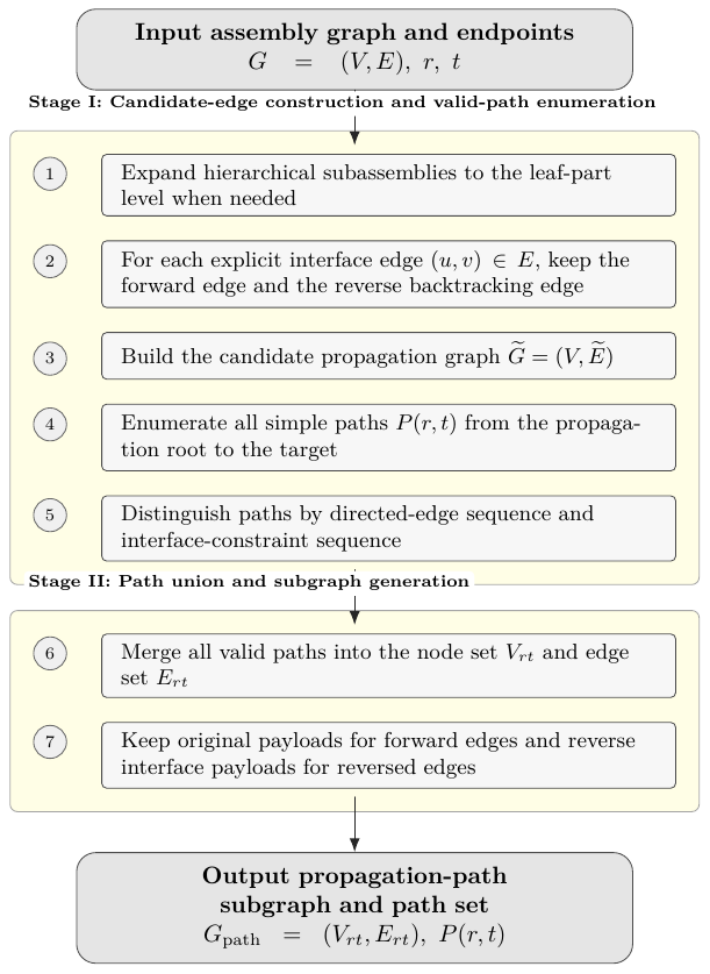
In practical assemblies, the source location of variation transfer does not necessarily coincide with the global root of the original assembly directed graph; instead, it may be introduced through an external datum interface acting directly on an internal node of a subassembly. Under such conditions, enforcing a globally single-root orientation for all edges may treat local upstream backtracking, parallel-branch preservation, and subsequent assembly constraints within the same topological rewriting step, thereby weakening the discrimination of target-oriented transfer structure. Accordingly, the present work formulates the problem as the construction of a propagation-path subgraph for a designated source datum r and target node t. Assembly edges carrying explicit interface constraints are permitted to support both forward traversal and local reverse backtracking while preserving interface semantics, whereas pure precedence edges retain their original orientation so that no reverse path is introduced without interface evidence. All simple paths from r to t are then enumerated on the resulting candidate graph, and physically distinct paths are discriminated by the directed-edge sequence together with the interface-constraint sequence rather than by part sequence alone. In this way, paths sharing the same part chain but following different interface features or datum roles remain distinguishable. Reverse traversal therefore denotes only a local upstream backtracking process along an existing interface relation; associated interface payloads are reversed consistently, and the historical assembly sequence itself remains unchanged.
Figure 1: Workflow of propagation-path subgraph generation for the assembly directed graph.
To organize dimensional tolerances, geometric tolerances, and measured deviations inside each part in a unified way, a dimension and tolerance propagation graph is constructed for every part. Assembly-relevant geometric features are represented as vertices, while dimensional or geometric constraints are represented as multi-edges. Measurement residuals, estimated deviation torsors, and covariance information can be attached as edge attributes. In
A Deviation Propagation Graph Model and Deviation Propagation Computation 281 this way, the part-level graph preserves not only the nominal topology of dimensional and geometric tolerance chains, but also a direct attachment point for the measured variation information required by downstream transfer analysis. For compliant parts, the same graph can also host finite- element meshes, equivalent stiffness data, or interface-condensation results, so that geometric tolerances, measurement uncertainty, and compliant response can all be accessed through a unified entry.
Based on the assembly directed graph and the dimension and tolerance propagation graph, the proposed assembly relation propagation graph is not treated as a third foundational model parallel to the ADG and DTPG. Instead, it serves as a solver-ready representation obtained by coupling the propagation-path subgraph with the relevant DTPGs. Inter-part interface relations are inherited from the assembly edges retained in the propagation- path subgraph and define dependency direction and constraint type, whereas intra-part feature, tolerance-chain, and measurement relations are inherited from the dimension and tolerance propagation graphs and map manufacturing tolerances, measurement residuals, and compliant local transfer blocks to assembly-relevant interface features. Once these two types of structures are aligned at the interface-feature level, the resulting graph provides a unified structural description from variation sources to target functional features and places information that would otherwise remain dispersed between the assembly layer and the part layer within a common transfer framework.
For rigid parts, the proposed formulation adopts a local single-path policy inside each DTPG: for every input/output feature pair, only one representative tolerance chain satisfying the priority rules is retained, so that ambiguity in intra-part tolerance transfer can be eliminated. For compliant parts, the
condensed interface transfer blocks obtained offline are used directly. By contrast, the system level follows a global multi-path policy: all effective parallel branches preserved in the propagation-path subgraph continue to appear in the assembly relation propagation graph and remain available for downstream branch-wise comparison. In this way, target-oriented branch screening at the assembly level and local transfer semantics at the part level are coupled within the same graph structure.
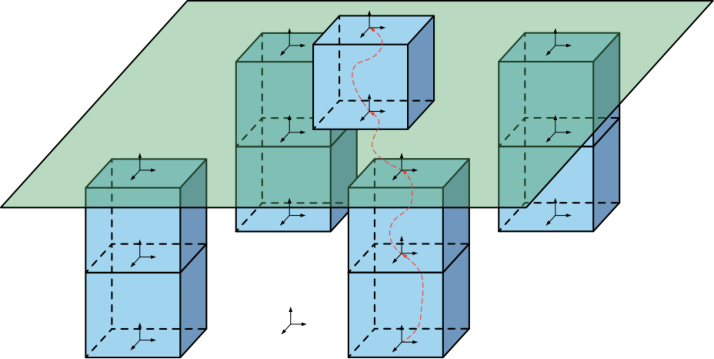
CASE STUDY AND RESULTS A plate-type rigid-flexible hybrid assembly unit is used as the illustrative case. The base platform provides the global datum and four corner supports, thereby generating four parallel transfer branches. A compliant panel is constrained through four corner pads and coupled with a transfer block at the center, and the final response is observed on the upper target plane. From the standpoint of assembly variation modeling, the base platform and support structure mainly carry assembly-level locating dependency and rigid interface transfer, whereas the four corner pads and the central transfer block of the compliant panel define the key interface nodes associated with functional element pairs. This configuration, characterized by corner-wise parallel input, central compliant convergence, and upper-level functional output, contains the three representative features of multi-source input, parallel transfer, and compliant coupling at the same time. It is therefore suitable not only for testing whether the generated propagation-path subgraph can preserve parallel branches stably, but also for examining whether the trimmed local graph still reflects the actual assembly semantics accurately.
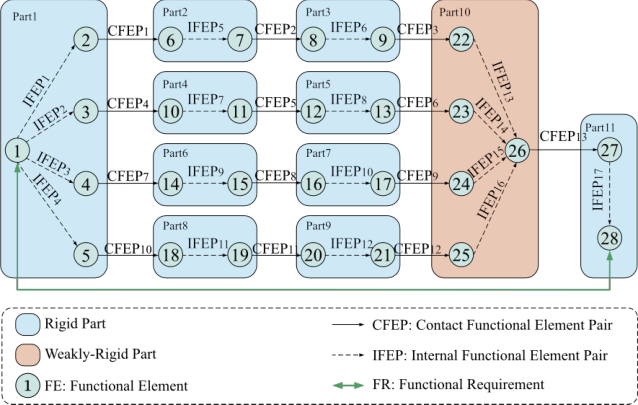
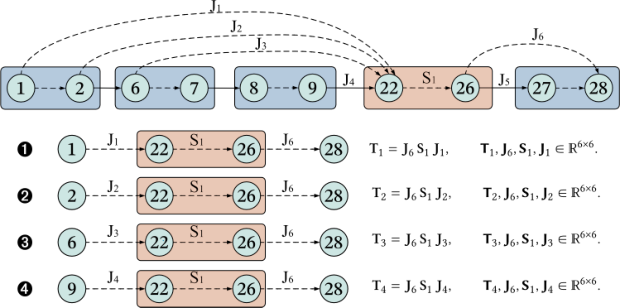
Figure 2: Case scenario of the plate-type rigid-flexible hybrid assembly and its main propagation direction.Figure 3: Assembly relation propagation graph for the plate-type rigid-flexible hybrid assembly case.Figure 4: Representative source-to-target transfer chains and their path-wise computational organization.
For this case, based on the assembly directed graph and the propagation- path subgraph strategy, part-level dimension and tolerance propagation graphs and the assembly relation propagation graph based on functional element pairs are constructed. For the compliant panel, interface-level condensed transfer blocks are integrated into the same graph together with rigid-body coordinate transformations. The assembly relation propagation graph shown in Figure 3 is used to present the overall transfer structure associated with the target functional feature, whereas Figure 4 does not provide a complete map of all target-related transfer paths. Instead, it extracts one representative downstream trunk from the assembly relation propagation graph and, along this trunk, organizes several path-wise transfer relations from upstream variation sources to the target feature.
The graph in Figure 3 shows that several parallel branches remain independent before reaching the compliant panel, while the central region of the panel couples their inputs and transfers the resulting response further upward. If the analysis is performed on the complete assembly representation, coordinate-transformation nodes, local relay interfaces, and branches only weakly related to the target tend to introduce considerable structural redundancy. By first restricting the upstream structure at the assembly level through the propagation-path subgraph and then coupling it with the relevant DTPGs through the assembly relation propagation graph, the principal transfer structure may be summarized more clearly as “base platform - support branch - panel center - target plane”, so that the target-related information becomes more concentrated and the structural representation more concise. Figure 4 further indicates that, once the target feature is fixed, path-wise transfer computation may be organized around a selected downstream trunk while tracing several representative upstream variation sources to the same target feature.
Further examination shows that the geometric lever arms of the branches are globally similar, and that their major differences are mainly reflected in the local compliance and coupling behavior encoded by the condensed transfer blocks of the panel. This indicates that once an assembly exhibits a pronounced parallel topology together with compliant segments, a single tolerance chain or a single representative path tends to mask the true branching and convergence relations of the transfer process. By contrast, the proposed graph model preserves these transmission branches explicitly and provides a clearer structural basis for subsequent path-level transfer- matrix comparison, dominant-branch identification, and support-layout optimization.
CONCLUSION
This paper presents a dual-layer model composed of an assembly directed graph and a dimension and tolerance propagation graph for rigid-flexible hybrid assembly variation analysis and, on that basis, generates an assembly relation propagation graph by coupling the propagation-path subgraph with the relevant DTPGs for branch-wise comparison and variation tracing with respect to target functional features. The propagation-path subgraph strategy allows multi-datum assembly, parallel supports, and local backtracking inside subassemblies to be handled within the same analytical framework, while the dimension and tolerance propagation graph allows dimensional tolerances, geometric tolerances, and measured deviations inside each part to be organized in the same framework as assembly-level relations. The plate-type rigid-flexible hybrid assembly case confirms that the proposed method preserves the effective transfer structure associated with the target feature even when parallel paths and compliant convergence coexist, thereby improving the interpretability of the relations among variation sources, transmission branches, and target responses. Future work will further integrate quantitative path-level transfer analysis and extend local transfer- block modeling and uncertainty-propagation strategies to multi-condition, nonlinear-contact, and large-deformation scenarios.
REFERENCES
Camelio, J., Hu, S. J. and Ceglarek, D. 2003, ‘Modeling variation propagation of multi-station assembly systems with compliant parts’, Journal of Mechanical Design 125(4), 673–681. Cao, Y., Liu, T. and Yang, J. 2018, ‘A comprehensive review of tolerance analysis
models’, The International Journal of Advanced Manufacturing Technology 97(5), 3055–3085. Desrochers, A., Ghie, W. and Laperrière, L. 2003, ‘Application of a unified jacobiantorsor model for tolerance analysis’, Journal of Computing and Information Science in Engineering 3(1), 2–14. Desrochers, A. and Rivière, A. 1997, ‘A matrix approach to the representation
of tolerance zones and clearances’, The International Journal of Advanced Manufacturing Technology 13(9), 630–636. Homem de Mello, L. S. and Sanderson, A. C. 1991, ‘Representations of mechanical assembly sequences’, IEEE Transactions on Robotics and Automation 7(2), 211–227. Hu, S. J. and Koren, Y. 1997, ‘Stream-of-variation theory for automotive body
assembly’, CIRP Annals 46(1), 1–6. Liu, S. C. and Hu, S. J. 1997, ‘Variation simulation for deformable sheet metal assemblies using finite element methods’, Journal of Manufacturing Science and Engineering 119(3), 368–374. Mantripragada, R. and Whitney, D. E. 1999, ‘Modeling and controlling variation
propagation in mechanical assemblies using state transition models’, IEEE Transactions on Robotics and Automation 15(1), 124–140. Qureshi, A. J., Dantan, J.-Y., Sabri, V., Beaucaire, P. and Gayton, N. 2012, ‘A statistical tolerance analysis approach for over-constrained mechanism based on optimization and monte carlo simulation’, Computer-Aided Design 44(2), 132–142. Requicha, A. A. G. 1983, ‘Toward a theory of geometric tolerancing’, The
International Journal of Robotics Research 2(4), 45–60.
LISTED IN THE AHFE DIGITAL BOOKSTORE CATALOGUE
Explore the complete digital volume
Human Factors and Ergonomics In Design
Read this individual research paper free through the original publisher, or explore the full digital proceedings book.
ISBN 978-1-964867-86-1
Explore this ISBN in the AHFE Bookstore ↗Listed in the July 2026 bookstore catalogue; search by ISBN to confirm current availability · Digital book purchase optional