Xinlu Qu, Zhang Yiran, Wenyu Wu, Xiaojun Liu (2025). Menu optimization of digital twin system based on user experience: A case study of lyophilized injection workshop. In: Intelligent Human Systems Integration (IHSI 2025): Integrating People and Intelligent Systems. AHFE Open Access, vol. 160, pp. 278–285. https://doi.org/10.54941/ahfe1005833
1 School of Mechanical Engineering, Southeast University, Nanjing 211189, China ↗
2 School of Mechanical Engineering, Southeast University, Nanjing 211189, China; Engineering Research Center of New Light Sources Technology and Equipment Ministry of Education, Southeast University, Nanjing 210018, China ↗
Menus are not only a basic user interface element in digital twin systems, but also a key component to improve system usability, user experience, and operational security. Pie menus have been used in SunView, NEWS, and many other systems since Hopkins pioneered them, but they are not widely used in digital twin systems. Previous studies have shown that its usage efficiency is better than that of linear menus, so this paper takes the lyophilized injection workshop digital twin system as an example to verify the user experience differences between pie menus and linear menus within the digital twin system. According to the function of the production line in the lyophilized powder production workshop, the pie menu and linear menu are designed for the interface of the cartoning robotic arm equipment in the intelligent packaging line, and the usability test is used to quantify the user experience data, and through the reliability and validity test and data analysis, it is concluded that the pie menu is higher than the linear menu in terms of ease of learning, use efficiency, usability, and satisfaction, etc., and that the adoption of the pie menu can help to improve user experience.
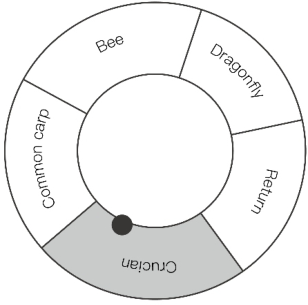
Menus Despite the two-dimensional nature of computer screen displays, current interface systems are still dominated by linear menus that do not take full advantage of the two-dimensional display space. In 1991, Hopkins et al. (1991) pioneered the pie menu (see Figure 1). Since then pie menus have been used in SunView, NeWS and many other systems.
According to Fitz’s law, the selection efficiency of pie menu should be better than that of linear menu (MacKenzie et al., 1992). Callahan chose novices as the research object, and analyzed the comparison between pie menu and linear menu, and the results showed that compared with linear menu, the time for users to complete the search task with pie menu is shorter, and the rate of correctness is higher, which is consistent with the Fitz’s law (Callahan et al.,
Menu Optimization of Digital Twin System Based on User Experience 279
2008). The linear arrangement of the linear menu results in an increasing distance for the cursor when it reaches each menu item from the top to the bottom, and the corresponding clicking difficulty gradually increases; while the pie menu adopts a uniform distribution of options equidistant from the center of the circle, and the consistency of this distance helps the formation of the user’s operational memory.
Figure 1: Pie menu schematic (adapted from Hopkins, 1991).
Digital Twin System for Lyophilized Injection Workshop The lyophilized powder injection 2 workshop of Yangzijiang Pharmaceutical consists of several production lines, while each production line consists of several equipments, including bottle washer, oven, filling machine, capping machine, lyophilizer, and packaging line, etc (Kumar et al., 2024). These equipments complete the process of glass bottle cleaning, drying and de- pyrogenic sterilization, aseptic filling, semi-capping, etc. through automation technology in the production process, and finally complete the production of lyophilized powder injection. In the workshop, the production process of the product mainly includes the configuration of washing and drying, de- sterilization and filtration, filling, semi-corking, freeze-drying, capping, light checking, packaging and other steps, among which, the packaging line is a very important step, thus this paper takes the intelligent packaging line as an example to make a comparison between the pie menu and the linear menu.
In the lyophilized powder production workshop, the main task of the intelligent packaging production line is to realize the five major processes of labeling, blistering, boxing, cartoning and storage management of the vials in storage. The production line includes packaging equipment, logistics and warehousing equipment, auxiliary production equipment, intelligent induction devices and control systems. Through the synergistic effect of these equipments, the production line is able to realize the processes of automatic stocking, labeling, cartoning and warehousing to improve the production efficiency and quality. The equipment configuration of the intelligent packaging production line mainly includes packaging equipment,
logistics storage equipment, auxiliary production equipment, intelligent induction device and control system (see Table 1).
Table 1. Intelligent packaging line workshop equipment configuration.
AGV car, intelligent tower, conveyor belt, corner machine Auxiliary production equipment Intelligent induction device Weighing machine, labeling detection machine, RFID reader Control system MES system, DSC system
In the intelligent packaging line, the cartoning robotic arm is one of the important components (Yang et al., 2019). Real-time monitoring and control of the entire production line can be achieved through real-time mapping and adjustment of state attributes and movement information of the cartoning robotic arm of the intelligent packaging line, as well as collection and analysis of external signals. This approach can help manufacturing plants operate more efficiently and improve the productivity and quality of the production line.
In this paper, we propose to validate the difference in user experience between pie menus and linear menus in a digital twin system.
EXPERIMENTAL DESIGN Digital Twin System and Menu Design of Lyophilized Powder Injection Workshop
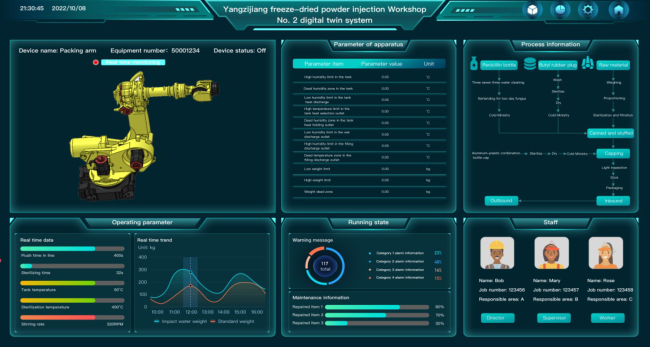
On the basis of understanding the production process, the information in the interface of the packing robot arm of the intelligent packaging line is classified to form the overall information layer of the system. In this paper, the bottom- up information classification method is adopted, and the information of lower level is gradually summarized into the information of higher level, and the interface of the workshop digital twin system is obtained (see Figure 2).
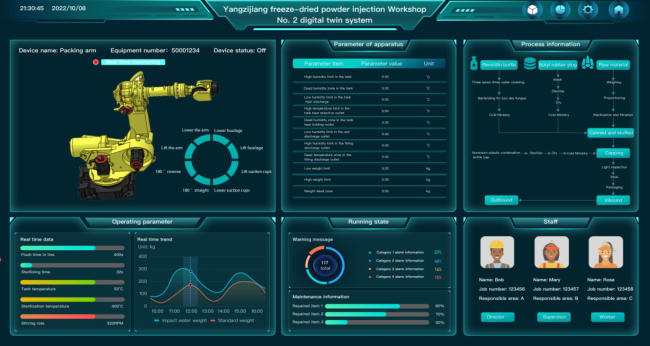
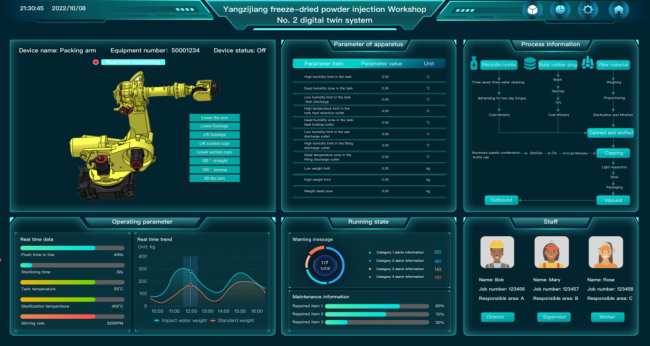
This study takes the case loading robotic arm in the packaging production line as an example for the operation flow design, and summarizes the operation of the case loading robotic arm as follows: put down the suction cups, lift the suction cups, rotate 180 degrees clockwise, rotate 180 degrees counterclockwise, put down the arm, lift the arm, put down the body, and lift the body. The pie menu (see Figure 3) and linear menu design (see Figure 4) is shown below.
Menu Optimization of Digital Twin System Based on User Experience 281
Figure 2: Packing mechanical arm device interface.Figure 3: Pie menu interface design.Figure 4: Linear menu interface design.
Experimental Subjects This validation experiment invites 10 relevant operators who are familiar with the digital twin system of Yangzijiang lyophilized powder injection No. 2 workshop, including 8 males and 2 females, aged between 24 and 26 years old.
Experimental Process Before the experiment began, the main experimenter introduced to the subjects the operation process of the loading and loading task of the control robot arm in the digital twin system of the second workshop of Yangzijiang Freeze-dried powder injection, showed the pie menu and linear menu, and conducted practice experiments to ensure that the subjects entered the formal experiment in the expert mode.
In order to ensure the accuracy of the experimental results, the menu is fixed in the upper left corner of the interface, and the menu appears after the subjects right-click the cross icon in the upper left corner of the interface. The menus were labeled as “lower the body, lower the arm, lower the suction cup, lift the suction cup, lift the arm, lift the body, rotate counterclockwise by 180 degrees, lower the body, lower the arm, lower the suction cup, lift the suction cup, lift the arm, lift the body, rotate clockwise by 180 degrees”. Each subject completed 3 sets of operation procedures using each of the two menus, with a break of 3–5 minutes between each set.
Questionnaire Design In order to ensure that the subjective evaluation was based on uniform criteria, a questionnaire needed to be completed at the end of all experimental trials. The SUS questionnaire was used for this subjective evaluation, with one questionnaire designed for each of the two menus, for a total of 2 questionnaires, 10 questions per questionnaire, and a total of 20 questions for the whole questionnaire. The specific questionnaire questions, for example, for the pie menu were as follows (see Table 2). Besides, it adopt the 5-level Likert scale score, subjects need to choose the most suitable item from the strongly opposed, opposed, average, satisfied and very satisfied.
Table 2. Pie menu sus questionnaire questions.
Table available in the original PDF paper.
Questionnaire Questions
1. I think I would like to use the pie menu more often. 2. I think pie menus are too complicated. 3. I think the pie menu is easy to use. 4. I think I will need professional help to use the pie menu. 5. I think the pie menu is well integrated with the overall shop system. 6. I think the pie menu and the shop system are too inconsistent and not relevant. 7. I think most people will learn to use the pie menu fairly quickly. 8. I think pie menus are very clumsy to use. 9. I feel confident using pie menus. 10. I think there are a lot of things I need to learn before using the pie menu.
Menu Optimization of Digital Twin System Based on User Experience 283
Data Analysis Firstly, the experimental data were tested for reliability. The two menus corresponding to the evaluation data were respectively verified by SPSS for reliability analysis, and the results showed that the Alpha coefficient was above 0.6, indicating that the questionnaire data had a certain degree of reliability. In this paper, KMO and Bartlett’s test were chosen for validity, i.e., the correspondence between the dimensions and the analyzed items was disregarded. The results show that the KMO value is above 0.6 and the p-value of Bartlett’s sphericity test is 0.000, which indicates that the questionnaire data has a certain validity. Therefore, the sus score calculation was carried out.The results show that the SUS score and rating of pie menu are higher than that of linear menu (see Table 3).
Table 3. SUS scale scores for linear menu and pie menu.
Table available in the original PDF paper.
Menu Type Sus Score Score Rating Linear menu 79.25 C Pie menu 88.75 B
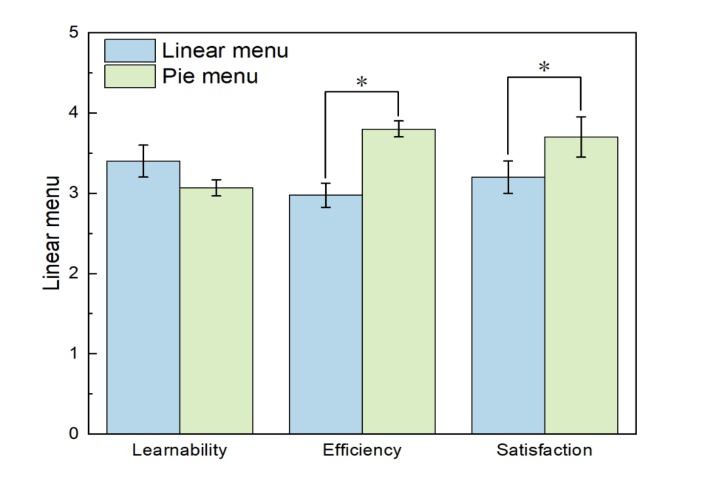
Since the SUS model consists of 10 questions, the odd-numbered items are positive statements and the even-numbered items are negative statements. Among them, items 4, 5, and 10 constitute the subscale “learnability”; items 2, 3, 7, and 8 constitute the subscale “efficiency”; and items 1, 6, and 9 constitute the subscale “satisfaction”. The two menu sus questionnaires were compared by extracting the questions related to ease of learning, efficiency of use, and satisfaction and calculating their mean values (see Table 4).
Table 4. Comparison of the average score of learnability, efficiency and satisfaction of sus between linear menu and pie menu.
Table available in the original PDF paper.
Menu Type Learnability Efficiency Satisfaction Linear menu 3.4 2.975 3.2 Pie menu 3.067 3.8 3.7
According to Table 4 data to make a bar chart, analysis can be obtained: the best easy to learn is the linear menu, the best efficiency is the pie menu, and the highest satisfaction is also the pie menu (see Figure 5).
CONCLUSION
According to the sus usability score rating, the linear menu is rated C the pie menu is rated B, and the pie menu is superior to the linear menu in sus usability score.
The result of the learnability of the subjects is that the linear menu is better than the pie menu. For the subjects, the linear menu has a long-term use basis, and there is almost no learning cost in the experiment, but the pie menu requires learning cost. Many subjects mentioned in the interview: “Although it needs to learn, the pie menu is not difficult to learn, it is easy to get started.”
Figure 5: Comparison of subjective evaluation between linear menu and pie menu.
The comparison result of the use efficiency of the subjects is that the pie menu is better than the linear menu. For this result, combined with the description of the subjects in the interview, it can be inferred that: Although the subjects are more familiar with the linear menu, they need to accurately click the control after searching for the target option, while the pie menu only needs to drag the cursor outside the scope of the control, which is more fault-tolerant and more random, so it is more efficient to use.
The result of the comparison of the satisfaction of the subjects is that the pie menu is superior to the linear menu because the pie menu has higher performance and less load. Therefore, in the digital twin shop scene, the pie menu based on click-enhancement technology is superior to the traditional linear menu.
ACKNOWLEDGMENT
First of all, I would like to express my sincere thanks to my supervisor, Mr. Liu Xiaojun, for his guiding opinions and helpful suggestions on my thesis. I am very grateful to him for his help in finishing this thesis. Secondly, I would like to thank Teacher Wu Wenyu and other senior teachers who helped me directly and indirectly. They spent a lot of time and energy to comment on my draft. Finally, I would like to thank my parents for their support and encouragement.
REFERENCES
Callahan, J., Hopkins, D., Weiser, M. & Shneiderman, B. 2008. 2.2 An empirical comparison of pie vs. linear menus.
Menu Optimization of Digital Twin System Based on User Experience 285
Hopkins, D. 1991. The design and implementation of pie menus. Dr Dobbs Journal, 16, 16–26. Kumar, S., Sanap, S. N., Vasoya, M., Handa, M., Pandey, P., Khopade, A. &
Sawant, K. K. 2024. Application of lyophilization in pharmaceutical injectable formulations: An industry and regulatory perspective. Journal of Drug Delivery Science and Technology, 100, 106089. Mackenzie, I. & Scott 1992. Fitts’ Law as a Research and Design Tool in Human- Computer Interaction. Human Computer Interaction. Yang, Y. I., Xiaojun, L., Jindan, F., Tingyu, L., Jinshan, L. & Zhonghua, N. I.
2019. Representation and generation method of digital twin-oriented product skin model. Computer Integrated Manufacturing Systems.
LISTED IN THE AHFE DIGITAL BOOKSTORE CATALOGUE
Explore the complete digital volume
Intelligent Human Systems Integration (IHSI 2025): Integrating People and Intelligent Systems
Read this individual research paper free through the original publisher, or explore the full digital proceedings book.
ISBN 978-1-964867-36-6
Explore this ISBN in the AHFE Bookstore ↗Listed in the July 2026 bookstore catalogue; search by ISBN to confirm current availability · Digital book purchase optional