Sijia Guo, Wenyu Wu (2025). The Effect of Tactile Prompts During the Takeover Process of Autonomous Driving. In: Intelligent Human Systems Integration (IHSI 2025): Integrating People and Intelligent Systems. AHFE Open Access, vol. 160, pp. 486–493. https://doi.org/10.54941/ahfe1005853
Autonomous driving technology is a key approach to enhancing road traffic safety and efficiency. Autonomous vehicles operate at a semi-autonomous level, necessitating driver intervention in certain situations. When the autonomous driving system encounters an emergency and issues a takeover request warning, it is imperative for the driver to promptly, safely, and smoothly assume control of the vehicle within the prescribed reaction time. During driving, auditory and visual channels are often occupied, which may lead to missed takeover information delivered through these modalities. Tactile signals emerge as an effective alternative to address this issue. This study utilizes a driving simulator to replicate driving scenarios and investigates the impact of tactile takeover signals on driver takeover efficiency. Additionally, subjective questionnaires were administered to assess drivers' psychological perceptions. The results demonstrate that tactile signals can effectively enhance driver takeover efficiency and are favorably received by drivers.
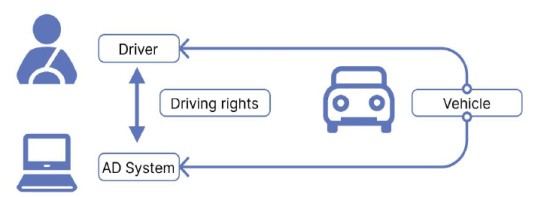
With the development of automotive assistance systems, the level of vehicle intelligence has continuously improved, resulting in significant changes in the driving tasks and cognitive load that drivers must undertake during driving. In 2016, the Society of Automotive Engineers (SAE) classified autonomous vehicles (AV) into six levels, with the vision of achieving full AV (Fagnant and Kockelman, 2015). However, due to limitations in automation technology and legal regulations, true autonomous driving is unlikely to be realized in the short term. AVs will still operate in conditionally automated driving (Level 3). In Level 3 autonomous driving, the autonomous driving system can control the vehicle in most situations, allowing the driver to perform non-driving-related tasks. However, the driver may enter a deactivated state and have diminished awareness of the driving environment, especially after engaging in prolonged non-driving tasks. Taking over control of the vehicle and transitioning back to an active driving state can be extremely challenging (Dillmann et al., 2021). After the takeover request is issued, the driver can quickly notice the road conditions ahead and complete the transfer of driving rights (see Figure 1), but there is a problem in immediately understanding the situation. The resulting time loss increases the risk of the driver making wrong decisions or delayed decisions. This is because the driver’s ability to
The Effect of Tactile Prompts During the Takeover Process of Autonomous Driving 487
regain control of the vehicle depends on their situational awareness at the time the takeover request is made and their ability to re-establish situational perception prior to taking over.
Figure 1: Driving rights switching in level 3 driving.
Although drivers may quickly notice the road conditions after a takeover request is issued, they often encounter difficulties in immediately understanding the situation, which increases the time lost and raises the risk of errors or delayed decisions. The form and timing of interaction between the driver and the autonomous driving system during a takeover process significantly influence the driver’s performance. Optimizing the system’s timing and method of issuing takeover requests has become a research focus in human-machine interaction for intelligent vehicles. Research on the human-machine interaction of autonomous driving takeover requests has mainly focused on the combination of auditory, visual, and tactile channels, as well as the modes of issuing takeover requests. Currently, visual channels are predominantly used for human-machine information exchange in autonomous vehicles. However, due to spatial limitations, information outside the driver’s field of view is prone to being overlooked, and shifting attention may cause visual distractions (Nukarinen et al., 2015). Compared to visual channel prompts, auditory signals are faster and more accurate, with a compelling attention-grabbing characteristic that makes them particularly effective for alerting the driver and prompting decision-making in emergency situations (Lorenz et al., 2014).
In contrast to visual or auditory stimuli, tactile prompts have a relatively smaller impact on automotive driving. However, tactile prompts are effective in capturing attention and are difficult for drivers to ignore (Van, 2002). This suggests that tactile stimuli, compared to visual or auditory stimuli, compete for fewer cognitive resources. Visual stimuli may be ignored when they are out of the driver’s field of view, and auditory stimuli may also be overlooked when the driver is engaged in non-driving-related auditory tasks. Given that drivers of autonomous vehicles are likely to engage in non-driving activities, such as resting or making phone calls, they may miss takeover requests if these requests are conveyed through traditional visual or auditory channels. Therefore, visual or auditory takeover alerts are not ideal for the takeover requirements in autonomous driving scenarios. Tactile stimuli serve as an effective complement to these channels. Multi-channel takeover alerts using auditory, visual, and tactile signals increase redundancy, thereby reducing the probability of drivers missing the alerts (Straughn et al., 2009). Tactile
488 Guo and Wu
information, through directed vibration cues, can guide the driver’s attention to the hazard area, enhance situational awareness, and reduce takeover time by shortening the search time for the event location after receiving the takeover alert.
Compared to visual and auditory signals, tactile signals have a lesser impact on automotive driving and can more effectively capture the driver’s attention. Consequently, tactile signals impose less perceptual and attentional load (Mohebbi et al., 2009). An earlier study found that increasing the distance between vibrators facilitates the driver’s ability to discern the direction of the vibration stimuli. Additionally, the number of simultaneously activated vibrators affects the driver’s subjective experience, with higher satisfaction levels when more vibrators are activated simultaneously (Petermeijer et al., 2017).
In this study, we confirmed the driver’s response to the driving simulator by using tactile stimulation to confirm that the driver’s response to the driving simulator is effective. In order to make the experimental results more universal, three different weather condition variables were selected to simulate real road scenarios and measure the effectiveness of the vibration channel takeover prompts.
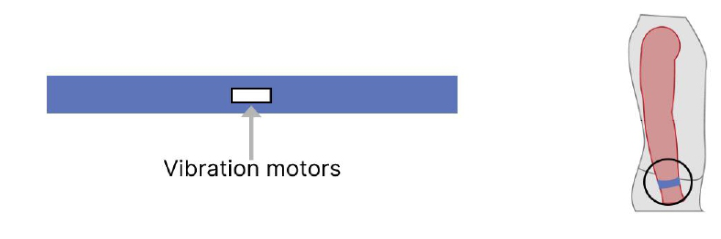
EXPERIMENTAL APPARATUS The experimental setup is illustrated in Figure 2. The vibration motor is a small, time-responsive linear vibration motor controlled by a tactile motion controller and a microcomputer, model number Jinlong Electromechanical G0825001. The vibration motor is embedded in a long nylon fixed strap to assemble into a bracelet, with a size of 30 mm in width and 330 mm in length, which can be adjusted according to the size of the participant to ensure that the signal of the vibration motor can be accurately transmitted to the skin surface. The experimental hardware equipment includes a 4K-165Hz high- resolution display produced by Samsung, which is composed of three displays spliced together to provide the driver with a wide viewing angle of about 180
horizontally. In addition, it is equipped with an adjustable semi-bucket seat (XDracing), a steering wheel and a pedal (Logitech, G923TRUEFORCE), and the average sensitivity of the equipment is set to 80%.
Figure 2: Experimental apparatus for tactile stimulation.
The Effect of Tactile Prompts During the Takeover Process of Autonomous Driving 489
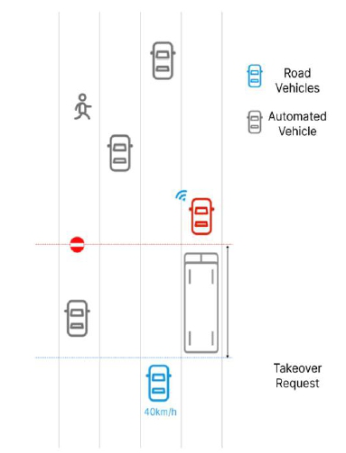
EXPERIMENTAL DESIGN The test block is a simulated urban highway environment. The subject vehicle is traveling in the middle lane at 40 miles per hour. Other vehicles are driving simultaneously beside the subject vehicle in the same direction. Due to system boundaries, three different common collision scenarios (pedestrian crossing the road, vehicle ahead breakdown, vehicle ahead blocking the view) are randomly presented in the driver’s lane to represent vehicle takeover scenarios (Figure 3). To avoid a crash, the driver can slow down or stop in his/her lane, or switch to the left or right lane. The takeover request of the experiment was the independent variable, which was a single auditory warning and vibration and auditory warning. In order to make the experimental results more universal, three different common weather conditions were selected for simulation: normal weather condition, foggy and rainy. Each participant performed 6 driving simulation experiments and recorded their reaction time. After the experiment, questionnaires were distributed to each subject and collected.
Figure 3: The test block.
PARTICIPANTS In order to ensure the smooth achievement of the experimental objectives and the effectiveness of the experimental results, all subjects recruited this time have held a driving license for more than 3 years. There are a total of 20 experimental participants, including 9 males and 11 females, with an age range of 18–45 years old, and an average age of 25.3 years old. All subjects have normal visual ability and photosensitivity, normal eye movement data collection, visual acuity or corrected visual acuity above 0.6, and healthy
490 Guo and Wu
mental state. They are required to have a normal work and rest schedule before the experiment, avoid eye contact with special light environment before the experiment, and maintain adequate sleep and rest.
EXPERIMENTAL RESULTS Firstly, the data were tested for normality and the results were as follows:
Table 1. Tests of normality–normal weather condition.
Table available in the original PDF paper.
Prompts Kolmogorov-Smirnova Shapiro-Wilk Statistic df Sig. Statistic df Sig.
Reaction time Auditory .204 10 .200* .936 10 .511 Vibration–auditory .170 10 .200* .931 10 .459 *. This is a lower bound of the true significance. a. Lilliefors Significance Correction
Table 2. Tests of normality–foggy.
Table available in the original PDF paper.
Prompts Kolmogorov-Smirnova Shapiro-Wilk Statistic df Sig. Statistic df Sig.
Reaction time Auditory .213 10 .200* .938 10 .530 Vibration–auditory .206 10 .200* .907 10 .260 *. This is a lower bound of the true significance. a. Lilliefors Significance Correction
Table 3. Tests of normality–rainy.
Table available in the original PDF paper.
Prompts Kolmogorov-Smirnova Shapiro-Wilk Statistic df Sig. Statistic df Sig.
Reaction time Auditory .204 10 .200* .911 10 .290 Vibration–auditory .132 10 .200* .952 10 .694 *. This is a lower bound of the true significance. a. Lilliefors Significance Correction
The significance (Sig) values for both groups are greater than 0.05, indicating that the data from both groups can be considered to follow a normal distribution. This confirms that the assumption of normality is met for the reaction time data under both conditions (with and without vibration reminders). Consequently, parametric statistical methods, which rely on the assumption of normality, are appropriate for analyzing these datasets.
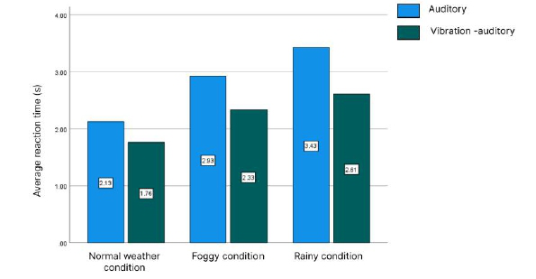
The reaction times under three different weather conditions were statistically analyzed, and the average reaction times are shown in the Figure 4.
The Effect of Tactile Prompts During the Takeover Process of Autonomous Driving 491
Figure 4: Average reaction time in each weather condition.
It can be observed that under each weather condition, the combination of vibration and auditory cues resulted in shorter reaction times compared to auditory cues alone.
Subsequently, an independent samples t-test was performed on the three datasets to evaluate whether the addition of vibration cues had a significant effect on drivers’ reaction times. The results are as follows:
The results indicated that p<0.05, demonstrating a significant difference in reaction times under the three weather conditions (clear, foggy, and rainy) depending on the presence of vibration cues. Specifically, reaction times were significantly faster when vibration cues were present compared to when they were absent. This finding suggests that the integration of vibration cues can effectively enhance drivers’ responsiveness across varying weather conditions, potentially contributing to improved driving safety and reduced response delays in critical situations.
For normal weather, p = 0.0010, which is highly significant, though slightly larger than the p-values for the other two weather conditions (still an extremely small probability). For foggy and rainy conditions, p = 0.0000, indicating that the differences reached an extremely significant level. This suggests that under adverse weather conditions, the addition of the tactile channel in reducing reaction times is nearly indisputable. As the weather conditions worsen (from normal to foggy to rainy), the p-values approach 0, indicating that the statistical evidence for the improvement in reaction
492 Guo and Wu
times due to the tactile channel becomes stronger under more challenging conditions.
The mean difference for normal weather is approximately 0.366 seconds, with a 95% confidence interval (CI) of [0.1934, 0.5386] seconds. This interval is relatively narrow and the difference is modest, yet it is still significantly greater than 0. In contrast, the mean difference for rainy weather is approximately 0.8170 seconds, with a CI of [0.6097, 1.0243] seconds. Compared to normal weather, this CI is not only entirely within the positive range but also larger and has no overlapping region, indicating that the improvement in reaction time due to the tactile channel in rainy weather ranges from 0.61 to 1.02 seconds, representing a much more substantial enhancement than in normal weather. As weather conditions worsen, the confidence intervals expand and remain entirely within the positive range, suggesting that under adverse conditions (foggy and rainy weather), the improvement in reaction times due to tactile feedback becomes more pronounced and more reliable.
The Cohen’s d for normal weather is approximately 1.5171, which represents a very large effect size, indicating that the tactile channel has had a significant impact on reaction times. For rainy weather, Cohen’s d is approximately 2.8196, which is even larger. This suggests that under rainy conditions, the effect of tactile feedback is not just statistically significant but also strong and of considerable practical significance. The comparison of effect sizes indicates that the benefits of tactile feedback become more pronounced as weather conditions worsen, with the greatest effect observed in rainy weather, followed by foggy weather, and the smallest effect, though still significant, observed in normal weather.
The analysis of the subjective questionnaire results revealed that 95% of participants reported that the tactile vibration reminder was effective, while one participant felt that the vibration reminder had little effect. Furthermore, 80% of participants indicated that, under varying weather conditions, the lower the visibility, the more noticeable and effective the vibration reminder became in capturing their attention. These findings provide strong evidence for the effectiveness of the tactile vibration reminder in this experiment. The high proportion of participants who acknowledged its usefulness highlights the potential of tactile feedback as an attention-enhancing tool, particularly in conditions where visual cues may be less reliable. The fact that a majority of participants found the vibration reminder more effective in low-visibility conditions, such as fog or rain, suggests that tactile cues can serve as a valuable supplemental alert in adverse weather. This indicates that tactile feedback has the potential to improve driver awareness and safety by compensating for reduced visual perception, thereby supporting its application in real-world driving scenarios, especially under challenging environmental conditions.
CONCLUSION
In this study, we evaluated the effectiveness of tactile prompts as takeover signals under simulated real-world driving conditions using a driving simulator. We simulated three different driving scenarios to assess the impact
The Effect of Tactile Prompts During the Takeover Process of Autonomous Driving 493
of tactile feedback. The results demonstrate the effectiveness of providing vibration stimuli to drivers in the context of conditional automation. The effectiveness of the vibration reminder varied across different weather conditions, highlighting that environmental factors play a crucial role in determining the efficacy of such reminders.
The subjective questionnaire results revealed that the tactile prompts did not impose any negative effects or cognitive load on the drivers. This suggests that tactile feedback is a non-intrusive and efficient communication method that does not overload the driver’s cognitive resources, making it a viable tool for autonomous driving systems. However, one limitation of the current study is that we did not modify the tactile vibration reminders based on varying road conditions.
Therefore, future research should focus on adapting tactile vibration reminders according to different road conditions, encoding the feedback to provide directional and indicative cues. Such modifications could enhance the contextual relevance of the tactile signals, offering drivers clearer and more specific guidance, particularly in complex driving environments. It would be valuable to conduct further simulation experiments to validate the significance of these adaptive tactile feedback systems in diverse driving conditions, ensuring their practical applicability in real-world autonomous driving scenarios.
REFERENCES
Dillmann, J., den Hartigh, R. J. R., Kurpiers, C. M., Pelzer, J., Raisch, F. K., Cox, R. F. A. and De Waard, D. (2021). Keeping the driver in the loop through semi- automated or manual lane changes in conditionally automated driving. Accident Analysis & Prevention, 162, p. 106397. Fagnant, D. J. and Kockelman, K., 2015. Preparing a nation for autonomous vehicles:
Opportunities, barriers and policy recommendations. Transportation Research Part A: Policy and Practice, 77, pp. 167–181. Lorenz, L., Kerschbaum, P. and Schumann, J., 2014, September. Designing take over scenarios for automated driving: How does augmented reality support the driver to get back into the loop?. In Proceedings of the Human Factors and Ergonomics Society Annual Meeting (Vol. 58, No. 1, pp. 1681–1685). Sage CA: Los Angeles, CA: Sage Publications. Mohebbi, R., Gray, R. and Tan, H. Z., 2009. Driver reaction time to tactile
and auditory rear-end collision warnings while talking on a cell phone. Human factors, 51(1), pp. 102–110. Nukarinen, T., Rantala, J., Farooq, A. and Raisamo, R., 2015, June. Delivering directional haptic cues through eyeglasses and a seat. In 2015 IEEE World Haptics Conference (WHC) (pp. 345–350). IEEE. Petermeijer, S., Doubek, F. and De Winter, J., 2017, October. Driver response
times to auditory, visual, and tactile take-over requests: A simulator study with 101 participants. In 2017 IEEE international conference on systems, man, and cybernetics (SMC) (pp. 1505–1510). IEEE. Straughn, S. M., Gray, R. and Tan, H. Z., 2009. To go or not to go: Stimulusresponse compatibility for tactile and auditory pedestrian collision warnings. IEEE Transactions on Haptics, 2(2), pp. 111–117. Van Erp, J. B., 2002, July. Guidelines for the use of vibro-tactile displays in human
computer interaction. In Proceedings of eurohaptics (Vol. 2002, pp. 18–22).
LISTED IN THE AHFE DIGITAL BOOKSTORE CATALOGUE
Explore the complete digital volume
Intelligent Human Systems Integration (IHSI 2025): Integrating People and Intelligent Systems
Read this individual research paper free through the original publisher, or explore the full digital proceedings book.
ISBN 978-1-964867-36-6
Explore this ISBN in the AHFE Bookstore ↗Listed in the July 2026 bookstore catalogue; search by ISBN to confirm current availability · Digital book purchase optional