Yining Xing, Wenyu Wu, Zhijie Xia, Chengqi Xue (2022). Evaluation of interface interaction efficiency of industrial design education based on virtual reality. In: Ergonomics In Design. AHFE Open Access, vol. 47, pp. 379–386. https://doi.org/10.54941/ahfe1001960
Virtual technology is more and more widely used in various fields, such as medical treatment, military, entertainment, education and so on. However, Virtual Reality (VR) has not been well applied in education, especially for industrial design, which requires multidimensional perception system and advanced interaction technology to achieve more interactive efficiency and learning effect. The purpose of this paper is to study the effect of VR on the efficiency of classroom interaction in industrial design and to predict its application prospects. By collecting and quantifying the user's attitude and feelings through the Likert scale and semantic differential method to design questionnaire, the paper analyzes the classroom learning effect of applying VR. Then uses Kano model to predict the necessity of applying VR to promote the interaction efficiency of educational interface based on several learning characteristics of industrial design classroom. Data analysis based on 132 survey volumes shows that users are more expected to integrate VR in the classroom, especially the understanding and memoryability of the classroom interface. However, Kano model shows that application of VR is still not necessary. Therefore, it is necessary to adapt to the new visual interaction mode according to the changes in learning styles, which will bring convenience to design education.
VR has been widely used in medical treatment, games, tourism, aerospace and other industries. Many experts believe that advanced information technology such as virtual reality, used in games, education and business, is an urgent development trend, and the application of VR can also promote innovation in the traditional education industry (Mykhailovska, 2019). The applica- tion of VR technology in various fields has brought feasibility. For example, the application of 5G, with its characteristics of large bandwidth and high reliable delay, will bring a better experience to VR, and help reduce the thre- shold of user consumption and improve user experience (Prasad, 2018). In addition, the emergence of COVID-19 has also prompted the application of VR, the urgent need for distance education has increased the importance of VR. Therefore, governments around the world begin to consider the role
and practicability of virtual reality education for the classroom, in order to alleviate the defects of distance education (Nesenbergs, 2021).
Therefore, it is necessary to consider the feasibility of the application of VR in industrial design education. The purpose of this paper is to analyze the necessity of VR for the current industrial design education based on questi- onnaire survey data, by using correlation analysis method and Carnot model, thus to predict the change of users classroom performance on the classroom effect after the application of VR technology.
EXPERIMENTAL PLATFORM This article is based on the evaluation and questionnaire survey of interface efficiency on the zSpace platform, a desktop virtual reality and augmen- ted reality device based on VR/AR, which includes a display with zSpace head tracking stereoscopic display technology, the use of 3D glasses to gene- rate parallax to achieve high-fidelity stereoscopic effect 3D glasses, and an interactive stylus (Aljumaiah, 2021).
METHOD
Questionnaire Design In this paper, the user’s different attitude towards the two forms of education is collected by questionnaire method, and the user’s attitude is quantified by subjective scale method and semantic split method respectively in questi- onnaire setting. Kano model, correlation analysis, main component analysis method is used. The data analysis software used is Spssau.
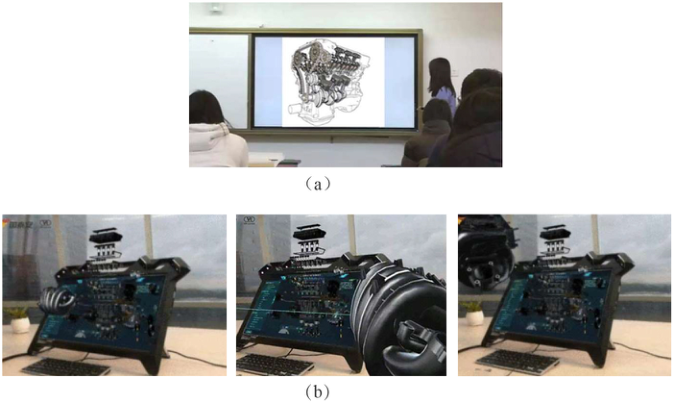
In this paper, by selecting the multimedia teaching interface of the traditi- onal industrial design classroom, as well as the VR dynamic map of zspace product structure disassembly, see Figure 1, although the document can not show the dynamic effect of the VR teaching interface, but in the actual questi- onnaire, the subject saw a 7-second dynamic map, so it can more intuitively reproduce the characteristics of the VR teaching interface scene. Four pairs of antonyms were used to evaluate the two interfaces, and four pairs of antonyms were, monotonous - vivid, difficult to understand - easy to under- stand, hard to remember - easy to remember, abstract - real, all four pairs of adjectives are closely related to the learning characteristics of the classroom interface, thus the four pairs of antonyms can be used for the four function points (vividness, comprehension, memory, authenticity) of the Kano model.
In addition, the subjects’ subjective feelings about the effect of VR class- room teaching were collected, which can also be considered as an advantage of increasing VR classroom. From 5 dimensions to evaluate, respectively, practicality, promote communication, enhance the visual sensory experie- nce, enhance classroom learning interest, promote learning and memory effect, respectively, corresponding to the following 5 questions, each que- stion applied Likert scale into 5 levels. The problem is: For classrooms that have added the above VR: How practical do you think the VR is in improving comprehension? How helpful do you think the technology is in facilitating student communication? How helpful do you think it is in enhancing the
Evaluation of Interface Interaction Efficiency of Industrial Design Education 381
Figure 1: (a) A dynamic diagram of the multimedia teaching interface, (b) VR teaching interface in traditional industrial design classrooms.
visual sensory experience? If VR is designed to increase interest in classroom learning, how much help do you find? Do you think the classroom with VR, learning and memory effect will be more profound?
The above five questions are convenient for analysis and are reduced to five advantages, namely, improving classroom comprehension, promoting student communication, enhancing visual and other sensory experiences, enhancing interest in classroom learning, and increasing learning memory, represented by the characters “S1, S2, S3, S4, S5”.
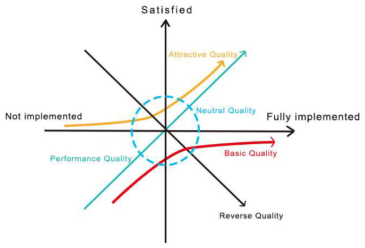
Kano Model The KANO model is a useful tool for classifying and prioritizing user needs by Noriaki Kano (1984). Reflects the nonlinear relationship between pro- duct performance and user satisfaction. Based on the relationship between different types of quality characteristics and customer satisfaction, Profes- sor Kano classes the quality characteristics of product services into five categories: Must-be Quality (M), One-dimensional Quality (O), Attractive Quality (A), Neutral Quality (I), Reverse Quality (R) and Suspicious Qua- lity (Q), the corresponding relationship between satisfaction degree and function implementation degree is shown in the Figure 2.
In order to assess what learning characteristics are more needed and neces- sary when using VR to improve the efficiency of industrial design classrooms, the Kano model is used to evaluate the quality characteristics of the four lear- ning characteristics. The quality characteristics used in this paper are four learning characteristics, namely vividness, comprehension, memory, auth- enticity, and replaced by the characters F1, F2, F3, F4. The four learning characteristics are divided into 5 dimensions, namely A, B, C, D, E, where A represents good functionality, B represents better functionality, C represents
Figure 2: Kano model product performance and satisfaction relationship.
neutrality, D represents poor functionality, E represents poor functionality. The attitudes of users who were able to collect them through the 5 dimen- sions of the questionnaire. In addition, the overall user attitude of different classrooms were investigated, named the attitudes of VR, also use positive and negative questions as well.
By setting a pair of positive and negative questions for each function point, each question is divided into 5 levels from satisfied to dissatisfied, that is, from A to E, according to each problem satisfaction can corre- spond to the Kano model classification comparison table, to judge the quality characteristics of each functional point.
In order to better analyze the different quality characteristics mentioned above, in addition to the above classification of properties, calculating the Beetter-Worse coefficient is more intuitive and clearer. Thus, scatterplot can be drawn according to the coefficient values (Fan, 2020), to achieve a visual classification of functional properties, the formula is as follows.
Equation reproduced from the original PDF.
SII means satisfaction increase index means, DDI means dissatisfaction decrease index. Here the letters “A, O, M, I” refer to the percentage of each attribute in the quality characteristic. With this model, we can predict the necessity of applying industrial design education to VR to improve the efficiency of classroom function points.
Relevance Analysis It is mainly used to evaluate the correlation between the subjects’ functio- nal semantics for VR classroom and the 5 functional points of effect, and to further evaluate the effect of VR classroom teaching by applying correlation analysis to the quality attributes obtained by Kano model. The absolute value of the correlation coefficient is considered to be moderately correlated betw- een 0.3-0.5, and strong correlation is found to be greater than 0.5. Since only the correlation between the two sets of indicators needs to be analyzed, there is no need to make an exact correspondence, and the pearson coefficient is used for correlation analysis.
Evaluation of Interface Interaction Efficiency of Industrial Design Education 383
Table 1. Results of the VR classroom effect questionnaire.
Table available in the original PDF paper.
Attributes \ Functions A(%) O(%) M(%) I(%) R(%) Q(%) Category F1 43.20 3.20 2.40 41.60 2.40 7.20 A F2 31.20 0.00 4.80 53.60 3.20 7.20 I F3 32.00 4.00 7.20 48.80 2.40 5.60 I F4 29.60 3.20 7.20 46.40 7.20 6.40 I F5 25.60 0.80 1.60 68.00 1.60 2.40 I
RESULTS
This study collects user data through the questionnaire star online que- stionnaire, the questionnaire consists of 8 questions, 4 subjective choice questions, 4-gauge questions, of which 2-gauge questions contain four dimen- sions (understanding, vividness, memory, abstraction), each dimension has 5 levels. This questionnaire collected a total of 132 questionnaires, 116 valid questionnaires, undergraduate and master’s users as the main research object.
Reliability analysis was conducted on all scale data of the questionnaire. The Cronbachαof traditional classroom was 0.748 >> 0.7, indicating good reliability. For validity, the former has higher validity (KMO = 0.752 > 0.5), the latter is not valid but acceptable (KMO = 0.606 > 0.5). Therefore, this questionnaire data can be used for Kano model and related analysis.
This article differs slightly from the general Kano model usage, but does not affect the principle output of the model, and changes from a generally physically interpretive function (e.g., air conditioning in the classroom) to a functional feature without physical meaning (e.g., improved comprehension). The summary results are shown in Table 1. As can be seen, vividness (F1) has the largest proportion of charm attributes, so it can be considered that vividness is a learning attribute. However, other results are more regrettable, no difference attributes account for the highest proportion, so the remaining functional points are non-differentiated properties.
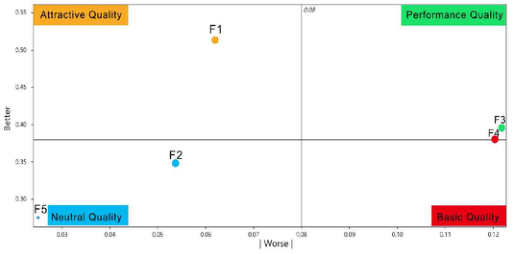
As a result of taking the form of questionnaires, subjects may be more casual filling situation, as well as the possibility of conservative users, the problem settings are not precise enough and other factors, resulting in no difference in the proportion of attributes. However, this does not necessa- rily mean that the property is necessarily a non-differentiated factor, as these attributes are still highly proportional charm attributes, expected attributes, so the Better-Worse coefficient of the Kano model is introduced to further classify some non-differentiated attributes (Yao, 2018) and prioritize indi- vidual quality characteristics. The Better value (SII) and Orse value (DDI) coefficients for the five functional points are calculated from the formula (1). And the quartile scatter diagram was drawn based on the coefficients is shown in Figure 3. The quality characteristics of the newly assigned functions are visually clearly classified in the diagram. A higher SII value in the same quadrant indicates a higher priority (4), so the higher to the lowest priority is: F3 (O) > F4 (O) > F1 (A) > F2 (I) > F5 (I).
It is necessary to analyze the five advantages of the four learning chara- cteristics of the above VR classroom related to the effect of VR classroom.
Therefore, it is possible to obtain the relevant learning characteristics index from the analysis of the classroom effect, and the results of the kano model analysis can be analyzed and predicted according to the quality attribute of the Kano model of the learning characteristic index.
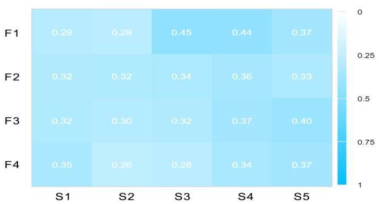
The results of the analysis are shown in Figure 4, the smaller the p value is, the greater the correlation is. As reflected in the figure, the darker the thief color is, the greater the correlation is. All significance P values are less than 0.005, indicating that there are significant correlations and that all relationships are positive.
Among them, the enhanced characters “S1, S2, S3, S4, S5” represent five classroom effect advantages, “F1, F2, F3, F4” represents four learning cha- racteristics. Visual analysis of all relationships and related coefficients, as shown in Figure 4, according to the correlation coefficient r value, F1 and S3, S4 correlation coefficient is the highest, r value is 0.45, 0.44, followed by F3 and S5, r value is 0.4.
DISCUSSION
From the results of the Carnot model, besides vividness, the current traditio- nal industrial design classroom application of VR to enhance other learning characteristics (understanding, memory, authenticity) is not necessary. Alth- ough maintaining the status quo can make students get a good learning cost performance, the application of VR can still further improve the vividness of classroom teaching in industrial design.
Evaluation of Interface Interaction Efficiency of Industrial Design Education 385
From the results of Better-Worse, although the first classification of F3, F4 are classified as non-differentiated attributes, but the second classification presents the characteristics of the desired attributes, the priority is higher than the first classification of the unique charm attributes. In addition, the DDI values of F3 and F4 (−0.1217, −0.1204) are closer to −1 than other learning characteristics, indicating that classes without VR may be slightly dissatisfied with these two learning characteristics. Therefore, it can be initially assumed that both F3 and F4 have the opportunity to develop into desired attribu- tes (He, 2020) when considering the application of VR to industrial design education. On the whole, for F5, that is, whether VR is applied to indu- strial design education, its quality characteristics in the second classification still showed no difference attributes, and F3 and F4 DDI values relative to other learning characteristics (−0.1217, −0.1204) is much larger than −1, indicating that even if VR is not now available, users will not be obvious dissatisfaction, perhaps because the reason why VR has not yet been popu- larized, user acceptance and understanding is not too high. From the results of the Kano model derived from the user’s attitude, it can be concluded that there is not much need to apply VR in design education.
Combined with the conclusion of correlation analysis,it can be argued that if we want to enhance the sensory experience such as vision and enhance the interest of classroom learning, it is relatively effective to enhance the vividness of classroom learning, and vividness belongs to the charm attri- bute, so schools or institutions should enhance the visual and other sensory experience of industrial design students’ classroom learning, classroom lear- ning interest, consider the application of VR is a good choice. Similarly, if the learning memory effect of industrial design students’ classroom is increa- sed in the future, the most relevant learning characteristics are memory, and although there are no difference attributes, but its second attribute also con- tains more expected attributes, to a certain extent, can solve some students’ dissatisfaction with the lack of deep memory in the classroom.
CONCLUSION
This paper researched the VR of industrial design education information visu- alization interaction, through the investigation and analysis, the user for the integration of VR is wanting in the classroom, in addition, the user is recogni- zed for VR effect of class teaching, VR under the class interface can increase the comprehensibility of the course and can help memory. This is also where VR classroom interface has advantages over traditional classroom interface. However, in industrial design education, it is not advisable to add VR teach- ing methods into the teaching. The change of learning mode means the change of teaching mode. Teachers should carefully study the characteristics of disci- plines to adapt to the new visual interaction mode, which brings convenience to the design practice in education. The kano model results showed there is no need to apply VR in industrial design classroom, but there is no denying that the visual interaction of industrial design education information under VR has broad prospects for development, so we believe that with the software
and hardware technology matures, One day VR will be fully integrated into the design education classroom.
ACKNOWLEDGMENT
Before the questionnaire is designed, it should be necessary to let the par- ticipants fully understand VR, and the participants’ lack of understanding may cause deviations from the results. In addition, due to the reasons of the COVID-19 and the limitations of equipment, this survey lacks the actual experience of VR equipment, and hopes that in the future, more people will be invited to obtain more realistic data through actual experience VR classrooms.
REFERENCES
Aljumaiah, A. and Kotb, Y. (2021) “The Impact of Using zSpace System as a Virtual Learning Environment in Saudi Arabia: A Case Study”, Education Research International, pp. 1–12. Fan, C. and Pongpatcharatrontep, D. (2020) “Kano Model for Identifying Cross-
Border e-Commerce Factors to Export Thai SMEs Products to China.”, 2020 Joint International Conference on Digital Arts, pp. 358–363. He, H., Zhang, R., and Sun, W. (2020) “Design of Intelligent Waste Recycling System Based on Kano Model”, 2020 13th International Symposium on Computational Intelligence and Design (ISCID), pp. 180–183. Kano, N. (1984) “Attractive quality and must-be quality”, The Journal of the
Japanese Society for Quality Control, 14(2), pp. 39–48. Mykhailovska, O. V., Chervynskyi, A. I. and Fokin, D. P. (2019) “The Prospects of Virtual Reality (Vr) Technology in Educational Process and Business”, Scientific Bulletin of Polissia, 17(1), pp. 139–147. Nesenbergs, K. et al. (2021) “Use of Augmented and Virtual Reality in Remote
Higher Education: A Systematic Umbrella Review”, Education Sciences, 11. Prasad, A. et al. (2018) “Challenges for enabling virtual reality broadcast using 5G small cell network”, 2018 IEEE Wireless Communications and Networking Conference Workshops (WCNCW), Wireless Communications and Networking Conference Workshops (WCNCW), 2018 IEEE, pp. 220–225. Yao, M.-L., Chuang, M.-C., and Hsu, C.-C. (2018) “The Kano model analysis of feat-
ures for mobile security applications”, Computers & Security, 78, pp. 336–346.
LISTED IN THE AHFE DIGITAL BOOKSTORE CATALOGUE
Explore the complete digital volume
Ergonomics In Design
Read this individual research paper free through the original publisher, or explore the full digital proceedings book.
ISBN 978-1-958651-23-0
Explore this ISBN in the AHFE Bookstore ↗Listed in the July 2026 bookstore catalogue; search by ISBN to confirm current availability · Digital book purchase optional