Chang Gao, Zhisheng Zhang, Zhijie Xia (2022). Trend Analysis of the Layout Design of the Smartphone's Rear Screen Based on Aesthetics. In: Ergonomics In Design. AHFE Open Access, vol. 47, pp. 358–366. https://doi.org/10.54941/ahfe1001957
The layout design elements of the smartphone’s rear screen mainly include the camera, flash, fingerprint lock, brand logo, product information. In order to study the trend of the layout design of the rear screen elements of mobile phones in the context of the rapid iteration of smartphones. This paper selected 12 mobile phones in 3 series of Apple brand and Huawei brand as the research object. In addition, 6 aesthetic metrics: balance, symmetry, integrity, simplicity, cohesion, and proportional beauty were selected to perform quantitative calculations on the layout of mobile phone rear screen elements. And 59 users were required to perform subjective evaluation and sorting of the research objects. The results indicated that samples with high user acceptance have the better comprehensive performance of aesthetic evaluation. In addition, the layout design of mobile phone rear screen elements shows a trend of paying more attention to aesthetics. In particular, the results could help designers grasp the trend of mobile phone rear screen design better based on the aesthetic evaluation.
The layout design of the rear screen of the smartphone mainly includes the layout and design of the camera, flash, fingerprint lock, brand logo, product information, and other elements. A good layout design is conducive to giving users a good visual experience and attracting consumers to buy. The layout of the rear screen of the same brand or series is also integrated with their respective brand characteristic elements to form a unified style.
Nowadays, smartphones have become a necessity in people’s lives. With the advancement of technology, the technological gap between mobile phone manufacturers is getting smaller and smaller, and the homogenization com- petition among mobile phone manufacturers is becoming more and more fierce. According to the 2020 mobile phone brand and high-end correla- tion (brand influence) survey, Huawei and Apple ranked first and second respectively. Huawei and Apple, as two major brands that attach importa- nce to the image of brand products, have formed their unique brand styles.
Trend Analysis of the Layout Design of the Smartphone’s Rear Screen 359
Huawei has launched different series of products for consumer groups with different consumption capabilities, but the same series of mobile phones still maintain a serialized design style.
In the era of rapid technological development, the frequency of smartph- one replacements is also increasing. Most brand series of smartphones will launch the latest phones every year. As technology advances, the proportion of photography function blocks increases, the screen fingerprint locks gradu- ally being unlocked front or side of the screen to unlock replacement, brand identity, continue to simplify product information, the phone screen element layout design there is a certain trend.
In the process of exploring the beauty standard, Zhou Lei et al. star- ted from the interface layout, abstracted the interface elements that affect the user’s aesthetic experience, and proposed the calculation and evaluation methods of the interface beauty. The evaluation model consists of 12 measu- rement features, and Zhou Lei et al. verified the influence of these features on interface aesthetics through experiments, and to obtain the most beautiful interface aesthetic evaluation index.
This article mainly selects 6 aesthetic metrics: balance, symmetry, inte- grity, simplicity, cohesion, and proportional beauty. Select Huawei P series smartphones, Huawei Mate series smartphones, and Apple smartphones, and analyze and compare 12 layout design of the rear screen elements of this mobile phone, discussing the results and reasons, and combining subjective evaluation, hopes to have a certain reference significance for the image design of smartphones.
QUANTITATIVE INDICATORS FOR EVALUATING THE LAYOUT OF INTERFACE ELEMENTS According to Zhou Lei et al. study, avoiding a more abstract and emotional description such as fashion, to ensure that the evaluation results with a certain objectivity, proposed 12 interfaces aesthetic imagery vocabularies.
Combining the layout characteristics of the elements of the rear screen of the mobile phone, this paper selects balance, symmetry, integrity, sim- plicity, cohesion, and proportional beauty as evaluation indicators for quantification.
Balance Balance refers to the overall element layout of the interface to give users a sense of visual stability, and a good layout can avoid visual imbalance.
Symmetry Symmetry interface element in the vertical, horizontal and diagonal 3 symme- try degree direction. Good symmetry can improve users’ cognitive efficiency.
Integrity The overall degree refers to the definition of the compactness of the interface element distribution by analyzing the relationship between the element layout and the interface frame.
Simplicity Simplicity is to reduce the user’s difficulty in understanding the form of the interface design by calculating the alignment and combination of interface elements.
Cohesion Cohesion refers to the visual coordination between interface elements and the aspect ratio of the frame layout. The degree of cohesion can be improved through similar element aspect ratio.
Proportional Beauty Proportional aesthetics usually refer to commonly used aesthetic ratios (1/1, 1/1.414, 1/1.618, 1/1.73, 1/2) to calculate and compare the similarity between the ratio of interface elements and layouts and the beauty ratio.
EXPERIMENT Calculation of the Beauty of the Layout of the Elements on the Back of the Smartphones
Based on 2020 smart phone brand and high-end correlation chart, select were ranked list of the first and second Huawei and iPhone as an experimental sample. Among them, Huawei selects the P series, which is positioned as a young group of users, and focuses on the fashionable camera function, and the flagship Mate series, which is positioned as the business person by the user. According to the chronological order of mobile phone releases, 12 smart phones released in the past four years were selected.
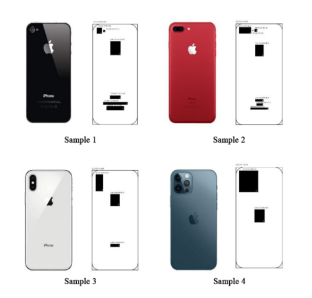
Apple brand selected the iPhone 4S (2011), the iPhone 8 (2016), the iPhone the X (2017), the iPhone 12 Pro (2020) four smartphones (Figure 1).
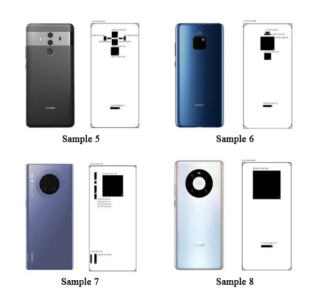
Huawei Mate series selected Huawei Mate 10 Pro (2017), Huawei Mate 20 Pro (2018), Huawei Mate 30 Pro (2019), Huawei Mate 40 Pro (2020) four smartphones (Figure 2).
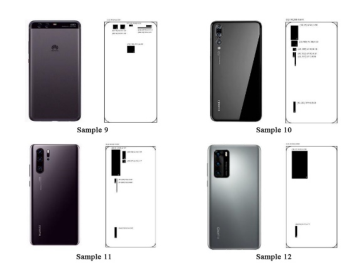
Selected Huawei P series: P10 PLUS (2017), Huawei P20 Pro (2018), Hua- wei P30 Pro (2019), Huawei P40 Pro (2020) four smartphones (Figure 3).
Experimental select 12 smartphone screen layouts has some differences, and contains a with the development, update and use of technology in the aesthetic change. First, to eliminate the effect of color on the screen aesthetics the on the 12 mobile phone back screen images in black and white proces- sing. Secondly, based on functional differences, will the phone screen elements divide into chunks camera, fingerprint function block, product identifica- tion chunks. Characterize each functional block as a minimized rectangle. Interface and a characterization of the positioning elements.
The interface element layout evaluation quantization formula, each on 12 mobile phone back screen layouts of a sample balance, symmetry, the whole of the simple degree, degree of aggregation, aesthetic value calculated ratio, results shown in Table 1.
Trend Analysis of the Layout Design of the Smartphone’s Rear Screen 361
Figure 1: Samples layout of rear screen interface of Apple brand mobile phone.Figure 2: Samples layout of the rear screen interface of Huawei Mate series mobile phones.Figure 3: Samples layout of the rear screen interface of Huawei P series mobile phones.
Analysis of Aesthetics Calculation Results The results of 12 sample aesthetics values with MATLAB, analyzed as follows.
Table 1. Beauty value of smart phone sample interface.
Same Series Analysis With the continuous update of technology, people have higher and higher performance requirements for smart phones. Smart phone design pays more attention to the user experience while focusing on functions.
In terms of performance and experience, smartphone design shows the fol- lowing trends. First, the photography function of mobile phones is becoming more and more perfect, the camera of mobile phones is showing an increa- sing trend, and the proportion of the camera on the rear screen is increasing; second, the fingerprint unlocking area of the rear screen gradually transforms into unlocking under the front screen or side screen unlocking is more in line with ergonomics; third, the functional blocks of the rear screen are more concentrated; fourth, the size of the mobile phone screen is increasing, and large-screen mobile phones have gradually become the market trend.
In the samples of Apple brand smartphones: 1) The balance of the four samples shows a decreasing trend. The screens of mobile phones are getting bigger and bigger, the number of cameras is increasing, and the improper expansion of photographic function blocks affects to a certain extent. balance the overall layout; 2) on the symmetry, the sample 3 has the highest degree of symmetry, which is a camera, the product logo layout along the vertical,
Trend Analysis of the Layout Design of the Smartphone’s Rear Screen 363
transverse and radial balance better; 3) on the integrity, the overall degree of the four samples is gradually showing an upward trend, indicating that the mobile phone rear screen design is more compact; 4) In terms of simplicity, the simplicity of the four samples is on the rise, and the new mobile phone rear screen design is becoming more and more simple; 5) In terms of cohesion, the latest sample 4 has a higher degree of cohesion, giving people a better visual sense, and the other three samples are not much different; 6) In terms of the aesthetics of proportion, the four samples show an upward trend, and the newer model the higher the aesthetic value of the mobile phone proportion.
Huawei Mate series of mobile phones in the sample: 1) On balance, the sample 5, sample 6, sample 7 showed a downward trend, sample the newest 4 because photography function blocks accounted for more than expanding and moving to mark the midline, it has a higher degree of balance; 2) In terms of symmetry, sample 7 has the highest symmetry in the layout of the rear screen elements; 3) In terms of integrity, sample 7 is the most scattered in layout, and sample 8 is the most compact in layout;
4) In terms of simplicity, sample 8 simplifies product information and combines the photographic areas more concentratedly, with the highest sim- plicity; 5) In terms of proportional beauty, the proportional beauty of the four samples shows an upward trend, and the new mobile phone design Pay more attention to the beauty of proportion.
In the samples of Huawei P series mobile phones: 1) In terms of balance, the balance of the four mobile phone samples shows a decreasing trend. Due to the increase in the number of cameras, the expansion of the photogra- phic function block, and the left shift of product identification information, the balance is caused; 2) In terms of symmetry, sample 9 has a lower sense of symmetry because the camera is at the upper end, and the layout center of gravity is shifted upwards. The other three models have little difference; 3) In terms of integrity degree, the layout of sample 1 and 2 is more concen- trated and compact. Sample 12 has the highest overall degree; 4) In terms of simplicity, the simplicity of the four samples shows an upward trend; 5) In terms of cohesion, sample 1 and 2 have the highest degree of cohesion, with more coordinated element layout; 6) Proportional aesthetics, sample 9 has the highest proportion of beauty, because the photography function blocks is increasing, the ratio has declined beauty, but in multi-camera design sample 10, 11, 12 are in an upward trend.
Horizontal Analysis Regarding the layout design of the rear screen of the three series (brands) of smartphones: 1) In terms of balance, except for sample 8 of the series, all have a downward trend. With the continuous advancement of technology, the proportion of the camera function block of mobile phones has been con- tinuously expanded, so the balance has been reduced; 2) In terms of integrity degree, the latest mobile phones of the three series have the highest overall degree. Nowadays, the design trend of the rear screen of mobile phones pays more attention to the sense of compactness; 3) In terms of simplicity, the latest mobile phones of the three series have the highest simplicity. Now the design
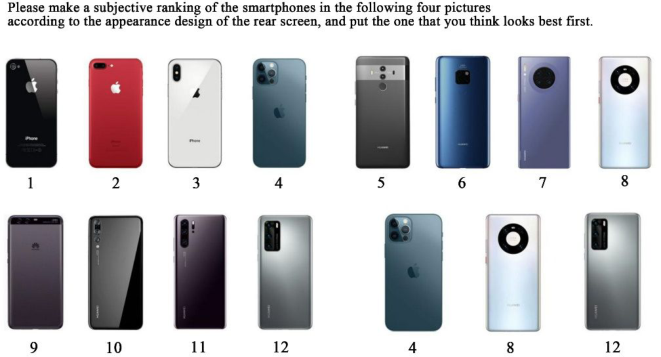
Figure 4: Subjective evaluation of the rear screen layout design of samples.Table 2. Subjective evaluation scores of the rear screen layout design of the samples.
Sample 4 8 12 Average composite score 2.12 1.66 1.69
of the rear screen layout pays more attention to the design of each functional block; 4) In terms of cohesion, the three series of samples also show an upw- ard trend in the main body, and the design of the rear screen layout is more coordinated; 5) In terms of proportional beauty, the proportional beauty of series 1 and series 2 mobile phone samples values are on the rise, and the design of new phones pays more attention to the aesthetics of proportion.
User Subjective Evaluation Analysis In the questionnaire design, layout design requires the user to aesthetic after three series phone screen samples sorted by subjective evaluation, while three samples of the latest mobile phones in subjective evaluation order (Figure 4). The average comprehensive score of the options = (6 frequency × wei- ght)/number of people filled in this question. The higher the score, the higher the overall ranking. Were recovered 59 valid questionnaires, the results (Table 2) were analyzed as follows.
Trend Analysis of the Layout Design of the Smartphone’s Rear Screen 365
For series 1, the average comprehensive score of the user’s subjective eva- luation is sample 3 > sample 1 > sample 4 > sample 2. Users have good acceptance of sample 3. For series 2, the average comprehensive score of the user’s subjective evaluation is sample 7 > sample 8 > sample 6 > sample 5. The user has a good acceptance of sample 7. For the series of 3, the user’s subjective evaluation average composite score Sample 10> Sample 11> to Sample 12> The sample 9, the user of Sample 10 has a higher acceptance.
Compared with the calculated value of aesthetic, the result of subjective evaluation has a certain deviation from the calculated value of aesthetic. But the results of a comprehensive 6 values, sample 3, sample 7, Sample 10 in the calculation of the performance of the aesthetic calculation, though not the highest score, but with a better overall performance.
Out of the subjective evaluation of the latest new phones, the average com- posite score is a subjective evaluation sample 4 > Sample 12> The sample 8. Compare and analyze with the calculated value of aesthetic. The symmetry, simplicity, integrity, and cohesion of sample 4 are greater than those of sample 12 and sample 8. Based on the calculation results of the 6 aesthetic values, the comprehensive performance of sample 4 and sample 12 is also higher than that of sample 8.
CONCLUSION AND REFLECTION According to the analysis and calculation of the beauty value of the layout design of the rear screen elements of the three brands and series of mobile phones, it is found that with the continuous advancement of technology, the performance of mobile phones continues to be stronger, various har- dware facilities are constantly being replaced, and the beauty of the rear screen layout is also presented. A certain trend of change: 1) In terms of balance, due to the continuous increase in the proportion of photographic functional blocks, the main body of the value of balance shows a downward trend; 2) In terms of overall degree, the main body of the overall value of the mobile phone’s rear screen layout design shows an upward trend. The layout design of the rear screen of mobile phones pays more attention to the sense of cohesion; 3) The latest mobile phones of the three series have the high- est simplicity, and the layout design of the rear screen pays more attention to the concentration of various functional blocks; 4) In terms of cohesion, each series of mobile phones the cohesion of the samples also shows an ove- rall upward trend. The layout design of the rear screen of mobile phones has a trend of focusing on coordination; 5) In terms of proportional aesthetics, the proportional aesthetic value of each series of mobile phone samples also shows an overall upward trend. Pay more attention to the trend of propor- tional beauty. Generally speaking, the layout design of mobile phone rear screen elements has a tendency to pay more attention to beauty, which can help designers grasp the direction of element layout and evaluate compre- hensive beauty better. This has certain reference significance for the layout design of mobile phone rear screen elements.
In terms of subjective evaluation of users, when users buy a mobile phone, in addition to considering the beauty of the design, they also consider the
price, functions, operating system, cost performance, brand loyalty and other factors of the mobile phone. Therefore, the calculation result has a certain deviation from the value calculated by aesthetic. However, according to the comprehensive comparative analysis, the samples with higher user accepta- nce have better comprehensive calculation values of beauty, which also has certain reference significance for the design of the layout of the mobile phone rear screen elements.
Due to the small number of mobile phone samples calculated in the experi- ment, the overall design trend of the layout of the rear screen elements is not enough to draw a clearer conclusion. In addition, users consider many other factors when purchasing mobile phones, which are highly subjective. The questionnaire does not consider other influencing factors such as age, gen- der, and purchasing power, so it has a certain impact on the reliability and validity of the analysis results. With the changes of the times and the further development of science and technology, users have higher and higher perfor- mance requirements for mobile phones, and the factors that affect the trend of smartphones will also undergo certain changes. Therefore, the conclusions of this article may only have partial reference significance.
ACKNOWLEDGMENT
I am very grateful to my teacher Zhou Lei for her influence on me, and my senior Fang Chao for his academic help, and also to my friend Helena Wang for her support.
REFERENCES
BAUERLY, M. & LIU, Y. L. 2008. Effects of symmetry and number of compositional elements on interface and design aesthetics. International Journal of Human-Computer Interaction, 24, 275–287. CYR, D., HEAD, M. & LARIOS, H. 2010. Colour appeal in website design within
and across cultures: A multi-method evaluation. International Journal of Human- Computer Studies, 68, 1–21. NGO, D. C. L., TEO, L. S. & BYRNE, J. G. 2003. Modelling interface aesthetics.
Information Sciences, 152, 25–46. WANG, J. & HSU, Y. 2020. The Relationship of Symmetry, Complexity, and Shape in Mobile Interface Aesthetics, from an Emotional Perspective-A Case Study of the Smartwatch. Symmetry-Basel, 12. ZHANG, N., WANG, J. & YANG, Y. 2015. Evaluation Method of Aesthetic Image
for Man-machine Interface Form Elements Layout Design. Mechanical Science and Technology for Aerospace Engineering, 34, 1594–1598. ZHOU, L., XUE, C., TANG, W., LI, J. & NIU, Y. 2013. Aesthetic Evaluation Method of Interface Elements Layout Design. Journal of Compute-Aided Design and Graphics, 25, 758–766.
LISTED IN THE AHFE DIGITAL BOOKSTORE CATALOGUE
Explore the complete digital volume
Ergonomics In Design
Read this individual research paper free through the original publisher, or explore the full digital proceedings book.
ISBN 978-1-958651-23-0
Explore this ISBN in the AHFE Bookstore ↗Listed in the July 2026 bookstore catalogue; search by ISBN to confirm current availability · Digital book purchase optional