Erdem Gelec, Melih Sah Dogru (2024). Framework for agile organization and work design for industry 4.0. In: Human Aspects of Advanced Manufacturing, Production Management and Process Control. AHFE Open Access, vol. 146, pp. 1–10. https://doi.org/10.54941/ahfe1005145
For manufacturing companies in a dynamic environment their capabilities to achieve changeability and agility with minimum effort can lead to competitive advantages. A changeable production system is able to meet requirements in different dimensions. Enabler known from literature are universality, mobility, scalability, modularity and compatibility. The focus on digitalization and industry 4.0 solutions can lead to potential benefits. In most cases the technology focused way is not sufficient to design changeability as the activation thereof is embedded in the organization, the individual employees, and the corporate culture. Within this paper, the framework for the agile organization and work design will be presented. It displays the first step and result of the German research project “agileASSEMBLY” which addresses the work stages of assembly, commissioning and service. Subsequently, a pilot implementation, operation, and evaluation of the achievements are planned to prove the success expectations of the concept.
Small and medium-sized enterprises (SMEs) are currently facing significant challenges arising from the dynamics and uncertainties resulting from glob- alization with international supply chains and rapid technological advance- ments. The digitization of business processes, new production technologies of Industry 4.0, and increasingly complex hybrid products with a growing share of software and services require a high level of innovation and adapt- ability in production. Unpredictable demand volumes and uncertain material supply necessitate a broad capacity and substantial flexibility within the production processes. Unforeseeable events and crises are occurring more frequently, as illustrated by the global impacts of the COVID-19 pandemic with its extensive travel restrictions or the latest energy crisis in Germany. In the late stages of product creation, it becomes evident that the approaches of linear order processing planning and sequential execution of individual activ- ities no longer meet the increased demands for delivery capability, lead time, and product customization. Especially in in the manufacturing of capital
goods, time-to-market and delivery capability have become essential compet- itive factors. To successfully address these challenges and respond resiliently to dynamic and uncertain conditions, manufacturing companies require a high degree of adaptability and innovation speed. Thus the authors of this study are engaged with their industrial partners in the research project “agile- ASSEMBLY” to establish the most suitable agile practices to be developed according to their specific needs, so that they can improve their capabili- ties in late stages of product creation to deliver more value to customers and stakeholders. Following a literature review the dedicated framework for orga- nization and work design for industry 4.0 will be presented with reference to the industrial pilot studies. The goal is to contribute significantly by bridging the gap between theory and practice to aid manufacturing companies in their transformation towards agile and changeable organizations.
BASIC WORK AND TERMINOLOGY Digital transformation, also known as Industry 4.0, stands for the fourth industrial revolution, a new level of organizing and controlling the entire value chain. The specific potential lies especially in high-flexibility, high- productivity, resource friendly production that enables the manufacturing of highly individualized products. Therefore, in addition to technological per- spectives it is also required that companies transform their organization and culture so that they can become a learning, agile company capable of adapting continuously (Schuh et al., 2020; Plattform Industrie 4.0, 2022).
Changeability is often used as a synonym for agility or adaptability and is essential to ensure future competitiveness. In summary, changeability can be understood as the structural capacity of a (production) system to go beyond its pre-planned configurations, with the aim of actively responding to changes in various dimensions such as quantity, quality, time, product, and cost struc- tures caused by changes in the environment (VDI 2017; Westkämper and Zahn, 2009).
In a fast-moving world, where business demands a constant change of processes, rigid organization structures cannot provide the necessary fast decision making and flexibility (Gunasekaran, 2001; Schumacher and Pokorni, 2020). The design process contains several activities such as process definition, task allocation, the definition of team structures and respective team and department interfaces. It follows a set of company-specific prin- ciples such as span of control and level of (de-)centralization (Galbraith, 2014). Although most agile organizations and agile work concepts have evolved in white-collar workplaces, there are some examples of agile work organizations in the manufacturing industry (Pokorni et al., 2022; Bader et al., 2019). FAVI transformed their production from a traditional shaped pyramid to a mini- factory concept (Laloux, 2014). Industry examples also include Scania and Volvo (Oudhuis and Tengblad, 2020).
Management guides or frameworks are mental representations that order experience in ways that enable us to comprehend it. Evaluation criteria sup- ports to assess analytical frameworks and to identify the best ones (Gray,
Framework for Agile Organization and Work Design for Industry 4.0 3
2021). Management literature on organization design focuses on the orga- nizational design process (Roberts, 2004; Kates and Galbraith, 2007) or is expressly designed to focus on the management of the redesign pro- cess (Heidari-Robinson and Heywood, 2016). Other publication provides a set of methods to develop adaptive organizations focusing on strategy and innovation (Dark horse innovation, 2023).
Existing models from new product development and software develop- ment or cannot be transferred directly into the manufacturing domain for the reason of different preconditions. To bridge the gap, we focus on the late phases of product creation which include the last steps towards customer: assembly, commissioning and service. We conduct research to find a suitable framework for this particular context.
LITERATURE REVIEW
A systematic literature review (SLR) was conducted to initially record the state of research. The main objective of the literature review is to identify existing frameworks and measures for increasing organizational changeabil- ity in the context of the late phase of product creation in manufacturing companies. The systematic literature review to identify frameworks or cri- teria for increasing organizational change capability was conducted based on the procedure described by Xiao and Watson (Xiao and Watson, 2017). Based on the objective of the systematic literature search described above, the Scopus and Web of Science databases were selected as part of the search strategy to identify as many potentially relevant sources as possible. As a result, the following search string was used in the systematic literature search to identify potentially relevant documents based on their title or abstract: (framework OR practices OR strategy OR guideline OR actions OR princi- ples) AND (increase OR improvement OR optimisation OR boost) AND (changeability OR adaptability OR flexibility OR adaptivity OR agility) AND (“manufacturing company” OR “late phase product creation” OR “product development”).
When searching the literature, Scopus returned 351 results, Web of Science 256 results. In the following steps, all results from Scopus and Web of Sci- ence were analyzed. After identifying duplicate results, 507 documents were included for review. In the first step, the results were filtered based on the title of the document to focus on organizational changeability and the late phase of product creation in the further course of the quality assessment. In the next step, the abstracts of the remaining 129 documents were assessed according to the same criteria. For the resulting 66 references with a relevant abstract, an attempt was made to obtain access to the full text, which was not possible in two cases. After reviewing the remaining 64 documents, these were assessed according to their relevance to the objective of the SLR. Nine documents with relevant content were included in the final selection. These sources provide valuable insights into the concept of organizational agility and address relevant aspects that can contribute to increasing organizational adaptability. Various criteria can be identified that contribute to improving organizational agility. However, current research does not provide specific
4 Gelec and Dogru
and directly applicable criteria that explicitly target organizational agility during the late phase of product creation in manufacturing companies. The insights gained are presented and summarized in following Table 1.
Table 1. Enablers for increasing organizational adaptability/agility/changeability.
Table available in the original PDF paper.
Author Enablers for increasing organizational adaptability/agility/changeability from the literature Meier und Kock (2023) 1. Culture based on agile values 2. Customer integration 3. Autonomy 4. Iterative working 5. Cross-functional collaboration 6. Flat hierarchies Arsawan et al. (2022) 1. Social capital 2. Collaborative Knowledge 3. Firm Innovation Carvalho et al. (2019) 1. Horizontal organizations 2. Development of people 3. Implementing agile strategy 4. Improving communication Kristensen et al. (2021) 1. Non-complex, transparent structure 2. Effective governance, clear accountable roles 3. Shift away from hierarchical organizational structures 4. Continuous decision making 5. Evolving technology architecture and tools Rößler und Gericke (2022) 1. Emphasis on change, flexibility, iterative and incremental development 2. Close collaboration with end users 3. Implementation of agile practices in existing structures 4. Hybrid approaches Atzberger und Dethloff (2023)
1. Context-specific development and application of a frame- work for internal collaboration 2. Implementation of agile product development Autonomy 3. Cross-functional teams with high autonomy 4. Investigation and tailoring of the entire value chain Duehr et al. (2021) 1. Bringing together diverse competencies and resources through global extension 2. Managing conflicts and building trust in distributed prod- uct development 3. Implementing agile working practices for higher flexibil- ity 4. Improving communication Büttner und Müller (2018) 1. Implementing flexible communication processes as a means of increasing the ability to change 2. Development of a model for successful communication processes Hoonsopon und Puriwat (2021)
1. Top-Management-support 2. Learning Organization 3. Ability to detect changes in technology and customer demand 4. Teaching Entrepreneurial management skills
Framework for Agile Organization and Work Design for Industry 4.0 5
FRAMEWORK FOR AGILE ORGANIZATION AND WORK DESIGN With the proposed framework for agile organization and work design for industry 4.0 we meet following criteria:
1. The framework focuses on agility in late stages of product creation for manufacturing companies. That means it does not cover all main factors for organizational redesign of organizations. It pays attention to factors that are particularly relevant for the managers and stakeholders on the shopfloor that want to achieve higher agility. 2. The framework is balanced and pays attention to organizational aspects, the technical dimensions based on industry 4.0 and to people. By doing so, the framework recognizes that all dimensions need to be considered and included in the design. 3. The framework recognizes that agile organization and work design is a dynamic iterative process cycle. It accepts that there is an existing operating model in place which influences any redesign. 4. The framework is pragmatic and proposes solutions.
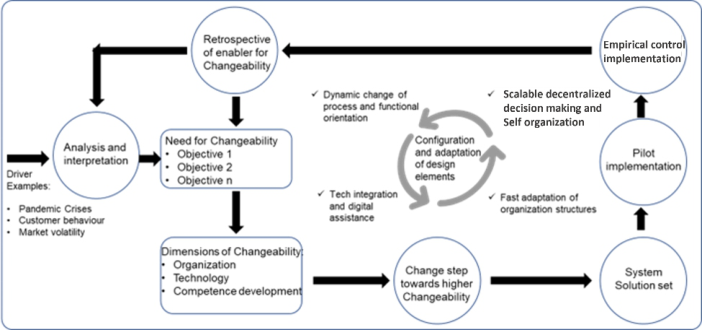
Following the explanation of the criteria a macroview of the framework and a description of the overall logical flow is provided. Then we explain and provide examples of our practices that we have used working with industrial companies in our research to provide a concept that can support practitioners. The process of redesigning the organization of late stages of product creation logically proceeds through six phases in the outer loop which are labeled as “Analysis and interpretation” “Change step” “System solution set” “Pilot implementation”“Empirical Control implementation”and “Retrospective of enabler” as illustrated in Figure 1. After “Analysis and interpretation” two steps are included and labelled as “Need for Changeability” and “Dimen- sion for Changeability”. The core of the framework includes the iterative process cycle “Configuration and adaptation of design elements”where chal- lenging design choices about organization, processes, people and technology are made.
Figure 1: Framework illustration.
6 Gelec and Dogru
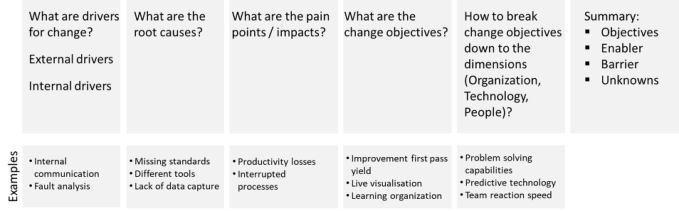
The framework starts with the phase: Analysis and interpretation. The main objective is to get a common and clear understanding of the initial situ- ation, to define objectives and dimensions of changeability. The analysis and interpretation of external and internal drivers can be supported by a canvas, see Figure 2.
Figure 2: Canvas for the analysis and interpretation phase.
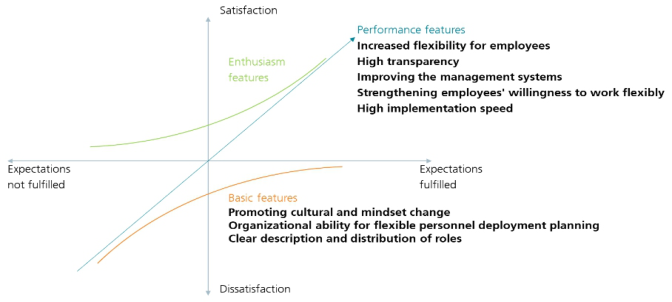
In the phase Change step towards higher changeability participants refine and assess the ideas generated in the process and design optional concepts. The envisaged outcome is to identify an adequate option and to initiate the adaption of design elements in the dimensions: organization, technol- ogy and people, following the inner loop of the framework. Suggestions for design principles are clustered and a meaningful terminology is developed and approved. It is sensible to consider all principles equally, but due to lim- ited resources certain principles can be incorporated with increased intensity. A Kano analysis can be utilized to improve understanding on the subject and provide further insights into the organizational principles. The method was proven to be effective in the context of agile transformation (Coimbra et al., 2023). We have applied it in a small group with four managers that are part of the project team by using spreadsheet questionnaires. The results show that three principles were classified as a “Must-be” or basic requirement, see Figure 3. Missing these requirements leads to dissatisfaction and therefore these are prioritized.
Figure 3: Kano analysis to evaluate design principles.
Framework for Agile Organization and Work Design for Industry 4.0 7
The main objective of the third phase system solution set is to consider the first prototype results in each dimension and approve an overall con- cept how the different parts of the solution interact with each other. Since organizational adaptation can be an extensive process compared to techno- logical adaptation, robust planning is required to determine when the pilot implementation is ready to start.
For the phase pilot implementation, it is essential to meet following prerequisites:
It is essential that the executive team stand by the approved concept
Managers must be ready to defend the chosen solution
The solution concept must be well-explained and documented clearly
The intensification of change management is critical
Establishment of a communication plan.
Also, agile practices can support the success of pilot implementation. Especially when unexpected issues occur, they should be picked up and han- dled promptly. Some of the practices include Lean Coffees, daily stand-up meetings and sprints.
The phase empirical process control emphasizes the importance of adjust- ing and deciding based on observation and experimentation. This principle relies on the pillars: transparency, inspection and adaptation (Rubin, 2012). In contrast to defined process control which is based on detailed plans, learn- ing and adapting takes place based on what happens during the process. In order to set operational goals “Objectives and Key results” (OKR) can be employed (Doerr, 2018). Town hall meetings can be an effective tool to share significant update information. Especially shopfloor employees who do not have instant easy access to information feel more involved and informed, which can improve morale and loyalty.
In the phase retrospective of enabler for changeability the first cycle of the outer loop is closed by identifying what worked well, what did not, how pro- cesses can be improved for upcoming work cycles. This is enabling teams to learn from their experiences and apply lessons learned to enhance efficiency and effectiveness in subsequent efforts. As a follow- up the next cycle can be started by checking if the set of main change objectives are still valid or need adaptation. When there are signals for new external and internal drivers the “Analysis and interpretation” phase needs to be repeated considering significant factors and the insights from the previous process.
DISCUSSION
Based on the major enablers and insights from the literature review, the framework was designed to support practitioners towards agility and change- ability in the late stages of product creation in manufacturing companies. The framework was presented to six industrial manufacturing companies (machinery, sheet metal, smart energy components, gears) in Germany and was rated as helpful for strengthening changeability. The main fields for the five industrial use cases that are addressed are: collaboration with cus- tomer and suppliers in virtual commissioning, self-organized shift planning
8 Gelec and Dogru
and dynamically networked work organization. Data gathered during a more extended period would have benefitted the research. This research is limited to five industrial use cases in Germany and its applicability in different con- text and environment remains open. For future research, researchers could use this framework across several industries globally.
CONCLUSION AND FURTHER WORK The application of the framework presented supports organization and work design for industry 4.0. To successfully empower practitioners the dimensions organization, people and technology are considered in the context. Based on a systematic literature review enablers were identified and integrated into the framework design. To achieve high-quality framework criteria were defined. This research provides a guide for the manufacturing industry and may help leaders in this domain. Furthermore, the methodology employed provide researchers and leaders with a framework and related tools that can be applied in different industries, The application would enrich the discussion on the subject, provide further insights into changeability in manufacturing context, and contribute further to the literature in the field.
ACKNOWLEDGMENT
The research and development project “agileASSEMBLY” is funded by the German Federal Ministry of Education and Research (BMBF) within the Framework Concept “Innovation for Tomorrow’s Production, Service and Labour” and managed by the Project Management Agency Karlsruhe (PTKA).
REFERENCES
Arsawan, I. Wayan Edi; Hariyanti, N.; Atmaja, I.; Suhartanto, D.; Koval, V.
(2022): Developing Organizational Agility in SMEs: An Investigation of Innova- tion’s Roles and Strategic Flexibility. In: Journal of Open Innovation: Technology, Market, and Complexity 8 (3), S. 149. doi: 10.3390/joitmc8030149. Atzberger, A.r; Dethloff, C. (2023): The Hotdog Model – How Turn A Tier 1 Automotive Company Into An Agile Organization. In: Proc. Des. Soc. 3, S. 3395–3404. doi: 10.1017/pds.2023.340. Bader, S., Barth, T., Krohn, P., Ruchser, R., Storch, L., Wagner, L., Findeisen, S., Poko-
rni, B., Braun, A., Ohlhausen, P., Palm, D. (2019) Agile Shopfloor Organization Design for Industry 4.0 Manufacturing (International Conference on Production Research Manufacturing Innovation - Cyber Physical Manufacturing <25, 2019, Chicago/Ill. >) In: Procedia manufacturing, Vol. 39 (2019), pp. 756–764 Büttner, R.; Müller, E. (2018): Changeability of manufacturing companies in the context of digitalization. In: Procedia Manufacturing 17, S. 539–546. doi: 10.1016/j.promfg.2018.10.094. Carvalho, A. M.; Sampaio, P.; Rebentisch, E. (2019): On Agile Metrics for Opera-
tions Management: Measuring and Aligning Agility with Operational Excellence. In: 2019 IEEE International Conference on Industrial Engineering and Engineer- ing Management (IEEM). Macao, 15.12.2019 - 18.12.2019: IEEE, S. 1601–1605. Coimbra, H. Cormican, K. McDermott, O. and Antony, J. (2023): Leading the transformation: agile success factors in an Irish manufacturing company,
Framework for Agile Organization and Work Design for Industry 4.0 9
Total Quality Management & Business Excellence, 34:15–16, 1940–1967, doi: 10.1080/14783363.2023.2214515. Dark Horse Innovation: Future Organization Playbook (2023). Murmann Publishers, Hamburg 2023. ISBN: 9783867747554. Doerr, J. (2018): Measure What Matters. Penguin Books Ltd. ISBN: 9780241983881. Duehr, K.; Efremov, P.; Heimicke, J.; Teitz, E. Ferdinand; Weissenberger-Eibl, M.;
Albers, A. (2021): The Positive Impact Of Agile Retrospectives On The Col- laboration Of Distributed Development Teams – A Practical Approach On The Example Of Bosch Engineering GMBH. In: Proc. Des. Soc. 1, S. 3071–3080. doi: 10.1017/pds.2021.568. Galbraith, J. R. (2014) Designing Organizations: Strategy, Structure, and Process at the Business Unit and Enterprise Levels, Jossey-Bass, Third Edition. Gray, D. (2021): What makes successful Frameworks rise above the rest MIT Sloan
Management Review 62, no. 4 (2021): 1–6. Gunasekaran, A. (2001) Agile Manufacturing: The 21 st Century Competitive Strategy, Elsevier. Hoonsopon, D.; Puriwat, W. (2021): Organizational Agility: Key to the Success of
New Product Development. In: IEEE Trans. Eng. Manage. 68 (6), S. 1722–1733. doi: 10.1109/TEM.2019.2929500. Heidari-Robinson, S.; Heywood, S. (2016): ReOrg: How to get it right. Harvard Business Review Press, (Boston, MA, 2016). Kates, Amy; Galbraith, Jay R. (2007): Designing your organization. Jossey Bass.
Wiley. ISBN: 978–0787994945. Kristensen, S.; Shafiee, M.; Shafiee, S. (2021): Organization Design In Motion: Designing An Organization For Agility. In: Proc. Des. Soc. 1, S. 2349–2358. doi: 10.1017/pds.2021.496. Laloux, F. (2014) Reinventing Organizations: A Guide to Creating Organizations
Inspired by the Next Stage of Human Consciousness, Nelson Parker. Meier, A.; Kock, A. (2023): Agile R&D units’ organisation and its relationship with innovation performance. In: R & D Management, Artikel radm.12655. doi: 10.1111/radm.12655. Oudhuis, M.and Tengblad, Stefan (2020). “The viability of the Scandinavian work-
life model and the impact of lean production: The case of Scania.” Economic & Industrial Democracy (2020). https://doi.org/10.1177/0143831X20939137. Plattform Industrie 4.0 (2022). Available at: https://www.plattform-i40.de/IP/Na vigation/EN/Industrie40/WhatIsIndustrie40/what-is-industrie40.html (Accessed: 14. February 2024). Pokorni, B., Gelec, E., Verhasselt, S., Findeisen, S. (2022). Self-directed Shop
Floor Teams for Industry 4.0. In: Waldemar Karwowski and Stefan Trzcielin- ski (eds) Human Aspects of Advanced Manufacturing. AHFE (2022) Interna- tional Conference. AHFE Open Access, vol. 66. AHFE International, USA. http://doi.org/10.54941/ahfe1002687 Roberts, J. (2004): The Modern Firm: Organizational design for Performance and Growth. Oxford University Press; Oxford. Great Britain. Rößler, L.; Gericke, K. (2022): Analysing Paradigms for Managing Product Devel-
opment: Conventional, Agile and Hybrid Approaches. In: Proc. Des. Soc. 2, S. 263–272. doi: 10.1017/pds.2022.28. Rubin, K. (2012): Essential Scrum: A Practical Guide to the Most Popular Agile Process. Addison-Wesley Professional. ISBN: 0137043295.
10 Gelec and Dogru
Schuh G., Anderl R., Dumitrescu R., Krüger A., ten Hompel M. (2020) Industrie 4.0 Maturity Index. Available at: https://www.acatech.de/publikation/industrie- 4-0-maturity-index-update-2020/download-pdf?lang=en (Accessed: 14. February 2024). Schumacher, S.; Pokorni, B. (2020) Framework kognitive Produktionsarbeit 4.0:
Konzeption und Grobmodell für das Produktionssystem der Zukunft im Future Work Lab, in wt Werkstattstechnik online 110 (2020), Nr. 3, S. 108–112 VDI – Verein Deutscher Ingenieure e. V. (2017): VDI 5201 Blatt 1:2017-01: Wandlungsfähigkeit – Beschreibung und Messung der Wandlungsfähigkeit produzieren- der Unternehmen – Beispiel Medizintechnik. Beuth Verlag, Berlin. Westkämper, E.; Zahn, E. (2009): Wandlungsfähige Produktionsunternehmen.
Springer-Verlag, Berlin, Heidelberg 2009. doi: 10.1007/978-3-540-68890-7. Xiao, Y.; Watson, M. (2017). Guidance on Conducting a Systematic Literature Review. Journal of Planning Education and Research, 39(1), 93–112. https: //doi.org/10.1177/0739456X17723971
LISTED IN THE AHFE DIGITAL BOOKSTORE CATALOGUE
Explore the complete digital volume
Human Aspects of Advanced Manufacturing, Production Management and Process Control
Read this individual research paper free through the original publisher, or explore the full digital proceedings book.
ISBN 978-1-964867-22-9
Explore this ISBN in the AHFE Bookstore ↗Listed in the July 2026 bookstore catalogue; search by ISBN to confirm current availability · Digital book purchase optional