Antero Karvonen, Jami Aho, Hanna Koskinen, Mika Luimula, Mari Myllylä, Bastian Tammentie (2024). Human Centered Research Agenda for Intelligent Technology in Process Control. In: Human Aspects of Advanced Manufacturing, Production Management and Process Control. AHFE Open Access, vol. 146, pp. 129–139. https://doi.org/10.54941/ahfe1005159
Intelligent technologies (e.g., AI-based applications and solutions) are entering many domains of modern human activity, including industry operations. However, integrating intelligent technology into human work requires conscious and well-informed design processes. One important question that arises is what kind of areas and issues should be considered in research and development to integrate intelligent technologies into human work such that it increases worker productivity and well-being, promotes meaningful work and seamless and sustainable human-technology cooperation, as advocated in Industry 5.0 and Society 5.0. Within our Business Finland funded research project COACH we have developed an initial roadmap for new intelligent process control work, which helps to find relevant research focus areas and to take better guided steps towards realizing the vision of Industry 5.0 paradigm. In the present paper, we introduce the roadmap and give several examples of how its research items could be addressed.
Emerging technologies present novel design problems. In recent years, intelli- gent technologies (e.g., AI-based applications and solutions) have made great strides and have the potential to enhance industry operations. In parallel, industrial applications of the metaverse and its core technologies are emerg- ing. To integrate new technologies into human work to promote seamless and sustainable human-technology cooperation, as advocated in Industry 5.0 and Society 5.0 (Huang et al., 2022; Kaasinen et al., 2022), requires conscious and well-informed design processes. Research and development roadmaps are useful in integrating research with emerging trends and practical needs in industry.
To advance research-industry cooperation, an impactful roadmap requires a holistic perspective. Therefore, the structure of a research agenda needs to account for, among others, current societal and technological drivers, enablers, and trends; practical application targets; and normative visions, in addition to pure research targets. The key to realizing Industry 5.0 and related agendas in practice is in balancing and connecting these different perspectives.
The roadmap helps ensure that all relevant items related to the vision of developing new intelligent and sustainable process industry are being con- sidered and appropriately addressed. It helps to find the relevant research focus, increase research validity, find implicit issues and take better guided steps towards the vision. It also points out the practical impacts the research can have in industry applications, relates them to desired future visions and the drivers and trends behind the development. The function of the roadmap framework is twofold. First, it allows a structured way to discuss and gener- ate contents for research and application directions in the context of emerging technologies. Second, once populated, it allows for making reasoned claims and arguments that connect research evidence and application in an indus- trial context. Furthermore, as research and application work progress in line with the roadmap, it begins to generate evidence-based knowledge that fol- low the shape of technical norms, as articulated by Niiniluoto (1993): if you wish to achieve X, and you believe you are in situation B, you should do A. The roadmap can thus be seen as a complimentary higher-level companion for concrete design patterns, as outlined in a recent discussion on design sys- tems for intelligent technology (Myllylä, Karvonen & Koskinen, 2024). The central aspects of the framework are the structure and the main categories of the roadmap; the process by which these can be generated; and the specific contents (i.e., research questions, application targets).
The paper will continue as follows: First, we briefly describe the theoretical backgrounds that provided our perspectives on the roadmap work. Then we describe the methods and materials, after which the contents of the roadmap are provided as a main result of the work. Finally, we discuss the meaning of the roadmap for future research and development work.
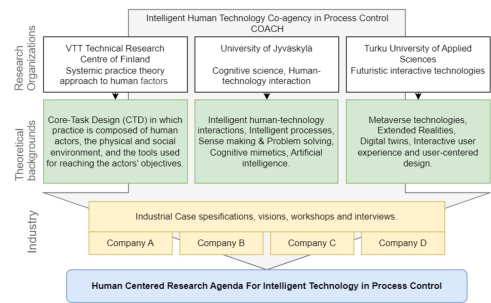
THEORETICAL BACKGROUNDS The work leading up to the roadmap and its contents was a multidisciplinary effort. Here we briefly introduce the theoretical backgrounds involved in the research project and formation of the roadmap (Figure 1). They give grounds for understanding why the contents of the roadmap are what they are.
Figure 1: The theoretical backgrounds of the areas of expertise involved in the project.
Human Centered Research Agenda for Intelligent Technology in Process Control 131
METHOD AND MATERIALS As a starting point for the roadmap, we had a temporally structured swim- ming lane diagram which included the categories outlined below in Table 1. However, it was found that at the level of abstraction of the categories, it was difficult to place research items on a timeline. Thus, we followed a different approach and combined some of the temporal-causal aspects of a roadmap with a holistic view to generate a schematic that gives a narrative gestalt of the research agenda.
Roadmap Categories In Table 1, the six main categories of the roadmap are described.
Table 1. Roadmap categories with their descriptions.
Table available in the original PDF paper.
Category Description
1. Drivers, Enablers, Trends
Makes visible emerging technologies, societal trends and other relevant factors identified in the environment. These can be understood as influencing factors, or factors that enable (or force) novelty in the context of research and application and the concrete context. 2. Vision Entails taking a normative stance with respect to a desirable future state. This statement summarizes and scopes what the relevant research targets and applications areas are. 3. Context Makes visible relevant aspects within the context of research and application. What the context entails cannot be exhaustively defined, but even so it allows for raising issues regarding both particular and general features of the domain of research and application. 4. Research Areas & Questions
Lays out the basic directions where research should be geared towards, given the overall context of the total roadmap. For present purposes, this is the category of main interest and will be explicated in more detail. 5. Application Targets
Connect research areas and questions with practical industrial problems and contexts. While the entire roadmap is geared towards applied science, this part in particular should articulate the ways in which, for example industrial work or design practice can benefit from research. 6. Practical Examples of Impacts
Make the case that the overall research agenda leads to beneficial outcomes when applied in practice. Depending on the stage and maturity of the overall research programme, this may be an educated guess or an identified fact.
Participants The participants consisted of a multidisciplinary researcher group, includ- ing representatives from cognitive science, human factors, and futuristic interactive technology design fields (Figure 1). The total number of core par- ticipants during the roadmap process was seven, and from time to time, other
researchers in the project also participated in the work. While the roadmap contents were reflected against the data gained from empirical case stud- ies (i.e., operator and designer interviews), the interviewees did not directly participate in building the research roadmap.
Roadmap Procedure The creation of roadmap started in early 2023. At the first phase, the con- struction of the roadmap began by dividing the researchers into three groups, each group approaching the six above-mentioned categories from their own research approaches (i.e., cognitive science, practice theory, and futuristic interactive technologies) point of view. From the position of the different approaches, each group discussed and listed the most important factors or items related to each given category. In the next phase, the content produced by the three groups was reviewed together in several roadmap sessions, where the contents were discussed and evaluated, compared with each other, and the concepts were modified to be more uniform and relevant for the research project’s context (i.e., process control work). In this phase, the contents in the roadmap were reflected against empirical data from case studies. Finally, the contents were compiled into a synthesis summarising the main contents, concepts and objectives of future research and development work into list of key issues or considerations under each of the six categories. As the devel- opment of the research agenda is an iterative process, the roadmap will be developed and enriched as research progresses.
RESULTS
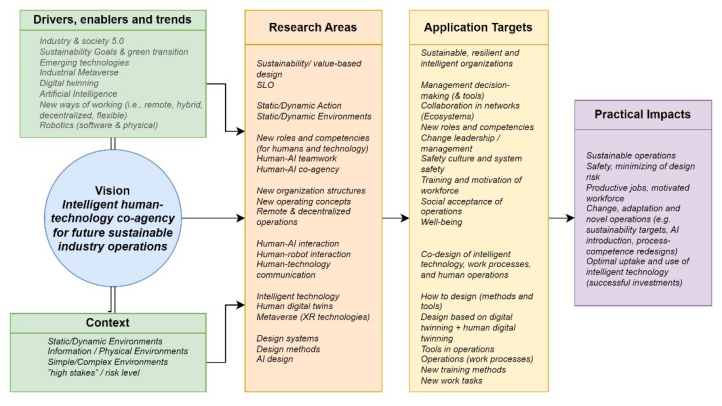
Figure 2 presents the roadmap in its current form with the research items and contents identified as relevant for the development of future industrial operations.
Figure 2: The comprehensive overall framework of the roadmap, with contents.
Human Centered Research Agenda for Intelligent Technology in Process Control 133
Drivers, Enablers and Trends Industry and Society 5.0 paradigms are characterized by human centricity, resilient and sustainable industries/ societies, adaptive and intelligent services and systems, and a variety of emerging technologies (Huang, 2022). Digi- talization and intelligent solutions (i.e., AI) hold great potential to support sustainability and the green transition (De Felice & Petrillo, 2021; Vinuesa et al., 2020).
Integrating physical spaces with parallel virtual ones holds new opportu- nities for improving manufacturing, industrial operations, and system design such as remote, decentralized, and flexible ways to work in hybrid environ- ments (Semeraro et al., 2021). Examples of new intelligent applications and concepts can be listed from Human-cyber-physical systems (HCPS), Human digital twins (HDTs), Greentelligent manufacturing (GIM), Human-robot collaboration (HRC) (Huang et al., 2022), to different Virtual Worlds (VW) such as the Metaverse (Rehm, Goel & Crespi, 2015).
Digital twins are examples of new virtual applications. They can be defined as high-fidelity digital, virtual models for physical entities to imitate their conditions and behaviors to better plan, design, simulate, and understand processes and operational conditions (Semeraro et al., 2021). A Human Digi- tal Twin (HDT) can be a virtual replica of a biological body or its mechanisms, but it can also emulate mental systems in “the realm of language and mean- ing” (Bruynseels, Santoni de Sio & van den Hoven, 2018, p. 3; Saariluoma, Myllylä & Karvonen, 2023).
The Metaverse has been introduced as the new immersive internet and many metaverse technologies such as Extended Reality, 5G and AI are cov- ered in a comprehensive survey by Lee et al. (2021). The industrial metaverse is explained as being the next step from digital twinning (World economic forum, 2023) in industry setting. A metaverse platform operated by humans is required to combine and connect enabling technologies such as extended reality, robotics, sensors, devices, and AI, along with other tools, for different settings (World economic forum, 2023; Kaarlela et al., 2023).
Artificial intelligence, a “non-human intelligence programmed to perform specific tasks” (Dwivedi et al., 2021, p. 2), and collaborative robotics can alleviate the human workers’ load, provide support, and improve the effi- ciency on physically and mentally demanding tasks in different sociotechnical systems (Kaasinen et al., 2022; Peres et al., 2020). As the use of AI and robotics is increasing, so is the demand for human talent, learning new skills and knowledge, and understanding of AI and other emerging technologies (Li, 2022). It is expected that advanced human-technology collaboration will change at least some ways of working (Huang et al., 2022) and require new ways of designing sociotechnical and joint cognitive systems for cooperation (Kaasinen et al., 2022).
Vision The vision was articulated as intelligent human-technology co-agency for future sustainable industry operations. This vision includes both technologi- cal development and sustainability goals, and places at the core how humans
and machines should collaborate in an industrial process control context. Co-agency is a concept used to point out that a key issue is to enhance and maintain human agency and action – though not dogmatically – while rec- ognizing that intelligent technology may impact this, by being in principle able to carry out more autonomous activities, sometimes replacing humans in tasks or subtasks. This framing implicates the need to design operations, work processes, tasks, and technology together.
Context Contextual issues often define how research and development can and should proceed. In industrial work, operators follow certain processes and proce- dures, which can limit what they can and ought to do. Processes can be suboptimal, and external occurrences or human behaviour itself can some- times be unpredictable (Ward, 2002). As we found in our earlier case study interviews, even in somewhat controlled process work some of the tasks can be very difficult to forecast (Myllylä, Karvonen & Koskinen, 2024). Thus, the operators’ work environments and tasks can vary from more simple and repetitive ones to ones where the situations are more complex and dynami- cally changing. When new intelligent technologies are integrated into work, it brings to the fore new aspects regarding the static versus dynamic nature of information and physical and mental (working) environments.
Contextual issues also include potential risks. Risks can be about, for example, worker safety, inadequate situational awareness or challenges in team interaction (Kaasinen et al., 2022), process or product quality, or even natural environmental hazards (Pasman, Knegtering & Rogers, 2013). Alter- natively, risks or stakes can be considered from the perspective of design – for instance, basic usability problems may prevent using a new designed func- tionality (Myllylä, Karvonen, Koskinen, 2024). Thus, the complexity of many issues requires dynamic risk assessments (Pasman, Knegtering & Rogers, 2013).
Research Areas & Questions The emphasis on sustainability in industry 5.0 and value creation in soci- ety 5.0 paradigms (Huang et al., 2022) raise questions how these may affect designing and operations in industrial processes. For instance, communities’ approval as a Social Licence to Operate (SLO) may be required for busi- ness activities that can have significant impacts socially or environmentally (Demuijnck & Fasterling, 2016). Designing sustainable AI has many open questions and challenges from ecological and social (Vinuesa et al., 2020) to ethical (Karvonen, 2020) and even cognitive ones (Myllylä, 2022). The effects can be difficult to predict because intelligent technologies are developed to be more autonomous, ubiquitous, and adaptive (Saariluoma & Karvonen, 2023). While many information technology applications in the current real- life contexts are “static”, that is, they are non-adaptive (Oulasvirta, Jokinen & Howes, 2022) and/or based on formal or computational languages with fixed meanings (Saariluoma & Karvonen, 2023), advancements in machine intelligence makes possible more dynamic AI systems in uncertain and
Human Centered Research Agenda for Intelligent Technology in Process Control 135
dynamic environments. Examples are machine learning methods, such as dynamic, artificial neural networks for forecasting (Pinto, Morais & Cor- chado, 2019), and deep learning for natural language processing (NLP) (Deng & Liu, 2018).
Organizations need dynamic capacities to adapt to and implement rapid technological innovations such as AI in their core functions, which can challenge existing process management practices and work systems (Benner, 2009; Makarius et al., 2020). Integrating AI into organizations may neces- sitate finding a good balance between making incremental changes and major reformation in work routines, but it can also affect learning, man- aging knowledge, and employees’ trust (Benner, 2009; Kaasinen et al., 2022; Makarius et al., 2020). Changes in technologies will inevitably raise questions not only on how jobs and the competencies or operators’ role will change, but also what kind of responsibilities a technological agent such as AI will have in a team and the task-related cognitive system or HCP (Huang et al., 2022; Kaasinen et al., 2022; Makarius et al., 2020). In addition, the development of Information and Communication Tech- nology (ICT) solutions and infrastructures and new ways for collecting and presenting data has enabled communication, operations, and process diag- nostics to be executed remotely, virtually, and from different locations (Gupta & Rastogi, 2022; Rehm, Goel & Crespi, 2015). These kinds of changes cre- ate new questions such as how human operators should share information between each other via HCPs, on-site or through digital interfaces, and with non-human agents such as supporting AI-entities (“AI-assistants”), so that the information content in communication is understandable, timely, and use- ful for different stakeholders and that it enables their smooth collaboration and interaction.
The above-mentioned problems can be condensed into research questions, such as how different types of theory languages (Saariluoma & Karvo- nen, 2023) and rationality of human psychocognitive processes (Oulasvirta, Jokinen & Howes, 2022; Howes, Jokinen & Oulasvirta, 2023) need to be considered in cooperative AI-design, so that information can be properly represented, shared and processed within the human-machine system. Infor- mation engineering of industrial systems can be improved with cognitive mimetics (Saariluoma, Karvonen & Kujala, 2021), in which case opera- tors’ intentional mental contents, information processes and actions when they interact with technologies can be explicated and (computationally) mod- elled as Human Digital Twins (HDTs) (Saariluoma, Karvonen & Sorsamäki, 2021; Saariluoma, Myllylä & Karvonen, 2023). Thus, HDTs are middleware (Kaarlela et al., 2023) that merge not only physical, but also aspects of human mental properties with the virtual world. To help to do design work in more organized manner, the emerging issues in Design Systems (DSs) for intelligent technology, and design methods in general, need to be investigated (Myllylä, Karvonen & Koskinen, 2024).
To research and test real-life human user interactions and experiences with new intelligent technologies, such as AI assistants and robot systems, and in new digital work environments such as the industrial metaverse (Kaarlela et al., 2023), requires also developing and experimenting with new test
methods. Developing design methods is an iterative and explorative research practice which involves many concrete activities ranging from the initiative task analysis (Norros, Savioja, and Koskinen, 2015; Oulasvirta, Jokinen & Howes, 2023), actor-network and value analysis (Kaasinen et al., 2022), to planning test setups and building new types of interfaces and virtual platforms (Kaarlela et al., 2023).
Application Targets and Practical Examples of Impact Industrial process work will be impacted by intelligent technologies from the day-to day work at the factory-floor level to the larger organisational processes, structures, standards, management, and collaborative ecosystems. Impacts can vary from how work is done and what kind of skills and training it requires, to organizations’ ability to plan and manage integration of intel- ligent technology into work processes so that they remain motivating and acceptable.
Digital and virtual intelligent applications and their combinations can improve efficiency and quality of operations, as they make it easier to man- age, understand, and predict tasks in complex human-cyber-physical systems. Consequently, design thinking and design methods for researching and devel- oping intelligent technology solutions must be kept up-to-date and developed further, so that the benefits of new solutions can be captured, and the risks can be anticipated and minimized.
It is foreseeable that conducting research in partnership with industry as articulated in our research agenda can lead to more resilient, adaptive, and sustainable organizations and processes so long as a culture and practice of co-designing technology and human operations concurrently is present. This would lead to successful investments, but also increased productivity and well-being. The fundamental point is that a multi-perspectival and multidis- ciplinary agenda is required, and here we provided a rough sketch and a framework of what that may entail.
DISCUSSION AND CONCLUSION Developing a roadmap for intelligent technology is a challenging task. Items in the roadmap can be approached from different positions, ranging from large-scale holistic to detailed atomistic views, which can also bring about new questions regarding understanding the interrelations between things and viewing them as a system. Thus, when discussing and planning the roadmap it is necessary to move back and forth from the holistic to the more detailed level.
Many propositions remain in the level of hypothesis before more infor- mation can be gained through further research and development activities. In other words, the roadmap needs to be handled at least to some level as a “living document”. The content of the roadmap must reflect practice and research.
There are many hurdles to overcome when it comes to emerging, intelligent technologies and their implementation. Many of the obstacles and risks, but also unpredictable benefits, can be difficult to foresee. While the nature of the
Human Centered Research Agenda for Intelligent Technology in Process Control 137
roadmap is dynamic and more specific content is expected to be developed as the project progresses, we expect the high-level topics covered in this article to provide an adequate way to guide our future research and development efforts.
ACKNOWLEDGMENT
This work has been funded by Business Finland through the COACH-project (project number 3289/31/2022). We thank the case companies and colleagues in the project for their input.
REFERENCES
Benner, M. J. (2009). Dynamic or Static Capabilities? Process Management Practices and Response to Technological Change. Journal of Product Innovation Management, 26(5), pp. 473–486. Bruynseels, K., and Santoni de Sio, F., and van den Hoven, J. (2018). Digital Twins in
Health Care: Ethical Implications of an Emerging Engineering Paradigm. Frontiers in Genetics, 9(31). doi: 10.3389/fgene.2018.00031. De Felice, F., and Petrillo, A. (2021). Green Transition: The Frontier of the Digicircular Economy Evidenced from a Systematic Literature Review. Sustainability, 13(19), Article 11068. doi: 10.3390/su131911068. Demuijnck, G., and Fasterling, B. (2016). The Social License to Operate. Journal of
Business Ethics, 136, pp. 675–685. doi: 10.1007/s10551-015-2976-7. Deng, L., and Liu, Y. (2018). A Joint Introduction to Natural Language Processing and to Deep Learning. In Deng, L. and Liu, Y. (Eds.) Deep Learning in Natural Language Processing. Singapore: Springer, pp. 1–15. doi: 10.1007/978-981-10- 5209-5_1. Dwivedi, Y. K., et al. (2019). Artificial Intelligence (AI): Multidisciplinary Perspec-
tives on Emerging Challenges, Opportunities, and Agenda for Research, Prac- tice, and Policy. International Journal of Information Management, 57, Article 101994. doi: 10.1016/j.ijinfomgt.2019.08.002. Gupta, B. K., and Rastogi, V. (2022). Integration of Technology to Access the Manufacturing Plant via Remote Access System – A Part of Industry 4.0. Materials Today: Proceedings, 56, pp. 3497–3505. doi: 10.1016/j.matpr.2021.11.135. Howes, A., Jokinen, J. P. P., and Oulasvirta, A. (2023). Towards Machines That
Understand People. AI Magazine, 44, pp. 312–327. doi: 10.1002/aaai.12116. Huang, S., Wang, B., Li, X., Zheng, P., Mourtzis, D., and Wang, L. (2022). Industry 5.0 and Society 5.0—Comparison, Complementation, and Co-Evolution. Journal of Manufacturing Systems, 64, pp. 424–428. doi: 10.1016/j.jmsy.2022.07.010. Kaarlela, T., Pitkäaho, T., Pieskä, S., Padrão, P., Bobadilla, L., Tikanmäki, M., Haav-
isto, T., Blanco Bataller, V., Laivuori, N., and Luimula, M. (2023). Towards Metaverse: Utilizing Extended Reality and Digital Twins to Control Robotic Systems. Actuators, 12(6), Article 2191. Kaasinen, E., Anttila, A. H., Heikkilä, P., Laarni, J., Koskinen, H., and Väätänen, A. (2022). Smooth and Resilient Human–Machine Teamwork as an Industry 5.0 Design Challenge. Sustainability, 14(5), Article 27731. Karvonen, A. (2020). Cognitive Mimetics for AI Ethics: Tacit Knowledge, Action
Ontologies and Problem Restructuring. In: Rauterberg, M. (Eds.) Culture and Computing. HCII 2020. Lecture Notes in Computer Science, vol 12215. Springer, Cham, pp. 95–104. doi: 10.1007/978-3-030-50267-6_8.
Lee, L.-H., et al. (2021). All One Needs to Know about Metaverse: A Complete Survey on Technological Singularity, Virtual Ecosystem, and Research Agenda. Computers and Society, arXiv:2110.05352. doi: 10.48550/arXiv.2110.05352. Li, L. (2022). Reskilling and Upskilling the Future-ready Workforce for Industry 4.0
and Beyond. Information Systems Frontiers. doi: 10.1007/s10796-022-10308-y. Makarius, E. E., Mukherjee, D., Fox, J. D., and Fox, A. K. (2020). Rising with the Machines: A Sociotechnical Framework for Bringing Artificial Intelli- gence into the Organization. Journal of Business Research, 120, pp. 262–273. doi: 10.1016/j.jbusres.2020.07.045. Myllylä, M. (2022). Psychological and Cognitive Challenges in Sustainable AI
Design. In: M. Rauterberg (Ed.), Culture and Computing: 10th International Conference, C&C 2022. Lecture Notes in Computer Science, 13324. Springer, pp. 426–444. doi: 10.1007/978-3-031-05434-1_29. Myllylä, M., Karvonen, A., and Koskinen, H. (2024). Design Systems for Intelligent Technology. In: Ahram, T., Karwowski, W., Russo, D., and Di Bucchianico, G. (Eds.) Intelligent Human Systems Integration (IHSI 2024): Integrating People and Intelligent Systems. AHFE (2024) International Conference. AHFE Open Access, vol 119. AHFE International, USA, pp. 255–265. doi: 10.54941/ahfe1004490. Niiniluoto, I. (1993). The Aim and Structure of Applied Research. Erkenntnis, 38(1),
pp. 1–21. Norros, L., Savioja, P., and Koskinen, H. (2015). Core-Task Design: A Practice- Theory Approach to Human Factors. Synthesis Lectures on Human-Centered Informatics. Cham: Springer. Oulasvirta, A., Jokinen, J. P. P., and Howes, A. (2022). Computational Ratio-
nality as a Theory of Interaction. In: CHI Conference on Human Factors in Computing Systems (CHI ‘22). ACM, New York, NY, USA, 14 pages. doi: 10.1145/3491102.3517739. Pasman, H. J., Knegtering, B., and Rogers, W. J. (2013). A Holistic Approach to Control Process Safety Risks: Possible Ways Forward. Reliability Engineering & System Safety, 117, pp. 21–29. doi: 10.1016/j.ress.2013.03.010. Peres, R. S., Jia, X., Lee, J., Sun, K., Colombo, A. W., and Barata, J. (2020).
Industrial Artificial Intelligence in Industry 4.0 – Systematic Review, Chal- lenges and Outlook. IEEE Access, 8, pp. 220121–220139. doi: 10.1109/AC- CESS.2020.3042874. Pinto, T., Morais, H., and Corchado, J. M. (2019). Adaptive Entropy-Based Learning with Dynamic Artificial Neural Network. Neurocomputing, 338, pp. 432–440. doi: 10.1016/j.neucom.2018.09.092. Rehm, S.-V., Goel, L., and Crespi, M. (2015). The Metaverse as Mediator between
Technology, Trends, and the Digital Transformation of Society and Business. Futures, 8(2). doi: 10.4101/jvwr.v8i2.7149. Saariluoma, P., and Karvonen, A. (2023). Theory languages in designing artificial intelligence. AI & Society. doi: 10.1007/s00146-023-01716-y. Saariluoma, P., Karvonen, A., and Kujala, T. (2021). Conceptual Basis of Cogni-
tive Mimetics for Information Engineering. Journal of Physics: Conference Series, 1828, Article 012004. doi: 10.1088/1742-6596/1828/1/012004. Saariluoma, P., Karvonen, A., and Sorsamäki, L. (2021). Human Digital Twins in Acquiring Information About Human Mental Processes for Cognitive Mimetics. In: Tropmann-Frick, M., Jaakkola, H., Thalheim, B., Kiyoki, Y. and Yoshida, N. (Eds.) Information Modelling and Knowledge Bases XXXIII (EJC 2021). Fron- tiers in Artificial Intelligence and Applications, 343. IOS Press, pp. 163–176. doi: 10.3233/faia210484.
Human Centered Research Agenda for Intelligent Technology in Process Control 139
Saariluoma, P., Myllylä, M., and Karvonen, A. (2023). Human digital twins in interaction design : from abstract to concrete. In: PETRA ‘23: Proceedings of the 16th International Conference on Pervasive Technologies Related to Assistive Environments. ACM, pp. 259–264. doi: 10.1145/3594806.3594843. Semeraro, C., Lezoche, M., Panetto, H., and Dassisti, M. (2021). Digital twin
paradigm: A systematic literature review. Computers in Industry, 130, Article 103469. doi: 10.1016/j.compind.2021.103469. Vinuesa, R., Azizpour, H., Leite, I., et al. (2020). The role of artificial intelligence in achieving the Sustainable Development Goals. Nature Communications, 11, Article 233. doi: 10.1038/s41467-019-14108-y. Ward, L. M. (2002). Dynamical Cognitive Science. London: A Bradford Book. World Economic Forum. (2023). Exploring the Industrial Metaverse: A Roadmap to
the Future [online]. Available at: https://www3.weforum.org/docs/WEF_Explori ng_the_Industrial_Metaverse_2023.pdf [Accessed: 12 February, 2024].
LISTED IN THE AHFE DIGITAL BOOKSTORE CATALOGUE
Explore the complete digital volume
Human Aspects of Advanced Manufacturing, Production Management and Process Control
Read this individual research paper free through the original publisher, or explore the full digital proceedings book.
ISBN 978-1-964867-22-9
Explore this ISBN in the AHFE Bookstore ↗Listed in the July 2026 bookstore catalogue; search by ISBN to confirm current availability · Digital book purchase optional