Vesna Spasojevic Brkic, Aleksandar Brkic, Martina Perisic, Zorica Veljkovic (2023). Transport and Mining Machinery Foot Controls: Safety and Human Factors View. In: Human Factors and Systems Interaction. AHFE Open Access, vol. 84, pp. 134–141. https://doi.org/10.54941/ahfe1003598
Extremely rare research has been carried out related to the assessment of the anthropometric convenience of transport and mining machinery cabins and its human-centered design. The importance of studying this problem largely exceeds the number of published works. Despite today's the risk awareness, incidents in heavy machinery operations have not substantially decreased. Transport and mining machinery operators’ job is very demanding since high precision is needed and they remain in cabins during almost the whole shift. Inadequate shape and dimensions of control devices, their inadequate arrangement in the cabin, as well as mismatch of the forces required to activate the control devices with the anthropometric characteristics of the operator, have an impact on the quality of the performance of the work task and overall safety. Foot controls are of special importance, so aim of this paper was to examine and compare transport and mining machinery operators’ height and weight and foot controls ergonomics convenience. Samples of 31 transport machinery and 65 mining machinery operators working in Serbian and Montengrin companies were examined. Descriptive statistics included sample sizes, mean values, median, minimum and maximum, range, standard deviation and coefficient of variation expressed in percentages. In cases when the coefficient of variation is greater than 30%, the variable is inhomogeneous, thus non-parametric statistics is used. Otherwise, the Kolmogorov test for normality was additionally conducted, where the d test values and p values for the Kolmogorov test were given. Comparison of operators’ height and weight have not shown differences found between transport and mining machinery. Descriptive statistics regarding vibrations feeling through the foot controls and its easiness to be reached and used/controlled of both transport and mining machinery has been done and although slightly lower values are obtained from mining machinery operators, statistically significant differences have not been found, too. The last data that was compared between operators of transport and mining machinery are injuries at work, for which proportions were used, where it was shown that 16,129% of operators of transport machinery had injuries, while that number among operators of mining machinery was 13,846%. The comparison again showed that this difference is not statistically significant, given that the p-level of the test is 0.7205. Later on, failures and stoppages of both types of machinery are collected and analyzed and Pareto diagrams are given, where completely different causes are evident in the field of “vital few” causes. Anyhow, since statistically proved facts show that there are no differences regarding safety and human factors issues it could be indicated to designers that there is the possibility of applying the same innovative solutions to both types of mechanization in the field of foot controls. Further collection and analysis of anthropometric dimensions is recommended as future research avenue.
The assessment of anthropometric convenience of transport and mining machinery cabins and its human-centred design are rarely examined. The importance of studying this problem largely exceeds the number of publi- shed works. Despite today’s the risk awareness, incidents in heavy machinery operations have not substantially decreased (Duarte et al. 2021).
Transport and mining machinery operators’ job is very demanding since high precision is needed and they remain in cabins during almost the whole shift (Brkic et al. 2015; Apud 2012). Inadequate shape and dimensions of control devices, their inadequate arrangement in the cabin, as well as
Transport and Mining Machinery Foot Controls: Safety and Human Factors View 135
mismatch of the forces required to activate the control devices with the anth- ropometric characteristics of the operator, have an impact on the quality of the performance of the work task and overall safety. In the Swedish mining industry, in the period from 1980 to 2010, progress has been noted when it comes to safety, in accordance with the development of technologies, while at the beginning of the 2000s, the focus shifted to the organizational aspect of safety (Lööw et al. 2019). In Chile, more than 50% of health reason absenteeism was linked with musculoskeletal disorders caused by poor ergo- nomic workplace (Apud 2012). Also, in the South Africa, non-ergonomically adapted workplaces in examined industries are related with musculoskeletal disorder (Schutte 2005). Study conducted on the data from Mine Safety and Health Administration (MSHA) has showed that 32% of total incidents were caused due to operator’s foot slipping (Santos et al. 2010). When it comes to the transport machines, accidents occurred during the material transport and handling proved to be the most dangerous with extremely high risk (Jeon et al. 2013; Jiang, 2020). Study conducted in the Hong Kong construction indu- stry, showed that human factors have significant impact on safety (Tam et al. 2011). From the ergonomics aspect work posture has an important role in the occurrence of injuries at work (Suseno 2021). Crane cabins’ space do not suits to the most operators from the ergonomic point of view (Zunjic et al. 2015). A non-ergonomic environment affects accidents caused by the human factor, and it is necessary to provide an ergonomic environment in order to reduce the number of these accidents (Lee and Jung 2021). As well as mining mach- ines operators, transport machinery operators are facing numerous health issues such as back and lower limb disorders, due to non-ergonomic working positions (Vander Molen et al. 2004; Spasojevic Brkic et al. 2015). The recent study in Serbia showed that there is no significant difference between tran- sport and mining operator’s attitudes, number of injuries and absenteeism due to poor working conditions (Spasojevi´c-Brki´c et al. 2022).
The aim of this paper is to compare data related to foot controls and inju- ries both for transport and mining operators and to show whether there are differences between them, together with analysis of failures and stoppages by Pareto diagram for both type of machineries.
STATISTICAL EXAMINATION OF FOOT CONTROLS ERGONOMIC CONVENIENCE The study conducted samples of 31 transport and 65 mining machinery ope- rators working in Serbian and Montenegrin companies. Data on operators’ height and weight were collected and the following three questions related to foot controls ergonomic convenience were examined: Q1- Do you feel vibrations from the equipment through the foot controls? Q2 - Can you easily reach the foot controls? Q3 - Can you easily/adequately use the foot controls?
Results of descriptive statistics for operator’s height and weight are given in Table 1. Since for all categories significance level p is lower than 0.05, the non-parametric test is required because the data are not following normal contribution (Montgomery & Runger 2013). Descriptive statistics included
Table 1. Descriptive statistics for operator’s height and weight.
Table available in the original PDF paper.
Transport
machinery
operator’s
height
Transport
machinery
operator’s
weight
Mining
machinery
operator’s
height
Mining
machinery
operator’s
weight
Transport and Mining Machinery Foot Controls: Safety and Human Factors View 137
sample sizes, mean values, median, minimum and maximum, range, stan- dard deviation and coefficient of variation expressed in percentages. In cases when the coefficient of variation is greater than 30%, the variable is inhomo- geneous, thus non-parametric statistics is used. Otherwise, the Kolmogorov test for normality was additionally conducted, where the d test values and p values for the Kolmogorov test were given.
After descriptive statistics and normality test, the non-parametric Mann–Whitney U* test was performed. Table 2 shows the results of Mann–Whitney U* test that compares operator’s height and weight for both transport and mining machinery.
It has been shown that there are no significant differences (n.s.) on both types of machinery operator’s height and weight.
Table 3 shows descriptive statistics for both transport and mining mach- inery operators with the results of normality test and Table 4 shows descri- ptive statistics for average values for the same questions both for transport and mining operators with the results of the normality test.
Comparison between foot control related question between transport and mining machinery operators is given in Table 5.
Finally, the comparison for foot control related questions group is given in Table 6.
It has been shown that there are no statistically significant differences regarding vibrations feeling through the foot controls and its easiness to be reached and used/controlled of both transport and mining machinery.
Table 2. Mann–Whitney U* test for transport and mining machinery operator’s general data comparison.
Table 6. Comparison of all foot control related questions of transport and mining machinery operators.
Table available in the original PDF paper.
Transport machinery Mining machinery Z p Significance 1.082 0.1395 n.s.
Foot control related questions group
= Foot control related questions group
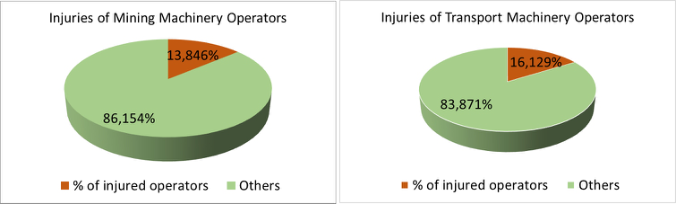
Figure 1: Percentages of injured operators of mining and transport machinery.
The last data that was compared by testing the difference in two population proportions, namely if between operators of transport and mining machinery are equal proportions of injuries, and those data is shown on Figure 1. The comparison again showed that this difference is not statistically significant, given that the p-level of the test is 0.7205.
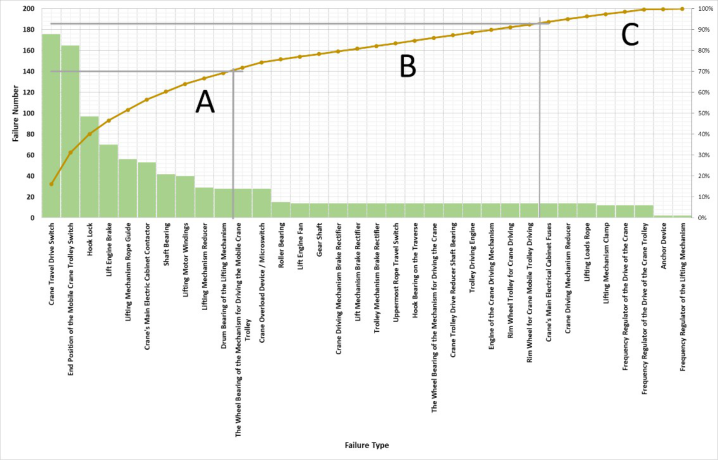
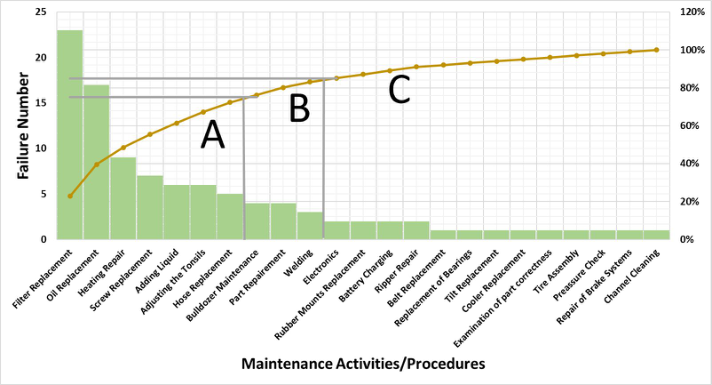
PARETO ANALYSIS OF FAILURES AND STOPPAGES Finally, failures and stoppages of both types of machinery are collected and analysed and Pareto diagrams constructed. As it can be seen on Figure 2 and Figure 3, all failures and stoppages for transport and mining machi- nery can be divided in three groups. The first, group A is group with the most influence on failures and stoppages. For the transport machinery, the most common cause of failures and stoppages are crane travel drive switch,
Transport and Mining Machinery Foot Controls: Safety and Human Factors View 139
Figure 2: Pareto diagram of failures and stoppages for transport machinery.Figure 3: Pareto diagram of failures and stoppages for mining machinery.
end position of the mobile crane trolley switch, hook lock, lift engine brake, lifting mechanism rope guide, crane’s, main electric cabinet contactor, shaft bearing, lifting motor windings, lifting, mechanism reducer and drum bearing of the lifting mechanism while for mining machinery it is filter replacement, oil replacement, heating repair, screw replacement, adding liquid, adjusting the tonsils, hose replacement, bulldozer maintenance, part repairment and welding.
140 Brki´c et al.
CONCLUSION
The aim of this paper was to examine and compare transport and mining machinery operators’ height and weight and foot controls ergonomics conve- nience. Comparison of operators’ height and weight have not shown diffe- rences found between transport and mining machinery. Descriptive statistics regarding vibrations feeling through the foot controls and its easiness to be reached and used/controlled of both transport and mining machinery has been done and although slightly lower values are obtained from mining mach- inery operators, statistically significant differences have not been found, too. The last data that was compared between operators of transport and mining machinery are injuries at work, for which proportions were used, where it was shown that 16.129% of operators of transport machinery had injuries, while that number among operators of mining machinery was 13.846%. The comparison again showed that this difference is not statistically significant, given that the p-level of the test is 0.7205. Later on, failures and stoppages of both types of machinery are collected and analysed and Pareto diagrams are given, where completely different causes are evident in the field of “vital few” causes. Pareto analysis of transport machines failures and stoppages showed that the most of them are caused by crane travel drive switch, end position of the mobile crane trolley switch and hook lock and for the mining machines, they are filter replacement, oil replacement and heating repair.
Anyhow, since statistically proved facts show that there are no differences regarding safety and human factors issues it could be indicated to designers that there is the possibility of applying the same innovative solutions to both types of mechanization in the field of foot controls.
Further collection and analysis of anthropometric dimensions is recom- mended as the future research avenue.
ACKNOWLEDGMENT
This research was supported by the Science Fund of the Republic of Serbia, #GRANT No. 5151, Support Systems for Smart, Ergonomic and Sustainable Mining Machinery Workplaces – SmartMiner and the Ministry of Science, Technological Development and Innovations contract no. 451-03-47/2023- 01/200105 from 03.02.2023.
REFERENCES
Apud, Elías. (2012). Ergonomics in Mining: The Chilean Experience. HUMAN FACTORS, Volume 54 No. 6. pp. 901–907. Brki´c-Spasojevi´c, Vesna. Klarin, Milivoj and Brkic, Aleksandar. (2015). Ergonomic
design of crane cabin interior: The path to improved safety. SAFETY SCIENCE, Volume 73, 43–51. Duarte, J. Marques, A, Torres and Santos Baptista, J. (2021). Occupational accidents related to heavy machinery: a systematic review. SAFETY, Volume 7 No. 1. 21. Jeon, Hyun Woo. Jung, In Su and Lee, Chan Sik. (2013). Risk Assessment for Redu-
cing Safety Accidents caused by Construction Machinery. JOURNAL OF THE KOREAN SOCIETY OF SAFETY, Volume 28 No. 6. pp. 64–72.
Transport and Mining Machinery Foot Controls: Safety and Human Factors View 141
Jiang, Tiantian. (2020). Safety risk analysis and control of tower crane. IOP CON- FERENCE SERIES: EARTH AND ENVIRONMENTAL SCIENCE, Volume 546 No. 4. pp. 042070. Lööw, Joel. and Nygren, M Magnus. (2019). Initiatives for increased safety in the
Swedish mining industry: Studying 30 years of improved accident rates. SAFETY SCIENCE, Volume 117. pp. 437–446. Lee, Yongseok and Jung, Kihyo. (2021). Ergonomic Analysis and Improvement of Crane Safety Certification Standards. JOURNAL OF THE KOREA SAFETY MANAGEMENT & SCIENCE, Volume 23 No. 3. pp. 1–9. Montgomery, Douglas C., and Runger, George C. (2013). Applied statistics and
probability for engineers, (6 ed). John Wiley & Sons. Santos, Brenda R. Porter, William L. and Mayton, Alan G. (2010). An Analysis of Injuries to Haul Truck Operators in the U. S. Mining Industry. PROCEEDINGS OF THE HUMAN FACTORS AND ERGONOMICS SOCIETY ANNUAL MEE- TING Volume 54 No. 21. pp. 1870–1874. Schutte, P. C. (2005). Ergonomics in the South African mining industry. JOURNAL
OF THE SOUTHERN AFRICAN INSTITUTE OF MINING AND METAL- LURGY, Volume 105 No. 6. pp. 369–372. Spasojevi´c-Brki´c, Vesna. Veljkovic, Zorica. Brkic, Aleksandar. Misita, Mirjana.
Perisic, Martina and Papic, Neda. (2022). Transport and mining machines ope- rators’ behavioral attitudes in safety climate context. JOURNAL OF APPLIED ENGINEERING SCIENCE, 13 October 2022, pp. 1–7. Suseno, Wahyu. (2021). Work posture analysis using ovako working postural analysis system (OWAS) on workers at PT INKA (Persero). BKM PUBLIC HEALTH AND COMMUNITY MEDICINE [online], Volume 37 No. 11. Available from: https://journal.ugm.ac.id/v3/BKM/article/view/2545 [accessed 21 November 2022]. Tam, Vivian W Y. and Fung, Ivan W H. (2011). Tower crane safety in the con-
struction industry: A Hong Kong study. SAFETY SCIENCE, Volume 49 No. 2. pp. 208–215. Vander Molen, Henk F. Grouwstra, Robin. Kuijer, P Paul FM. Sluiter, Judith K and Frings-Dresen, Monique HW. (2004). Efficacy of adjusting working height and mechanizing of transport on physical work demands and local discomfort in construction work. ERGONOMICS, Volume 47 No. 7. pp. 772–783. Zunjic, Aleksandar. Spasojevic Brkic, Vesna. Klarin, Milivoj. Brkic, Aleksandar and
Krstic, Dragan. (2015). Anthropometric assessment of crane cabins and recom- mendations for design: A case study. WORK, Volume 52 No. 1. pp. 185–194.
LISTED IN THE AHFE DIGITAL BOOKSTORE CATALOGUE
Explore the complete digital volume
Human Factors and Systems Interaction
Read this individual research paper free through the original publisher, or explore the full digital proceedings book.
ISBN 978-1-958651-60-5
Explore this ISBN in the AHFE Bookstore ↗Listed in the July 2026 bookstore catalogue; search by ISBN to confirm current availability · Digital book purchase optional