Martina Perišić, Vesna Spasojevic Brkic, Nemanja Janev, Roberto Lujić, Aleksandar Brkic (2025). Comparative Assessment of Noise Exposure in Loaders’ and Bulldozers’ Cabin in Mining Industry: A Case Study. In: Human Factors in Design, Engineering, and Computing. AHFE Open Access, vol. 199, pp. 1782–1789. https://doi.org/10.54941/ahfe1006989
Occupational noise exposure is a significant issue in the mining industry, especially for operators of heavy machinery and it can result with serious health risks, including Noise-Induced Hearing Loss This case study analyzes the noise levels in cabins of two prevalent mining machines—bulldozer and loader, in aim to assess potential threats to operator health and to guide measures for enhancing workplace safety. Noise characteristics, such as peak sound pressure level, equivalent continuous sound level, and maximum sound level with fast weighting, were recorded during a single work shift. Descriptive statistics reviled non-normal data distribution, so the Mann-Whitney U test was applied. The results indicated statistically significant differences in all noise parameters between the two machineries (p < 0.01), with loader demonstrating elevated continuous noise levels and bulldozer exhibiting increased variability. The research underscores the necessity for specific noise reduction measures, particularly in loader cabins, to adhere to ISO 9612:2025 and ISO/11201:2010 standards and safeguard operator health. This study contributes valuable insights for occupational health assessments and serves as a foundation for future research. Subsequent research ought to build upon these findings by incorporating diverse machinery kinds and varying operating situations in order to to mitigate noise-related health risks in the mining sector.
Due to the high injury rates, the mining sector is regarded as one with the most hazardous workplaces despite still being one of the most important suppliers of raw materials for global industry (Bugari´c et al., 2024; Chebotarev et al., 2024; Miloševi´c et al., 2025). The companies in the mining sector face the challenge of implementing occupational health and safety policies in a way that not only promotes worker safety, health, and general welfare, but also to boost productivity, improve the quality of goods and services, and ultimately improve the standard of living for both individuals and society as a whole (Miloševi´c et al., 2025). It is clear from recent publications (An
Comparative Assessment of Noise Exposure in Loaders’ and Bulldozers’ Cabin 1783
et al., 2023; Bugari´c et al., 2024; Chebotarev et al., 2024; Miloševi´c et al., 2025; Brki´c et al., 2024; Brki´c et al., 2024; Zhironkin and Ezdina, 2023; Zhou, 2024), that the mining industry faces many difficulties, problems, and issues that require immediate attention in order to undergo a green, digital and sustainable transition. Cabins of mining machinery also are still not ergonomically suitable for their users (Brki´c et al., 2024). One of the most frequent concerns at work is exposure to hazardous noise (Feder et al., 2017).
Noise-induced hearing loss (NIHL), a major occupational condition globally, frequently occurs to mining workers being exposed to noise levels over permissible limits (Parra-Cortés et al., 2025; Themann and Masterson, 2019). Noise exposure at work is a serious health issue with economic repercussions (Pretzsch et al., 2021; Themann and Masterson, 2019). Hearing signals other than speech at work, like alarms and equipment sounds, can be also disrupted by noise exposure and/or hearing loss (Themann and Masterson, 2019). Both noise exposure and hearing loss have been linked to a higher incidence of occupational injuries, possibly as a result of challenges detecting and localizing signals at work (Themann and Masterson, 2019). High noise levels can cause workers to perform worse when multitasking or working on complicated tasks (Themann and Masterson, 2019). Noise is often combined with a number of other physical, chemical, biological, and psychological agents, which then is linked with even worse health outcomes (Golmohammadi and Darvishi, 2019).
In order to assess potential risks to operator health and improve occupational safety and health, this case study included a comparison of the noise levels in the cabins of two different mining machines: loader and bulldozer. This is because occupational noise exposure is a complex and preventable issue in the mining sector, especially for operators of heavy machinery, such as loaders and bulldozers. Peak Sound Pressure Level (LCpk), Equivalent Continuous Sound Level (LAeq), and Maximum Sound Level with Fast Weighting (LAFp) were the three main acoustic characteristics that were examined in this study.
Accordingly, after introduction, the previous research in the field is shown. The next section contains state-of-art literature review, methodology and results and results discussion with conclusion.
PREVIOUS RESEARCH The level of mining mechanization and automation has grown recently, but even as production efficiency has increased, the noise danger issue is getting worse (Wang et al., 2023). The main strategy for shielding employees from high noise exposure risks is to control noise exposure.
Occupational noise exposure causes between 7 and 21% of the hearing loss among workers (Lie et al., 2016). Frequent exposure to noise levels of 85 dBA or above can result in tinnitus, permanent hearing loss, and trouble recognizing speech over background noise, but also depression, balance issues, and cardiovascular disease are linked to it (Themann and Masterson, 2019). Additionally, there is strong evidence of a dose-response relationship between noise exposure and the risk of hypertension, as well as a link between
1784 Periši´c et al.
occupational noise exposure > 80 dB(A) and hypertension (Pretzsch et al., 2021). A significant problem is characterizing extremely fluctuating noise exposures over a long period of time (Neitzel et al., 2009).
According to research on occupational noise exposure in developing countries, occupational noise-induced hearing loss is still very common, and there is proof that the mining sector is aware of the problem (Moroe et al., 2018). Nevertheless, there is currently no success in reducing occupational noise-induced hearing loss (Moroe et al., 2018). Authors Moroe et al., (2018) in their systematic review that covered period from 1994 to 2016 have found only 9 studies in the targeted field and noticed relatively small sample numbers, reducing the likelihood that the results could be generalized. Study Chadambuka et al., (2013) in Zimbabwe surveyed underground mining machinery and evidenced noise of 102 dB(A). Consequently, given the evidence that suggests occupational noise-induced hearing loss is still increasing, additional research is required to address this condition in the African mining industry.
A total of 31.9% of the individual noise levels (LEX, 8h) surpassed 85 dB(A), according to the study done in China (Wang et al., 2023); the median dosages of non-coal miners with high noise exposure were 89.1 dB(A) for excavation workers, 88.7 dB(A) for mill operators, and 87.0 dB(A) for crusher operators. Systematic review study done in China (Zhou et al., 2020) evidenced the wide distribution of noise in different industries as well as high-level and long-term noise exposure, while study (Liu and Zhou, 2024) demonstrated on a sample of 211 employees in coal mines that the average 8-hour equivalent sound was 91.2 dB(A), with 56.4% of the LEX exceeding 85 dB(A) in total. The effectiveness of proposed dust and noise protection measures regarding three bulldozers, one grader, two shovels, one loader, 20 dump trucks at the Veliki Krivelj and Cerovo open pits of the Bor copper mine in Serbia is analyzed in a case study (Liu and Zhou, 2024) that addresses dust and noise control. According to Liu and Zhou (2024) there shouldn’t be any adverse noise effects at the closest residential objects, without noise measurements in vehicles’ cabin.
Evidently, research in the field is scarce although the consequences are serious. Even after adjusting for education and other sociodemographic characteristics, the authors of (Themann and Masterson, 2019) examine the economic implications and find that hearing-impaired people had 1.5 times the likelihood of having low income (less than $20,000 annually) compared to people with normal hearing. Garcia et al. (2018) calculated that preventing one instance of hearing loss would cost $10,567 after evaluating the cost- effectiveness of a single program. The costs of workers’ compensation are additionally borne by employers. There are many direct and indirect costs to society. These include expenses related to health care, special education and vocational rehabilitation programs, welfare payments, absenteeism, decreased earnings, and lost tax revenues (Neitzel et al., 2009).
Comparative Assessment of Noise Exposure in Loaders’ and Bulldozers’ Cabin 1785
It is clear that the high prevalence of hearing loss among workers exposed to noise is likely caused by a number of factors, including a lack of emphasis on noise control, an excessive reliance on hearing protection, an inability to recognize early signs of hearing damage, a failure to recognize the impact of hearing loss on quality of life, and a cultural acceptance of loud noise. Further research is therefore required.
METHODOLOGY AND RESEARCH Research was conducted on the noise level inside the cabins of certain mining machines, namely bulldozer (B) and loader (L). Peak Sound Pressure Level (LCpk), Equivalent Continuous Sound Level (LAeq), and Maximum Sound Level with Fast Weighting (LAFp) were measured. In all cases, the null hypothesis of equal distributions between groups was rejected, confirming that there is a statistically significant difference in noise levels between different machine types i.e., the loader produces much more noise compared to the bulldozer. Data were collected from a large dataset during one working shift at mining site. Firstly, descriptive statistics were performed and include the number of samples (N). mean value (Mean), median (Med), minimum (Min) and, maximum (Max) values, range (R), standard deviation (SD), coefficient of variation (CV), Kolmogorov statistics (d), and p-level, and it is given in Table 1.
Table 1. Descriptive statistics.
Table available in the original PDF paper.
Variable N Mean Med Min Max R SD CV d P LCpkL 14578 96.758 97.60 85.20 136.40 51.20 5.36 5.53 0.0504 <0.01 LAeqL 14578 81.383 81.80 67.00 83.40 16.40 1.83 2.24 0.21686 <0.01 LAFpL 14578 77.076 78.90 60.70 100.60 39.90 8.69 11.28 0.0808 <0.01 LCpkB 9992 104.13 107.40 71.90 136.00 64.10 12.17 11.68 0.16302 <0.01 LaeqB 9992 74.87 77.70 51.80 78.40 26.60 5.82 7.77 0.30815 <0.01 LAFpB 9992 75.33 79.10 39.80 98.80 59.00 9.64 12.82 0.022372 <0.01
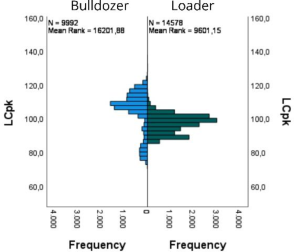
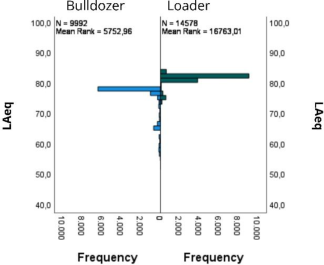
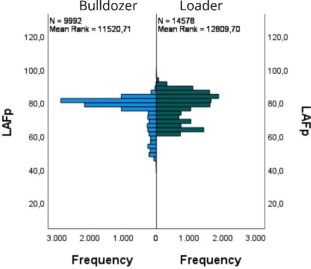
Given that the Kolmogorov test showed that the data do not follow a normal distribution (p<0.01), the Mann-Whitney U-test was performed. The test results are given in Table 2 and on Figures 1, 2 and 3.
Table 2: Mann-Whitney U test.
Table available in the original PDF paper.
Bulldozer Loader N U Statistics p-Value Significance LCpkB vs. LCpkL 24570 33699217.00 0.00 <0.01 LaeqB vs. LaeqL 24570 138104856.50 0.00 <0.01 LAFpB vs. LAFpL 24570 80473519.00 0.009241 <0.01
1786 Periši´c et al.
Figure 1: Mann-Whitney U test for LCpk.Figure 2: Mann-Whitney U test for LAeq.Figure 3: Mann-Whitney U test for LAFp.
DISCUSSION AND CONCLUSION Descriptive statistics revealed notably higher noise levels in loaders. Bulldozers have significantly higher mean peak sound levels at 104.13 dB, while loaders mean value is 96.76 dB, with a higher median as well. Bulldozers show a wider range, 64.1 dB in relation to loaders with a range of 51.2 dB, and much higher variability with a SD of 12.17, while the SD
Comparative Assessment of Noise Exposure in Loaders’ and Bulldozers’ Cabin 1787
of loaders is 5.36. CV is more than twice as high for bulldozers (11.68%) compared to loaders (5.53%), indicating that LCpk values in bulldozers vary more in relative terms. Secondly, analysis of LAeq has shown that loaders have higher mean continuous noise levels (81.38 dB) than bulldozers (74.87 dB), with a narrower spread around the mean. Bulldozers show higher range and SD, indicating more fluctuating noise levels. Again, bulldozers have a higher CV, suggesting more inconsistency in continuous sound exposure. Finally, the descriptive statistics of LAFp indicate that loaders have a slightly higher average LAFp (77.08 dB) compared to bulldozers (75.33 dB), although bulldozers exhibit slightly higher maximum and minimum ranges. Bulldozers again display more variability and a larger spread, despite the mean being lower, and they also show higher CV, confirming more variation in fast- weighted sound peaks. Also, according to the ISO 9612:2025 Acoustics — Determination of occupational noise exposure — Methodology and ISO 11201:2010 - Acoustics — Noise emitted by machinery and equipment — Determination of emission sound pressure levels at a work station and at other specified positions in an essentially free field over a reflecting plane with negligible environmental corrections, the loader fails to satisfy the standard guidelines, whereas the bulldozer does.
The independent-samples Mann-Whitney U test was used to see if the noise levels from the two machines were significantly different because the data do not follow a normal distribution. The null hypothesis of equal distribution was rejected in all three tests (p < 0.01), indicating statistically significant differences. Loaders demonstrated elevated average levels of LAeq and LAFp, signifying a noisier operational context. This case study confirmed that the level of the noise depends on the type of mining machinery that is observed. The limitation of this study is the comparison of only two mining machines’ types, so further research should be focused on expanding the sample, including comparisons with other types of mining machinery.
ACKNOWLEDGMENT
This research was supported by the Ministry of Science, Technological Development and Innovation of the Republic of Serbia under the Agreement on Financing Scientific Research Work of Teaching Staff at Accredited Higher Education Institutions in 2025 No. 451-03-137/2025-03/ 200105, from 04.02.2025, the bilateral cooperation between the Republic of Serbia and the Republic of Austria SAFECORNER No. 337-00-216/2023-05/244 and Eureka project No. 20495 - SMARTMEN.
REFERENCES
An, Zhengzhen. Zhao, Yue and Zhang, Yanfei. (2023). Mineral exploration and the green transition: Opportunities and challenges for the mining industry. Resources Policy, Volume 86, 104263. Bugari´c, Uglješa. Spasojevi´c Brki´c, Vesna. Petrovi´c, Nikola. Janev, Nemanja and
Periši´c, Martina. (2024). “A risk evaluation of bulldozer downtimes and its economic justification in open-pit mines”, IMCSM Proceedings-International May Conference on Strategic Management–IMCSM24, May 31, 2024, Bor, Serbia Volume 20, No. 1, 122–131.
1788 Periši´c et al.
Chadambuka, A. Mususa, F. and Muteti, S. (2013). Prevalence of noise induced hearing loss among employees at a mining industry in Zimbabwe. African Health Sciences, Volume 13, No. 4. Chebotarev, A. G. Sokur, O. V and Duryagin, I. N. (2024). Working conditions and
occupational health risks of open-pit mining machinery operators. Metallurgist, Volume 67, No. 11. Feder, Katya. Michaud, David. McNamee, James. Fitzpatrick, Elizabeth. Davies, Hugh and Leroux, Tony. (2017). Prevalence of Hazardous Occupational Noise Exposure, Hearing Loss, and Hearing Protection Usage Among a Representative Sample of Working Canadians. Journal of Occupational and Environmental Medicine, Volume 59, No. 1. Garcia, Seth L. Smith, Kenneth J. and Palmer, C Catherine (2018). Cost-effectiveness
analysis of a military hearing conservation program. Military Medicine, Volume 183, No. 9–10. Golmohammadi, Rostam and Darvishi, Ebrahim. (2019). The Combined Effects of Occupational Exposure to Noise and Other Risk Factors - A Systematic Review. Noise and Health, Volume 21, No. 101. International Organization for Standardization. (2010). Acoustics — Noise emitted
by machinery and equipment — Determination of emission sound pressure levels at a work station and at other specified positions in an essentially free field over a reflecting plane with negligible environmental corrections. (ISO Standard 11201:2010). https://www.iso.org/standard/54908.html. International Organization for Standardization. (2025). Acoustics — Determination of occupational noise exposure — Methodology ( ISO Standard No. 9612:2025). https://www.iso.org/standard/81317.html. Lie, Arve. Skogstad, Marit. Johannessen, Håkon A. Tynes, Tore. Mehlum, Ingrid
Sivesind. Nordby, Karl-Christian, Engdahl, Bo and Tambs, Kristian. (2016). Occupational noise exposure and hearing: A systematic review. Intenational Archives of Occupational and Environmental Health, Volume 89, No. 3. Liu, Dong and Zhou, Ye. (2024). Case study: Noise risk assessment of workers at the mechanized mining face of coal mines. Noise Control Engineering Journal, Volume 72, No. 2. Miloševi´c, Isisdora. Stojanovi´c, Andelka. Nikoli´c, Ðorde. Mihajlovi´c, Ivan. Brki´c,
Aleksandar. Periši´c, Martina and Spasojevi´c-Brki´c, Vesna. (2025). Occupational health and safety performance in a changing mining environment: Identification of critical factors. Safety Science, Volume 184, 106745. Moroe, Nomfundo. Khoza-Shangase, Katijah. Kanji, Amisha. and Ntlhakana, Liepollo. (2018). The management of occupational noise–induced hearing loss in the mining sector in Africa: A systematic review – 1994 to 2016. Noise & Vibration Worldwide, Volume 49, No. 5. Neitzel, Richard. Daniell, William. Sheppard, Lianne. Davies, Hugh and Seixas, Noah. (2009). Comparison of perceived and quantitative measures of occupational noise exposure. Annals of Occupational Hygiene, Volume 53, No. 1. Parra-Cortés, María Victoria. García-Iglesias, Juan Jesús. Gómez-Salgado, Juan.
Prieto-Callejero, Blanca. Macías-Toronjo, Israel and Fagundo-Rivera, Javier. (2025). Hearing loss in miners exposed to high noise levels: A systematic review and meta-analysis of the last 10 years. Safety Science, Volume 191, 106942. Pretzsch, Anna. Seidler, Andreas and Hegewald, Janice. (2021). Health Effects of Occupational Noise. Current Pollution Reports, Volume 7, No. 3.
Comparative Assessment of Noise Exposure in Loaders’ and Bulldozers’ Cabin 1789
Spasojevi´c Brki´c, Vesna. Mihajlovi´c, Ivan. Brki´c, Aleksandar. Misita, Mirjana and Periši´c, Martina. (2024). Transport and mining machinery cabins’ ergonomic evaluation as a path to its redesign. International Journal of Occupational Safety and Ergonomics, Volume 30, No. 3. Spasojevi´c Brki´c, Vesna. Mihajlovi´c, Ivan. Nikoli´c, Ðorde and Brki´c, Aleksandar.
(2024). “Smart, ergonomic and sustainable mining machinery workplaces: An overview of the SmartMiner project”. IMCSM Proceedings-International May Conference on Strategic Management–IMCSM24, May 31, 2024, Bor, Serbia Volume 20, No. 1. 49–59. Themann, Christa L. and Masterson, Elizabeth A. (2019). Occupational noise exposure: A review of its effects, epidemiology, and impact with recommendations for reducing its burden. The Journal of the Acoustical Society of America, Volume 146, No. 5. Wang, Xin. Kang, Ning. Dong, Yiwen. Liu, Kai. Ning, Kang. Bian, Hongying.
Han, Feng. Chen, Yongqing and Ye, Meng. (2023). Noise exposure assessment of non-coal mining workers in four provinces of China. Frontiers in Public Health, Volume 10. Zhironkin, Sergey and Ezdina, Natalya. (2023). Review of Transition from Mining 4.0 to Mining 5.0 Innovative Technologies. Applied Sciences, Volume 13, No. 8. Zhou, Jiena. Shi, Zhihao. Zhou, Lifang. Hu, Yong and Zhang, Meibian. (2020).
Occupational noise-induced hearing loss in China: A systematic review and meta- analysis. BMJ OPEN, Volume 10, No. 9. Zhou, Yue. (2024). Natural resources and green economic growth: A pathway to innovation and digital transformation in the mining industry. Resources Policy, Volume 90, 104667.
LISTED IN THE AHFE DIGITAL BOOKSTORE CATALOGUE
Explore the complete digital volume
Human Factors in Design, Engineering, and Computing
Read this individual research paper free through the original publisher, or explore the full digital proceedings book.
ISBN 978-1-964867-75-5
Explore this ISBN in the AHFE Bookstore ↗Listed in the July 2026 bookstore catalogue; search by ISBN to confirm current availability · Digital book purchase optional