Ivo Soares, Mariana Baptista, Pedro Água, Armindo Frias, Miguel Silva, Catarina Martins (2026). Developing Command Capability Throughout the Career: A Competency-Based Model for Leadership and Communication in the Navy. In: Human Systems Engineering and Design (IHSED2026): Future Trends and Applications. AHFE Open Access, vol. 237, pp. 469–478. https://doi.org/10.54941/ahfe1008186
The increasing complexity of the maritime operational environment demands a shift from fragmented training to a longitudinal development of military officers’ competencies. While previous research at the Portuguese Naval Academy validated a staged approach for initial training, subsequent studies identified structural gaps in leadership and communication reinforcement throughout later career stages. This paper proposes a unified Global Development Model (GDM) for Portuguese Navy officers, integrating initial education with continuous professional development.Methodologically, the research employs a multi-phase mixed-methods design. Phase one analyses a case-based cadet intervention combining simulators and individual development plans. Phase two expands the empirical foundation through a survey of 255 officers and 17 semi-structured interviews, complemented by a comparative review of international programs.Data suggests that iterative cycles of assessment and feedback significantly improve self-confidence and communication effectiveness during initial training. Longitudinal analysis reveals a “dual-peak” demand for development: first, during initial command deployments, where technical skills often outpace behavioural readiness; and second, at the transition to senior leadership, where strategic and adaptive demands exceed previous training.The resulting GDM framework is structured into four clusters: (1) Initial Training (self-awareness/communication); (2) Operational Consolidation (situational leadership/stress management); (3) Command Development (mentoring/transformational leadership); and (4) Strategic Leadership (ethical governance/culture transformation). The GDM transforms leadership development from discrete activities into a learning infrastructure. While designed for the Portuguese Navy, its architecture – grounded in 360-degree feedback and mentoring cascades – offers a scalable solution for any professional military education program seeking to align strategic adaptability with operational risk reduction.
The contemporary maritime environment has shifted from traditional blue- water engagements to complex hybrid threats and “Grey Zone” scenarios (Cojocar, 2011). In this context, naval command effectiveness hinges on a Received May 15, 2026 Revised June 13, 2026 Accepted July 7, 2026 Available online September 25, 2026
sophisticated integration of tactical expertise and high-level behavioural competencies, particularly in leadership and interpersonal communication. For the Portuguese Navy, this shift demands a transition from fragmented training to a longitudinal development strategy.
While initial officer education has implemented successful staged approaches, research indicates that these skills often “atrophy” during the long intervals between formal promotion training courses (Soares et al., 2021). Building upon this, Soares et al. (2026) introduced the “Bridge-Bound Leaders” framework for continuous development, while Baptista (2024) established a necessary reference framework for command and managerial roles throughout the career.
Despite these advancements, a gap remains in transforming modular interventions into a unified, institutionalized infrastructure. Leadership should be recognized as a dynamic process nurtured throughout the professional life cycle (Day, 2011). In naval contexts, this aligns with the “Mission Command” philosophy, which requires advanced emotional intelligence and assertive communication to manage teams under stress (Bass & Riggio, 2006).
Empirical evidence identified a “dual-peak” in development demand: first during initial command deployments and, more acutely, during the transition to senior leadership (Hinck et al., 2023). Consequently, this paper proposes a Global Development Model that links behavioural growth with hierarchical responsibility, providing a scalable infrastructure to enhance organizational resilience and reduce operational risk (Reis, 2017).
BACKGROUND
Leadership and Communication in Volatile Environments The modern maritime environment is increasingly characterized by volatility, uncertainty, and hybrid operational scenarios. In this context, traditional leadership approaches centred on centralized decision-making are progressively challenged by more adaptive and collaborative models. As noted by Cojocar (2011), adaptive military leadership requires the ability to recognize patterns in complex operational settings and adjust behaviour accordingly. Effective communication therefore becomes a critical enabler of coordination, trust, and operational effectiveness within naval organizations.
In the Portuguese Navy, leadership is not merely a hierarchical position but a functional requirement for operational success. The “Mission Command” philosophy, which governs contemporary naval operations, necessitates a high degree of mutual trust and shared intent. However, this trust is built through consistent and effective interpersonal communication. Research has shown that command effectiveness is directly correlated with the leader’s ability to foster a psychological safety environment where information flows vertically and horizontally without distortion (Bass & Riggio, 2006).
The Development of Soft Skills in Military Education Historically, military education prioritized tactical and technical proficiency – the “hard skills” of warfare. However, the shift toward multi-domain operations and cognitive warfare scenarios has highlighted the critical role
Developing Command Capability Throughout the Career 471 of “soft skills,” such as emotional intelligence, conflict management, and cultural awareness. Day (2011) distinguishes between “leader development” (expanding individual capacity) and “leadership development” (building collective leadership processes). For a naval organization, both are essential. The Portuguese Naval Academy has addressed this by integrating behavioural training early in the officer’s curriculum. Soares et al. (2021) demonstrated that early intervention using experiential learning cycles significantly enhances cadets’ self-awareness. Yet, the challenge remains in the “longitudinal decay” of these skills. Competencies that are not reinforced through practice or formal training tend to atrophy, particularly when officers move from the structured environment of the Academy to the diverse demands of fleet service.
Career Stages and Behavioural Demands The career trajectory of a naval officer is marked by distinct transition points, each demanding a distinct set of behavioural competencies. Baptista (2024) identified that the skills required for a junior officer (e.g., direct supervision and tactical communication) differ fundamentally from those required at the strategic level (e.g., ethical governance and organizational change).
A critical finding in recent studies is the “dual-peak” phenomenon in development demand (Soares et al., 2026). The first peak occurs during the initial bridge-watchkeeping or platoon-leading roles, where the young officer must bridge the gap between theory and the human reality of command. The second peak appears during the transition to senior ranks (Commander and above), where the officer must move beyond managing people to leading systems and cultures (Hinck et al., 2023). This realization underscores the necessity of a GDM that provides continuous, rather than episodic, support.
Integrating Mentoring and Feedback Loops To sustain leadership growth throughout a 30-year career, the literature suggests moving toward a “learning infrastructure.” This includes the implementation of 360-degree feedback loops and mentoring cascades. As Reis (2017) argues, behavioural development in the Navy should not be confined to the classroom but integrated into the daily operational fabric. Mentoring serves a dual purpose: it provides the mentee with experienced- based wisdom while reinforcing the mentor’s own leadership identity. By standardizing these processes within a unified framework, military institutions can ensure that strategic adaptability becomes an organizational hallmark rather than a fortunate individual trait.
METHODS
To ensure the robustness and validity of the proposed GDM this research adopted a multi-phase mixed-methods approach (Creswell, 2014). This design allows for the triangulation of data, combining the depth of qualitative insights with the generalizability of quantitative findings, specifically tailored to the unique hierarchical and operational structure of the Portuguese Navy.
Phase 1: Case-Based Cadet Intervention The first phase focused on the initial education stage at the Portuguese Naval Academy. The intervention targeted cadets through an experiential learning framework (Kolb, 1984). The methodology involved:
High-Fidelity Simulation: Cadets were placed in bridge and tactical simulators to face high-stress operational scenarios.
Behavioural Assessment: Using the Calgary-Cambridge Guide and the BEM model as benchmarks, their communication and leadership actions were recorded and analysed.
Reflective Practice: Following the simulations, cadets participated in debriefing sessions and completed Individual Development Plans (IDPs) to foster self-awareness and bridge the gap between theory and action.
Phase 2: Officer Survey and Interviews To expand the model beyond initial education and address the full career life cycle, a second empirical phase was conducted. Quantitative Data Collection: A comprehensive survey was distributed to the eligible population of Portuguese Navy officers (n = 576). The final sample consisted of 255 respondents (44% response rate), representing a diverse range of ranks, from Midshipmen to Senior Captains. The survey assessed perceptions of leadership competence, training frequency, and identified career “pain points” where behavioural demands exceeded previous training. Qualitative Data Collection: Seventeen (17) semi-structured interviews were conducted with officers holding significant command or management experience. The interview script (Baptista, 2024) focused on resistances to change, cultural barriers to innovation, and the specific needs of strategic leadership.
Data Analysis: The Gioia Method The qualitative data from the interviews were analysed using the systematic inductive approach known as the Gioia Method (Gioia et al., 2013). This method was chosen to ensure scholarly rigor in representing the informants’ voices while transforming them into theoretical dimensions. The analysis followed a three-step coding process:
1. First Order Concepts: Identifying raw data themes directly from the officers’ language (e.g., “fear of making mistakes,” “lack of mentoring”). 2. Second Order Themes: Grouping these concepts into higher-level abstract categories (e.g., “Organizational Culture Resistance,” “Need for Continuous Feedback”). 3. Aggregate Dimensions: Synthesizing the themes into the foundational pillars that define the GDM structure: Individual Awareness, Operational Consolidation, Command Maturity, and Strategic Vision.
Developing Command Capability Throughout the Career 473 Ethics and Comparative Review
All participants provided informed consent, and data were anonymized to ensure confidentiality within the military institution. Finally, the findings were cross-referenced with a comparative review of Leadership Development Programs (LDPs) from other NATO naval academies to ensure the GDM’s alignment with international best practices (Soares et al., 2026).
RESULTS AND DISCUSSION
The analysis of the integrated data from both phases revealed a significant misalignment between the traditional episodic training and the actual psychological and operational demands experienced by officers. The results are synthesized into two main findings: the “Dual-Peak” demand phenomenon and the resulting GDM.
The “Dual-Peak” Demand Phenomenon The quantitative analysis of the 255 survey responses identified a non-linear demand for behavioural training. Survey results reinforced the perceived relevance of continuous behavioural development across the officer career cycle. A substantial proportion of respondents reported insufficient opportunities for leadership and communication training after initial education, while most officers considered experience-based and mentoring- oriented approaches as highly valuable for command preparation. Perceived training gaps were particularly evident during first command assignments and at senior leadership transition stages. While technical expertise follows a stable upward trajectory, the perceived need for leadership and communication training shows two distinct intensification points:
1. The Tactical Peak (Junior Officers): Occurs during the first command of a specialized unit or bridge watchkeeping. Officers report that while they feel technically prepared, the “human complexity” of managing diverse teams under operational stress exceeds their initial training. 2. The Strategic Peak (Senior Officers): Emerging at the rank of Commander, this peak represents the highest demand for development. At this stage, the shift from “leading people” to “leading systems” and managing organizational culture requires a set of competencies (e.g., ethical governance and adaptive leadership) that were not covered in previous career stages.
The GDM Architecture Following the Gioia Method analysis, the GDM was structured into four evolutionary clusters. This model transforms leadership development into a continuous learning infrastructure (Table 1).
Table 1: The global development model (GDM) framework.
Table available in the original PDF paper.
Cluster Career Stage Core Competencies Methodological Approach Initial training Cadets Simulators, IDPs, mentoring
Discussion: Bridging the Gap The GDM addresses the “atrophy” identified by Soares et al. (2021) by ensuring that the “Bridge-Bound Leaders” (Soares et al., 2026) have a standardized path for growth. A critical insight from the interviews was that 80% of officers feel capable of instructing subordinates if provided with a structured framework. The GDM acts as this framework, creating a “mentoring cascade” where senior officers provide guidance to juniors, thus institutionalizing leadership as an organizational asset.
Furthermore, the integration of 360-degree feedback loops – as proposed in the GDM – shifts the culture from a top-down authoritarian style to a “Mission Command” philosophy rooted in mutual trust. As suggested by Baptista (2024), this transition is vital for overcoming the cultural resistance to innovation identified by 60% of the participants. By aligning behavioural development with the “dual-peak” demands, the Portuguese Navy can reduce operational risk and enhance strategic adaptability in complex maritime environments.
This study presents some limitations, namely the exclusive focus on the Portuguese Navy context and the absence of longitudinal validation. Additionally, hierarchical and cultural dynamics inherent to military organizations may influence participants’ responses and the implementation of developmental mechanisms.
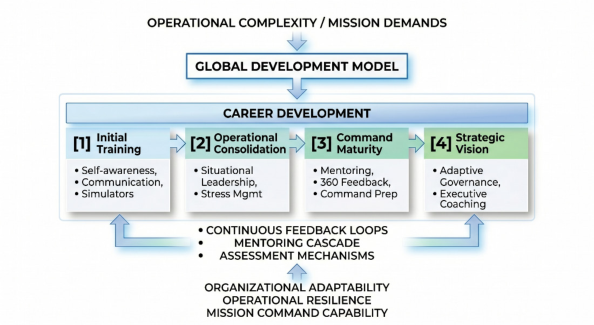
THE GLOBAL DEVELOPMENT MODEL (GDM) The GDM represents a shift from episodic, course-based training to a continuous learning infrastructure. Grounded in the empirical findings of the “dual-peak” demand and the qualitative insights from the officer corps, the GDM is organized into four evolutionary clusters that synchronize behavioural development with career progression, as shown in Figure 1.
Figure 1: Global development model (GDM) architecture integrating longitudinal lead ership and communication development across naval career stages through continu ous feedback, mentoring, and competency reinforcement mechanisms.
Cluster 1: Initial Training (The Foundation) The first stage of the GDM is situated within the Portuguese Naval Academy. The focus here is on transitioning from a civilian mindset to a military identity, with a heavy emphasis on self-awareness and basic interpersonal communication. At this stage, the model utilizes high-fidelity simulation and the Calgary-Cambridge Guide to provide cadets with immediate, objective feedback on their performance. The goal is to ensure that every graduate possesses a baseline of communication effectiveness – the ability to communicate intent clearly and manage their own emotional state under the initial pressures of maritime service.
Cluster 2: Operational Consolidation (The Tactical Edge) As officers transition to their first assignments as Ensigns or Lieutenants, the GDM moves into the Operational Consolidation phase. This cluster addresses the first “demand peak” identified in the research. The focus shifts toward situational leadership and decision-making under stress. Rather than classroom theory, this stage relies on “Action Learning” and peer-coaching. Officers are encouraged to use their real-world experiences on the bridge or in specialized units as the primary material for development. The GDM provides tools for assertive communication, ensuring that junior officers can lead small teams effectively while maintaining the technical precision required by their roles.
Cluster 3: Command Maturity (The Mentoring Cascade) The third cluster corresponds to the mid-career stage (Lieutenant Commander and Commander). Here, the model introduces the concept of the “Mentoring Cascade.” Recognizing that 80% of officers feel prepared to instruct others if given a framework, the GDM formalizes the officer’s role as a developer of talent. The core competencies at this stage include transformational leadership
and team building. This phase is supported by 360-degree feedback loops, which provide the officer with a holistic view of their leadership impact from the perspective of superiors, peers, and subordinates. This feedback is crucial for preparing the officer for the unique psychological and ethical demands of full command.
Cluster 4: Strategic Vision (The Adaptive Horizon) The final stage of the GDM addresses the senior leadership (Captain and above) and the second, more pronounced “demand peak.” Strategic leadership requires a departure from direct command toward the management of organizational culture and ethical governance. The GDM supports this transition through executive coaching and partnerships with civilian academic and corporate institutions. The focus is on “Adaptive Leadership” – the ability to lead the organization through complex, non-linear changes and to foster resilience across the entire force. At this level, the leader is no longer just a commander of a ship, but a steward of the institution’s values and its long-term strategic direction.
Implementation Mechanisms: Feedback and Mentoring The GDM works through two key mechanisms:
1. Iterative Feedback Loops: by standardizing 360-degree assessments at key career milestones, the Navy ensures that leadership development is data-driven and objective, reducing the “atrophy” of skills identified in previous studies (Soares et al., 2021). 2. Institutionalized Mentoring: by integrating mentoring as a formal requirement for senior officers, the GDM creates a self-sustaining cycle of learning. This not only benefits the mentees but reinforces the leadership identity of the mentors, aligning the individual’s professional growth with the organization’s strategic needs.
By transforming leadership from an occasional topic of study into a continuous learning infrastructure, the GDM provides the Portuguese Navy with a scalable solution to the challenges of the modern maritime environment.
CONCLUSION
Contemporary naval operations require officers capable of combining technical expertise with adaptive leadership and communication competencies in increasingly complex operational environments. This study proposed a Global Development Model designed to support the longitudinal development of Portuguese Navy officers throughout different career stages, aligning behavioural competencies with operational and strategic responsibilities.
Developing Command Capability Throughout the Career 477 The findings suggest that leadership development demands intensify particularly during two critical transition periods: the assumption of initial command responsibilities and the progression to senior leadership functions. These moments appear associated with increased pressure related to decision- making, situational leadership, mentoring, and organizational governance.
To address these demands, the GDM was structured into four developmental clusters integrating initial education, operational consolidation, command maturity, and strategic leadership. The model conceptualizes leadership development as a continuous and career-aligned process supported by mentoring practices and iterative feedback mechanisms.
This study also suggests that integrating behavioural development into professional military education may contribute to organizational adaptability and preparedness for command functions. However, some limitations should be acknowledged, namely the exclusive focus on the Portuguese Navy context, the use of self-perception data, and the absence of longitudinal validation.
Future research should focus on longitudinal implementation studies and the development of objective indicators to assess the operational impact of competency-based leadership systems. Additional attention should also be given to the integration of emerging digital and simulation-based technologies capable of supporting adaptive feedback, immersive training environments, and behavioural competency development in complex military settings.
ACKNOWLEDGMENT
The authors would like to acknowledge the Portuguese Naval Academy and CINAV for their support.
REFERENCES
Baptista, M., Soares, I., & Água, P. (2024). Development of leadership and communication skills throughout the career of Portuguese Navy officers. EDULEARN24 Proceedings, 10138–10147. https://doi.org/10.21125/ edulearn.2024.2454 Bass, B. M., & Riggio, R. E. (2006). Transformational leadership (2.ª ed.). Lawrence
Erlbaum Associates. Cojocar, W. (2011). Adaptive leadership in the military decision-making process: Not enough. Military Review, 91(3), 34−39. Day, D. V. (2011). Leadership development. In S. Zedeck (Ed.), APA handbook
of industrial and organizational psychology: Vol. 2. Selecting and developing members for the organization (pp. 643−672). American Psychological Association. https://doi.org/10.1037/12170-022 Gioia, D. A., Corley, K. G., & Hamilton, A. L. (2013). Seeking qualitative rigor in inductive research: Notes on the Gioia methodology. Organizational Research Methods, 16(1), 15−31. https://doi.org/10.1177/1094428112452151 Hinck, J. M., Davis, S. B., Mayes, R. K. S., & Griffith, R. G. G. (2023). Educating
leaders of character: Insights from professional military education. Wild Blue Yonder, 6(4), 1−12.
Reis, A. S. A. (2017). Behavioral Training in the Navy. Instituto Universitáriot Militar. Soares, I., & Silva, T. (2021). Benefits and Effects of Higher Education Accreditation and Quality Assessment in Portugal. INTED2021 Proceedings, 4229−4235. https://doi.org/10.21125/inted.2021.0862 Soares, I., Baptista, M., Água, P., Martins, C., Frias, A., & Silva, M. (2026). Bridge-
Bound Leaders: Continuous Development of Leadership and Communication in the Navy. INTED2026 Proceedings, 3145–3154. https://doi.org/10.21125/ inted.2026.0823
FIND THE COMPLETE VOLUME IN THE AHFE DIGITAL BOOKSTORE
Explore the complete digital volume
Human Systems Engineering and Design (IHSED2026): Future Trends and Applications
Read this individual research paper free through the original publisher, or explore the full digital proceedings book.