Ying Zhang, Jun Zhang (2025). Operation and Maintenance System Design with AI Intervention:Bibliometric Analysis Based on Citespace. In: Human Aspects of Advanced Manufacturing, Production Management and Process Control. AHFE Open Access, vol. 184, pp. 123–132. https://doi.org/10.54941/ahfe1006456
This paper employs bibliometric analysis to explore the design of AI-intervened operation and maintenance systems. By examining 326 relevant publications from the database, the study identifies key developments, research hotspots, and emerging trends within the field. The findings highlight a growing body of literature and increasing international collaboration, with research spanning diverse areas and showing notable shifts in focus. Through Citespace analysis, the paper uncovers design opportunities and underscores the importance of future research on human-AI interaction to enhance operational efficiency.
In fields such as industrial production (Brunetti et al., 2022), Internet services (Yan and Yan, 2022), and public infrastructure (Sabeti et al., 2021), operation and maintenance is directly related to system efficiency, reliability, security, and sustainability (Wellsandt et al., 2022). A good operation and maintenance mechanism can significantly reduce the economic cost of the system. With the continuous development of intelligent technologies and the deepening understanding of human-machine collaboration, modern industry is constantly advancing from Industry 4.0 to Industry 5.0 (Kiangala and Wang, 2024). As an indispensable and crucial part in industry, the concept of Operation and Maintenance 5.0 emerged as the times require (Cortés-Leal et al., 2022). Operation and Maintenance 5.0 emphasizes integrating humans into the entire operation and maintenance system to meet the development needs of Industry 5.0. Against this background, how to conduct innovative design by combining the capabilities of cutting-edge technologies to improve the operation and maintenance efficiency and the overall security of the system has become an important research direction at present.
This paper uses the bibliometric method and focuses on the operation and maintenance system design with the intervention of AI. The main research questions are as follows: (1) Analyze the development process, research hotspots and frontier research trends of the operation and maintenance system design research under the intervention of current frontier AI technologies such as LLMs.
(2) Explore the intelligent optimization design opportunity points of the operation and maintenance system, lay the foundation for future research in this field, and provide new perspectives and directions.
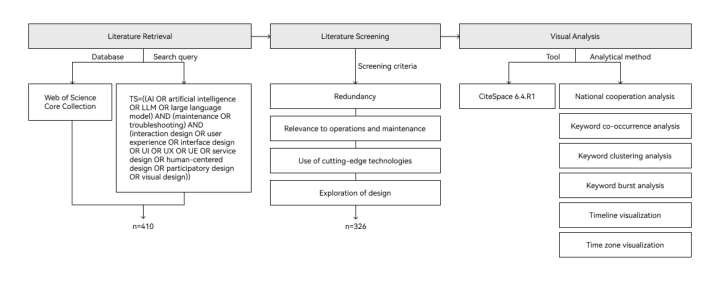
DATA SOURCES AND RESEARCH METHODOLOGY Pritchard’s bibliometric method reveals discipline development, analyzes structures, discovers hotspots and trends, and promotes academic exchanges (Pritchard, 1969). In the research of this paper, to ensure the authority of the data source, the literature data is sourced from the Web of Science Core Collection database. To improve the comprehensiveness and relevance of the literature retrieval results as much as possible, the retrieval conditions adopted are TS = ((AI OR artificial intelligence OR LLM OR large language model) AND (maintenance OR troubleshooting) AND (interaction design OR user experience OR interface design OR UI OR UX OR UE OR service design OR human-centered design OR participatory design OR visual design)). A total of 410 pieces of literature data were found in the Web of Science Core Collection database. After screening, the publication time coverage ranges from 1998 to 2025. After removing duplicate data and literature unrelated to the topic, a total of 326 valid pieces of literature were obtained for visual analysis (see Figure 1).
Citespace was developed by Chen’s team and is capable of detecting and visualizing emerging trends and transient patterns in bibliometric analysis (Chen, 2005), assisting researchers in analyzing the dynamic development of scientific knowledge fields. In this paper, CiteSpace 6.4.R1 is used, aiming to answer the main research questions of this paper through visual analysis methods.
Figure 1: Overview of the research process.
BIBLIOMETRIC RESULTS AND ANALYSIS Basic Feature Analysis
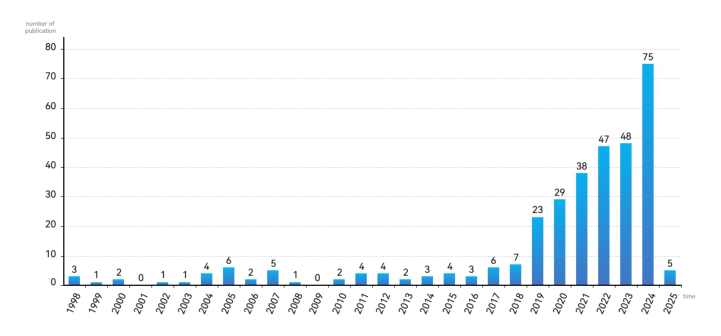
Through the analysis of the time series of the publication of valid papers (see Figure 2), the research development in this field can be divided into two stages: the initial accumulation period (from 1998 to 2018) and the
Operation and Maintenance System Design With AI Intervention 125
stable growth period (from 2019 to 2025). In the initial accumulation period, annual paper publications in this field were 0–7, potentially due to emerging technology limitations. In the stable growth period, there was a steady growth, with a calculated average growth rate of 26.2% (by geometric mean). Evidently, as AI technology advances, scholars are increasingly focusing on this field.
Figure 2: Annual output of operation and maintenance system design with AI intervention.
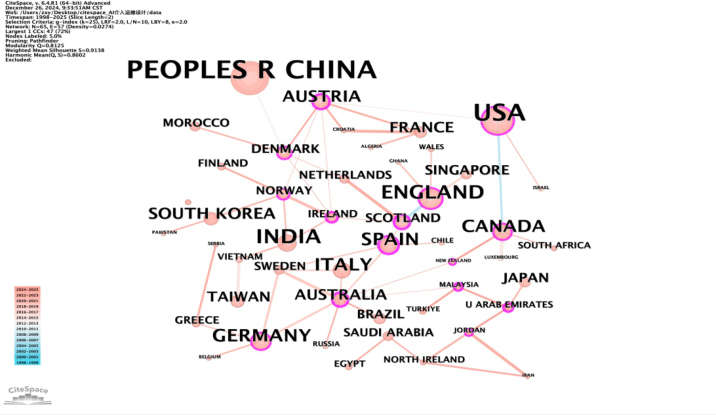
Analysis of national cooperation using Citespace reveals that between 1998 and 2025 (see Figure 3), a total of 65 countries or regions contributed to this field. In terms of publication output, China leads with 69 publications, with the first paper published in 2004. The United States follows, having produced 55 publications since 1998. When considering the centrality index (see Table 1), among the top ten countries by publication quantity, Spain has the most extensive cooperation with other countries, trailed by Australia. Overall, there is relatively close cooperation among these countries.
Table 1: The top 10 countries with the largest number of published papers.
Table available in the original PDF paper.
No. Country Freq Centrality Initial Pub. Year 1 PEOPLES R CHINA 69 0.07 2004 2 USA 55 0.28 1998 3 INDIA 26 0.09 2015 4 ENGLAND 21 0.15 2004 5 ITALY 17 0 2017 6 SPAIN 16 0.45 2017 7 GERMANY 16 0.13 1999 8 CANADA 15 0.13 2003 9 AUSTRIA 13 0.41 1998 10 SOUTH KOREA 12 0.04 2018
126 Zhang and Zhang
Figure 3: National cooperation analysis.
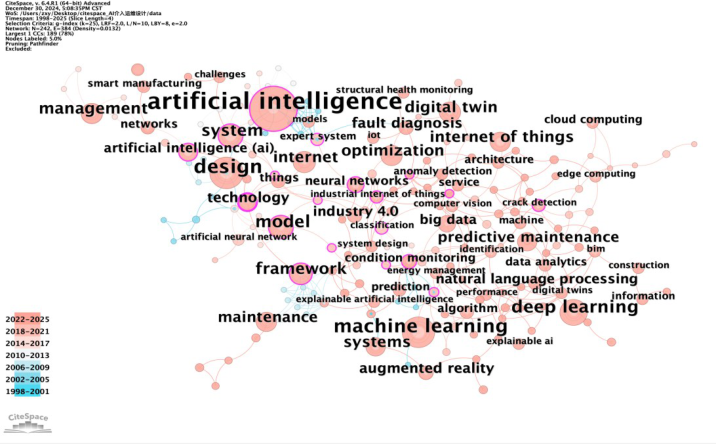
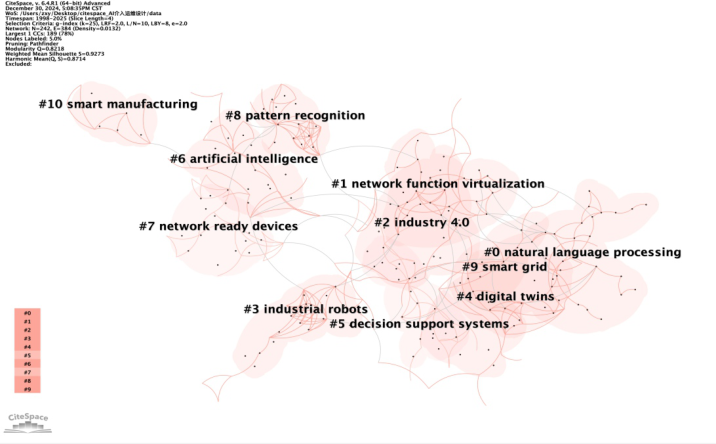
Research Hotspots Analysis By running Citespace, we obtained keyword co - occurrence maps (see Figure 4) and keyword clustering maps (see Figure 5), which help us understand the research hotspots in this field. Given that the valid literature covers a relatively long time span from 1998 to 2025, to make the analysis results clearer and more accurate, we ran Citespace with a time slice of four years (slice = 4). Eventually, we got 242 nodes and 384 connections, with Q = 0.8218 and S = 0.9273, indicating good overall network quality. After clustering the keywords, we obtained 11 sub - clusters. By summarizing these 11 sub - clusters, we finally derived three main clusters: Intelligent Technology, Industrial Manufacturing, and Network Information (see Table 2). This shows that the research hotspots of scholars in this field mainly focus on these three aspects.
Table 2: The clusters and sub-clusters of keywords.
Table available in the original PDF paper.
No. Cluster Sub-Cluster 1 Intelligent Technology #0 natural language processing #4 digital twins #5 decision support systems #6 artificial intelligence #8 pattern recognition 2 Industrial Manufacturing #2 industry 4.0 #3 industrial robots #10 smart manufacturing 3 Network Information #1 network function virtualization #7 network ready devices #9 smart grid
Operation and Maintenance System Design With AI Intervention 127
The first cluster, Intelligent Technology, comprises five sub - clusters: natural language processing, digital twins, decision - support systems, artificial intelligence, and pattern recognition. Prominent keywords within this cluster include Artificial Intelligence, Artificial Neural Network, Machine Learning, Deep Learning, Natural Language Processing, Algorithm, and Explainable AI. In the domain of intelligent technology, Artificial
128 Zhang and Zhang
Intelligence has emerged as the focal keyword among scholars in recent years. The continuous refinement of algorithms and the augmentation of computing capabilities have propelled machine learning and deep learning to achieve groundbreaking advancements in the innovative design of operation and maintenance systems (Izquierdo-Domenech et al., 2023) (Giordano and Fantoni, 2025).
The second cluster, Industrial Manufacturing, encompasses three sub - clusters: Industry 4.0, industrial robots, and smart manufacturing. Representative keywords within this cluster include Smart Manufacturing, Industrial Internet of Things, Digital Twin, Model, Framework, System Design, Predictive Maintenance, Energy Management, and Condition Monitoring. In the sphere of industrial production, the employment of digital twins to enhance overall operational and maintenance efficiency has become a frontier topic extensively explored by scholars. Predictive maintenance, a method frequently emphasized by scholars for improving maintenance efficiency, finds applications across diverse fields such as industrial production (Popan et al., 2024), internet systems (Goel et al., 2020), and transportation infrastructure (Chang et al., 2024). The third cluster, Network Information, consists of three sub - clusters: network function virtualization, network - ready devices, and smart grid. Notable keywords within this cluster include Internet of Things, Cloud Computing, Edge Computing, Big Data, Data Analytics, and Computer Vision. Yan and Yan explored the utilization of artificial intelligence and big data technologies to optimize its performance and user experience. By architecting an intelligent interaction system, they addressed the challenges confronted by operators in service interaction models, thereby offering an effective solution for intelligent operation and maintenance (Yan and Yan, 2022).
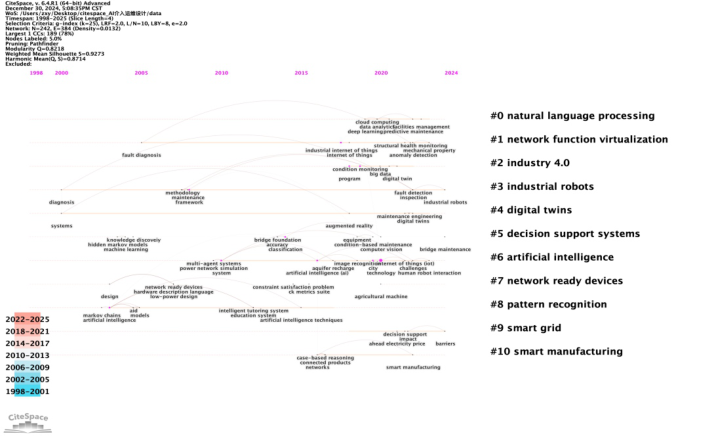
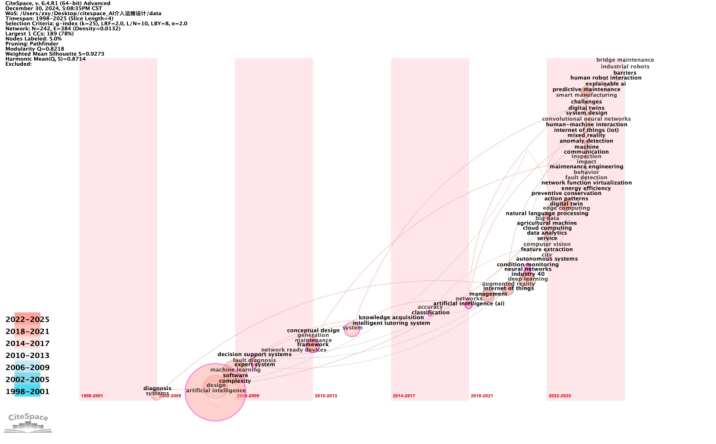
Research Hotspots Evolution Analysis By running Citespace, the timeline (see Figure 6) and time zone maps (see Figure 7) of keyword evolution are obtained, which assist us in understanding the evolving characteristics of research hotspots in this field. Through the analysis of these two maps, the research can be roughly divided into four stages: the early stage (1998–2005), the middle - term development stage (2006–2013), the technology application stage (2014–2021), and the intelligent upgrade stage (2022–2025).
During the early stage (1998–2005), the keyword ‘fault diagnosis’ was prominent in both the timeline and time - zone maps. In the early days of intelligent technology’s intervention in the operation and maintenance system, research mainly focused on using intelligent technology to address the fault diagnosis issues within the system. Fault diagnosis is a crucial basic function of the operation and maintenance system, thus receiving significant attention in the early stage.
In the middle - term development stage (2006–2013), ‘knowledge acquisition’ and ‘conceptual design system’ were key. As research deepened, it was understood that the operation and maintenance system required better
Operation and Maintenance System Design With AI Intervention 129
knowledge-acquisition for continuous learning and strategy optimization. Simultaneously, conceptual design system research became popular as researchers started considering how to construct a more intelligent and efficient system in terms of architecture and design concepts.
Figure 6: Timeline visualization.Figure 7: Time zone visualization.
During technology application stage (2014–2021), ‘machine learning’ and ‘intelligent agent’ were prominent in maps. Machine learning was more applied with tech progress, and intelligent agents meant a shift
130 Zhang and Zhang
to autonomous system capabilities. They enabled automated ops like monitoring and repair. Also, ‘condition monitoring’ and ‘predictive maintenance’ emerged, showing a focus on using such tech for intelligent ops and implementing predictive maintenance via real-time status monitoring to prevent failures and boost system reliability and efficiency.
In the intelligent upgrade stage (2022 - 2025), ‘diagnosis complexity’ and ‘AI-assisted decision-making’ are hotspots. As the system grows complex, accurate diagnosis and decision-making in such environments are challenging. ‘Edge computing’ and ‘cybersecurity’ emerged, indicating current and future research also focuses on system-external interaction. Edge computing enables local data processing for efficiency, and cybersecurity ensures system security against external threats and data leaks.
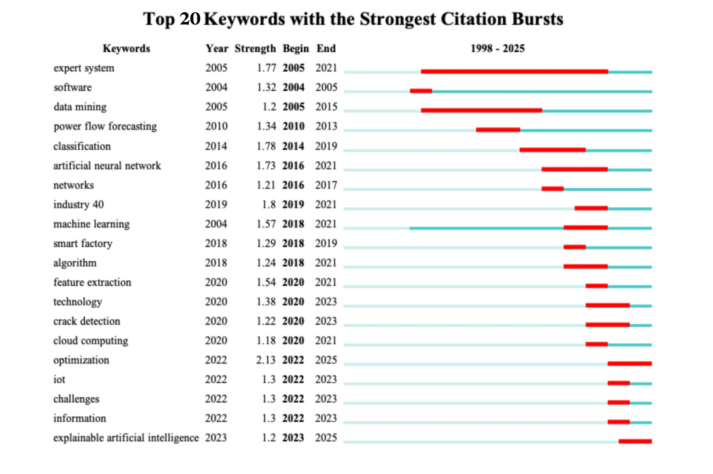
Front - End Trend Analysis and Preliminary Exploration of Design Opportunities Keyword bursts refer to keywords whose occurrence frequencies increase significantly in a certain period compared to other time periods. By running Citespace for keyword burst analysis (see Figure 8), we can better understand the changes in the frontier research trends of this field. The research frontiers have evolved from software basics to using expert systems, data mining, and machine learning to boost system intelligence. Lately, more focus is on smart manufacturing and AI-related areas like smart factories and algorithms. Also, system optimization, new tech applications (cloud computing, IoT), challenges, and explainable AI are being considered. As technology and applications grow, research on AI-intervened operation and maintenance system design is deepening and expanding.
Figure 8: Top 20 keywords with the strongest citation bursts.
Operation and Maintenance System Design With AI Intervention 131
Through the analysis of the evolution of frontier trends using Citespace, several design opportunities in the current intelligent operation and maintenance systems can be identified: First, as seen from the keyword burst diagram, machine learning has received significant attention in multiple time periods. In an intelligent operation and maintenance system, leveraging machine learning algorithms to process massive operation and maintenance data represents a crucial opportunity. A machine - learning - based data analysis module can be designed to predict equipment failures, optimize operation and maintenance processes, and so on. Second, big - data - related technologies, such as data mining, also gained popularity in the early stage. A big - data platform can be constructed to store and process operation and maintenance data from different devices and systems, uncovering potential patterns and regularities within to support operation and maintenance decision - making. Third, IoT is a current hot keyword. The intelligent operation and maintenance system can fully utilize the Internet of Things technology to achieve inter - connectivity of devices. By integrating different types of devices such as sensors and actuators, it can comprehensively monitor device status and enable remote control. Fourth, the early expert system can be combined with current artificial intelligence technologies to build a hybrid decision - making mechanism based on rules and models in the intelligent operation and maintenance system. By drawing on the knowledge and rules of the expert system and the learning ability of artificial intelligence models, more accurate operation and maintenance decisions can be made. Fifth, design an automated operation and maintenance process module. Based on predefined operation and maintenance strategies and event - triggering conditions, it can automatically execute operation and maintenance tasks such as device restarting and parameter adjustment. Meanwhile, use robotic process automation (RPA) technology to handle repetitive operation and maintenance operations like data entry and report generation. Sixth, optimize human - machine interaction by applying natural language processing technology. For example, operation and maintenance personnel can query device status and obtain operation and maintenance suggestions through natural language. Seventh, design a visual monitoring dashboard. By using various visualization means such as line charts, bar charts, pie charts, network diagrams, topological diagrams, and 3D models of equipment, information such as device operation parameters, fault distribution, and operation and maintenance processes can be presented. Implement dynamic data updates and interactive operations, such as drill - down analysis and zoom - in/out viewing, to assist operation and maintenance personnel in quickly identifying problems and making decisions.
CONCLUSION
This paper uses the bibliometric method to focus on the AI-intervened operation and maintenance system design. Employing CiteSpace, it analyzes 326 valid documents from the database to reveal development trends, hotspots, and frontiers, and explore optimization opportunities. Findings show paper publication had two stages with international cooperation.
132 Zhang and Zhang
Keyword analysis found three hotspot clusters, and keyword evolution reflects focus changes. Some design opportunities like machine learning application are identified. However, many current studies overlook the human role. With AI’s wide use, future research should stress human-AI interaction for overall efficiency improvement. Human-machine collaboration is expected to optimize processes, integrate human expertise with AI’s capabilities, and drive system development, bringing new changes to operation and maintenance management.
REFERENCES
Brunetti, D. Gena, C. Vernero, F. (2022). ‘Smart Interactive Technologies in the human - centric factory 5.0: A survey’. Applied Sciences, 12(16), 7965. Chang, X. et al. (2024). ‘Digital Twins in transportation infrastructure: An
investigation of the key enabling technologies, applications, and challenges’. IEEE Transactions on Intelligent Transportation Systems, 25(7), 6449–6471. Chen, C. (2005). ‘CiteSpace II: Detecting and visualizing emerging trends and transient patterns in scientific literature’. Journal of the American Society for Information Science and Technology, 57(3), 359–377. Cortés - Leal, A. Cárdenas, C. Del - Valle - Soto, C. (2022). ‘Maintenance
5.0: Towards a worker - in - the - loop framework for Resilient Smart Manufacturing’. Applied Sciences, 12(22), 11330. Giordano, V. Fantoni, G. (2025). ‘Decomposing maintenance actions into sub - tasks using natural language processing: A case study in an Italian automotive company’. Computers in Industry, 164, 104186. Goel, P. et al. (2020). ‘Integration of data analytics with cloud services for Safer
Process Systems, application examples and implementation challenges’. Journal of Loss Prevention in the Process Industries, 68, 104316. Izquierdo - Domenech, J. Linares - Pellicer, J. Ferri - Molla, I. (2023). ‘Environment awareness, multimodal interaction, and intelligent assistance in industrial augmented reality solutions with Deep Learning’. Multimedia Tools and Applications, 83(16), 49567–49594. Kiangala, K. S. Wang, Z. (2024). ‘An experimental hybrid customized AI and Generative AI Chatbot Human Machine Interface to improve a factory troubleshooting downtime in the context of industry 5.0’. The International Journal of Advanced Manufacturing Technology, 132(5–6), 2715–2733. Popan, I. A. et al. (2024). ‘Monitoring equipment malfunctions in composite material machining: Acoustic emission - based approach for abrasive waterjet cutting’. Applied Sciences, 14(11), 4901. Pritchard, A. (1969). ‘Statistical Bibliography or Bibliometrics?’. Journal of Documentation, 25, 348–349. Sabeti, S. et al. (2021). ‘Toward AI - enabled augmented reality to enhance the safety
of highway work zones: Feasibility, requirements, and challenges’. Advanced Engineering Informatics, 50, 101429. Wellsandt, S. et al. (2022). ‘Hybrid - augmented intelligence in predictive maintenance with Digital intelligent assistants’. Annual Reviews in Control, 53, 382–390. Yan, X. Yan, J. (2022). ‘Design and implementation of interactive platform for operation and maintenance of multimedia information system based on Artificial Intelligence and big data’. Computational Intelligence and Neuroscience, 2022, 1–9.
LISTED IN THE AHFE DIGITAL BOOKSTORE CATALOGUE
Explore the complete digital volume
Human Aspects of Advanced Manufacturing, Production Management and Process Control
Read this individual research paper free through the original publisher, or explore the full digital proceedings book.
ISBN 978-1-964867-60-1
Explore this ISBN in the AHFE Bookstore ↗Listed in the July 2026 bookstore catalogue; search by ISBN to confirm current availability · Digital book purchase optional