Xin-yue Li, Jun Zhang, Zhun Yu (2024). Experience Elements of User Feedback for Air Conditioning Systems in Office Buildings Based on Context Theory. In: Sustainable Construction in the Era of the Fourth Industrial Revolution. AHFE Open Access, vol. 149, pp. 111–121. https://doi.org/10.54941/ahfe1005280
The energy-efficient operation of air conditioning systems in office buildings plays a crucial role in the creation of sustainable built environment as well as the low-carbon development in the building sector. To achieve the goal of energy conservation without comfort penalty, it is desirable that relevant information from system users can be accurately collected through the user feedback method, thereby improving the system’s operation performance. The successful usage of this method is heavily dependent on system users’ experience which allows users to actively provide feedback. However, so far very few studies have given sufficient consideration to the user feedback experience of air conditioning systems in office buildings. Consequently, such experience is still poorly understood, and this hinders designers from developing effective strategies for designing corresponding tools with the goal of improving user feedback experience. To address this issue, this paper first analyzes the current status and characteristics of user feedback for air conditioning systems in office buildings. Then, the context theory is employed to analyze and define the experience elements of user feedback from the perspectives of user, environment, task, and product contexts. Based on the above analysis, the mutual influences between these experience elements are examined, and typical design strategies for the user feedback are further developed. Our future work will focus on validating the effectiveness of these experience elements and design strategies in improving user feedback experience by conducting design practices and tests.
In the last few decades, the reduction of energy use in office buildings has attracted considerable attention as they consume a huge amount of energy globally (Pang et al., 2020). Central air conditioning systems, as the major energy consumer in office buildings, play a crucial role in the energy reduc- tion and the creation of sustainable built environment, as well as low-carbon development (Jung and Jazizadeh, 2019). To achieve the goal of energy con- servation without comfort penalty, it is desirable that the information from system users, such as human thermal comfort and indoor occupancy, can be accurately collected and then effectively used during the process of system operation (Konis et al., 2020). To collect such information, many researchers employed different categories of sensors and instruments, and some literature
has been published (Xie et al., 2020). Despite these studies providing valuable insights into the energy efficiency improvement for air conditioning systems, it is still difficult for them to be widely used in practice due to the high costs of sensors and privacy issues of some instruments such as cameras. In recent years, some researchers have attempted to collect the information through the user feedback method, and corresponding tools have been designed (Lassen and Goia, 2021; Khan et al., 2021). Compared with the usage of relevant sensors and instruments, such a method can significantly reduce the cost and is very promising, while its successful usage is heavily dependent on system users’ experience that allows users to actively provide feedback (Jazizadeh et al., 2014). This indicates a need to fully understand the user feedback experience for air conditioning systems. However, such experience has been seldom considered during the design process in existing studies due mainly to the fact that its analysis involves the knowledge of different disciplines and the operation principle of air conditioning systems is relatively complex. Indeed, so far very few studies have been conducted on user feedback experience for air conditioning systems and it is still poorly understood. This hinders design- ers from developing effective strategies for designing relevant tools with the goal of improving user feedback experience. To address this issue, this paper proposes to employ the context theory to systematically investigate the user experience of user feedback for air conditioning systems in office buildings. Moreover, typical design strategies that can enhance user feedback experience are developed.
ANALYSIS OF USER FEEDBACK FOR AIR CONDITIONING SYSTEMS IN OFFICE BUILDINGS This section analyzes the current status and characteristics of user feedback for air conditioning systems in office buildings from the aspects of feedback content, feedback modes and feedback tools.
With regard to the content of user feedback, it can be classified by informa- tion types as subjective and objective. Subjective information mainly refers to the assessment of thermal comfort and indoor environmental quality as well as corresponding user complaints (Lassen and Goia, 2021). Objective infor- mation mainly refers to the presence and location of building users (Jazizadeh et al., 2014). In recent years, user feedback on thermal comfort and its appli- cation to the operation of air conditioning systems has received increased attention, while user feedback on the presence and location of building users was seldom studied.
With regard to the mode of user feedback, it can be classified by partic- ipation methods as active and passive. Active participation usually occurs when users are unsatisfied with the thermal comfort and indoor environ- mental quality, and passive participation usually occurs based on random or regular system requests (Khan et al., 2021). Nevertheless, frequent requests for user feedback may lead to a low rate of user response.
The user feedback tools for air conditioning systems mainly include appli- cations (e.g., smartphone applications and web applications), voting stations (e.g., fixed buttons and touchscreens), and wearable devices (e.g., smart
Experience Elements of User Feedback for Air Conditioning Systems in Office Buildings 113
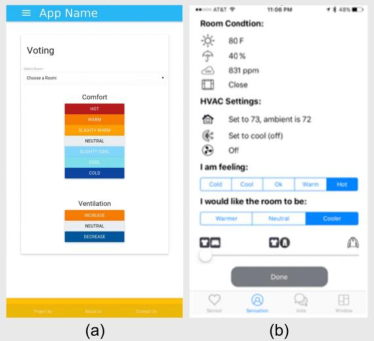
watches and smart bracelets) (Xie et al., 2020). Given that the location of voting stations is commonly fixed and the cost of wearable devices for all users is relatively high, the applications are mainly adopted in existing stud- ies and some designed interfaces are shown in Fig. 1 (Winkler et al., 2016; Li et al., 2017).
Figure 1: User feedback application interfaces: a (Winkler et al., 2016) and b (Li et al., 2017).
Previous studies have demonstrated that user feedback could be an effec- tive method for helping reduce the energy consumption of air conditioning systems while maintaining users’ thermal comfort in office buildings (Sarkar et al., 2015). These studies were generally conducted under experimental conditions, in which the users were informed and familiar with the content and the role of feedback. Also, one of the preconditions for these studies is that the users would actively participate and continuously provide feed- back during the operation of air conditioning systems. These conditions, however, may not be satisfied in practice. Indeed, users often have only a limited understanding of the content and effects of feedback in a real-life situation. Moreover, frequent requests for feedback will interfere with their work and rest activities, which tends to prevent them from gaining a good user experience. Consequently, the users could hardly be willing to actively and continuously provide feedback, resulting in an inability to collect suf- ficient information to meet the needs of air conditioning system operation adjustments. Due to the fact that office buildings have various scenarios (e.g., single offices, multiple offices and meeting rooms) and user behaviors (e.g., routine work, meeting and lunch break), the user experience in office build- ings commonly has a higher degree of complexity than that of other types of buildings such as hotel and residential buildings. To better understand and improve the user experience as well as increase the willingness of users to provide feedback, it is necessary to systematically analyze the elements of the user feedback experience and establish effective design strategies, thereby promoting the energy savings of air conditioning systems in office buildings.
CONTEXT THEORY AND CLASSIFICATION OF EXPERIENCE ELEMENTS OF USER FEEDBACK In recent years, different theories, such as the flow theory, emotional theory and context theory, have been employed to identify the dimensions of key elements of user experience for various products (He et al., 2023). Among these theories, the context theory proposed by Schilit et al. has been widely used, in which three important factors of context are defined as “where you are, who you are with, and what resources are nearby” (Schilit et al., 1994). This theory is frequently utilized in the design field to analyze the relationship among products, users and environment in a contextual space (Korhonen et al., 2010). Based on such relationship, new design directions and paths associated with user experience can be further acquired (Abowd et al., 1999). The analysis of user experience from the perspective of contexts has two main advantages. First, the experience is analyzed in a varying con- text, which enables it to be applied in complex situations with continuous dynamic changes. Second, user needs in specific contexts can be analyzed in detail and the methods for improving user experience can be developed accordingly (Holtzblatt and Beyer, 1997). With regard to user feedback for air conditioning systems in office buildings, it is generated according to the requirements of system energy reduction and user thermal comfort improve- ment, and thus is essential to meet user needs based on specific contexts. Moreover, to improve users’ feedback willingness, the experience of the inter- action between the users and feedback tools in varying contexts must be taken into account. Therefore, the context theory was employed to analyze the user feedback experience for air conditioning systems in office buildings in this study.
When applying the context theory to the study of user experience, it is generally necessary to first categorize the contextual experience elements according to the research field, specific system and user needs. In existing studies, researchers frequently started from the standpoint of users, and then analyzed the experience of man-machine-environment interaction systems in terms of the user, product and environment context (Luo et al., 2010). Given that the user feedback context of air conditioning systems in office buildings is primarily the process of interaction between office personnel, related prod- ucts and physical environment, the user, product and environment are also the basic contextual elements of user experience. At the same time, based on the optimal operation requirements of air conditioning systems, user feed- back needs to be provided under certain specific tasks. Hence, in addition to the above three elements, the task context is also an important element of the user feedback experience. Based on the above analysis, this paper classifies the experience elements of user feedback for air conditioning systems in office buildings into four categories: user contexts, task contexts, product contexts, and environment contexts. Note that a reasonable classification of experi- ence elements will lead to a complete understanding of user experience. It also provides the foundations for the clear definition of each element as well as the in-depth analysis of mutual influences between them.
Experience Elements of User Feedback for Air Conditioning Systems in Office Buildings 115
DEFINITION OF CONTEXTUAL EXPERIENCE ELEMENTS AND ANALYSIS OF MUTUAL INFLUENCES BETWEEN THEM Based on the characteristics of the user feedback for air conditioning systems in office buildings and the classification of its contextual experience elements, this section first gives a definition of each element, and then analyzes the mutual influences between them.
Definition of Contextual Experience Elements User Context Experience Elements From the perspective of differences and similarities between users, the user contextual experience element in the user feedback for air conditioning systems can be classified into individual attributes and group characteristics.
(a) Individual attributes mainly include a single user’s thermal comfort and occupancy states. Through the feedback of individual attributes and the corresponding air conditioning system operation adjustments, a user may feel more comfortable and thus make a judgment about the effec- tiveness of feedback (Liang et al., 2016). This will further affect the user’s satisfaction with the feedback process. (b) Group characteristics mainly include a group of users’ thermal comfort and the total number of occupants. It can be obtained based on the analysis of individual attributes. Due to individual differences in ther- mal comfort needs, it is often difficult for air conditioning systems to meet the requirements of all users (Wang et al., 2018). Hence, the pres- ence of overall distribution of thermal comfort needs based on group characteristics will affect the user’s understanding of air conditioning systems’ adjustment results. This will further affect their acceptability of the feedback process.
Task Context Experience Elements From the perspective of the feedback task process of air conditioning sys- tems, the task context experience elements can be classified into participation modes, input forms and response speed.
(a) Participation modes mainly include the active feedback based on users’ own needs and the passive feedback according to the system requests. The entrance position and style of active feedback will affect the guide of users’ visual flow, while the interaction mode and request frequency of passive feedback will affect the consistency in users’ operation habits. These will directly affect the ease of user operation. (b) Input forms mainly include the form of occupancy state input, thermal comfort voting and user complaint reporting. Users’ accurate under- standing of feedback tasks will be affected by the input forms, par- ticularly the setting of thermal comfort scales and complaint report dimensions. These will directly affect the clarity of the information of feedback tasks. (c) Response speed mainly includes high speed (e.g., instant response) and low speed (e.g., delayed response). Response speed determines how long
it takes for users to realize that their feedback has been received and used for air conditioning system operation adjustments. This will further affect the users’ trust accumulated over a long period of product usage.
Product Context Experience Elements From the perspective of indirect or direct improvement of thermal comfort by products, the product context experience elements can be classified into feedback media and regulating equipment.
(a) Feedback media mainly include applications for smartphones, webs and wearable devices. Given the advantages and weaknesses of each type of feedback media (e.g., wearable devices are portable while their screens are relatively small), a combined use of them can expand the scope of users’ feedback scenarios (Chatzigeorgiou and Andreou, 2021). This will further affect the convenience of user operation and the completeness of feedback information. (b) Regulating equipment mainly includes controllers of air conditioning systems and other auxiliary heating/cooling/ventilation equipment (e.g., fans and humidifiers). Air conditioning system operation adjustments based on user feedback usually have a certain time-lag effect, while the usage of regulating equipment can directly and quickly meet users’ need for comfort (Kim et al., 2018). This will effectively reduce their complaints and dissatisfaction, thereby positively affecting the user experience.
Environment Context Experience Elements From the perspective of the effect of environment context changes on user experience, the environment context experience elements can be classified into temporal points, spatial areas and environmental parameters.
(a) Temporal points mainly include regular points in time at which routine user activities occur and special points in time at which unpredicted user activities occur. Users’ activity states and needs normally vary at different temporal points, and thus whether the feedback methods are appropri- ate in terms of temporal points will affect their experience when they provide feedback. (b) Spatial areas mainly include office areas (e.g., offices and meeting rooms) and auxiliary areas (e.g., lobbies and corridors). In different areas, the operating requirements of air conditioning systems and users’ activeness to provide feedback may vary, and thus whether the feedback content and methods are appropriate in terms of spatial areas will help avoid collecting redundant information and improve task completion rates. This will further affect the user experience in terms of the efficiency of feedback information collection. (c) Environmental parameters mainly include indoor environmental param- eters and outdoor environmental parameters. The presentation of infor- mation about changes in environmental parameters before and after feedback will help users intuitively understand the effect of feedback.
Experience Elements of User Feedback for Air Conditioning Systems in Office Buildings 117
Mutual Influences between Different Contextual Experience Elements The user feedback experience for air conditioning systems in office build- ings is a complex system that consists of different experience elements in the user, environment, task, and product contexts. Lack of understanding of mutual influences between these contexts and elements may result in designers’ failure to develop effective design strategies, thereby partially or even completely deviating from the actual feedback needs of users. There- fore, based on the definition of these elements, this section further analyzes the mutual influences between different contexts as well as the experience elements.
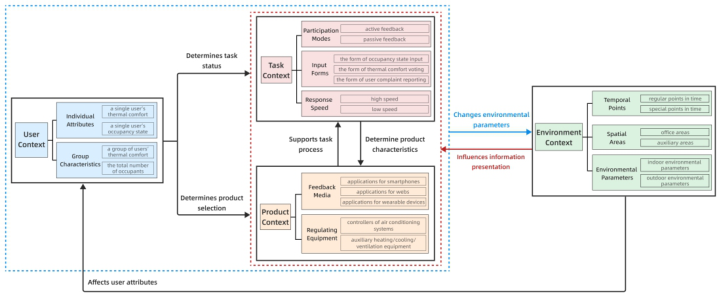
First, the change of user contexts forms the basis of the variation in task and product contexts. The degree to which user thermal comfort changes and the duration of occupancy state changes directly determine the status of feedback tasks, including the mode of active/passive participation in the task and the corresponding form of input. Meanwhile, they also determine the selection of feedback media and regulating equipment in the feedback process to some extent.
Second, based on the combined action of user, task and product contexts, environment contexts will be changed to meet different requirements simul- taneously. Specifically, after users are willing to provide feedback based on individual attribute changes or air conditioning system requests, and perform corresponding feedback tasks by using feedback media or regulating equip- ment, the indoor environmental parameters at different temporal points and in different spatial areas will be changed through the air conditioning sys- tem operation adjustments or the usage of regulating equipment. The change of environment contexts, in turn, has an effect on user, task and product contexts. Specifically, the variation of temporal points and spatial areas, as well as the corresponding change in indoor environmental parameters, will directly affect the individual thermal comfort and occupancy states, thereby further influencing the group characteristics. As for task and product con- texts, the changes in environment contexts will influence the information presentation of feedback task results in feedback media. In particular, when the changes in environment contexts do not meet users’ expectations, the various environmental parameters involved and specific user needs will influ- ence the content and response speed of the information presented in different feedback media. Accordingly, the users can either continue to provide their feedback through active/passive participation and input the corresponding content in different feedback media, or choose to use appropriate regulating equipment. The above process can be repeated until both the users’ needs for thermal comfort and the systems’ requirement for energy saving are satisfied.
Third, through the interaction between product and task contexts, the smooth running of user feedback can be achieved. On the one hand, partici- pation modes and input forms jointly determine the interface presentation and function definition of feedback media. On the other hand, feedback media, as the medium of various participation modes and input forms, sup- port the feedback task process. In addition, users’ selection of feedback media or regulating equipment also indirectly affects the response speed of feedback.
Based on the above analysis, the mutual influences between different contexts as well as the experience elements are illustrated in Figure 2.
Figure 2: The mutual influences between different contexts as well as the experience elements. Source: drawn by the author.
DESIGN STRATEGIES FOR USER FEEDBACK FOR AIR CONDITIONING SYSTEMS Based on the definition and the mutual influences between the four experi- ence elements, typical design strategies for user feedback for air conditioning systems in office buildings are developed as follows.
(1) Analyzing the information on group characteristics under different spa- tiotemporal conditions, and presenting them in feedback media through different means of visualization design. For example, at regular tempo- ral points (e.g., during office hours) and in multiple offices, different charts showing the overall distribution of thermal comfort preference and the reason for adjusting system operation can be presented based on the information of individual attributes. This can increase the degree of user acceptance of air conditioning system operation adjustments, par- ticularly for those users whose thermal comfort requirements are still not satisfied. (2) Analyzing the features of user feedback tasks under different spatiotem- poral conditions, and establishing a smooth task flow of feedback participation, information input, and response obtainment through effective interaction guidance. For example, at special temporal points (e.g., temporary meetings) and in meeting rooms, enabling users to pro- vide feedback rapidly and receive responses timely is commonly the key point of user feedback tasks. Accordingly, shortcuts to access the feedback interface for active participation can be designed, and clear instructions for inputting the information on thermal comfort and occu- pancy states can be provided. Also, prompting messages for the response from air conditioning systems can be sent to users. This can assist users in
Experience Elements of User Feedback for Air Conditioning Systems in Office Buildings 119
better understanding the product’s main functions and operation steps, thereby allowing them to successfully complete the feedback task. (3) Analyzing available regulating equipment and corresponding adaptive behaviors under different spatiotemporal conditions, and offering sug- gestions in feedback media for adaptive behavior adoption and its impacts on energy saving. For example, at regular temporal points (e.g., noon breaks) and in multiple offices, simple tips on the usage of auxil- iary heating/cooling/ventilation equipment at personal workstations can be given to users who feel uncomfortable. Also, the impact of these behaviors on energy reduction and the associated environmental protec- tion can be quantitively calculated and provided. This can raise users’ awareness about adaptive behaviors, thereby reducing system energy consumption through user behavior modification. (4) Analyzing the characteristics of environmental parameter change and corresponding air conditioning system operation under different spa- tiotemporal conditions, and choosing appropriate participation modes and input forms in terms of feedback tasks. For example, at regular tem- poral points (e.g., routine meetings) and in meeting rooms, given that office automation (OA) systems usually collect the meeting information in advance, feedback systems can be linked with OA systems to automat- ically obtain the exact number of occupants and the beginning/ending time of meetings. Also, requests from feedback systems on the selec- tion of predefined thermal comfort preferences can be made before the meeting. This can improve the accuracy of collected information and the efficiency of user feedback operation.
CONCLUSION
User feedback for air conditioning systems in office buildings is an effective means of helping achieve the goal of energy conservation without sacrificing user thermal comfort, and a good user experience in this process is crucial for users to actively and accurately provide relevant information. In this study, the current status and characteristics of research on user feedback for air con- ditioning systems in office buildings were first analyzed. Then, based on the context theory, the experience elements of user feedback were classified into four categories: user contexts, task contexts, product contexts, and environ- ment contexts. The definition of each experience element was given and the in-depth analysis of mutual influences between them was also conducted. Moreover, typical design strategies for user feedback for air conditioning systems in office buildings were developed. This study still has two limita- tions that need to be further explored. First, the research on the contextual experience elements was primarily performed based on descriptive analyses. Second, there is a lack of design testing of the user feedback strategies in practice. The main focus of future study should be placed on validating the effectiveness of these experience elements and design strategies in improving user feedback experience by conducting user research and design practices.
ACKNOWLEDGMENT
The authors would like to acknowledge all the reviewers who contributed their time and expertise.
REFERENCES
Abowd, G. D., Dey, A. K., Brown, P. J., Davies, N., Smith, M. et al. (1999).
“Towards a better understanding of context and context-awareness”, proceed- ings of Handheld and Ubiquitous Computing: First International Symposium, Karlsruhe, Germany. Chatzigeorgiou, I. M. and Andreou, G. T. (2021). A systematic review on feedback research for residential energy behavior change through mobile and web interfaces, Renewable and Sustainable Energy Reviews, 135, p. 110187. He, X. C., Ma, M. Y. and Wang, M. W. (2023). Research status and development
trend of international experience design based on bibliometric analysis, Packaging Engineering, 44(14), pp. 327–339 (in Chinese). Holtzblatt, K., and Beyer, H. (1997). Contextual design: defining customer-centered systems. Elsevier. Jazizadeh, F., Ghahramani, A., Becerik-Gerber, B., Kichkaylo, T., and Orosz, M.
(2014). User-led decentralized thermal comfort driven HVAC operations for improved efficiency in office buildings, Energy and Buildings, 70, pp. 398–410. Jung, W. and Jazizadeh, F. (2019). Human-in-the-loop HVAC operations: A quantitative review on occupancy, comfort, and energy-efficiency dimensions, Applied Energy, 239, pp. 1471–1508. Khan, D. S., Kolarik, J. and Weitzmann, P. (2021). Application of an occupant voting
system for continuous occupant feedback on thermal and indoor air quality-case studies in office spaces, Energy and Buildings, 251, p. 111363. Kim, J., Schiavon, S. and Brager, G. (2018). Personal comfort models-a new paradigm in thermal comfort for occupant-centric environmental control, Building and Environment, 132, pp. 114–124. Konis, K.et al. (2020). Trojansense, a participatory sensing framework for occupant-
aware management of thermal comfort in campus buildings, Building and Envi- ronment, 169, p. 106588. Korhonen, H., Arrasvuori, J. and Väänänen-Vainio-Mattila, K. (2010). “Analysing user experience of personal mobile products through contextual factor”, proceed- ings of the 9th International Conference on Mobile and Ubiquitous Multimedia, Limassol, Cyprus. Lassen, N. and Goia, F. (2021). A theoretical framework for classifying occupant-
centric data streams on indoor climate using a physiological and cognitive process hierarchy, Energy and Buildings, 241, p. 110935. Li, D., Menassa, C. C. and Kamat, V. R. (2017). “A personalized HVAC control smartphone application framework for improved human health and well-being”, in: Computing in Civil Engineering 2017. pp. 82–90. Liang, X., Hong, T. and Shen, G. Q. (2016). Occupancy data analytics and prediction:
A case study, Building and Environment, 102, pp. 179–192. Luo, S. J., Zhu, S. S., Ying, F. T., and Zhang, J. S. (2010). Scenario-based user experience design in mobile phone interface, Computer Integrated Manufacturing Systems, 16(02), pp. 239–248 (in Chinese). Pang, Z., Chen, Y., Zhang, J., O’Neill, Z., Cheng, H. et al. (2020). Nationwide HVAC
energy-saving potential quantification for office buildings with occupant-centric controls in various climates, Applied Energy, 279, p. 115727.
Experience Elements of User Feedback for Air Conditioning Systems in Office Buildings 121
Sarkar, C., Uttama Nambi S. N., and Prasad, R. V. (2015). “Learning individual preferences for energy-efficiency and comfortable living,” proceedings of the 2nd ACM International Conference on Embedded Systems for Energy-Efficient Built Environments, Seoul, South Korea. Schilit, B., Adams, N. and Want, R. (1994). “Context-aware computing applica-
tions”, proceedings of 1994 First Workshop on Mobile Computing Systems and Applications, Santa Cruz, CA. Wang, Z., de Dear, R., Luo, M., Lin, B., He, Y. et al. (2018). Individual difference in thermal comfort: A literature review, Building and Environment, 138, pp. 181–193. Winkler, D. A., Beltran, A., Esfahani, N. P., Maglio, P. P., and Cerpa, A. E. (2016).
“FORCES: Feedback and control for occupants to refine comfort and energy sav- ings”, proceedings of the 2016 ACM International Joint Conference on Pervasive and Ubiquitous Computing, Heidelberg, Germany. Xie, J., Li, H., Li, C., Zhang, J., and Luo, M. (2020). Review on occupant-centric thermal comfort sensing, predicting, and controlling, Energy and Buildings, 226, p. 110392.
LISTED IN THE AHFE DIGITAL BOOKSTORE CATALOGUE
Explore the complete digital volume
Sustainable Construction in the Era of the Fourth Industrial Revolution
Read this individual research paper free through the original publisher, or explore the full digital proceedings book.
ISBN 978-1-964867-25-0
Explore this ISBN in the AHFE Bookstore ↗Listed in the July 2026 bookstore catalogue; search by ISBN to confirm current availability · Digital book purchase optional