Panagiotis Markopoulos, Evangelos Markopoulos, Akash Nandi, Jussi Kantola (2024). Integrating Digital Twins into the Metaverse for Dynamic and Computer-Human Interactive Building Information Modelling. In: Sustainable Construction in the Era of the Fourth Industrial Revolution. AHFE Open Access, vol. 149, pp. 11–22. https://doi.org/10.54941/ahfe1005270
Digital Twins and the Metaverse are upcoming technologies that are each associated with several promising potential applications within many industries, one of which is the construction industry; more specifically, these technologies have significant potential applications to improve built environments consisting of Building Information Monitoring (BIM) systems. This paper analyses the integration of Digital Twins and the Metaverse into such built environments by highlighting their dynamic gathering, evaluation, and contribution of human-centric behavioural information to Building Information Modelling systems. Information of this type can impact critical decisions in the implementation strategy and management of any type of project within a built environment. The paper presents such a technology integration, and its system architecture indicates expected performance metrics and emphasizes the need for dynamic computer-human interactive data collection, evaluation and transmission into a BIM system. It also highlights the alignment of such a human-centric BIM approach with the United Nations Sustainable Development Goals that impact the built environment. Furthermore, we delineate the pre and post-conditions of applying this integrated technology, discuss presently-existing research limitations, and outline areas of further research.
Building Information Modelling (BIM) has been introduced in the last decade, bringing with it high expectations for the modernization of the construction industry and the built environment. This promising new concept is based on early principles of computer science and has trended toward becoming a
significant standard and requirement of the construction industry concerning the built process and environment.
This new concept, which is based on the early principles of computer science, seems promising and tends to become a significant standard and requirement in the built process and environment. However, the practical definition of BIM from the theoretical definition differs. The BIM theory seems to be incomplete, there is an emergence of understanding BIM as a panacea for all ills in AECO (Architecture, Engineering, Construction and Operation) of buildings, with an unclear relation between BIM promise and BIM performance (Koutamanis et al., 2023). Moreover, the costs, required effort, and complexity associated with the construction and maintenance of a BIM system vary significantly, further contributing to a limited common understanding of the key factors that determine the effectiveness of a BIM technology.
There is a wide range of various technologies that can provide data to a BIM system; thus, at the moment BIM is best thought of as a theoretical framework, rather than as a specific technology that is developed per case and need. We are thus left with two options: either we analyze and question BIM standardization efforts and goals, or we wait for the technology to mature and obtain a common consensus on its architecture, functionality, metrics, and outputs (Ocean, 2024).
Many of the technologies that can be used as BIM subsystems (or sub- technologies) are quite advanced and futuristic but are also quite new to the market and thus have a limited track, effectiveness, and impact record. This generates the risk of raising high expectations from their contribution to a BIM system, but also on their interconnection with other technologies within a BIM system.
BIM TECHNOLOGIES A practical and simplified definition of BIM can be similar to the definition of the built environments as a system of systems, which consequently needs a systems thinking approach to see the bigger picture and understand the details (Shrubsole, 2018). BIM systems vary in operations and efficiency based on the number and type of technologies integrated to generate the information needed for creating and managing a model. Some of these technologies are listed in Table 1.
BIM, however, is certainly not limited to the set of specific technologies that have already been used in the built environment. Several technologies that have yet to be directly associated with the built environment and BIM systems are very likely to be integrated withing the next five years. Artificial Intelligence in particular has much to offer to BIM: many AI technologies pos- sess the potential to coordinate with other BIM technologies, and many have the potential to contribute to information collection and analysis within a BIM. Some examples of these technologies include expert systems that power explanatory AI (XIA), Artificial Generate Intelligence (AGI), or AI-ILMS (Integrated Learning management systems).
Integrating Digital Twins Into the Metaverse 13
Table 1. Indicative elements of a BIM system.
Table available in the original PDF paper.
BIM system elements (indicative)
Real-time Rendering
Autodesk Revit Drones Robotics Integration Graphisoft ArchiCAD Digital Twins 3D Printing Technology VR Collaboration Tools Cloud computing Laser Scanning and Point Clouds AR for Construction Machine Learning for Predictive Analysis Unity Reflect for Real-time 3D Generative Design Tools IoT for Building Performance
Real-time kinematics Photogrammetry Blockchain for BIM Data Security
DIGITAL TWINS AND METAVERSE IN THE BUILT ENVIRONMENT Digital twins which are widely accepted and respected in the built envi- ronment are not such a new and novel technology. Early versions of the technology have often been employed as test environments or simulators. For instance, in the 1960s NASA developed a Digital Twin to simulate and access the conditions onboard Apollo 13 (Miskinis, 2019). David Gelernter’s work ‘Mirror Worlds’ showed a further evolution of Digital Twins (Gelernter, 1991). In 2002 the aforementioned work was applied to manufacturing by introducing the Digital Twins Software concept (Grieves, 2002); this software concept was further developed and ultimately introduced with its current meaning in the year 2010 by NASA’s John Vickers (Malshe et al., 2023).
The evolution of digital twins through the dynamic interactions between physical and digital assets has revolutionized the construction industry both in theory and practice. For instance, applications of Digital Twins have been successfully utilized by the Hong Kong International Airport (Chevin, 2021). In addition, Rolls-Royce uses digital twins for its “Intelligent Engine” pro- gram, Airbus and Boeing build digital twin aircrafts, and General Electric develops digital twin engines (Xiong and Wang, 2022). Furthermore, Lon- don’s Crossrail is a $21 billion test of virtual modelling (Peplow, 2016); the term “Crossrail twin” was set up before the term digital twin was even widely adopted (Lee, 2021).
Digital Twins technology has remarkable potential to assist the initial deployment of complex projects to market, and also to support after-market phases such as training, maintenance, repair, and retirement (Moser et al., 2023). However, widespread adaptation of Digital Twins appears to be inhib- ited by the implementation cost and maintenance requirements associated with the technology. These factors have led to the development of various technologies that offer digital-twin-types of functionalities and have also led to the creation of services that consult and aid clients who have projects requiring a staged transition from light simulation environments to actual Digital Twins.
While Digital Twins have gained rapid recognition and adaptation in the built environment, the Metaverse needs time to mature both as a technology
and as a concept. The metaverse remains an emerging digital realm charac- terized by 3D capabilities, leveraging virtual reality, augmented reality, and cutting-edge internet and semiconductor technologies. It enables individuals to engage in immersive personal and business experiences online (McKinsey, 2022). Nevertheless, there are pioneers in the built environment that are heav- ily involved in large-scale metaverse projects, Zaha Hadid Architects (ZHA) being one example (Finnley, 2022). For instance, the Libertland is a revo- lutionary ZHA project that links the Metaverse to the built environment industry by replicating the operations of a physical city in a virtual envi- ronment (Schumacher, 2022). Baidu’s Metaverse City is another large-scale metaverse project; in 2021 the project was already able to host over 100.000 simultaneous users (Cheng, 2021). Moreover, the development of smaller industry projects such as Gucci’s “Gucci Vault Land”Metaverse (Marr, 2022) and Ralph Lauren’s holiday world (McDowell, 2021) indicate that while the Metaverse may be very young, it is being developed quite rapidly.
DIGITAL TWINS AND METAVERSE INTEGRATION Both Digital Twins and the Metaverse offer significant benefits to the built environment with respect to collecting data from autonomous or human- enabled operations on digital assets.
However, the human element in digital twins is often neglected; instead, emphasis is mostly put on the technologies that power digital twin systems. In particular, a large focus is often put on data collection devices that gather specific inputs that are linked to specific metrics commonly understood by the involved actors (clients, suppliers, etc.).
Human elements do not directly generate trackable and measurable data to signal the status of a specific operation; however, such elements provide information to investigate a specific signal and further analyze it to identify its root cause. Human behavioral data is collected from either the response of the digital twin’s coordinator on a given situation based on the actions taken to specific metrics and signals, or is collected by observing the avatars’ movements and actions associated with them.
Avatars are mainly Metaverse elements and are rarely used in digital twin technology, as this technology is relatively more hardware-driven oriented (sensors, lidars, cameras, etc).
The integration of metaverse elements to a digital twin application can add human elements that allow for better understanding of a reading (metric), can identify the factors causing it, and can lead to the development of proactive strategies and better decision-making.
This form of integration has been seen in early-stage projects and applica- tions in the shipping and maritime industry, as there exist examples of digital twin and metaverse elements being used to provide real-time, realistic, and human interactive environments.
The MARISOT project, an initial virtual reality maritime training tech- nology (Markopoulos & Luimula, 2020), used elements of digital twins in a
Integrating Digital Twins Into the Metaverse 15
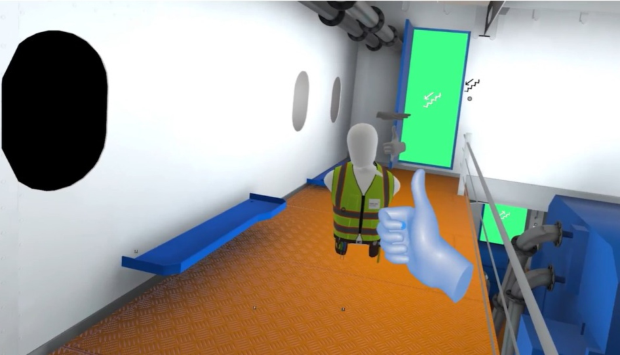
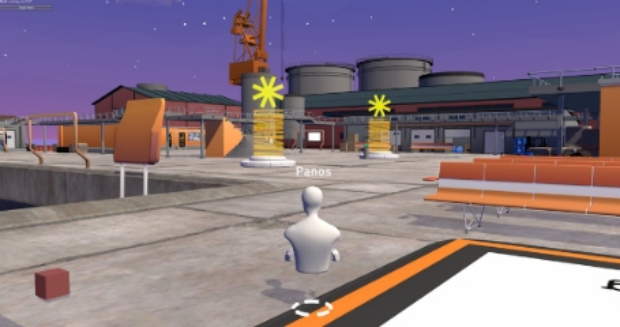
metaverse environment where avatars interact with digital assets in internal (see Figure 1) or external environments (see Figure 2).
Figure 1: Avatar operating in a virtual internal vessel environment (Luimula et al., 2021).Figure 2: Avatar operating in a virtual external port environment (Luimula et al., 2022).
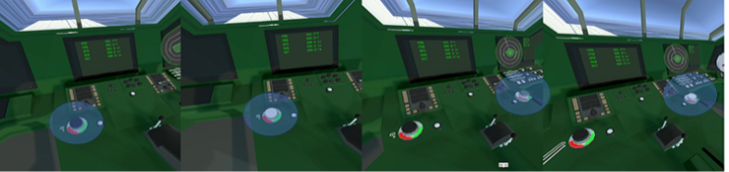
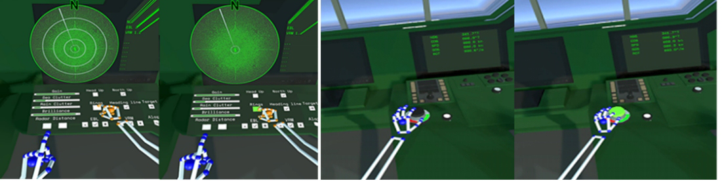
Furthermore, MARISOT used hand-tracking, eye-tracking, and finger- tracking technologies to generate data from the user’s behaviour and activities on the vessel. Eye-tracking data provides insights into the thinking and logic of the avatar (see Figure 3) while hand-tracking data is used to assess and analyze the execution of a task (see Figure 4).
Metrics were associated with the actual performance of the vessel by the user’s actions through their avatars and were also associated with the avatar’s behaviour before, during and after taking an action. Such behaviour was measured by the time taken by the avatar to do a reading (eye tracking),
time of hesitation taken before making a decision, body movement (hand tracking), and other information generated by the combination of the avatar’s eyes and the body movements; these data points were then compiled using advanced technologies such as neural networks to predict human success or errors (Markopoulos et al., 2021).
Figure 3: MarISOT eye-tracking technology - user turning eye from one focus point to another (Luimula et al., 2020).Figure 4: MarISOT hand tracking technology. Pointing and touching the ship’s radar buttons based on finger tracking, and pinching the ship’s manipulator based on hand tracking (Markopoulos et al., 2020).
The MARISOT example demonstrates the co-existence of Digital Twin technology and the Metaverse in an application and signifies the gradual evolution of Digital Twins in Metaverse environments. Furthermore, the integration of human-computer interaction in Digital Twins extends the clas- sification of Digital Twin towards AI technologies, particularly towards XAI technologies, due to the reasoning and justification that can be generated for actions taken based on real-time information (readings) gathering.
DIGITAL HUMAN CENTRIC BIM SYSTEMS BIM systems contribute to the evolution of technologies that serve the built environment. The technologies that compose a BIM system impact its effectiveness and contributions to any specific project.
For BIM to stay relevant, the value added that it provides to a project must stay relevant as well; moreover, it must remain aligned with current technological trends and project expectations.
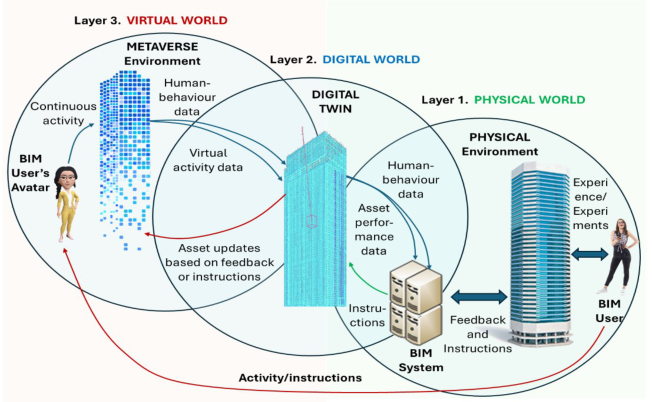
A Metaverse-based Digital Twins technology can be used towards enabling better decision-making at all construction stages and is relevant in the con- text of operations and maintenance. Figure 5 presents the use of metaverstic Digital Twin technology architecture in BIM. The given system architecture
Integrating Digital Twins Into the Metaverse 17
generates real-time data not able to be gathered by conventional digital twin technology. Such data can be related to an avatar’s time spent in each loca- tion, its time spent focusing on specific items, the items it observed, touched, or kept, its attention given to other avatars or activities, its response times, its expressions (via eye tracking), its body movement and balance, and other combinations of body coordination and association with actions taken.
Figure 5: Metaverstic digital twins’ contribution to BIM.
These metrics can indicate places of risky movement or places of preferred movement, which can be associated with time spent in a specific area, activi- ties done, user gatherings, and emotions generated. The data generated can be transmitted to the BIM technology to better understand the physical use and needs of a particular space or area, and the enhancements needed to facilitate a more safe or pleasant use of it.
The extent to which the metaverse integrates with the operations of a dig- ital twin can also be dictated by the purpose of using such technologies to understand human behaviour in a space, design preferences and ergonomics.
Zaha Hadid Architects moves in this direction by creating modular blocks of buildings that are coupled with computational design parameters and merged into Unreal Engine, ultimately providing a photorealistic, real-time design configurator that allows users to integrate with their designs (AEC, 2021). The company is among the firms using Twinmotion to create 3D ren- derings. Both Unreal Engine and Twinmotion, developed by Epic Games, enable the creation of digital twins, virtual representations of real-world buildings, and even entire cities. The creation of such virtual cities allows of the analysis of elements such as traffic flow, movement patterns, and comfort- able environments, with data passing from the physical world to the virtual model (Dezeen, 2021).
Epic Games explores the potential of linking its gaming worlds to digital twins via an expansion into the world of architecture and urbanism. Craig
Weir-McCall is the Head of Architecture at Epic Games, stated that the com- pany intends to build a metaverse on the foundations of the digital twins where people can live, work, and play alongside each other (Priestley, 2021).
BIM HUMAN CENTRIC APPROACH RELATIVITY WITH THE UN SDG’S A key factor related to the use of advanced technologies in managing the built environment is achievement of sustainable development. Over the years substantial progress toward reaching this goal has been made, and further integration of advanced technologies in BIM systems has played a larger role (Ogunmakinde et al., 2022). This progress is also largely due to research initiatives aimed towards the quantification of SDGS in the environmental assessment of civil engineering projects (Hojas et al., 2021).
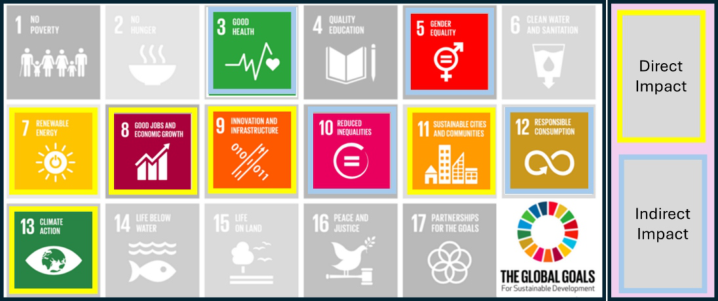
As metaverse and digital twins are newer additions to BIM, the proposed integration provides stronger dynamics towards enhancing sustainability in the built environment. Figure 6 highlights the UN Sustainable development goals that can be directly (climate, infrastructure, and economic growth) and indirectly (well-being and social inclusion) addressed with human-computer interactive BIM technologies.
PRE- AND POST-CONDITIONS FOR INTEGRATED DIGITAL TWINS AND METAVERSE APPLICATIONS The integration of digital twins, the metaverse, and BIM can be a technologi- cal challenge for many organizations, especially those that can only partially adapt BIM due to budget restrictions or lack of expertise.
Performing such an integration involves moving the monitoring and track- ing of a situation from a two-dimensional environment to a multidimensional environment; this change requires specialized hardware, high computing power, and expertise when adopting digital twin or metaverse technology such. Even though the construction sector and the built environment have recently made significant achievements in adapting advanced technologies, they still fall behind the readiness of the construction industry to either fully adopt them or maintain them.
A key pre-condition for making such investments is identifying technical and financial incentives that can support the budget and effort needed for this type of BIM system. A second level of pre-conditions is related to the technological maturity of both the contractors and the client organization on large-scale projects that can justify the need and utilize the benefits of such technologies, avoiding the illusionary faster-cheaper-better methodology.
The post-conditions are reciprocal to the pre-conditions. The contractor’s and client’s maturity and commitment to maintaining such technologies upon the completion of a project is the most significant condition for the rollout on other projects. This is also related to the return on investment of such tech- nologies, which in turn is related to the pre-condition of properly selecting and investing in the needed expertise and infrastructure.
Integrating Digital Twins Into the Metaverse 19
Figure 6: UN SDGs impact by human-computer interactive BIM technologies.
LIMITATIONS AND AREAS OF FURTHER RESEARCH The research conducted for this work has been based on a literature review and trend analysis. A limited number of projects have effectively integrated digital twins and the metaverse, and even fewer have extended this integration to also include BIM technology.
This work will be extended to further define the operations of the proposed architectures from a data exchange perspective between digital twins, meta- verse and BIM. This triangulation needs to be examined for the development of the data structures and conditions to transmit needed information between the Metaverse to digital twins, and from digital twins to the technologies that compose the BIM system per case.
CONCLUSION
The integration of digital twins and metaverse has been approached by vari- ous organizations theoretically by inventing new terms describing digital and immersive environments that replicate and connect organizational aspects to optimise experience and decision-making; some specific examples include Industrial Metaverse (Siemens, 2023) and Enterprise Metaverse (McKinsey, 2022). Such systems lean more towards digital twins than they do towards metaverses, as the use of avatars to operate within the digital replica and interact this the digital assets while impacting the physical ones is limited. Nevertheless, these are indications that actual metaverstic environments are an industry need and can be eventually achieved; specifically, this can occur once virtual human performance elements are fully integrated and are capable of measuring cognitive load in terms of the reasoning, feelings, and emotions that are experienced when executing a dark or making a decision.
This paper contributes towards the goal of integrating metaverse-based digital twins with BIM systems for sustainable construction. This integration creates a new category of information that is continuously transmitted into a BIM, one that allows improved accuracy and decision-making ability within the context of managing the built environment.
5. 2021. https://aecmag.com/visualisation/epic-games-build-architecture-2021-pr eview/ Chen (2021). Baidu to expand metaverse offerings and hold virtual conference via revamped VR app. Technode. Dec. 31, 2021. https://technode.com/2021/12/13/ baidu-to-expand-metaverse-offerings-and-hold-virtual-conference-via-revamp ed-vr-app/ Chevin D. (2021). Digital twinning Hong Kong’s super-smart airport. BIMplus. Nov.
30, 2021. https://www.bimplus.co.uk/digital-twinning-hong-kongs-super-smart- airport/ Dezeen (2021). Build: Architecture 2021 online event to explore frontiers of realtime 3D rendering. Oct. 22, 2021. https://www.dezeen.com/2021/10/22/build-ar chitecture-2021-online-event-3d-rendering/ Finnley A. (2022). Zaha Hadid Architects designs virtual Liberland Metaverse city.
Dezeen. March 11, 2022. https://www.dezeen.com/2022/03/11/liberland-metave rse-city-zaha-hadid-architects/ Gelernter, D. (1991). Mirror Worlds: Or: The Day Software Puts the Universe in a Shoebox. How It Will Happen and What It Will Mean (NY, 1991; online edn, Oxford Academic, 12 Nov. 2022. https://doi.org/10.1093/oso/ 9780195068122.001.0001. Grieves, M., (2002). Completing the Cycle: Using PLM Information in the Sales and
Service Functions [Slides]. In SME Management Forum. October 2002. Hojas. H. I., Del Toro G. E. M., Lopez I. M. (2021). Application of standard indicators for the quantification of SDGS in the environmental assessment of civil engineering projects. Proceedings of the Conference name: 14th Annual Interna- tional Conference of Education, Research and Innovation. Pages: 5346–5356, 8–9 November, 2021. Online Conference. doi: 10.21125/iceri.2021.1211. Koutamanis, A., Dainty, A., Kvan, T. (2023). The Enigma of BIM. Archit. Struct.
Constr. 3, 1–9 (2023). https://doi.org/10.1007/s44150-021-00017-6 Lee G. (2021). Queen Elizabeth’s digital twin: The technology helping Crossrail to know itself. Verdict. June 25, 2021. https://www.verdict.co.uk/queen-elizabeths-d igital-twin-the-technology-helping-crossrail-to-know-itself/ Luimula M., Markopoulos E., Kaakinen J., Markopoulos P., Laivuori N. (2020).
Eye Tracking in Maritime Immersive Safe Oceans Technology. Proceedings of the CogInfoCom 2020. 11th IEEE International Conference on Cognitive Info- communications. Vol. 1, pp. 245–250. On-Line Conference. Sept. 23–25, 2020. https://doi.org/10.1109/CogInfoCom50765.2020.9237854 Luimula M. Markopoulos E., Osterman M., Markopoulos P. Aho J., Ravise W., Saarinen J., Reunanen T. (2021). Avatar Based Multiplayer Functionalities in Next Generation Communication and Learning in Virtual Reality Social Platforms – Case MarISOT Room. Conference: The 12th IEEE International Conference on Cognitive Infocommunications. https://discovery.ucl.ac.uk/id/eprint/10153240/ Luimula, M., Haavisto, T., Pham, D., Markopoulos, P., Aho, J., Markopoulos, E.,
Saarinen, J. (2022). The use of metaverse in maritime sector – a combination of social communication, hands on experiencing and digital twins. In: Evange- los Markopoulos, Ravindra S. Goonetilleke and Yan Luximon (eds) Creativity, Innovation and Entrepreneurship. AHFE (2022) International Conference. AHFE Open Access, vol. 31. pp. 115–123. AHFE International, USA. http://doi.org/10. 54941
Integrating Digital Twins Into the Metaverse 21
Malshe H., Bapat S., Vickers J., Malshe A. (2023). Factories-in-space for servicing, assembly, & manufacturing. Manufacturing Letters. Volume 38, November 2023, Pages 24–28. https://doi.org/10.1016/j.mfglet.2023.08.142. Markopoulos, E. and Luimula, M (2020). Immersive Safe Oceans Technology:
Developing Virtual Onboard Training Episodes for Maritime Safety. Future Internet 2020, 12, 80. https://doi.org/10.3390/fi12050080 Markopoulos E., Markopoulos P., Laivuori N., Moridis C., Luimula M. (2020). Finger tracking and hand recognition technologies in virtual real- ity maritime safety training applications. Proceedings of the CogInfoCom 2020. 11th IEEE International Conference on Cognitive Infocommunications. Vol. 1, pp 251–256. On-Line Conference. Sept. 23–25, 2020. https://doi.or g/10.1109/CogInfoCom50765.2020.9237915 Markopoulos E., Luimula M., Calbureanu-Popescu C., Markopoulos P., Ranttila P., Laukkanen S., Laivuori N., Ravyse W., Saarinen J., Nghia T. (2021). Neural Network Driven Eye Tracking Metrics and Data Visualization in Metaverse and Virtual Reality Maritime Safety Training. Conference: 12th IEEE International Conference on Cognitive Infocommunications (CogInfoCom) (pp. 537–544), 2021. ISBN 978-1-6654-2494-3 https://discovery.ucl.ac.uk/id/eprint/10153244/. Marr B. (2022). Gucci Enters The Metaverse/ Forbes. Nov. 30, 2022. https://www.
forbes.com/sites/bernardmarr/2022/11/30/gucci-enters-the-metaverse/ McDowell M. (2021) Vogue Business, Feb. 3, Holidays in the Metaverse: Whats trending this year. December 8. 2021. https://www.voguebusiness.com/technolo gy/holidays-in-the-metaverse-whats-trending-this-year McKinsey (2022). Digital twins: The foundation of the enterprise metaverse. McK-
insey Digital. October 2022. https://www.mckinsey.com/capabilities/mckinsey-d igital/our-insights/digital-twins-the-foundation-of-the-enterprise-metaverse McKinsey (2022). What is metaverse?. August 17, 2022. https://www.mckinsey.com /featured-insights/mckinsey-explainers/what-is-the-metaverse Miskinis C. (2019). The history and creation of the digital twin concept. Challenge
Advisory, March 2019. https://www.challenge.org/insights/digital-twin-history/ Moser, B. R., Grossmann, W. (2023). Digital Twins of Complex Projects. In: Crespi, N., Drobot, A. T., Minerva, R. (eds) The Digital Twin. Springer, Cham. https: //doi.org/10.1007/978-3-031-21343-4_24 Ocean J. (2024). BIM Standards: ISO 19605 and more. Different Levels of BIM.
Revizto. January, 18, 2024. https://revizto.com/en/bim-standards-level-of-inform ation-bim/ Ogunmakinde O. E., Egbelakin T., Sher W. (2022). Contributions of the circular economy to the UN sustainable development goals through sustainable construc- tion. Resources, Conservation and Recycling. Volume 178, 2022, 106023, ISSN 0921–3449. https://doi.org/10.1016/j.resconrec.2021.106023. Peplow M. (2016). London’s Crossrail is a $21 billion test on virtual modelling IEEE
Explore. March 24, 2016. https://spectrum.ieee.org/londons-crossrail-is-a-21-bill ion-test-of-virtual-modeling Priestley T. (2021). Digital Twins, IOT and the Metaverse. Medium. Aug 5, 2021.
https://medium.com/@theo/digital-twins-iot-and-the-metaverse-b4efbfc01112 Schumacher, P. (2022). The metaverse as opportunity for architecture and society: design drivers, core competencies. ARIN 1, 11. https://doi.org/10.1007/s44223- 022-00010-z Shrubsole C. (2018). Systems thinking in the built environment: Seeing the big-
ger picture, understanding the detail. Indoor and Built Environment. 2018;27(4): 439–441. doi: 10.1177/1420326X18766131.
Siemens (2023) The industrial metaverse. Siemens Global. 2023. https://www.siem ens.com/global/en/company/digital-transformation/industrial-metaverse.html Xiong, M., Wang, H. Digital twin applications in aviationindustry: A review. Int
Sustainable Construction in the Era of the Fourth Industrial Revolution
Read this individual research paper free through the original publisher, or explore the full digital proceedings book.
ISBN 978-1-964867-25-0
Explore this ISBN in the AHFE Bookstore ↗Listed in the July 2026 bookstore catalogue; search by ISBN to confirm current availability · Digital book purchase optional