Evangelos Markopoulos, Aksel David Nordholm, Stavroula Iliadi, Panagiotis Markopoulos, John Faraclas, Mika Luimula (2022). A Certification Framework for Virtual Reality and Metaverse Training Scenarios in the Maritime and Shipping industry. In: Creativity, Innovation and Entrepreneurship. AHFE Open Access, vol. 31, pp. 36–47. https://doi.org/10.54941/ahfe1001505
The maritime and shipping industry tremendously impact on the society and the economy across the centuries. Today shipping is, environmentally and economically, the most efficient way to transport merchandise, serving nearly 90% of world trade. Safety at sea has always been a major issue for all the parties involved in shipping from different perspectives, reasons, and interests. Shipping and maritime training that can assure this safety is a key requirement for every ship to sail and for every seafarer, of any level and rank, to get on-bard and perform any operations. However, the cost of such training can be unbearable for many shipping companies especially in emerging markets that rely much on the readiness and effectiveness of their local seafarers. The introduction of virtual reality (VR) in maritime and shipping training became a solution for all those who seek affordable and reliable professional training, but the markets indicated skepticism on the quality and reliability of such training. Furthermore, there has been significant hesitation on the validity of VR ad Metaverse shipping training and its compliance with the international maritime training certification processes. The covid-19 pandemic and the continuous lockdowns that froze the world, helped VR training to be more accepted by all industries, including the shipping and maritime industry, and to be reconsidered as an accepted training alternative. Within the first year of the pandemic, the VR training industry has exploded in terms of applications, many of which indicate a significant degree of intelligence and state-of-the-art technologies, in hardware, software and communications between the trainee, the system, and the virtual environment. The MarSIOT (Maritime Safety, for Immersive Oceans Technology) case is examined throughout this paper along with other technologies. On the other hand and despite the justified need for virtual training and the readiness of the VR industry to respond to this need a major issue that still has not been resolved, but remains under research investigation and process formulation, is the certification of virtual training scenarios, as qualified and valid professional skills, by credible certification bodies. This paper presents an analysis of the maritime and shipping VR and Metaverse training certification demand, the requirements that need to be fulfilled for VR training scenarios to be certified, and the overall certification process that can be followed. The research is based on primary and secondary research with an extensive academic literature review, a survey with 80 maritime participants, five interviews with industry experts in maritime VR training and certification, case studies on the maturity and the readiness on the VR training in maritime and shipping, and analysis on the maritime virtual training requirements from leading certification organizations in the shipping professional training. The research results indicate an initial VR training certification process that can be used as a guide for VR training organizations on their efforts to certify their professional training applications and technologies. The paper indicates research limitations and areas of further research that can be explored for the standardization of the proposed VR certification methodology and its acceptance by the international maritime and shipping industry.
The maritime and shipping industry had always tremendous impact on the society and the economy across the centuries. Today shipping is, environmen- tally and economically, the most efficient way to transport merchandise, and in particular bulk cargoes - dry and wets in thousands of tons that no other means of transport can, serving nearly 90% of the world trade (ICS, 2021). Safety at sea remains a major issue for all the parties involved in shipping from different perspectives, reasons, and interests, hence the introduction of the ISM (International Safety Management code) and the ISPS (The Internati- onal Ship and Port Facility Security code) as well as the STCW (International
A Certification Framework for Virtual Reality and Metaverse Training Scenarios 37
Convention on Standards of Training, Certification and Watchkeeping for Seafarers), Shipping and maritime training that can assure this safety is a key requirement for every ship to sail and for every seafarer, of all levels and ranks, to get onboard and perform any operations.
However, the cost of such training can be unbearable for many shipping companies especially in emerging markets that rely much on the readiness and effectiveness of their local seafarers. The introduction of virtual reality (VR) in maritime and shipping training became a solution for all those who seek affordable and reliable professional training, The markets however indi- cated skepticism on the quality and reliability of such training. Furthermore, there has been significant hesitation on the validity of VR and Metaverse on shipping training and its compliance with the international maritime training certification processes. The covid-19 pandemic with the continuous lockdo- wns that froze the world, helped VR to be more accepted by all industries, including the shipping and maritime, and to be reconsidered as an accepted training alternative.
Within the first year of the pandemic, the VR training industry has exploded in terms of applications, many of which indicate a significant degree of intelligence and state-of-the-art technologies, in hardware, softw- are and communications between the trainee, the system, and the virtual environment. The MarSIOT (Maritime Safety, for Immersive Oceans Techno- logy) case is examined throughout this paper along with other technologies (Markopoulos and Luimula, 2020). On the other hand, and despite the justi- fied need for virtual training and the readiness of the VR industry to respond to this need, a major issue that still has not been resolved, but remains under research investigation and process formulation, is the certification of virtual training scenarios, as qualified and valid professional skills, by credible cer- tification bodies contributing and being within the requirements of the ISM, ISPS and STCW codes.
RESEARCH METHODOLOGY The research conducted in for this paper follows the triangulation method with primary and secondary research. It attempts to gather information from difference sources such as academic and theoretical perspectives, experts’ points of view and the general option of the industry.
The first leg of the method is approached with primary research which based on a survey with the participation of 80 professional in the mari- time and related sectors. The second leg was approached by interview- ing three shipping and maritime industry experts to gather detailed feed- back, complete to research gaps of the survey and to validate the survey results. The last leg was approached with an extensive literature review on the maritime sectors’ technological evolution and the industry needs to accept and adopt these new technologies. The results of the triangu- lation methods help verify the information gathered from three different sources. Therefore, the integration of these findings and the cross refere- nce analysis and evaluation that followed provides a the basis for initial conclusions.
LITERATURE REVIEW
While the Shipping Industry is considered one of the driving forces in the glo- bal economy since most of the products are transported between producers and distributors, shippers and receivers via ocean freight, it is also one of the most dangerous and delicate industries (Luimula et al. 2020). According to a study conducted by Allianz, human error is regarded as a major cause of incidents in the shipping sector with 75% to 96% of marine accidents being attributed to human error (Allianz, 2022). There are various reasons that impact seafarer’s performance that leads to accidents such as the wea- ther conditions, fatigue, loneliness, and irregular working shifts (MIC, 2017). However, research has shown that most of the accidents made from human error are related with miscommunication, improper use of equipment, or lack of knowledge on operations procedures (Anyanwu & Okoroji, 2014).
To prevent these potential consequences for a safer maritime industry the Maritime Safety Committee, the IMO’s senior technical body on safety- related matters, has developed and adopted international collision regulati- ons and global standards for seafarers with the following sub-committees: Carriage of Cargoes and Containers (CCC), Ship Design and Construction (SDC), Implementation of IMO Instruments (III), Navigation, Communi- cations and Search and Rescue (NCSR), Human Element, Training and Watchkeeping (HTW), Ship Systems and Equipment (SSE), and Pollution Prevention and Response (PPR). (IMO, 2022) Therefore, the need for continuous maritime education and training with the use of advanced simulation technologies is critical for the industry. For this to happen the existence of certified and credible virtual training technologies is not enough. Whereas the airline industry has accepted com- puter simulation as a practice offering a risk-free environment to test the capabilities of the trainees and therefore support classroom learning, the shipping industry has not shown the same progress since most of their training practices are based on physical time served on a training session (Markopoulos et al. 2020a).
This perception is very likely to changes as the 2020 Coronavirus (COVID-19) pandemic influenced the idea of remote working. In the Uni- ted Kingdom 46.6% of people in employment did some work at home in April 2020, with 86.0% of those because of the pandemic (Cameron, 2020). According to Forbes, the historic shift in the job market in 2020 leads to pre- dictions that by 2025 an estimated 70% of the workforce will be working remotely at least five days a month (Castrillon, 2021).
The timing for the maritime training sector to switch to on-line and virtual environments has come and several technologies such as the MarSEVR for collision avoidance (Markopoulos et al. 2019), the ShipSEVR for engineer room training (Markopoulos et al. 2020), ASTP (Arctic Simulator Training Program) for of ice breaking and winter navigation (Markopoulos et al. 2020a), and others have also matured during the pandemic by integrating state of the art features ranging from Virtual Reality, Artificial Intelligence (Luimula et al. 2020), Cognitive Science (Markopoulos et al. 2020b), and Metaverse (Markopoulos P. et al. 2021).
A Certification Framework for Virtual Reality and Metaverse Training Scenarios 39
ADVANCED MARITIME METAVERSE TECHNOLOGIES. THE MARISOT CASE Concerning the extension of the existing blue oceans strategies discovered with VR, there has been an attempt to combine interactive technologies with immersive VR and AR technologies, gamification and artificial. Technologies that combine such elements will lead the next generation of Maritime safety training.
The Maritime Immersive Safe Ocean Technology (MarISOT) meet these requirements and even more. Currently it is composed from four applicati- ons in the areas of command bridge, engine/machine room, crane, and fire handling training. (Markopoulos and Luimula, 2020). These safety strate- gies are driven by the corporate objective of environmental sustainability while maintaining financial sustainability. Such strategies lead to Green Capi- talism, with Green and Pink oceans where organizations can profit while protecting the environment (Markopoulos et al. 2020c) and delivering social value (Markopoulos et al. 2020d), (Markopoulos et al. 2020e) , (Marko- poulos et al. 2020f). The Eco and Green ship-finance become more or less mandatory from lenders.
MarISOT works with a jukebox type of operations model. It is composed from a number of applications with short and practical training scenarios that can be executed upon request anytime and anywhere. Furthermore, and for MarISOT to enlarge its distance from any competitor, a shift has been made towards an artificial intelligence driven metaverse environment. Technologies such as hand tracking, eye tracking and finger tracking have been integra- ted to gather information for the trainees mental and physical state during the execution of a training scenario (Luimula et al. 2020), (Markopoulos et al. 2020b). A neural network supports an artificial intelligence decision support system that analyse the concentration of the trainee and predicts the suitability to physically serve a post on a vessel (Markopoulos et al. 2021b). MarISOT has extended furthermore its technological advancements by developing a metaverse environment before metaverse becomes popular with its late announcement from Facebook. Since 2019 MarSIOT integrates tech- nologies such as multiplayer functionality, natural language processing, spe- ech recognition, and avatar based navigation in 3D virtual spaces (Luimula et al. 2021), leading the race in a new era that separates the experts form the amateurs in virtual technologies and in maritime virtual training in particular.
PRIMARY RESEARCH RESULTS Survey Results
The survey consisted of 30 questions, answered by 80 participants mostly young professionals with positive attitude towards technology, as it is alre- ady part of their daily live. The results showed that the respondents would be open to using VR tools for maritime training. The Covid-19 pandemic influenced their perspective since lockdown restrictions made the process of
obtaining licenses extremely difficult, and therefore VR training would be a solution due to its 24/7 availability, anywhere, and by anyone.
Furthermore, the results of 85% of the participants have had an experience with VR before since VR is very popular in the entertainment industry such as the gaming industry. Additionally, this could be a reason why the respondents believe that age would be a factor on why other individuals indicate resistance to change, refusing to accept technological advanced devices.
Moreover, even though most participants believe that VR could contri- bute to the maritime training there are still concerns about technological difficulties, the physical interaction with the ship itself, and low motivation.
Interview Results Three professionals within the maritime industry provided industry-relevant information and insightful knowledge from their long-term experience (see Table 1). Each interviewee was asked 12 questions with the aim of identifying the main challenges of maritime training, the effectiveness and efficiency of the implementation of virtual reality training, and the impact of the Covid-19 pandemic towards the acceptance of virtual reality.
The need for certified VR training seems to be the most important finding from the interviews. All the experts were positive to accept such training if they were certified by a reputable Maritime/Shipping authority or organiza- tion. The experts also mentioned that the cost of an average certified maritime training course varying from $500 to $5,000 with a duration from 1 day to 2 weeks depending on the syllabus and further development, therefore such an investment must be certified. Therefore if VR can reduce the cost must maintain the certification, they would highly consider it.
Table 1. Interviews with martime experts.
Table available in the original PDF paper.
Role Company Interviewee expertise
Allabouts- hipping.co.uk Company
Specialist in Maritime affairs, Consultant and Writer
KCL Group - QMS MTC
Experienced Tanker Captain with experience in ship management and safety systems providing professional and technological insights regarding Virtual Reality developments
Involvement in the shipping adventure through seafaring families for almost 700 years in Russia, Greece, the UK, Bermuda, and the United States providing general knowledge Captain and Maritime Training Executive.Senior Training Instructor, Qualified Navigation Assessor, Maritime Consultant General Manager Rethymnis & Kulukundis Shipping Ltd.
Experienced professional in the maritime industry and commercial manager of ships in operations, giving in-depth perspectives and critical approach on maritime training challenges
A Certification Framework for Virtual Reality and Metaverse Training Scenarios 41
Another intriguing observation is the shift to a more open-minded view towards VR alternatives which seems to be achieving rapid growth while saving time and costs due to the Covid-19 pandemic. During the pande- mic, the target was to obtain mandatory training certificates, which was very costly and time-consuming due to travel restrictions. If certified VR training was available that would have been a solution. On the other hand there are many agnostic individuals with a lack of knowledge having the tendency to resist due to ignorance, which can probably be resolved by tutorials that build trust in these technologies and for them to feel comfortable. Lastly, the English language is the lingua franca in Shipping. Therefore, any technology developed for the shipping industry must be in English to contribute on the trainees linguistic education.
Overall Results and Recommendations The main recommendations derived from the primary and secondary research analysis are listed in table 2.
MARITIME VIRTUAL TRAINING CERTIFICATION STANDARDS. THE DNV-ST-0033 Maritime Simulation Systems Merging the results from the literature review, the survey and the interviews it seems that the technology is available, the market is ready to adopt it but there is lack of trust of its effectiveness and legitimacy, due to the conservative maritime culture.
Table 2. Research recommendations.
Table available in the original PDF paper.
Recommendation Proposed Actions Sector/National Strategy advertise with VR to attract younger people (reduce the age average of the seafarers available) Introduction of VR in academic/maritime universities (preparation of future seafarers) Multilingual VR training scenarios for broader audience. Government subsidizing VR training by funding universities and academies to collaborate in various projects and subjects. VR training must be certified by reputable Maritime/Shipping authorities or organization
VR training needs to be more user friendly for faster learning processes, especially from the senior officers. The combination of VR training and the certification process needs have competitive costs. Strict procedures for the certification of VR training must be adopted for the technology not to be questioned VR training shall be mixed or supported with physical training
Repetitive VR training sessions to test in practice what has been learned in VR are needed. VR training support sessions on the use of hardwater and software. Implementation of digital virtual simulations (training ships, digital twins)
This need has been identified and actions have been taken by the lea- ding maritime classification organizations and societies, proving their fast adaptation even in unpredicted situations such as the Covid-19 pandemic.
In this paper two DNV certification standards are examined. Det Nor- ske Veritas (DNV) is a recognized advisor for the maritime industry and one of the world’s leading classification societies and member of IACS (Interna- tional Associations of Classification Societies). The organization enhances safety, quality, energy efficiency and environmental performance of the glo- bal shipping industry - across all vessel types and offshore structures (DNV, 2022). The first standard is the DNV-ST-0033 on Maritime simulator systems (DNV, 2021). This standard gives requirements for the performance of mari- time simulator systems and has been revised in June 2021 to be aligned with the new reality brought by the covid-19 pandemic. The purpose of the stan- dard is to ensure that the simulations provided by the simulator include an appropriate level of physical and behavioural realism in accordance with recognised training and assessment objectives.
It is required in the STCW (standards of training, certification and watch- keeping) convention that simulators, when used for mandatory simulator- based training, when used as a mean to demonstrate competence (assessment) and/or when used to demonstrate continued proficiency required by the same convention, shall be approved by the relevant maritime administration. This standard proposes one way of carrying out such approval There have been 21 amendments in the standard with 18 on the topics of cloud computing, artificial environments, and asynchronous training, listed in table 3.
The second standard is the DNV-ST-0008 on Learning programmes which has been edited on January 2020, at the beginning of the Covid-19 pandemic. the standard focuses on management, development, content, delivery and assessment of learning programmes (DNV, 2020).
DNV GL (now DNV) can consider alternative ways of complying with (parts of) this standard if these are found to represent an overall quality level equivalent to that of this standard. There have been two amendments on the standards with one of them to be on the use of digital signatures in electro- nic certificates, reference 3.2.2. This amendment helps the virtual training education as electronic certificates for digital education can be issued easier.
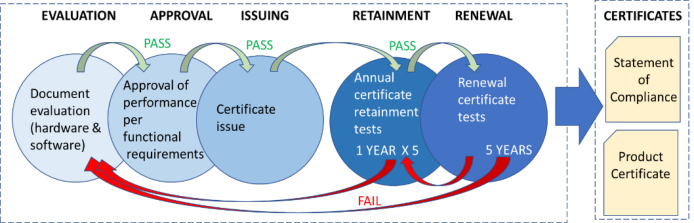
VR TRAINING CERTIFICATION PROCESS The certification process of maritime simulators can be generally carried out in five stages (See Figure 1): Document evaluation (hardware and software), approval of performance per functional requirements based on approved test programmes (initial tests), issue of the certificate, annual tests to retain the certificate, tests for renewal of the certificate at the end of the validity period. (Nordholm and Cross, 2018)
In the cases that alterations or additions to the approved simulator are proposed, which may substantially change the performance of the simulator, the new plans must be submitted to the Society for approval. The alterations
A Certification Framework for Virtual Reality and Metaverse Training Scenarios 43
Table 3. DNV-ST-0033 amendments of June 2021.
Table available in the original PDF paper.
Topic Amendments Description References
Table 1–2
Added new definitions
1 Added definitions on: cloud-based simulation, detached simulation, interactivity simulation and simulator class D 14 The specific requirements for web/cloudbased simulation is defined and included with acceptance criteria for certification New simulator class D for all function areas covering cloud-based simulation
1 In cases where cloud-based simulation is enabled, the measures that apply are described
2.1.1.8
Requirements for virtual reality simulation
1 In cases where the simulator is operated through an artificial environment, the measures that apply are described.
2.2
1 Different requirements for synchronous and asynchronous training and assessment are added
Requirements for instructor and assessor facilities
or additions must be delivered to the satisfaction of the auditor from the Society.
Substantial changes can be considered changes to the simulator, in which the learning objectives of a training programme may be affected. Minor changes to documents, hardware and software, and the use of comparable modules (e.g. different brands of simulated equipment) should be documen- ted and verified in conjunction with the next annual tests, to retain the certificate (Nordholm and Cross, 2018).
The certification process delivers two types of approvals of simulator systems. The first one is the Statement of Compliance to the simulator manu- facturer and the second one is the Product Certificate to the end user (see Figure 1).
Statement of compliance: The manufacturer who offers a simulator for examination or a mandatory simulator training that complies with the requi- rements of this standard may request verification to obtain a “Statement of compliance”. The statement refers to the appropriate competencies, which are the simulation objectives of the simulator. The validity period of the “Statement of compliance” is five years and can be renewed for another five years once the results from the annual renewal tests are satisfactory.
Product certificate: Maritime simulators that comply with the require- ments of the standard receive a product certificate for “Maritime simulator”. The certification states the area where the simulator function and the simu- lator class according to the standard. The product certificate refers the
Figure 1: The Maritime certification process.
appropriate competencies, which are the simulation objectives of the simula- tor. The validity period of the “Maritime simulator”product certificate is five years provided that annual tests shall be conducted with satisfactory results.
LIMITATIONS AND AREAS OF FURTHER RESEARCH The research has been conducted with the triangulation method to cross refe- rence and validate the primary and research results. However, the participants in both the survey and the interviews could have been higher. The 80 survey participants were mostly young professionals therefore the opinion of other ages is not well recorded and reflected. On the other hand, and in an attempt to interview only very experienced experts, the pool of potential interviewees got limited. In terms of the number of advanced VR maritime technologies studied, emphasis was given on MarISOT due to the existing literature on its development progress. On a similar note, the paper emphasizes on the DNV standards due to the readiness of the organisation to adapt fast on the new market needs and norms.
Further research can be conducted on the existing limitations to under- stand deeper the Covid-19 aftermath in the industry. The pandemic seems to be over but the continuous lockdowns people and business experienced the last two years created the need for alternative ways of communication for which the markets must accept and adjust accordingly. Lastly this resea- rch intends to further explore they type of amendments that need to be done by the classification societies towards further amending the already amended standards for the Metaverse era which has begun.
CONCLUSION
One of the main challenges advanced technologies have is their acceptance by the industry as part of their official operations. This acceptance can be easy in some sectors but quite complicated in other sectors ruled by rigorous standards and procedures such as the maritime and shipping.
Virtual Reality applications have been developed long before the industry standards considered to include them. The Covid-19 pandemic helped this recognition to become sooner than expected but the industry and the pro- fessional classification and certification societies and organizations have not
A Certification Framework for Virtual Reality and Metaverse Training Scenarios 45
been ready to follow this change. Attempts have been made by leading clas- sification societies to amend progressive standards that support technology driven operations, but still, it seems that there is a long way that requires tremendous efforts for the certification process to follow the technological progress.
This paper presented a framework that can be used today by taking into consideration advanced maritime virtual training technologies such as the MarsISOT, and the latest standards on simulations from a leading certification society such as DNV.
The framework and the standards presented can be an initial process tow- ards certifying VR and Metaverse maritime training applications, making them accessible to the markets. However more adjustments are needed on the certification standards to capture aspects beyond the cloud computing which indeed is used in VR and Metaverse applications. The standards, and the certification process need now to be aligned with concepts beyond novelty, concepts that seem to be imaginary, but they are real, they are here.
REFERENCES
Allianz Global Corporate & Speciality. (2022). Allianz claims dashboard 2017. AGCS Global. Allianz Website: https://www.agcs.allianz.com/news-and- insights/expert-risk-articles/global-claims-review-2017-claims-dashboard.html. Anyanwu, J. O., & Okoroji, L. (2014). The Causes and Minimization of Maritime Disasters on Passenger Vessels. Global Journal Of Research In Engineering. https: //engineeringresearch.org/index.php/GJRE/article/view/1131 Cameron, A. (2020). Coronavirus and homeworking in the UK: April 2020. Office
for National Statistics Website: https://www.ons.gov.uk/employmentandlabour market/peopleinwork/employmentandemployeetypes/bulletins/coronavirusandh omeworkingintheuk/april2020. Castrillon, C. (2021). This Is the Future Of Remote Work In 2021. Forbes Website: https://www.forbes.com/sites/carolinecastrillon/2021/12/27/this-is-the- future-of-remote-work-in-2021/?sh=747951141e1d DNV (2020) DNVGL-ST-0008 Learning programme Edition January 2020 DNV (2021). Standard — DNV-ST-0033. Maritime simulator systems. Edi- tion June 2021 DNV (2022) DNV Website: https://www.dnv.com/about/maritime/index.html International Chamber of Shipping. (2021). Shipping and World Trade: Top Con-
tainership Operators. ICS Website: https://www.ics-shipping.org/shipping-fact/s hipping-and-world-trade-top-containership-operators/. International Maritime Organization. (2022). Maritime Safety. International Maritime Organization Website: https://www.imo.org/en/OurWork/Safety. Luimula, M. & Markopoulos, E. & Kaakinen, J. K. & Markopoulos, P. & Laivu-
ori, N. & Rayyse, W. (2020). Eye Tracking in Maritime Immersive Safe Oceans Technology. IEEE International Conference on Cognitive Infocommunications (CogInfoCom), Mariehamn, Finland, pp. 000245–000250. https://doi.org/10. 1109/CogInfoCom50765.2020.9237854. Luimula M., Markopoulos E., Osterman M., Markopoulos P. Aho J., Ravise W., Saarinen J., Reunanen T. (2021). Avatar Based Multiplayer Functionalities in Next Generation Communication and Learning in Virtual Reality Social Platforms – Case MarISOT Room. Conference: The 12th IEEE International Conference on Cognitive Infocommunications.
Maritime Injury Center. (2017). Inadequate Training Accidents. Maritime Injury Center Website: https://www.maritimeinjurycenter.com/accidents-and- injuries/inadequate-training/ Markopoulos E., Lauronen J., Luimula M., Letho P., Laukkanen S.. (2019). Maritime Safety Education with VR Technology (MarSEVR) Proceedings of the 10th IEEE International Conference on Cognitive InfoCommunications, CogInfoCom, Vol. 1, pp. 283–288. October 23–25 2019. Naples, Italy Markopoulos E., Luimula M. (2020). Immersive Safe Oceans Technology: Deve-
loping Virtual Onboard Training Episodes for Maritime Safety. Future Inter- net 2020, 12, 80. Markopoulos E., Luimula M., Porramo P., Pisirici T., Kirjonen A. (2020a) Virtual Reality (VR) Safety Education for Ship Engine Training on Maintenance and Safety (ShipSEVR). In: Markopoulos E., Goonetilleke R., Ho A., Luximon Y. (eds) Advances in Creativity, Innovation, Entrepreneurship and Communication of Design. AHFE 2020. Advances in Intelligent Systems and Computing, pp. 60–72, vol. 1218. Springer, Cham. https://doi.org/10.1007/978-3-030-51626-0_7 Markopoulos E., Markopoulos P., Laivuori N., Moridis C., Luimula M. (2020b).
Finger tracking and hand recognition technologies in virtual reality maritime safety training applications. Proceedings of the CogInfoCom 2020. 11th IEEE International Conference on Cognitive Infocommunications. Vol. 1, pp. 251–256. On-Line Conference. Sept. 23-25, 2020. Markopoulos E., Kirane I.S., Piper C., Vanharanta H. (2020c) Green Ocean Strategy: Democratizing Business Knowledge for Sustainable Growth. In: Ahram T., Karwowski W., Pickl S., Taiar R. (eds) Human Systems Engineering and Design II. IHSED 2019. Advances in Intelligent Systems and Computing, chapter 20, pp. 115–125. vol. 1026. Springer, Cham. https://doi.org/10.1007/978-3-030- 27928-8_19 Markopoulos E., Ramonda M.B., Winter L.M.C., Al Katheeri H., Vanharanta H.
(2020d) Pink Ocean Strategy: Democratizing Business Knowledge for Social Gro- wth and Innovation. In: Markopoulos E., Goonetilleke R., Ho A., Luximon Y. (eds) Advances in Creativity, Innovation, Entrepreneurship and Communica- tion of Design. AHFE 2020. Advances in Intelligent Systems and Computing, pp. 39–51, vol. 1218. Springer, Cham. https://doi.org/10.1007/978-3-030-51626- 0_5 Markopoulos E., Kirane I.S., Gann E.L., Vanharanta H. (2020e) A Democratic, Green Ocean Management Framework for Environmental, Social and Governa- nce (ESG) Compliance. In: Ahram T., Taiar R., Gremeaux-Bader V., Aminian K. (eds) Human Interaction, Emerging Technologies and Future Applications II. IHIET 2020. Advances in Intelligent Systems and Computing. pp. 21–33, vol. 1152. Springer, Cham. DOI: https://doi.org/10.1007/978-3-030-44267-5_4 Markopoulos E., Gann E.L., Kirane I.S., Vanharanta H. (2020f) Green Capitalism:
Democratizing Sustainable Innovation by Recycling Intellectual Capital Energy. In: Ahram T., Taiar R., Gremeaux-Bader V., Aminian K. (eds) Human Intera- ction, Emerging Technologies and Future Applications II. IHIET 2020. Advances in Intelligent Systems and Computing, pp. 507–519. vol. 1152. Springer, Cham. DOI https://doi.org/10.1007/978-3-030-44267-5_77 Markopoulos P. Pyae A., Khakurel J. Markopoulos E., Saarnio R., Luimula M.
(2021a). Understanding How Users Engage in an Immersive Virtual Reality-Based Live Event. Conference: The 12th IEEE International Conference on Cognitive Infocommunications.
A Certification Framework for Virtual Reality and Metaverse Training Scenarios 47
Markopoulos E., Luimula M., Calbureanu-Popescu C., Markopoulos P., Ranttila P., Laukkanen S., Laivuori N., Ravyse W., Saarinen J., Nghia T. (2021b). Neural Network Driven Eye Tracking Metrics and Data Visualization in Meta- verse and Virtual Reality Maritime Safety Training. Conference: The 12th IEEE International Conference on Cognitive Infocommunications. Nordholm A. D., Cross S. J. (2018). Applications of simulation and adoption of new
function areas to the DNV GL Standard for Certification of Maritime Simula- tor System, MARSIM 2018 Proceeding. International Marine Simulation Forum. Halifax (Canada), August 12–16, 2018
LISTED IN THE AHFE DIGITAL BOOKSTORE CATALOGUE
Explore the complete digital volume
Creativity, Innovation and Entrepreneurship
Read this individual research paper free through the original publisher, or explore the full digital proceedings book.
ISBN 978-1-958651-07-0
Explore this ISBN in the AHFE Bookstore ↗Listed in the July 2026 bookstore catalogue; search by ISBN to confirm current availability · Digital book purchase optional