Evangelos Markopoulos, Emmanuel Querrec, Mika Luimula (2022). A strategic partner selection decision-making support methodology in the business modelling phase for startups in the pre-incubation phase. In: Creativity, Innovation and Entrepreneurship. AHFE Open Access, vol. 31, pp. 271–279. https://doi.org/10.54941/ahfe1001529
Partner choice is an important element for any business throughout its lifecycle. It is even more strategic in early startup stages, when the business model is set in the pre-incubation phase.Entrepreneurs are confronted to take decisions on which partners to choose. Those strategic decisions on which partners to commit with, and defining their roles, can be made more or less formally, with the risk of relying on “gut feelings” when there is complex data to be taken in consideration and when there is pressure, constraints, limited resources and no proper methodology for the entrepreneur to base its decision on.Confronted to such a situation, it is interesting to consider building a decision-making support methodology for strategic partner choice for in the business modelling phase of a startup pre-incubation phase. This can offer support to the entrepreneur and make its leadership anchored in more formal approach to decision-making.This research presents a methodological framework that can support early startups, while still in the pre-incubation phase, to select the most suitable strategic business partner(s) and develop, based on that, their business operations, management, development and commercialization models. The methodology offers an initial approach which allows an entrepreneur to make more formal investigation and be assisted in the decision-making process on choosing the partners and defining their roles and contribution in the strategy of the start-up. Specifically, the methodology intends to provide support on selecting the most relevant and feasible data types that need to be collected for the effective partner evaluation and selection. Furthermore, it provides a data collection mechanism and algorithm, a partner evaluation procedure, support on identifying the strategic intend or need from a specific partner, the analysis of the potential partner based on the partnership needs, a scoring tableau based on several parameters per partner selection criteria and finally the calculation of the potential partner’s score. The research conducted evaluated twenty-one potential partners for a VR training startup that intends to operate in the following months and it is currently at the partnerships establishment phase. The partners that have been analyzed derive from eight, related to the start-up, professional sectors, from five countries, and with more than fifty unique activities that cover the fourteen key parameters of the partner evaluation methodology. The paper presents the overall methodological approach in stages and the procedure (steps) of each stage. It indicates the goal setting approach, the evaluation of the partner’s activities, the partner’s evaluation scorecard, the computation of the scoring process and the visualization of the scoring results in tables and charts that create a partner’s evaluation dashboard for effective partners comparison in total or in specific partnership requirements as set in the partnerships strategy and objectives. It must be noted that the proposed methodology is not an optimal tool but more of a heuristic exploratory tool. Further research has been scheduled to be extend the testing of the methodology with more cases, to increase the number of partner evaluation parameters and to link several of the related parameter metrics with sources than can provide more subjective values.
Entrepreneurs are confronted to take decisions on which partners to choose. Those strategic decisions on which partners to commit, with defined roles, can be made more or less formally, with the risk of relying on “gut feelings” when there is com-plex data to be taken in consideration and when there is decision pressure, constraints, limited resources and no proper methodology for the entrepreneur to use. Confronted to such a situation, it is interesting to consider building a decision-making support methodology for strategic partner choices in the startup pre-incubation business modelling phase. Such methodology can offer support to the entrepreneur and make its leadership anchored in more formal approach to decision-making. In general Entrepre- neurs’ decision-making is influenced by human capital, emotions as well as
perception of the environmental conditions (Shepherd et al., 2015). When an entrepreneur engages into shaping a startup’s business model during the pre- incubation stage, it is critical to formulate the business hypothesis in view of validating it.
This process is well-spread as a best practice for entrepreneurs in busi- ness accelerators with various methods such as the Lean Startup approach (Diego et al., 2015), the Startup Life Cycle model (Dvalidze and Marko- poulos, 2020), the Agile Startup business plan (Markopoulos et al., 2020d), and others. A critical aspect of the business model design is the choice in corporate partnerships and collaboration with established firms (Kurpjuweit and Wagner, 2020). With regards to the specific challenge of strategic par- tner selection, a hands-on methodology has been developed that supports the entrepreneur in that stage. The methodology proposes a formal structure for the heuristics that the entrepreneur uses when taking decisions related to strategic partnerships.
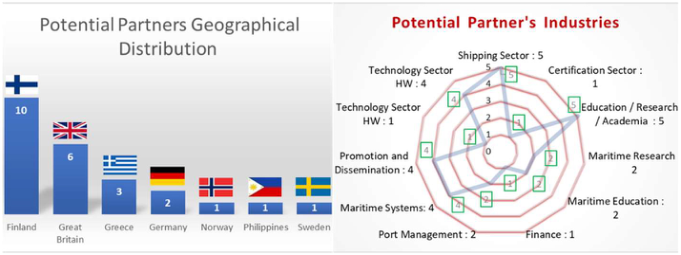
RESEARCH METHODOLOGY The research methodology followed in this paper was based on semi- structured interviews driven by the strategic partnership-oriented questions on business development and applied research. The interviews were exten- sive with 60-120’ each to identify the most potential opportunities and to critically evaluate the potential of each partnership. Twenty-four (24) orga- nizations, from eleven (11) professional sectors and from five (5) countries, all with international activity participated in this research (figure 1). All of the interviewees were senior executives, CEOs, partners or business owners. More than fifty (50) unique activities have been identified and analyzed.
THE STRATEGIC PARTNER SELECTION METHODOLOGY (SPaSM) The SPaSM Commercialization Strategy Dashboard, is a multi-objective deci- sion-making support methodology for the evaluation of candidate partners in the development and implementation of the early stage start-up business planning. Furthermore, the methodology can be considered as a supportive strategy tool in the early transformation stages of the start-up’s technology
Figure 1: Research participants by country and industry.
A Strategic Partner Selection Decision-Making Support Methodology 273
for the best possible utiliza-tion and commercialization of the technology developed. The partners are eligible for different roles, ranging from being possible interme-diaries, suppliers, co-product developers and/or customers acting upon can impact significantly the business model and consequently the commercialization strategy.
The model is based on decoding interviews, discussions and prior or exi- sting col-laboration agreements that indicate the potentiality of a successful partnership. This approach has a degree of difficulty and a degree of error as there is a significant amount of subjectivity on the values given in the partner evaluation weighted pa-rameters. On the other hand this subjectivity can be considered a strength of the model as figures and data cannot indicate the capacity of a relationship that can gen-erate the desired opportunities for a successful partners in. The model generates the initial partners selection and collaboration directions de-spite the challenge to make a sound judgment on how to plan the startup’s commer-cialization strategy. The model drafts the initial strategy and builds the initial stra-tegic partnerships and business networking based on which the commercialization plan will be developed and supported furthermore in the maturity stages that will follow.
SPasM is not a formal knowledge and data optimization model but rather a methodological tool to make explicit the knowledge collected from a set of potential partners. It supports however decision-making activities by for- mally listing knowledge characteristics, parameters and possible outcomes of the various collaboration scenarios that are being generated.
SPasM PARAMETERS AND MULTIPLIERS The valuation of each potential partner is done through total score that aggre- gates the scores of fourteen (14) parameters which are distributed in five (5) categories as indicated in Table 1.
Each parameter itself is an index that can include objective metrics (e.g. secondary source data such as OECD ranking), semi-objective metrics (e.g. based on collected formal and informal primary data during interviews) and
Status Evaluation Country score Industry score Reputation Score - Value contribution Activity score Value added for the start up Funding ability
- -
Market impact Market influence power
Market network strength
- -
Co-evolution potential
Co-Development potential
Co-Research potential
Collaboration options
Customer for the start-up
Re-Seller for the start-up
Investor for the start-up
Distributor for the start-up
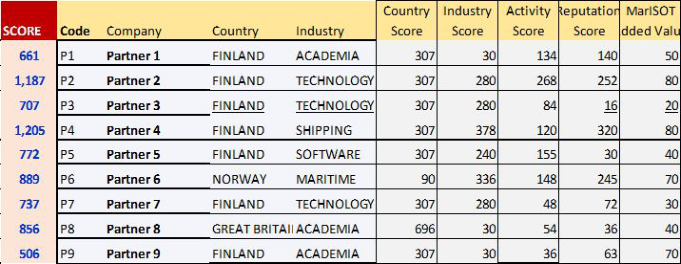
Figure 2: SPaSM parameters scoring table.
subjective metrics (e.g. expert estimates). Figure 2 presents the score of five (5) parameters for nine (9) potential partners.
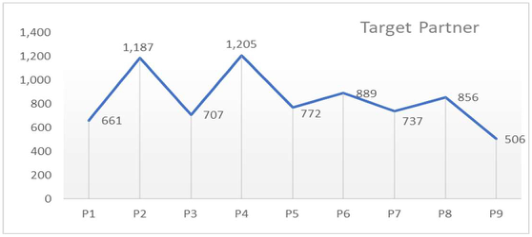
Each parameter is impacted by a set of multipliers that the decision-maker can fine-tune to adjust the parameter’s score based on the strategic interest of the startup. The multipliers are subjective values given by the strategy decision-maker. These multipliers must be subjective in order to ‘gamify’ the evaluation tool and observe different scenarios by making different adju- stments based on different strategy priorities and plans. SPAsM has 3 (three) multipliers that can be applied on each parameter. These are ‘Interest’, ‘Cri- ticality’ and ‘Potentiality’, and they can be applied on any parameter. If for example the score for the reputation of a partner is 10, and the multipliers have values I=2, C=3, P=1, then the total value of the Reputation parameter becomes 10*2*3*1 = 60. Another parameter with value 20 and multipliers I=2, C=1, P=1, give the total value of 20*1*2*1 = 40. Figure 3 presents the score of 9 partners (P1-P9) analyzed for this purpose.
PARAMETER SCORE CALCULATION The valuation of each potential partner is done through a score that aggrega- tes the scores in the following parameters. Each parameter itself is an index that can include objective metrics (e.g. secondary source data such as OECD ranking), semi-objective metrics (e.g. based on collected formal and informal primary data during interviews) and subjective metrics (e.g. expert estima- tes). Most of the parameter scores are calculated with the help of the activity metrics or the score of other available metrics. The set of activities derives from relevant partnership choice decision-making criteria, and each interview session provided inputs to the scores in each of those activities.
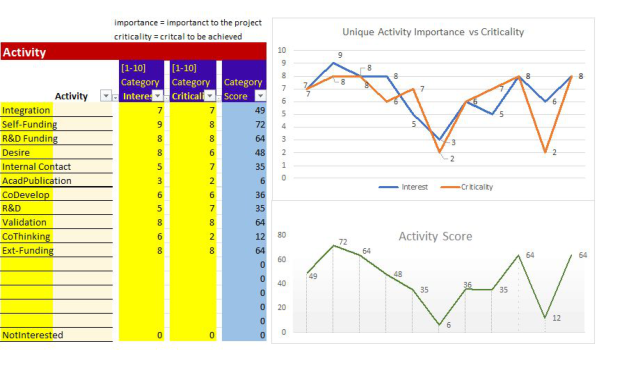
For example, in the case of the status evaluation parameter, a potential partner that operates in 10 high impact countries (critical to the startup’s strategy), gets a higher country score if compared with a partner that opera- tes in 3 such countries or in a large amount of low impact countries. Figure 4 presents the sub-activities identified for a specific partner under the para- meter Business Activity which evaluates how each partner may commit and deliver value to the various sub-activities. The list of sub-activities is not
A Strategic Partner Selection Decision-Making Support Methodology 275
Figure 3: SPaSM graph indicated the score of 9 potential partners.
closed and can vary from partners to partner. The 10 sub-activities presen- ted in the initial version of SPaSM derive from relevant partnership choice decision-making criteria and the analysis of the research participants and represent the most frequent and common activities that appeared in their operations.
The final activity score is computed by summing up the value of all relevant and available activities of a given partner as they are impacted by 2 from the 3 multipliers (Equation 1). It must be noted than not all multipliers need to be applied in each parameter. All calculations are supported with the related graphs that justify the scoring process and the impact of each multiplier on each sub-activity.
Activity overall score
=
nP
Importance of the activity ∗criticality of the activity (1) (For all elligible activities)
Equation for Each Parameter Score Each one of the 14 SPaSM parameters is calculated through a fixed high level equation. Equations 2-14 present the remaining parameters’ calculation.
Country score = Relativity ∗Innovation Rep ∗Market Size ∗OECD rank
100 (2)
Equation reproduced from the original PDF.
Reputation score = Domestic ∗International ∗StarUp reputation (4) Added Value to the Startup score = Added Value ∗Added Value Multiplier (5)
Funding Ability score = Internal ∗External domestic ∗External international (6) Influence Power score = Company Internal ∗Domestic ∗International (7)
Equation reproduced from the original PDF.Figure 4: SPaSM example on the calculation of the Activity parameter score.
CoDevelop score = With Own Funds ∗With R&D Funds (9) CoResearch score = With Local Programs ∗With International Programs
Equation reproduced from the original PDF.
Sell MarISOT score = Local ∗International (12) Distribute the Startup technology score = With Money ∗With Expertise(13)
Equation reproduced from the original PDF.
ALIGNMENT WITH OTHER STRATEGY AND DECISION-MAKING MODELS The SPaSM methodology is designed to support decision-making on strate- gic management initiatives. Its logic and the structure of the methodology is linked with several significant international business management model such as:
Porter 5 Forces: SPaSM analyzes the supplier and seller relationships among the partners as well as the competition perspective.
VRIO/VRINE: SPaSM identifies the VRINE elements of a potential par- tnership and especially the value, rarity and the inimitability as it seeks unique strategic and competitive product/service advantages.
The Business Model Canvas: SPaSM covers all nine business canvas segments with exemption of the value propositions which is the pivot for the SPaSM partner analysis.
PESTLE Analysis: SPaSM takes into consideration all PESTLE elements and it addresses the international dimension of the partnerships by assessing the partner’s international activity and reputation.
SWOT Analysis: The SPaSM multipliers are used to control the SWOT elements especially the Threats and the Weaknesses.
A Strategic Partner Selection Decision-Making Support Methodology 277
CAGE Model. SPaSM analyzes all 4 CAGE elements form a cultural dimension for the viability of intentional business development.
Blue Ocean Strategy: SPaSM can lead startups to bule oceans as it is an innovation driven model targeting strategic partners that are most likely to secure blue oceans.
Green Ocean Strategy: As a Scandinavian model SPaSM addresses envi- ronmental and sustainability issues in the partnership analysis that can contribute towards reaching Green Oceans (Markopoulos et al., 2020a).
Pink Ocean Strategy: SPaSM addresses social innovation and ethi- cal management issues in the partnership analysis that can contribute towards reaching Pink Ocean and alignment with the UN2030 agenda (Markopoulos et al., 2020c).
SOCIOECONOMIC IMPACT According to Forbes, 90% of the startups fail in the first two years (For- bes, 2015). This tragic rate has a significant impact on the local and global economies as brilliant minds with innovative ideas face massive failure and disappointments (Williamson et al., 2020) (Forbes, 2016). Along with that they face financial loses as well as loses of opportunities they declined to stay focused on their innovative ideas and entrepreneurial journey. The failure of a startup has deeper impact and consequences than the failure of a small business. The entrepreneurial, and the geo-entrepreneurial revolution today (Markopoulos et al., 2020b) has been built upon this vision and if this vision faints over the time the innovation rate will decline globally.
SPaSM has been developed to help startups evaluate effectively busi- ness partnerships and form winning and co-evolutionary teams that can return mutual benefits to all involved (Markopoulos and Vanharanta, 2018). Successful startups with strong partnership agreements and support can be significant assets to the local and global economies, a continuous inspiration of innovation and creativity, but also well-tested opportunities for multinati- onal corporations to invest and excel through the startup’s innovations.
LIMITATIONS AND AREAS OF FURTHER RESEARCH The development of the SPaSM methodology has been directed towards the needs of a specific VR-Training startup on its commercialization route. There- fore, the partner categories and selection criteria can be, to an extent, related towards the specific goal. However, this can change with the development of more generic criteria than might reduce the accuracy of the prediction but enlarge the areas of application. It must be noted that the proposed metho- dology is not to be used as an optimization tool but more of as a heuristic exploratory tool. Further research has been scheduled to extend the testing of the methodology with more cases, increase the number of partner evaluation parameters and to link several of the related parameter metrics with sources than can provide more objective values.
CONCLUSION
This research presented in this paper is a methodological framework that can support early startups, while still in the pre-incubation phase, to select the most suitable strategic business partner(s) and develop, based on that, their business operations, management, development and commercializa- tion models. The methodology offers an initial approach which allows an entrepreneur to make more formal investigation. It assists startups in the decision-making process on choosing the right partners and defines their roles and contribution in the startup’s operations strategy. Specifically, the metho- dology intends to provide support on selecting the most relevant and feasible data types that need to be collected for the effective partner evaluation and selection. Furthermore, it provides a data collection mechanism, a partner evaluation procedure, support on identifying the strategic intend., or need, from a specific partner, the analysis of the potential partner based on the partnership needs, a scoring tableau based on several parameters per partner selection criteria and finally the calculations for the potential partner’s score. The methodology is applied in the beginning of the business planning pro- cess, but the beginning, according to Aristotle seems to be more than half of the whole (Peters, 1906).
REFERENCES
Diego, S. S., Ghezzi, A., Barbosa de Aguiar, R., Marcelo, N. C., & Carla Schwengber, t. C. (2020). Lean startup, agile methodologies and customer deve-lopment for business model innovation: A systematic review and research agenda. Internatio- nal Journal of Entrepreneurial Behaviour & Research, 26(4), pp. 595–628. doi: http://dx.doi.org/10.1108/IJEBR-07-2019-0425 Dvalidze N., Markopoulos E. (2020) Understanding the Nature of Entrepreneuri-
al Leadership in the Startups Across the Stages of the Startup Lifecycle. In: Kantola J., Nazir S. (eds) Advances in Human Factors, Business Management and Lea-dership. AHFE 2019. Advances in Intelligent Systems and Compu- ting, pp. 281–292, vol 961. Springer, Cham. https://doi.org/10.1007/978-3-030- 20154-8_26 Forbes Website (2015), last viewed 05.03.2022: https://www.forbes.com/sites/neilpatel/2015/01/16/90-of-startups-will-fail-hereswhat-you-need-to-know-about-the-10/?sh=3bace1806679 Forbes Website (2016), last viewed 05.03.2022: https://www.forbes.com/sites/chrismyers/2016/11/09/an-entrepreneurs-guide-to-de
aling-with-disappointment/?sh=19db75786571 Kurpjuweit, S., & Wagner, S. M. (2020). Startup supplier programs: a new model for managing corporate-startup partnerships. California Management Review, 62(3), pp. 64–85. https://doi.org/10.1177/0008125620914995 Markopoulos E., Kirane I.S., Piper C., Vanharanta H. (2020a) Green Ocean Strat-
egy: Democratizing Business Knowledge for Sustainable Growth. In: Ahram T., Kar-wowski W., Pickl S., Taiar R. (eds) Human Systems Engineering and Design II. IHSED 2019. Advances in Intelligent Systems and Computing, chapter 20, pp. 115–125. vol 1026. Springer, Cham. https://doi.org/10.1007/978-3-030- 27928-8_19 Markopoulos E., Markopoulos G., Vanharanta H. (2020b) Democratizing Innovation. A Geo-Entrepreneurial Analysis and Approach Through the Company
A Strategic Partner Selection Decision-Making Support Methodology 279
Democ-racy Model. In: Markopoulos E., Goonetilleke R., Ho A., Luximon Y. (eds) Ad-vances in Creativity, Innovation, Entrepreneurship and Communica- tion of De-sign. AHFE 2020. Advances in Intelligent Systems and Computing, pp. 3–16, vol 1218. Springer, Cham. https://doi.org/10.1007/978-3-030-51626- 0_1 Markopoulos E., Ramonda M.B., Winter L.M.C., Al Katheeri H., Vanharanta H.
(2020c) Pink Ocean Strategy: Democratizing Business Knowledge for Social Gro- wth and Innovation. In: Markopoulos E., Goonetilleke R., Ho A., Luximon Y. (eds) Ad-vances in Creativity, Innovation, Entrepreneurship and Communica- tion of Design. AHFE 2020. Advances in Intelligent Systems and Computing, pp. 39–51, vol 1218. Springer, Cham. https://doi.org/10.1007/978-3-030-51626- 0_5 Markopoulos E., Umar O., Vanharanta H. (2020d) Agile Start-up Business Plan-ning and Lean Implementation Management on Democratic Innovation and Creativity. In: Ahram T., Karwowski W., Pickl S., Taiar R. (eds) Human Systems Enginee- ring and Design II. IHSED 2019. Advances in Intelligent Systems and Computing, chapter 134, pp. 885–895, vol 1026. Springer, Cham. DOI:10.1007/978-3-030- 27928-8_134 Markopoulos, E., Vanharanta H. (2018). Project teaming in a demo-cratic com-
pany context. Theoretical Issues in Ergonomics Science, 19:6, pp. 673–691, DOI:10.1080/1463922X.2018.1439543 Peters, F. H. (1906) The Nicomachean of Aristotle. 10th Edition. Kegan Paul, Trench, Trubner & Co Ltd, London. Shepherd D. A., Williams T. A. and Patzelt H. (2015). Thinking About Entre-
preneurial Decision Making: Review and Research Agenda. Journal of Manage- ment. 41(1), pp. 11–46. DOI: 10.1177/0149206314541153 Williamson, A. J., Drencheva, A., & Battisti, M. (in press). Entrepreneurial disappointment: Let down and breaking down, a machine-learning study. Entrepre- neurship Theory and Practice. https://doi.org/10.1177/1042258720964447
LISTED IN THE AHFE DIGITAL BOOKSTORE CATALOGUE
Explore the complete digital volume
Creativity, Innovation and Entrepreneurship
Read this individual research paper free through the original publisher, or explore the full digital proceedings book.
ISBN 978-1-958651-07-0
Explore this ISBN in the AHFE Bookstore ↗Listed in the July 2026 bookstore catalogue; search by ISBN to confirm current availability · Digital book purchase optional